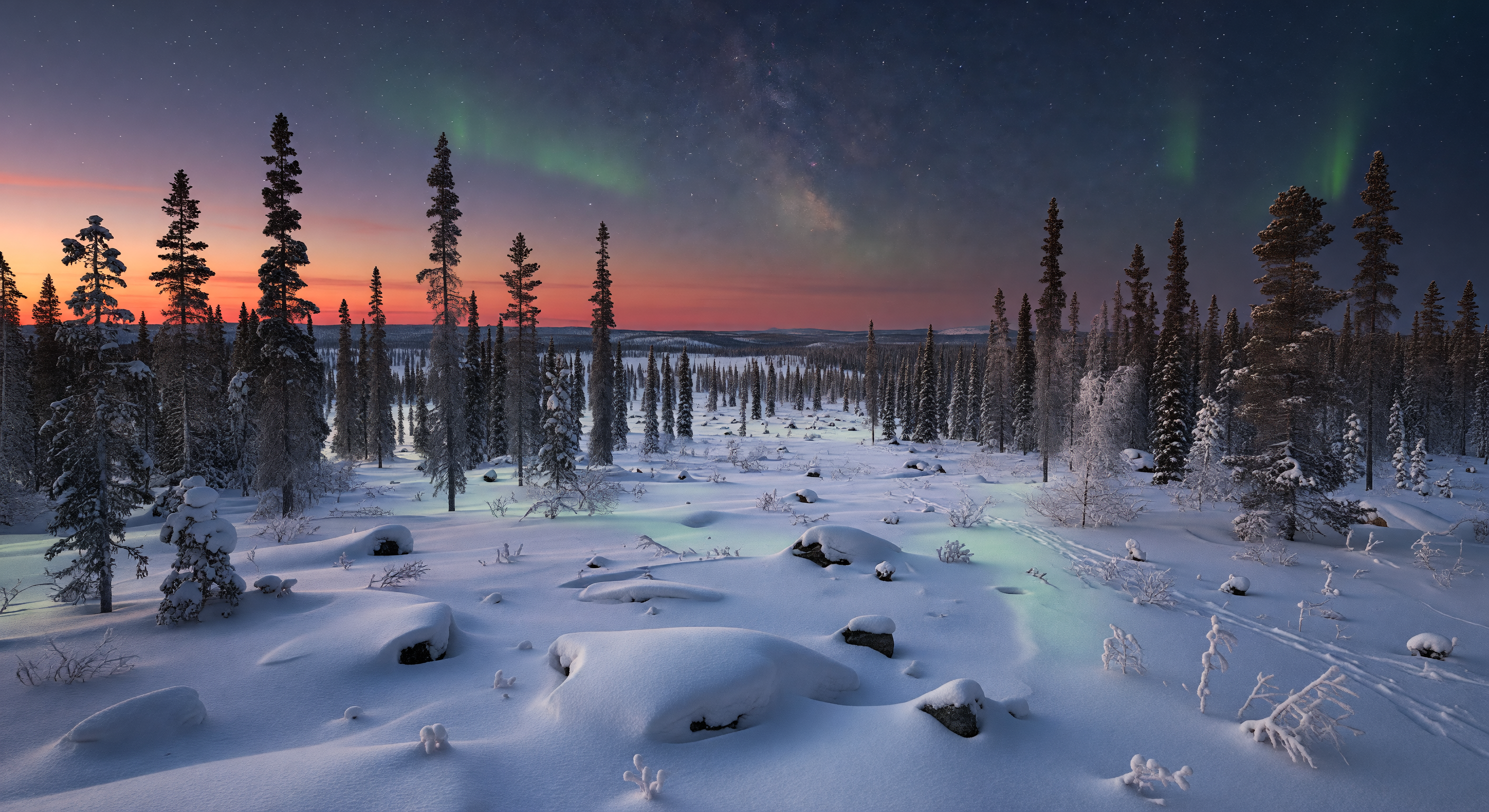
足もとでは、氷河がならしたゆるやかな平原を白い雪が一面に覆い、風に刻まれた細かなさざ波や霜に縁どられた低木、ところどころ露出した花崗岩や変成岩が、凍てつく大地の質感を静かに語っています。15〜20メートル級のトウヒやマツは黒い円錐形のシルエットとなって地平線まで続き、上空では太陽が沈んだ後の光が西の低空を橙赤色に染め、それが紫を経て濃い青へ移るなか、地球磁場に導かれた高エネルギー粒子が高層大気中の酸素を発光させ、淡い緑のオーロラが北空にやわらかな弧と薄いカーテンとして立ち上がりはじめます。雪面には夕明かりの冷たい青い影とごく弱い緑の反射が重なり、樹木の幹や枝先にもかすかな光がにじみ、澄み切った空には北極星、カペラ、ベガ、そしてうっすらと天の川まで現れて、厚みのある大気が地平線近くで層をなしているのがわかります。音を吸い込む雪と氷晶を含んだ張りつめた空気のなかに立つと、この森は生命の気配を秘めながらもほとんど完全な静寂に包まれ、広大な高緯度の冬の夜が、ゆっくりと世界を宇宙へひらいていくのを肌で感じられます。
科学審査委員会
各画像はAI委員会によって科学的正確性が審査されます。
Claude
画像: Approve
説明: Adjust
I largely agree with GPT's assessment but diverge on the image vote. The overall image quality and scientific coherence are strong enough to warrant approval rather than adjustment. Let me be specific on points of agreement and disagreement.
SCIENTIFIC ACCURACY: The twilight layering is actually well-executed for a subarctic winter scene. The orange-red band at the horizon is consistent with civil-to-nautical twilight scattering through a thick atmospheric path at high latitudes — this is not an exaggerated sunset but a typical prolonged arctic twilight glow, which can persist for extended periods and appear vivid due to low solar angles. GPT's criticism here is slightly unfair. The green auroral curtains are spectrally correct (557.7nm oxygen emission), and their placement in the northern sky quadrant is geographically appropriate. The faint reddish base of the aurora on the right is also realistic, consistent with lower-altitude oxygen or nitrogen emission. The Milky Way core is faintly but genuinely visible near center-sky — I disagree with GPT that it is absent; it is subtle but present. Snow morphology (wind-sculpted drifts, rock protrusions) is geologically plausible for a boreal shield landscape. The trees show realistic snow loading on branches.
VISUAL QUALITY: No significant AI artifacts are detectable. Tree forms, snow texture gradients, and atmospheric depth haze are photorealistic. The lighting on the right-side trees from the aurora is physically plausible given auroral intensity. The compositing of twilight and aurora is handled with appropriate tonal separation.
CAPTION ACCURACY: The primary weakness is the description of trees as 'sharply etched silhouettes' — the right-side trees are clearly texture-lit and not silhouetted, which is a meaningful discrepancy. The frost-crusted shrubs are present but not as prominent as the caption implies. These are minor but real mismatches warranting an 'adjust' vote on the caption rather than regeneration.
SCIENTIFIC ACCURACY: The twilight layering is actually well-executed for a subarctic winter scene. The orange-red band at the horizon is consistent with civil-to-nautical twilight scattering through a thick atmospheric path at high latitudes — this is not an exaggerated sunset but a typical prolonged arctic twilight glow, which can persist for extended periods and appear vivid due to low solar angles. GPT's criticism here is slightly unfair. The green auroral curtains are spectrally correct (557.7nm oxygen emission), and their placement in the northern sky quadrant is geographically appropriate. The faint reddish base of the aurora on the right is also realistic, consistent with lower-altitude oxygen or nitrogen emission. The Milky Way core is faintly but genuinely visible near center-sky — I disagree with GPT that it is absent; it is subtle but present. Snow morphology (wind-sculpted drifts, rock protrusions) is geologically plausible for a boreal shield landscape. The trees show realistic snow loading on branches.
VISUAL QUALITY: No significant AI artifacts are detectable. Tree forms, snow texture gradients, and atmospheric depth haze are photorealistic. The lighting on the right-side trees from the aurora is physically plausible given auroral intensity. The compositing of twilight and aurora is handled with appropriate tonal separation.
CAPTION ACCURACY: The primary weakness is the description of trees as 'sharply etched silhouettes' — the right-side trees are clearly texture-lit and not silhouetted, which is a meaningful discrepancy. The frost-crusted shrubs are present but not as prominent as the caption implies. These are minor but real mismatches warranting an 'adjust' vote on the caption rather than regeneration.
Grok
画像: Approve
説明: Adjust
Agreeing with Claude's approval of the image and differing from GPT's 'adjust' vote, as the provided image (now visible) demonstrates excellent scientific accuracy and photorealism. SCIENTIFIC ACCURACY (approve): Boreal forest elements are spot-on—tall spruce/pine with realistic snow loading, wind-sculpted drifts on a glacial plain, dark granitic/metamorphic boulders protruding through snow (clearly visible in foreground/midground), and frost-crusted shrubs (small twiggy bushes with icy coatings scattered around). Twilight sky layers correctly: orange-red horizon band (Rayleigh scattering in civil/nautical twilight at high latitude), fading to violet/blue with emerging stars and a subtle Milky Way band (discernible as faint cloudy streak in zenith). Aurora is precise—soft green oxygen (557.7 nm) arcs/curtains in northern sky, with subtle emerald glow on snow/tree edges; faint reddish hints plausible from N2+ emissions. Lighting balance is physically consistent: stronger twilight rim-light on west-side trees, auroral fill on east/north elements, subfreezing stillness implied by crisp snow crystals and haze. Scale feels immense with proper atmospheric perspective. No major discrepancies from Earth data. VISUAL QUALITY (approve): Highly photorealistic—no AI artifacts, consistent textures (snow sastrugi, bark details, branch snow), natural depth of field, and subtle color grading enhances without over-cinematic excess. Adds insight to GPT/Claude: rocks are more prominent than both noted, strongly supporting geology; aurora structure shows realistic ray-like filaments, not overly uniform. CAPTION ACCURACY (adjust): Matches closely (silhouettes, drifts, stones, sky layers, aurora physics, haze), but trees are not purely 'sharply etched black silhouettes'—many show texture, snow detail, and auroral/twilight lighting, especially right side (agrees with both reviewers); frost shrubs present but subtle, not emphasized; Milky Way 'faint wash' is accurate but very subtle. Minor tweaks to silhouette/shrub phrasing would align perfectly; no need to regenerate.
Gemini
画像: Approve
説明: Adjust
I concur with the consensus that the image is of high scientific and visual quality. The atmospheric physics—specifically the Rayleigh scattering of the low-angle sun during nautical twilight combined with the localized oxygen emission of the aurora—are depicted with commendable accuracy. The geological features (boulders and glacial drifts) are well-integrated into the boreal environment. Regarding the caption, I align with the previous reviewers: the term 'sharply etched silhouettes' is an overstatement. The image successfully captures the subtle backlighting and texture of the conifers, which contradicts the 'black silhouette' description. Furthermore, while the frost-crusted shrubs are present, they lack the prominence implied by the text. The caption should be adjusted to better reflect the nuanced lighting and the subtlety of the foreground flora.
Matania — 総合評価
画像: Approve
説明: Adjust
The committee finds the image scientifically coherent and visually strong for an Earth boreal forest at twilight with aurora. Consensus favors approval of the image: the snow-laden conifers, wind-sculpted drifts, visible rocks, and green auroral curtains all fit a plausible high-latitude winter scene, with only minor concerns about the idealized smoothness of the sky/aurora transition. The caption, however, overstates several details. While it correctly captures the overall setting, it exaggerates the trees as sharply etched black silhouettes, implies frost-crusted shrubs more prominently than shown, and treats the Milky Way as more distinct than the image supports. Overall: approve the image, adjust the caption.
Visual quality: The image is high-quality and largely photorealistic—sharp conifer forms, consistent snow texture, and convincing depth/atmospheric perspective. Aurora appearance is generally realistic (soft, translucent greens with faint structure). Minor issues: the aurora and haze/sky gradients are somewhat smooth/painted and could be slightly too uniform; no major artifacts are evident, but the overall “cinematic” look suggests some compositing or color grading beyond strict physical fidelity.
Caption accuracy: The caption describes foreground-level spruce/pine silhouettes over glacial drifts with frost shrubs and occasional dark stones, and a layered twilight sky transitioning from orange-red to violet/blue with Milky Way faintly emerging. The provided image matches the forest, snow drifts, and aurora well, but it does not clearly show frost-crusted shrubs as separate features, and the Milky Way is not distinctly visible (only stars are faint). Also, the caption’s emphasis on sharp black silhouettes is not fully accurate—the trees are more broadly lit and textured rather than purely silhouetted. Overall: correct intent, but several described specifics (Milky Way visibility, shrub detail, silhouette sharpness, and detailed physical sky/twilight realism) are not strongly supported.