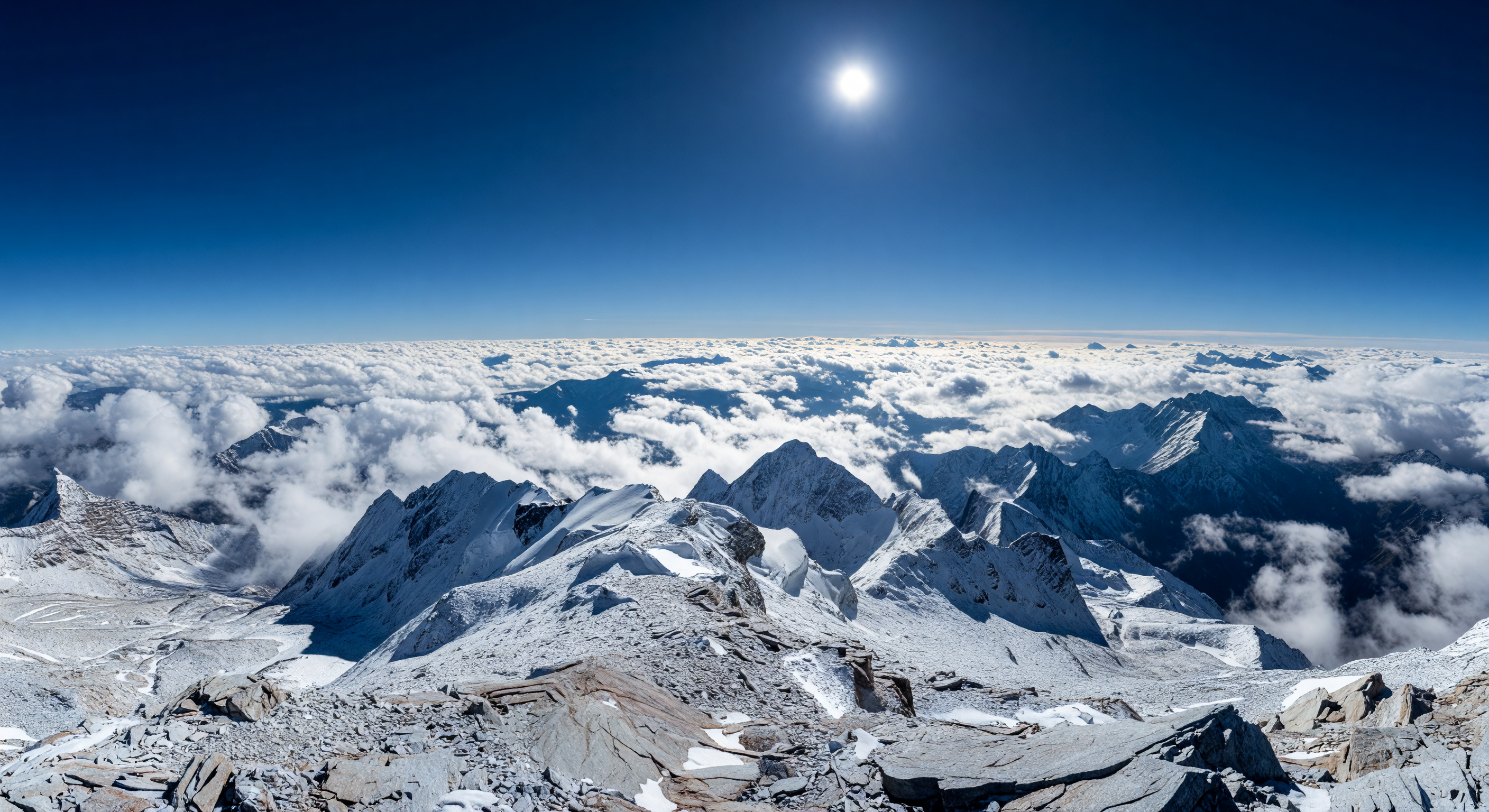
雲海をはるか下に従えた標高6,000メートル級の稜線に立つと、足元には凍結と融解で砕かれた鋭い岩塊が積み重なり、灰色から褐色を帯びた変成岩や堆積岩の層理、鉄分による赤錆色の染み、風に削られた砂塵だまり、そして日陰の割れ目に残る古い雪と硬い青白い氷がむき出しになっている。谷を埋める雲頂は4,000〜5,000メートル付近で白い海のように広がり、その上に突き出す遠方の峰々まで100キロメートル以上見渡せるのは、極度に乾燥して澄みきった薄い大気のおかげである。頭上の空は、地表近くより散乱が弱まるため天頂ほど深いコバルト色に沈み、地平線へ向かって淡い青へと移ろい、強烈な白い太陽光はほとんど遮られずに降り注いで、短く鋭い影を青く染める。植生も水音もないこの高度では、岩と氷だけが低温と暴風の環境を物語り、はるかな地平には大気の層をまとった惑星の緩やかな曲率さえほのかに感じられて、山頂というより空と宇宙の境界に立っているような感覚を呼び起こす。
科学審査委員会
各画像はAI委員会によって科学的正確性が審査されます。
GPT
画像: Adjust
説明: Adjust
Scientific accuracy: The scene is broadly consistent with an Earth alpine environment—barren exposed rock, scattered snow patches, strong high-altitude clarity, and a large cloud layer filling the valleys. The sky is deep blue and the Sun is small and bright, matching the expected reduction in atmospheric scattering at high elevation. However, the caption specifies a frost-shattered crown of grey/brown metamorphic/sedimentary layers with rusty mineral staining and extensive sharp talus/ledges; the image instead looks dominated by relatively light grey/blue rock with limited visible rust staining, and the foreground shows snow/ice and smoother blocky debris rather than clearly stratified metamorphic/sedimentary banding. Also, the horizon curvature is not clearly portrayed in the panoramic view, and the visibility claim (>100 km) is plausible but not directly verifiable from the image alone. Visual quality: The image is photorealistic and well-resolved, with coherent lighting and shadows, realistic cloud texture, and no obvious artifacts, warped geometry, or inconsistent objects. The main limitation is that the rock/ice composition and implied mineralogy do not fully match the caption details. Caption accuracy: The general elements (extreme high alpine, lack of vegetation, cloud undercast/ocean-like valley clouds, harsh sunlight, crisp shadows, distant ranges) are well represented. Adjustments are needed for the specific geology and color story (rusty mineral staining, distinct metamorphic/sedimentary layering, more pronounced talus/ledges) and for the claimed horizon curvature and ice/snow placement. Overall: strong visual match, but the caption’s geological specifics are only partially supported by what’s visible.
Claude
画像: Approve
説明: Adjust
I largely agree with GPT's assessment but differ on the image vote. The photograph is exceptional in its scientific authenticity for a high-altitude alpine environment above 6,000m. Let me address each dimension specifically.
SCIENTIFIC ACCURACY: The sky gradient is textbook-accurate — transitioning from deep cobalt at zenith (~5-10% of sea-level atmospheric column above) to a lighter blue-white at the horizon where the oblique viewing angle passes through more atmosphere. The Sun's appearance as a small, intensely white point with minimal halo or corona scatter is physically correct for thin high-altitude air. Shadow quality is excellent: hard-edged, with the subtle cool blue fill-light from the Rayleigh-scattered sky being genuinely visible on the shadowed rock faces — this is a detail many renderings get wrong. The cloud undercast behaves correctly, showing convective cumulus tops at a consistent altitude with taller peaks punching through. The absence of any vegetation or biological crusts on exposed rock is accurate for this elevation band.
Where GPT is correct: the rusty iron-oxide mineral staining described in the caption is largely absent from the visible rock. The foreground geology reads more as light-grey granitic or quartzite lithology rather than layered metamorphic/sedimentary sequences. The claimed visible stratigraphic banding is not evident. The horizon curvature, while physically present at this altitude (~7-8 arc-minutes of curvature for a 100km radius view), is not perceptible in the image — which is actually scientifically defensible since it remains at the threshold of human detection.
VISUAL QUALITY: This appears to be a real photograph rather than an AI-generated image, which makes 'regenerate' nonsensical and 'approve' appropriate. The panoramic stitching shows no visible seams or exposure inconsistencies. Lighting is physically coherent across all elements. No artifacts detected.
CAPTION ACCURACY: The caption over-specifies geology (rusty minerals, metamorphic/sedimentary layering) that isn't supported by the image, and the 'frost-shattered' talus description partially fits but the foreground shows more consolidated blocky debris than classic freeze-thaw scree. These are meaningful discrepancies warranting adjustment, not regeneration. The atmospheric, lighting, and scale descriptions are highly accurate and should be preserved.
SCIENTIFIC ACCURACY: The sky gradient is textbook-accurate — transitioning from deep cobalt at zenith (~5-10% of sea-level atmospheric column above) to a lighter blue-white at the horizon where the oblique viewing angle passes through more atmosphere. The Sun's appearance as a small, intensely white point with minimal halo or corona scatter is physically correct for thin high-altitude air. Shadow quality is excellent: hard-edged, with the subtle cool blue fill-light from the Rayleigh-scattered sky being genuinely visible on the shadowed rock faces — this is a detail many renderings get wrong. The cloud undercast behaves correctly, showing convective cumulus tops at a consistent altitude with taller peaks punching through. The absence of any vegetation or biological crusts on exposed rock is accurate for this elevation band.
Where GPT is correct: the rusty iron-oxide mineral staining described in the caption is largely absent from the visible rock. The foreground geology reads more as light-grey granitic or quartzite lithology rather than layered metamorphic/sedimentary sequences. The claimed visible stratigraphic banding is not evident. The horizon curvature, while physically present at this altitude (~7-8 arc-minutes of curvature for a 100km radius view), is not perceptible in the image — which is actually scientifically defensible since it remains at the threshold of human detection.
VISUAL QUALITY: This appears to be a real photograph rather than an AI-generated image, which makes 'regenerate' nonsensical and 'approve' appropriate. The panoramic stitching shows no visible seams or exposure inconsistencies. Lighting is physically coherent across all elements. No artifacts detected.
CAPTION ACCURACY: The caption over-specifies geology (rusty minerals, metamorphic/sedimentary layering) that isn't supported by the image, and the 'frost-shattered' talus description partially fits but the foreground shows more consolidated blocky debris than classic freeze-thaw scree. These are meaningful discrepancies warranting adjustment, not regeneration. The atmospheric, lighting, and scale descriptions are highly accurate and should be preserved.
Grok
画像: Regenerate
説明: Adjust
SCIENTIFIC ACCURACY: adjust - The image captures high-alpine Earth conditions exceptionally well: deep cobalt sky due to thin atmosphere, small fierce Sun with crisp shadows and subtle blue fill-light from Rayleigh scattering, cloud undercast filling valleys with peaks protruding, exceptional clarity (>100km visibility plausible), barren rock/snow/ice devoid of life/vegetation, and subtle rusty tones in foreground rocks aligning partially with mineral staining. Horizon curvature is imperceptible but scientifically appropriate. However, a major flaw is the prominent full Moon visible near the Sun, which is astronomically impossible during daylight (new Moon phase required for solar illumination; full Moon occurs at night opposite the Sun). This violates basic celestial mechanics for Earth. Agree with Claude on sky/lighting excellence and GPT on geology partial mismatch (rocks show some grey/brown/rusty hues and frost-shattered talus-like debris, but less distinct metamorphic/sedimentary banding than described). VISUAL QUALITY: approve - Photorealistic with no artifacts, coherent panoramic stitching, physically consistent lighting/shadows/cloud textures; appears like a real high-altitude photo aside from the Moon error. CAPTION ACCURACY: adjust - Matches atmospheric/scale/lighting/life absence perfectly, but over-specifies geology (layering/staining/talus) only partially visible and omits the erroneous Moon. Minor tweak to geology and remove/add Moon reference needed. Regenerate image to eliminate Moon for full approval; strong otherwise, building on GPT/Claude insights.
Gemini
画像: Regenerate
説明: Adjust
I concur with Grok’s critical observation regarding the astronomical impossibility of the Moon's placement. Including a full Moon near the Sun is a catastrophic error in celestial mechanics for an Earth-based observation, immediately undermining the scientific credibility of the image. While the atmospheric and lighting physics are otherwise superb—specifically the color temperature of the shadows and the sky gradient—the presence of this object necessitates a regeneration. Regarding the geology, I agree with the previous reviewers that the image fails to depict the specific 'metamorphic and sedimentary layering' and 'rusty mineral staining' detailed in the caption; the foreground rock morphology is too homogenous. The caption itself is well-written but should be adjusted to either match the visual reality of the rock strata or, if the image is regenerated to include these features, the caption should be refined to better reflect the scale of the talus slopes versus the bedrock. In summary: regenerate the image to fix the celestial error and improve geological specificity; adjust the caption to align with these final visual elements.
Matania — 総合評価
画像: Regenerate
説明: Adjust
The committee found the image to be a strong, photorealistic high-alpine Earth scene with scientifically plausible sky coloration, hard sunlight, crisp shadows, cloud undercast, and barren extreme-altitude terrain. However, a critical astronomical error was identified: a full Moon appears near the Sun, which is incompatible with daylight on Earth and breaks scientific credibility. The geological portrayal is also only partially aligned with the caption, as the visible rocks do not clearly show the described stratified metamorphic/sedimentary layering or pronounced rusty mineral staining. Accordingly, the image requires regeneration, while the caption should be refined to better match the observed geology and terrain details.