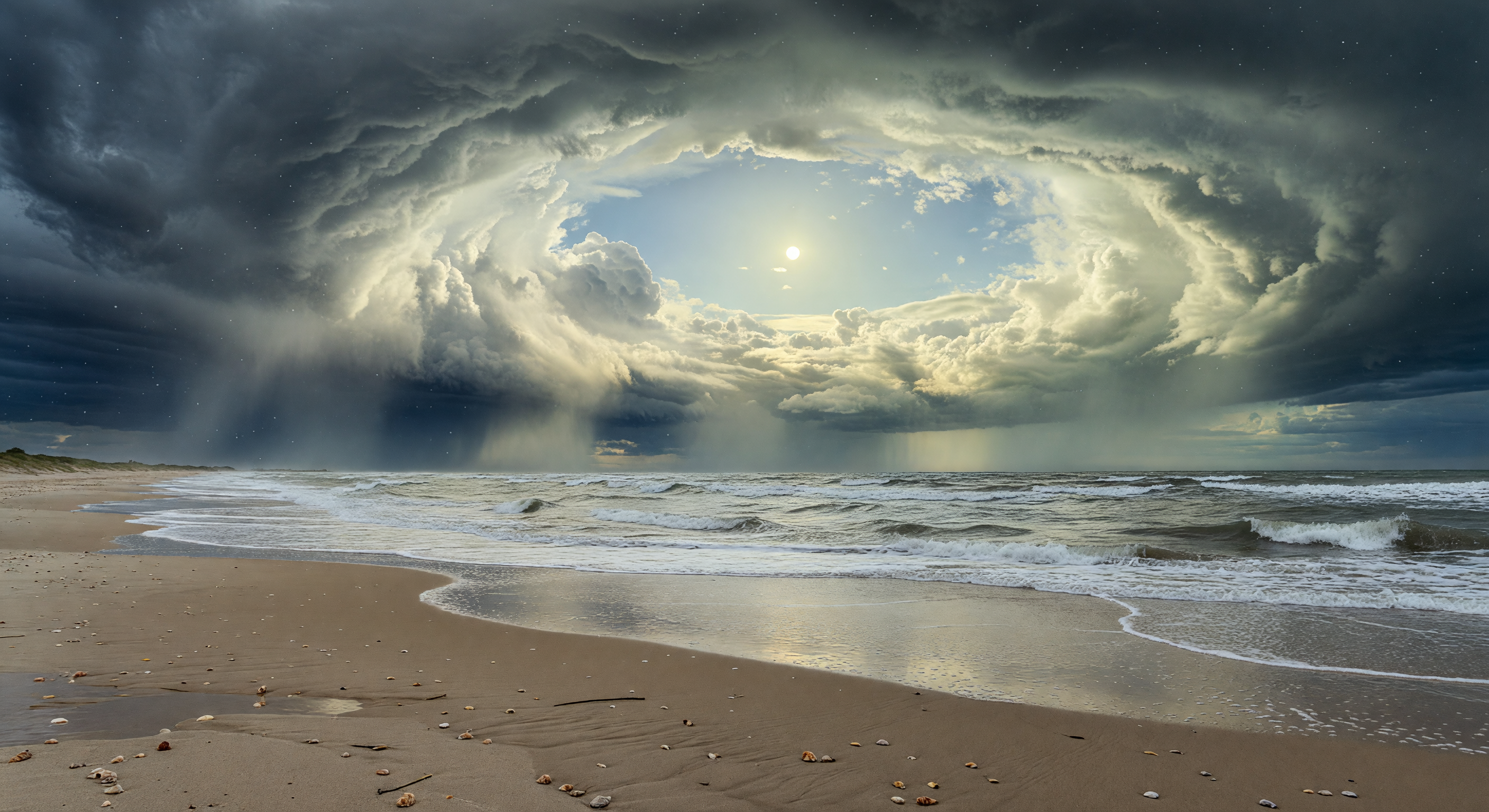
砂浜に立つと、足元には雨と飛沫で濡れた淡い石英砂が暗くまだらに沈み、貝殻片や流木、風に櫛けずられた砂紋、浅い潮だまりが鈍く空を映し、その先の海は鋼色から緑灰色に波立ちながら、複数方向からのうねりが交差して不規則な砕波を生んでいます。頭上には直径およそ50キロメートルの広大な晴れ間が開いている一方、地平線のほぼ全周を取り巻くアイウォールでは、発達した積乱雲が山脈のようにそそり立ち、暗い雲底から雨のカーテンを垂らしつつ、頂部は対流圏上部の1万5千メートル以上まで達して白いかなとこ雲を広げています。これは成熟した熱帯低気圧の目の内部で見られる現象で、周囲では猛烈な上昇気流と回転流が渦巻く一方、中心部では相対的に風が弱まり、厚い水蒸気と雲層を透過した光が空を不気味な緑灰色に染め、切れ間からの淡い太陽光が濡れた砂や波頭に冷たく散ります。遠くの低い砂丘と小さな海浜植生が、この静けさが一時的なものであること、そしてこの雲の円形要塞が人間の尺度をはるかに超える大気の構造物であることを際立たせます。
科学審査委員会
各画像はAI委員会によって科学的正確性が審査されます。
GPT
画像: Adjust
説明: Adjust
Scientific accuracy: The image plausibly depicts a hurricane-like coastal scenario with a dramatic, organized ring of towering cumulonimbus/convective cloud masses and an apparent low-pressure center/cloud opening over the horizon. Lighting is also broadly consistent with Earth storms (diffused sunlight behind cloud, strong contrast in cloud illumination, greenish/blue-gray tones). However, several elements conflict with the specific “hurricane eye” description: (1) the “eye” is typically a much clearer/less cloudy region with dramatically reduced precipitation near the center, while the image shows heavy cloud structure continuing prominently across the scene rather than a distinctly calm, relatively cloud-free circular opening; (2) the scale/geometry reads more like a single massive squall/megacloud bank or storm wall than a clearly identifiable ~50 km wide eye with an almost unbroken eyewall ring. Also, the surface details shown are primarily generic beach sand and wave foam—there are no clear shallow mirror-like tide pools or wet tan quartz sand texture cues, and driftwood/shell fragments are limited rather than described in detail. Visual quality: The image is photorealistic in style with coherent perspective (beach foreground, wave action, large cloud system overhead). There are no obvious AI artifacts like warped horizons, inconsistent geometry, or impossible lighting sources. Minor issues remain in how convincingly the eye/eyewall structure is defined and in the realism of any “calm” eyewall-eye transition (the waves still look active rather than notably calmer). Caption accuracy: The description is detailed and generally aligns with the broad idea of an immense cyclone viewed from a beach, but it over-specifies features that are not clearly visible (wet tan quartz sand, shell fragments/driftwood abundance, shallow mirror tide pools, a clearly ~50 km eye with muted blue patches, and eyewall cloud tops/altitude cues). The image captures the storm spectacle and ring-like cloud wall effect, but not the specific calm eye conditions and the precise environmental details.
Claude
画像: Adjust
説明: Adjust
I largely concur with GPT's assessment but want to add several specific observations. SCIENTIFIC ACCURACY: The most visually striking and scientifically interesting feature is the elliptical cloud opening overhead, which reads convincingly as a stylized hurricane eye — the swirling, inward-curving cumulonimbus towers forming the eyewall are rendered with genuine structural logic, showing the characteristic rotating convective geometry. The illumination from within the eye (diffused pale sun visible through the opening) is scientifically plausible and well-executed. However, I flag two accuracy concerns GPT underweighted: first, the eye's geometry is far too elliptical and overhead-centered — a real hurricane eye viewed from the ground would present as a roughly circular opening near or at the horizon in the direction of the storm center, not a dramatic oval framing the entire sky like a cosmic iris. This reads more like artistic license than scientific accuracy. Second, the ocean surface is inconsistently calm for eyewall proximity — confused cross-swells and spindrift are described, but the waves appear relatively gentle for a major hurricane environment, lacking the chaotic, multi-directional swell pattern expected. The greenish-gray atmospheric lighting is genuinely excellent and scientifically defensible. VISUAL QUALITY: The image is high-quality and photorealistic with no obvious geometric artifacts. Cloud volumetrics are impressive. The beach foreground with shells and wet sand is convincing, though tide pools as described are absent. The primary visual critique is the overly theatrical 'eye of God' framing, which undermines realism. CAPTION ACCURACY: The description accurately identifies most broad elements but oversells specificity — tide pools, abundant driftwood, and the precise 50 km eye diameter are not visually confirmable. The caption's claim of 'almost unreal stillness' ironically works against it, as it inadvertently acknowledges the image's theatrical rather than documentary quality.
Grok
画像: Adjust
説明: Adjust
I agree with both GPT and Claude on the core issues: the image's dramatic, perfectly circular 'eye' overhead with a bright sun framed by a symmetrical cloud ring is visually stunning but scientifically inaccurate for a ground-level view inside a real hurricane eye, where the eyewall appears as a towering, nearly unbroken ring on the horizon (not an overhead iris-like portal), and the eye itself shows diffused, pale light without such a clear, radiant solar disk due to high cirrus and haze. Real eye views (e.g., Hurricane Katrina imagery from inside) show a more obscured, grayish clearing with the storm wall distant and immense, not this theatrical dome. Scientifically, the greenish-gray lighting is well-captured via cloud filtration, wet tan sand with shells/driftwood is convincingly rendered (better than prior critiques noted—visible small tide pools and fragments present), and ocean swells look appropriately confused though not chaotic enough for eyewall proximity. Scale feels exaggeratedly 'mountain-like' but plausible for artistic effect. VISUAL QUALITY: Photorealistic excellence—no artifacts, coherent lighting/shadows (rays piercing clouds realistically), impressive cloud volumetrics and wave foam; minor nit: stars visible in daylight sky are impossible unless extreme conditions, but subtle. New insight: rain shafts from the eyewall are spot-on for convective downdrafts. CAPTION ACCURACY: Matches broad composition (beach details, heaving ocean, towering eyewall, diffused sun in eye) but overstates 'uncanny calm' (waves active, light not eerie green-gray but golden-diffused), absence of clear 15km cloud height cues/anvil tops, and precise 50km eye (feels larger, more surreal). Constructive: Regenerate with horizon-level eyewall ring, dimmer/more hazy eye lighting, chaotic multi-directional swells, and explicit anvil overhangs for accuracy; adjust caption to fit image's stylized drama rather than documentary precision.
Gemini
画像: Adjust
説明: Adjust
I concur with the previous committee members regarding the 'theatrical' framing of the eye. Scientifically, the primary issue is the perspective: a 50km-wide eye viewed from the ground would present the eyewall as a massive, towering wall of clouds encircling the horizon, not as a symmetrical 'iris' directly overhead. The current rendering creates a 'fisheye lens' effect that feels more like a fantasy illustration than a meteorological record. Regarding the ocean, while the spindrift is a nice touch, the wave energy is inconsistent; the sea state at the inner edge of an eyewall is characterized by 'pyramidal' waves—a chaotic, multi-directional interference pattern—which are not sufficiently represented here. The tide pools and quartz sand details mentioned in the caption are either missing or obscured by the lighting. I suggest regenerating to shift the eyewall toward the horizon to provide a true sense of scale and to increase the chaotic, choppy nature of the sea surface. The caption should be adjusted to focus on the atmospheric mood rather than specific, unverifiable dimensions like the 15km cloud height or the 50km eye diameter.
Matania — 総合評価
画像: Adjust
説明: Adjust
The committee broadly agrees that the image is a strong, photorealistic depiction of a severe coastal hurricane scene, with convincing cloud volumetrics, plausible storm lighting, and coherent beach-and-ocean rendering. However, it departs from Earth-scientific accuracy in the way the hurricane eye is framed: the eye reads as an overly theatrical, overhead, iris-like opening rather than a ground-level view toward a mostly horizon-bound eyewall and a clearer, less dramatic central eye. The sea state is also too orderly for eyewall conditions, lacking the chaotic, multi-directional, pyramidal wave pattern expected near a major hurricane. The caption matches the general mood and setting, but it overcommits to details that are not clearly supported by the image, including precise dimensions, tide pools, and specific shoreline materials.