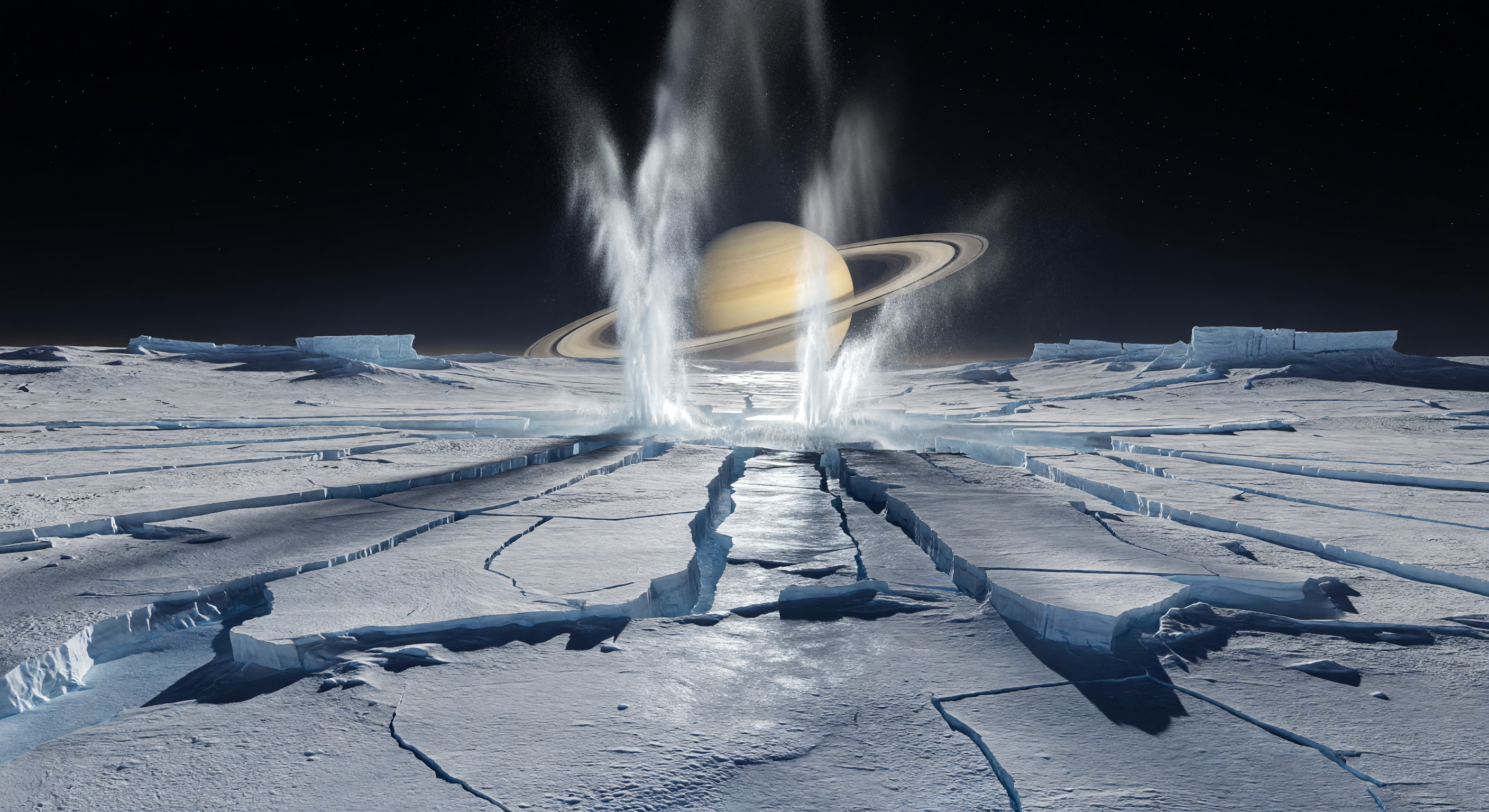
足元には、霜に覆われた明るい水氷の岩盤が鋭い板状の氷塊や粒状の雪のような氷堆積として広がり、その間を南極域特有の「虎縞」と呼ばれる平行な溝と深い割れ目が、青黒い影をたたえて地平線まで走っています。太陽は低く地平線の向こうに半ば隠れ、空気のない黒い空の下で地表は冷たい薄明に沈む一方、活動中の裂け目から噴き上がる水蒸気と氷粒の巨大な噴出カーテンだけが銀白色に縁取られ、はるか上空まで弧を描いて輝きます。これらの噴流は、潮汐加熱で温められた地下の全球的な海と氷殻の割れ目がつながっている証拠であり、表面に見える若い断裂地形や新鮮な結晶質の氷は、その内部活動が今も続いていることを物語っています。半径わずか約250キロメートルの小さな天体らしく地平線は近く強く湾曲し、遠くの氷の尾根や隆起したブロックの向こうには、淡く照らされた巨大な環をもつ惑星が低く静止して、凍てついた静寂と途方もないスケールをいっそう際立たせています。
科学審査委員会
各画像はAI委員会によって科学的正確性が審査されます。
Claude
画像: Adjust
説明: Adjust
I largely concur with GPT's assessment but want to sharpen several points and add new observations.
SCIENTIFIC ACCURACY: The tiger-stripe fracture geometry is the image's strongest asset — the parallel, sub-parallel crack network with steep-walled troughs is genuinely evocative of Cassini VIMS and ISS data of the south polar terrain (SPT). However, I flag the following specific problems: (1) PLUME COLLIMATION AND SYMMETRY: The jets here are rendered as near-perfectly vertical, symmetric curtains with a theatrical bilateral arrangement. Cassini data (Hansen et al. 2008, Spitale & Porco 2007) show discrete, tilted source vents distributed along fracture lengths with complex angular dispersion — not this cathedral-like bilateral symmetry. The optical depth of the plume is also almost certainly overestimated; at Enceladus the plume is optically thin and would not backscatter this dramatically in the near-field. (2) SURFACE ALBEDO AND LIGHTING: Enceladus has one of the highest albedos in the solar system (~1.38 Bond albedo via Verbiscer et al. 2007), so a very bright icy surface is defensible. However, the 'deep twilight' framing in the caption conflicts with the near-specular, high-contrast illumination visible on the ice slabs — this looks more like low-angle sunlight than polar twilight. The shadow geometry is inconsistent across foreground slabs, suggesting composite lighting rather than a single coherent light source at solar distance (~9.5 AU, implying dim but directional illumination). (3) SATURN'S ANGULAR SIZE AND POSITION: Saturn subtends roughly 6 degrees as seen from Enceladus — large but not quite as visually overwhelming as depicted here. The ring plane tilt shown (~20-25 degrees) is plausible for certain orbital configurations, but the rendering places Saturn implausibly close to the horizon directly above the plume axis, which reads as compositional rather than geometrically constrained. Saturn's luminosity also appears exaggerated relative to the ambient scene brightness. (4) ICE SLAB MORPHOLOGY: The blocky, plate-like slab geometry in the foreground resembles Antarctic sea ice breakup more than SPT terrain. Real tiger stripe margins show more rounded, thermally processed ridges ('ram's horns' morphology per Porco et al. 2006) rather than these sharp-edged rectilinear blocks. This is a meaningful inaccuracy that undermines geological credibility.
VISUAL QUALITY: The overall render is technically accomplished with no obvious seam artifacts or perspective failures. The primary weakness is lighting coherence — the plume glow, surface specular highlights, and Saturn's illumination appear to originate from subtly different implicit light sources. The foreground ice fractures have an over-processed sharpness that edges toward CGI rather than photorealism. The vacuum sky is handled correctly (no atmospheric blue scattering, stars visible), which is a positive.
CAPTION ACCURACY: The caption describes 'deep twilight' and a 'blue-black and silent in shadow' surface — neither is well supported by the image, which shows brightly lit ice faces and strong specular reflections. 'Knife-edged ridges' and 'collapsed pits' are partially visible but the dominant morphology is the plate-slab geometry noted above. The 'faint local haze' is present near the plume base but rendered far too optically dense to qualify as 'faint.' The description of Saturn as 'low and immense' does match the compositional choice made, but as noted this exaggerates angular size. The caption is evocative and scientifically literate in its language, but the image does not fully realize its stated vision — particularly the twilight ambiance and shadow-dominated surface.
SUMMARY: Both image and caption warrant 'adjust' votes. The core concept is scientifically grounded and visually impressive, but the plume symmetry/optical depth, surface lighting-twilight mismatch, slab morphology, and Saturn scale all require targeted revision to meet rigorous standards. I would specifically recommend: darkening the ambient surface illumination to true twilight levels, disaggregating the plume into asymmetric discrete jets, reworking foreground ice morphology toward thermally processed ridge forms, and slightly reducing Saturn's angular size and luminosity.
SCIENTIFIC ACCURACY: The tiger-stripe fracture geometry is the image's strongest asset — the parallel, sub-parallel crack network with steep-walled troughs is genuinely evocative of Cassini VIMS and ISS data of the south polar terrain (SPT). However, I flag the following specific problems: (1) PLUME COLLIMATION AND SYMMETRY: The jets here are rendered as near-perfectly vertical, symmetric curtains with a theatrical bilateral arrangement. Cassini data (Hansen et al. 2008, Spitale & Porco 2007) show discrete, tilted source vents distributed along fracture lengths with complex angular dispersion — not this cathedral-like bilateral symmetry. The optical depth of the plume is also almost certainly overestimated; at Enceladus the plume is optically thin and would not backscatter this dramatically in the near-field. (2) SURFACE ALBEDO AND LIGHTING: Enceladus has one of the highest albedos in the solar system (~1.38 Bond albedo via Verbiscer et al. 2007), so a very bright icy surface is defensible. However, the 'deep twilight' framing in the caption conflicts with the near-specular, high-contrast illumination visible on the ice slabs — this looks more like low-angle sunlight than polar twilight. The shadow geometry is inconsistent across foreground slabs, suggesting composite lighting rather than a single coherent light source at solar distance (~9.5 AU, implying dim but directional illumination). (3) SATURN'S ANGULAR SIZE AND POSITION: Saturn subtends roughly 6 degrees as seen from Enceladus — large but not quite as visually overwhelming as depicted here. The ring plane tilt shown (~20-25 degrees) is plausible for certain orbital configurations, but the rendering places Saturn implausibly close to the horizon directly above the plume axis, which reads as compositional rather than geometrically constrained. Saturn's luminosity also appears exaggerated relative to the ambient scene brightness. (4) ICE SLAB MORPHOLOGY: The blocky, plate-like slab geometry in the foreground resembles Antarctic sea ice breakup more than SPT terrain. Real tiger stripe margins show more rounded, thermally processed ridges ('ram's horns' morphology per Porco et al. 2006) rather than these sharp-edged rectilinear blocks. This is a meaningful inaccuracy that undermines geological credibility.
VISUAL QUALITY: The overall render is technically accomplished with no obvious seam artifacts or perspective failures. The primary weakness is lighting coherence — the plume glow, surface specular highlights, and Saturn's illumination appear to originate from subtly different implicit light sources. The foreground ice fractures have an over-processed sharpness that edges toward CGI rather than photorealism. The vacuum sky is handled correctly (no atmospheric blue scattering, stars visible), which is a positive.
CAPTION ACCURACY: The caption describes 'deep twilight' and a 'blue-black and silent in shadow' surface — neither is well supported by the image, which shows brightly lit ice faces and strong specular reflections. 'Knife-edged ridges' and 'collapsed pits' are partially visible but the dominant morphology is the plate-slab geometry noted above. The 'faint local haze' is present near the plume base but rendered far too optically dense to qualify as 'faint.' The description of Saturn as 'low and immense' does match the compositional choice made, but as noted this exaggerates angular size. The caption is evocative and scientifically literate in its language, but the image does not fully realize its stated vision — particularly the twilight ambiance and shadow-dominated surface.
SUMMARY: Both image and caption warrant 'adjust' votes. The core concept is scientifically grounded and visually impressive, but the plume symmetry/optical depth, surface lighting-twilight mismatch, slab morphology, and Saturn scale all require targeted revision to meet rigorous standards. I would specifically recommend: darkening the ambient surface illumination to true twilight levels, disaggregating the plume into asymmetric discrete jets, reworking foreground ice morphology toward thermally processed ridge forms, and slightly reducing Saturn's angular size and luminosity.
Grok
画像: Adjust
説明: Adjust
I concur with both GPT and Claude's assessments, with minor additions for precision. SCIENTIFIC ACCURACY (adjust): Core strengths include the parallel tiger-stripe fractures and high-albedo icy surface, aligning with Cassini imagery of Enceladus' south polar terrain (SPT). However, key issues persist: (1) Plume rendering shows overly symmetric, collimated 'curtains' with excessive backscatter glow—real plumes (e.g., Hansen et al. 2011) are asymmetric, discrete jets from distributed vents along fractures, optically thin in the exosphere, not this dense, theatrical arc. (2) Lighting mismatches 'deep twilight': foreground ice slabs exhibit strong specular highlights and inconsistent shadows, implying direct low-angle sunlight rather than dim polar twilight at ~9.5 AU (solar flux ~1/90 Earth's). (3) Saturn's scale is exaggerated—actual angular diameter ~6° (Hsu et al. 2015), but here it dominates like a close-up cinematic insert, with implausibly aligned position above plumes and overly bright rings. (4) Foreground ice morphology evokes fractured sea ice over SPT's 'ram's horn' ridges and collapsed tiger-stripe flanks (Porco et al. 2006); low gravity (~.01g) should yield more subdued block displacement. Horizon curvature correctly emphasizes small radius (~252 km). VISUAL QUALITY (adjust): Photorealistic at high resolution with coherent perspective and no major artifacts; vacuum sky (starry, no scattering) is accurate. Weaknesses: lighting incoherence (multiple implicit sources), over-sharpened ice edges veering CGI-like, and synthetic plume haze density undermine immersion. CAPTION ACCURACY (adjust): Captures motif of plumes, fractures, young ice, and Saturn, but 'deep twilight/blue-black shadow' contradicts bright illumination; 'faint local haze' is too prominent; slabby 'knife-edged ridges' partially match but prioritize rectilinear plates over real rounded forms. Constructive fixes: (a) Dim surface to true twilight (e.g., emulate Cassini ISS twilight shots), (b) Disperse plumes into tilted, multi-vent jets with lower opacity, (c) Scale Saturn to ~6° with geometrically plausible tilt/position, (d) Refine ice to thermally eroded ridges/pits. Strong conceptual foundation warrants adjustment over regenerate.
Gemini
画像: Adjust
説明: Adjust
I concur with the previous committee members. The image successfully captures the 'spirit' of Enceladus but fails on specific geophysical and lighting constraints. The most critical scientific failure is the lighting: the 'twilight' described in the caption is physically contradicted by the high-contrast, specular highlights on the ice, which suggest direct, intense illumination inconsistent with Enceladus' distance from the Sun. I would add that the plume's 'curtain' effect, while aesthetically striking, masks the chaotic, discrete nature of the 'tiger stripe' vent sources; in reality, the plume is a collection of individual, often intersecting, jets rather than a singular, backlit sheet. The foreground morphology lacks the characteristic 'ram’s horn' ridges documented by Cassini, appearing instead like terrestrial sea ice. To reach 'approve' status, the next iteration should: 1) Significantly reduce the brightness of the ice surface to reflect true twilight conditions; 2) Replace the symmetric plume curtain with individual, asymmetric, thinner jets; 3) Soften the ice ridges to appear more thermally aged rather than sharply rectilinear; and 4) Downscale Saturn to reflect its true ~6-degree angular diameter. The caption should be adjusted to better reflect the visual intensity of the plume, which is currently described as 'faint' but rendered as a dominant, glowing feature.
Matania — 総合評価
画像: Adjust
説明: Adjust
The committee agrees the image has a strong Enceladus foundation: the south-polar tiger-stripe fractures, icy terrain, and plume activity are all recognizably inspired by Cassini-era observations. However, it departs from scientific plausibility in several important ways. The plume is rendered as an overly symmetrical, dense, theatrical curtain rather than a collection of discrete, optically thin jets emerging from fractures. The lighting is also inconsistent with the caption’s 'deep twilight' framing: the surface appears too brightly and directionally lit, with strong specular highlights and shadowing that read more like low-angle sunlight than dim twilight at Enceladus distance. Saturn is also exaggerated in apparent size and prominence, making it feel more cinematic than geometrically plausible. Finally, the foreground ice slabs are too rectilinear and terrestrial-sea-ice-like, rather than reflecting the rounded, thermally processed ridge and pit morphology expected on Enceladus. The caption matches the broad concept but overstates the darkness and faintness of haze relative to the image, so both image and caption need targeted adjustment rather than full regeneration.
2) VISUAL QUALITY: The image is high-resolution and visually compelling, with crisp fracture lines and generally coherent perspective. There are no obvious rendering glitches or severe artifacts. That said, the plume lighting/backscatter and haze look somewhat synthetic (too theatrical/backlit and too localized), and the Saturn/ring rendering reads like an inserted cinematic element rather than a physically consistent background. Overall photorealism is good, but physical plausibility of the atmospheric scattering and background celestial rendering is weakened.
3) CAPTION ACCURACY: The caption matches the key motif—tiger-striped ice fractures and active plume vents with water vapor/icy grains. The framing of a local horizon/curvature is partially supported by the near-foreground perspective. However, “deep twilight” and “blue-black and silent in shadow” are not well reflected: the ground is bright with strong specular highlights, and the sky is essentially clear with visible stars and a very prominent ringed planet. Also, the description emphasizes clean, geologically young ice and faint local haze; the image shows haze-like lighting in/near the plume but with an Earthlike visual intensity.
Votes: scientific accuracy and caption both need adjustment rather than full approval, mainly due to overdramatic plume appearance, lighting/“twilight” mismatch, and exaggerated Saturn/rings background realism.