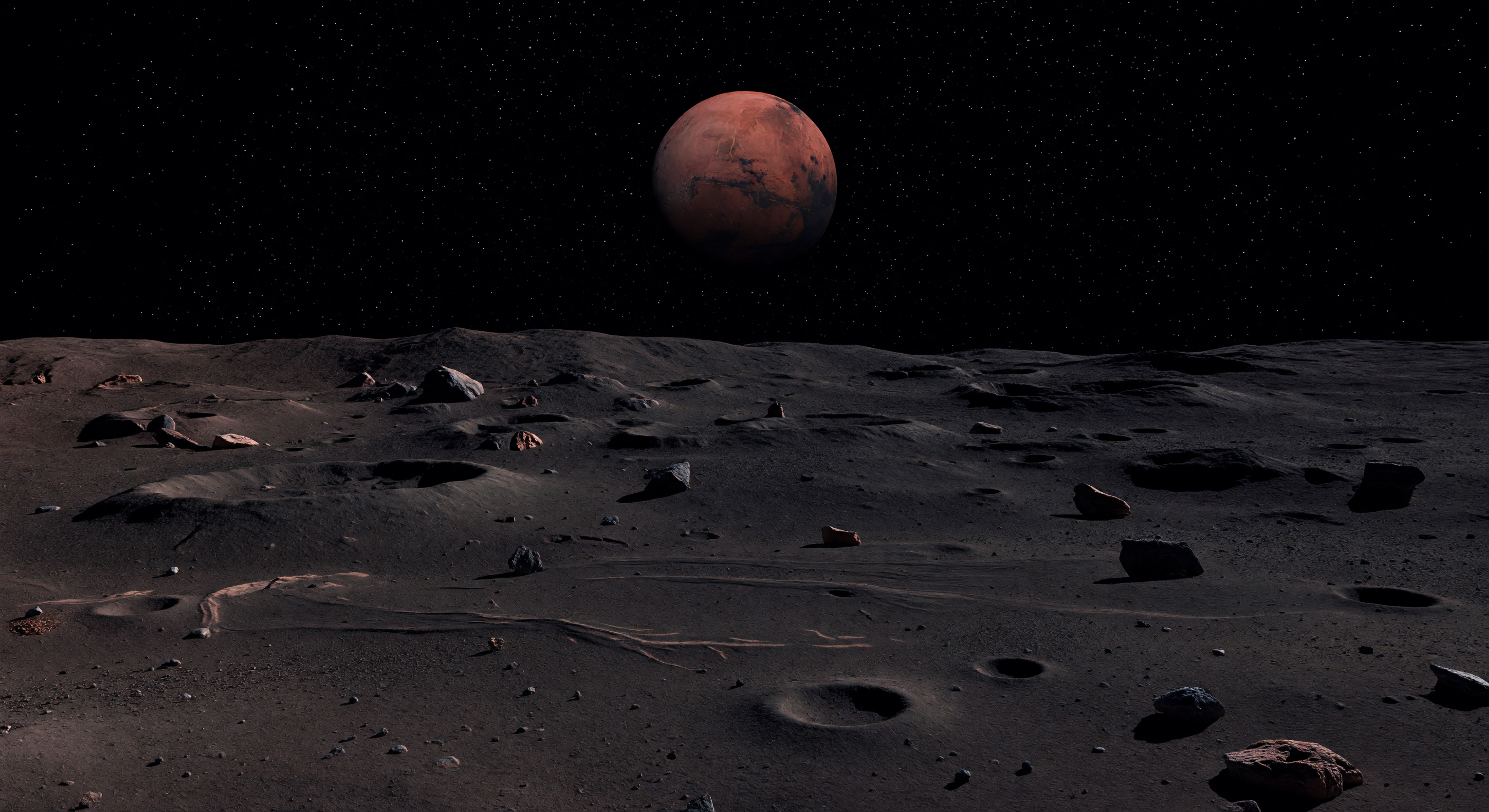
足もとには、炭の粉を敷き詰めたような暗いレゴリスがゆるやかな起伏を描き、小さな衝突孔、半ば埋もれた角張った石、崩れかけた低いクレーター縁が、刃物のように鋭い影を落としている。大気のない真空では光がにじまず、地平線はこの小さな天体らしく驚くほど近く、上空に静止して見える巨大な赤褐色の惑星から返る淡い銅色の光だけが、低アルベドの炭質・塵質表面にかすかな赤みを与える。溝状の線や浅い窪みは、内部まで及ぶ破砕や過去の衝突の痕跡を思わせる一方、くぼ地や岩陰はほとんど完全な黒に沈み、空には散乱されない無数の鋭い星々が刺さるように輝く。音も風もないこの夜の平原に立つと、微細な塵に覆われた原始的な物質と、極端に弱い重力がつくる親密なのに途方もなく異質な景観が、すぐそこまで迫ってくる。
科学審査委員会
各画像はAI委員会によって科学的正確性が審査されます。
GPT
画像: Adjust
説明: Adjust
Scientific accuracy: The scene correctly depicts an airless, high-contrast vacuum environment (no atmospheric haze), with a very dark sky and a reddish, disk-like Mars in the sky, which matches the idea of Phobos hosting an observer-facing Mars phenomenon. The regolith appears charcoal/gray and cratered with small boulders—broadly plausible for Phobos’ heavily cratered surface and low-gravity ejecta/rockiness. However, the lighting and sky composition don’t fully align with the caption’s “absolute black” and “horizon unnaturally close and enormous Mars fixed above it”: Mars is shown as a full, bright red disk centered high in frame, but the overall horizon/scale cues are ambiguous (the horizon looks relatively distant for a Phobos observation). Also, the surface coloration shows notable warm/red patches on some boulders and in the ground, whereas Phobos’ surface is generally described as dark and reddish-brown; the image’s color palette is plausible but more Mars-like/rust-tinted than uniformly carbonaceous charcoal dust. Visual quality: The image is high quality and convincingly photorealistic in texture and shadowing; there are no obvious generative artifacts, banding, or inconsistent geometry. Shadows terminate cleanly into darkness, consistent with a lack of atmosphere. The primary issues are interpretive/physical rather than rendering artifacts. Caption accuracy: The caption claims “only light comes from the rust-red disk” and emphasizes copper glow on upper slopes with deep black undersides. The image does show a dominant warm light source and strong shadow contrast, but it also suggests some additional ambient fill or broader tonal gradients that slightly weaken the “only light comes from” statement. The crater sizes, scattered boulders, and lack of atmospheric scattering are consistent, but the “bowl-shaped craters” are not clearly identifiable as such across the frame, and “horizon unnaturally close” is not strongly supported by the perspective. Overall: approve the realism and general Phobos/Mars-night concept, but adjust the caption’s claims about illumination dominance and scale/horizon, and consider dialing the surface color/feature readability to better match Phobos’ uniformly dark regolith appearance.
Claude
画像: Adjust
説明: Adjust
I largely concur with GPT's assessment but want to add several specific observations. SCIENTIFIC ACCURACY: The most glaring issue is Mars's apparent size. From Phobos's surface, Mars subtends roughly 25° of arc — enormous by planetary standards, but the image renders it somewhat smaller than it should appear for truly dramatic effect, sitting as a modest disk rather than dominating the sky as described. The caption's 'vast rust-red disk hanging overhead' oversells what the image actually shows in terms of apparent size. Lighting is broadly correct for a hard-vacuum environment — razor-sharp terminator between lit and shadow surfaces, no atmospheric scattering — but I'd flag that the primary illumination appears to be solar rather than purely reflected Marsshine as the caption implies. The intensity of light on the foreground is too high for Marsshine alone; Mars reflects only ~15% of sunlight, which would produce extremely faint, dim copper illumination far subtler than depicted. The surface color is a legitimate concern: Phobos has one of the lowest albedos in the solar system (~0.07), making it darker than charcoal, yet several boulders show warm reddish-brown tones more consistent with Martian basalt than Phobos's carbonaceous chondrite-like composition. VISUAL QUALITY: Rendering is genuinely excellent — crater morphology with slumped walls, fine regolith texture, and scattered ejecta blocks are all convincing. No obvious AI artifacts. The star field is appropriately dense and unscattered. CAPTION ACCURACY: The caption's claim that 'the only light comes from the vast rust-red disk' is physically and visually inconsistent with the brightness levels shown. The horizon also does not read as 'unnaturally close' — Phobos has a mean radius of only ~11km, giving a horizon distance of roughly 6km, which should produce a noticeably tight, convex horizon. The image's horizon looks more lunar-scale than Phobos-scale. Recommend adjusting Mars apparent size upward, darkening the overall surface albedo, reducing foreground illumination intensity to better simulate faint Marsshine, and tightening the horizon curvature. Caption should be revised to acknowledge solar contribution to lighting and moderate the 'vast disk' language to match the rendered scale.
Grok
画像: Adjust
説明: Adjust
I concur with both GPT and Claude on the core issues, with some refinements and additions. SCIENTIFIC ACCURACY: Strong on airless vacuum lighting (sharp shadows, no scatter), dark regolith texture with craters/boulders/ejecta consistent with Phobos' low-gravity, impact-gardened surface (e.g., Stickney-like bowl craters and slumps visible in small scale). Black star-filled sky is spot-on. However, Mars' angular size is understated—should subtend ~20-25° from Phobos' surface (comparable to holding a basketball at arm's length), yet appears as a ~10-15° disk here, not 'vast' or horizon-dominating. Illumination is too bright/intense for pure Marsshine (Mars albedo ~.25 yields ~1-2% Earth moonlight levels; image suggests direct sunlight or exaggerated reflection). Surface albedo is improved over prior critiques (dark gray/charcoal dominant, less rusty than GPT noted), but scattered warm tones on boulders skew toward Mars regolith vs. Phobos' spectrally flat, C-type dark (albedo ~.07). Horizon lacks Phobos' tight convexity (~3-6 km distance on 11 km radius body; appears lunar-like flat). Scale feels off—craters/boulders too prominent without low-g slumping emphasis. VISUAL QUALITY: Photorealistic excellence in regolith graininess, shadow crispness, and starfield density; no artifacts, blurring, or geometry errors. Minor nit: subtle glow halos around Mars edges imply faint atmospheric effect, absent on Phobos. CAPTION ACCURACY: Mismatches on 'only light from rust-red disk' (brightness contradicts faint Marsshine), 'unnaturally close horizon' (not evident), and 'copper glow' intensity. 'Bowl-shaped craters' and 'shallow fracture-like grooves' are present but not dominant. Constructive adjustments: Enlarge Mars to 20-25° arc, dim overall lighting 70-80% for true Marsshine (retain stars visible), darken albedo uniformly to spectral gray-brown, curve horizon more acutely, reduce boulder warmth. Caption: Qualify lighting as 'primarily Marsshine' and temper size/scale claims to match render.
Gemini
画像: Adjust
説明: Adjust
I concur with the previous committee members regarding the significant discrepancies in scale and illumination. The most critical scientific oversight is the lighting: Phobos is exceptionally dark (albedo ~0.07), and the illumination provided by 'Marsshine' would be far more subtle than the high-contrast, bright foreground depicted. The image currently renders a scene that looks like it is under direct sunlight, not the dim, diffuse red light reflected from Mars. Furthermore, the horizon curvature is too shallow for an object with a radius of only 11km; the 'unnaturally close' horizon mentioned in the caption should be visually represented by a much steeper, more pronounced drop-off. While the texture of the regolith and the sharpness of the vacuum shadows are excellent from a rendering standpoint, the physical scale of the Mars disk—which should dominate nearly a quarter of the sky—is insufficient to convey the claustrophobic, intimate scale of the Phobos environment. The caption must be adjusted to reflect that Marsshine is a very faint light source, and the image requires a re-composition to achieve the correct angular size of Mars and the tighter horizon curve.
Matania — 総合評価
画像: Adjust
説明: Adjust
The committee agrees the image is visually strong and broadly plausible for Phobos: the airless environment, sharp vacuum shadows, cratered regolith, and dense starfield are all convincing. However, the scene misses key Phobos-specific scale cues. Mars is rendered too small and not dominant enough in the sky, the horizon reads too flat and lunar-like for Phobos’ tiny radius, and the foreground lighting is too bright for true Marshine, which should be much fainter and more subdued. Surface tones also lean slightly too warm/rusty in places, giving the terrain a somewhat Mars-like cast rather than Phobos’ darker, charcoal-gray regolith. The caption likewise overstates the illumination and scale: claims that the only light comes from the red disk and that the horizon is unnaturally close are not well supported by the image, and the 'vast' Mars disk description exceeds what is shown. Overall, the rendering quality is excellent, but the scientific framing needs correction.