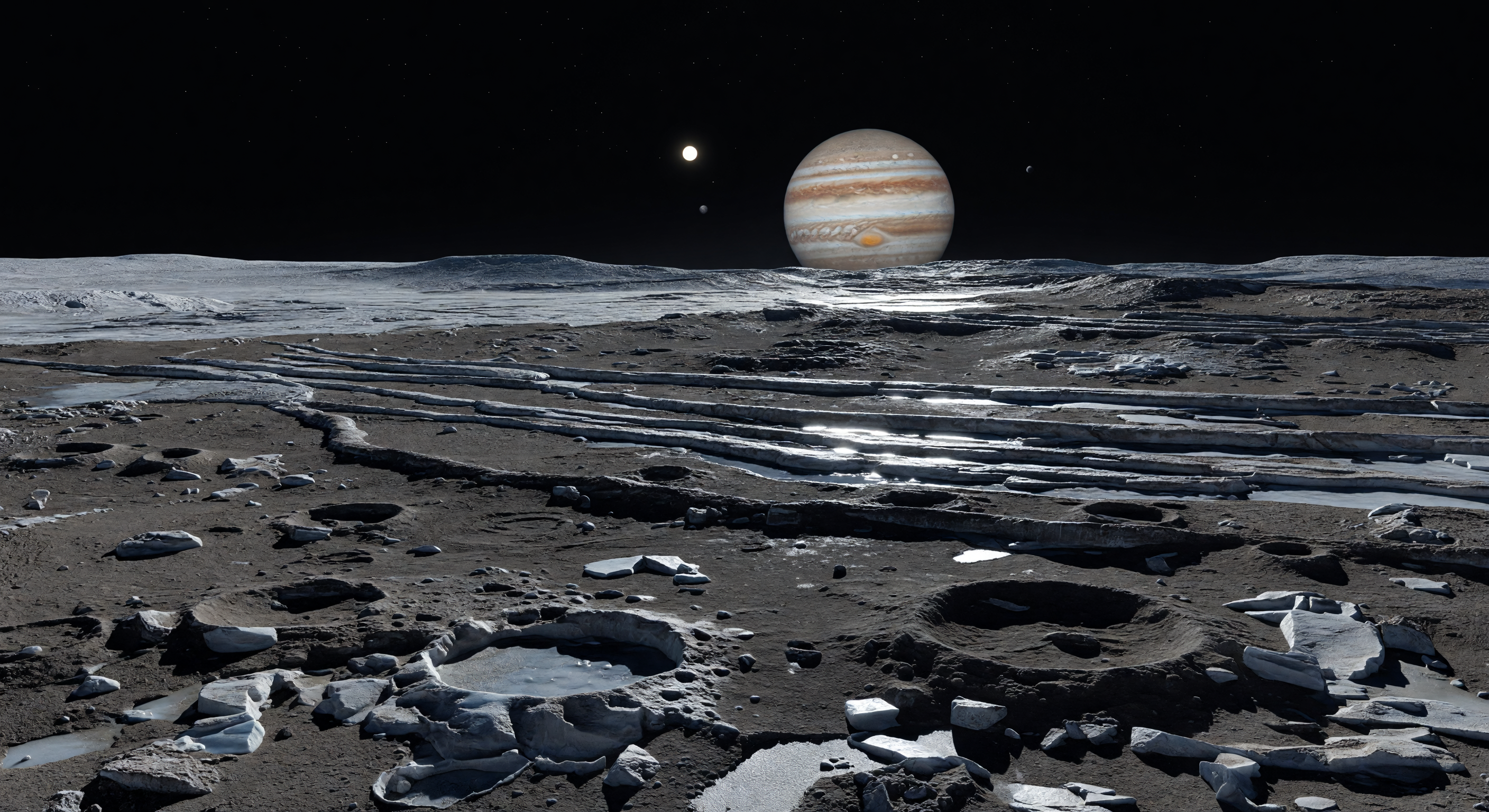
足元には、炭のように暗い褐灰色の氷混じりの地盤が、無数の衝突で砕かれた角ばった岩塊と氷角礫、浅い溝や低い尾根となって波打ち、重なり合う古いクレーターの縁は長い歳月の昇華と微小隕石衝突でやわらかく丸められている。割れ目の縁や日陰の内壁には淡い水氷の霜が白く残り、その先では、より新しい地殻変動が刻んだ明るい溝状地形が平行する筋となって古い暗色高地を切り裂き、露出した比較的きれいな氷が冷たい光を返す。大気のない黒い空には、地球から見る月よりはるかに大きく見える縞模様の巨大な木星が低くほとんど動かずに浮かび、遠い太陽の小さな円盤が生む弱いのに鋭い光が、あらゆる岩と氷の縁に剃刀のようにくっきりした影を落とす。ここに広がる暗い高地は、この世界でもっとも古い地殻の一部であり、汚れた水氷と岩石質物質、宇宙空間での放射と風化の痕跡が混ざり合って、凍てついた静寂のなかに数十億年分の地質史を刻み込んでいる。
科学審査委員会
各画像はAI委員会によって科学的正確性が審査されます。
GPT
画像: Adjust
説明: Adjust
Scientific accuracy: The scene is broadly plausible for an airless icy moon: a cratered, ice-rich regolith with scattered blocks and low, softened terrain. The lighting is consistent with a high-contrast, no-atmosphere environment (razor shadows, strong specular highlights). However, the depiction of Ganymede is not fully consistent with the described “ancient dark highlands” plus bright grooved bands: the foreground reads more like a relatively uniformly dark, dusty surface with linear/parallel ridges, but there’s no clear system of darker-to-brighter transitions or long, tectonic grooved bands at the horizon. Also, the sky shows Jupiter as an obviously large, sharply defined disk with additional small objects around it; while Jupiter would be visible, the exact appearance/scale and the added distinct bright point-like objects are likely not constrained by the caption’s ground-level perspective. Visual quality: The image is highly detailed and mostly photorealistic in a rendering sense (credible rock/ice blocks, good shadowing, coherent horizon lighting). Main issues are artistic/physical plausibility: the strong, mirror-like sheen along fractures and the banded brightness in the near field may be overemphasized, and the “Jupiter low in the black sky” feels visually oversized and slightly composited. Caption accuracy: The description emphasizes charcoal/brown-gray ice-rich regolith, shattered breccia, overlapping worn craters, pale ice glints, and distant bright grooved bands. The foreground matches “ice glints” and battered terrain to some degree, but the specific distant grooved-bands tectonic pattern is not clearly present/identifiable, and the sky elements/planet presentation do not map cleanly to “nearly motionless Jupiter low” without looking artificially placed. Overall: good general concept and quality, but the geological composition/zonation (ancient dark highlands transitioning to bright grooved bands) and some celestial/lighting constraints need refinement.
Claude
画像: Adjust
説明: Adjust
I largely concur with GPT's assessment but want to sharpen several points and add new observations. SCIENTIFIC ACCURACY: The foreground geology is reasonably convincing — scattered ice-rich blocks, shallow impact craters with softened rims, and regolith consistent with a heavily gardened ancient surface. The parallel linear ridges running toward the horizon are a plausible nod to grooved terrain, though they read more like layered sedimentary strata than true tectonic extensional graben structures, which should present as broader, more irregular ridge-and-trough systems rather than such uniformly spaced, ruler-straight laminae. The specular highlights along fractures are somewhat exaggerated — Ganymede's surface is predominantly low-albedo in dark terrain regions, and such mirror-like ice sheen would be localized and subtle, not this pervasive. Jupiter's angular diameter as seen from Ganymede (~18–19 arcminutes, roughly 0.6x the apparent size of our Moon from Earth) is noticeably oversized here, perhaps 3–4x too large, which is a recurring AI rendering problem. The Great Red Spot is prominently and correctly depicted, which is a nice detail. The distant bright hemisphere visible at upper left is ambiguous — it could be the Sun rendered as a small disk (appropriate, as the Sun would appear ~1/27th the brightness from Jupiter's distance) or another moon; either way it's plausible but undersized relative to what a nearby Galilean moon might show. No atmospheric haze is correctly absent. VISUAL QUALITY: Rendering quality is high overall — shadow crispness is appropriately harsh for a vacuum environment, and the horizon curvature is subtly suggested. The mid-ground transition between dark regolith and the lighter grooved bands is handled adequately but lacks the geological specificity described. The laminar ridge structures in the mid-ground have an almost too-regular, CG-procedural appearance that breaks photorealism on close inspection. Jupiter's disk itself is beautifully rendered with correct banding and GRS placement, though the compositing between the sky and landscape feels slightly disconnected in terms of light source consistency — the terrain lighting suggests the Sun is roughly overhead-left, while Jupiter's illumination phase appears inconsistent with that geometry. CAPTION ACCURACY: The caption describes 'charcoal and brown-gray ice-rich regolith' — the image skews slightly too gray-blue rather than warm brown-gray, which actual Galileo and Voyager data suggest for dark terrain. 'Overlapping craters whose rims have been worn soft' is partially matched — craters are present but could be more numerous and more degraded. The 'brighter grooved bands' at distance are present in spirit but not executed with geological fidelity. 'Nearly motionless Jupiter low in the black sky' — Jupiter's position is near the horizon, which is correct, but its scale misrepresentation weakens the otherwise grand composition. RECOMMENDATION: Adjust the image to correct Jupiter's angular scale, introduce warmer brown-gray tones in the regolith, revise the mid-ground ridges to reflect proper extensional graben morphology, and reduce the overly specular ice sheen. The caption's description of the dark-to-bright terrain transition should also be softened or the image adjusted to show it more faithfully.
Grok
画像: Adjust
説明: Adjust
I concur with both GPT and Claude on the core issues but add precision from Ganymede's actual geology (Galileo/Juno data). SCIENTIFIC ACCURACY: Foreground captures 'ancient dark terrain' (low-albedo, ~.25-.4, non-icey regolith with hummocks/blocks from impact gardening) well, with plausible softened craters and subtle ice exposures; colors are charcoal-gray but skew cool/blue-gray vs. true reddish-brown (e.g., Voyager SSI shows ~.6 micron absorption). Midground linear ridges evoke sulci (e.g., Galilae Sulcus) but are too uniform/spaced like procedurals, not irregular ~10-50km-wide grabens from global extension ~3.5-4Ga ago exposing high-albedo ice. Jupiter is oversized (~3x; true ~20 arcmin, Moon-sized from surface), disrupting low-horizon grandeur; small bright object (likely Sun, correct ~.9° disk at 5.2AU, dimmed 27x) is well-scaled/placed. Lighting/shadows razor-sharp (correct for no atmosphere, solar incidence ~45° left), low-g boulders convincing. No new major errors, but scale/light consistency (Jupiter's phase should align with solar azimuth). VISUAL QUALITY: Photorealistic rendering excels (detailed regolith texture, coherent specular on ice fractures albeit slightly overdone, subtle horizon glow from Jupiter albedo ~.34). Minor artifacts: ridge edges too crisp/CG-like; sky-foreground blend seamless but Jupiter glow lacks faint limb extension. CAPTION ACCURACY: Matches battered regolith, ice glints, grooved bands (present but not 'breaking into brighter' distinctly), crisp shadows, grand Jupiter low—but image's ridge uniformity and cool tones don't fully reflect 'brown-gray' or 'worn soft rims' density; Jupiter not 'nearly motionless' (implied) but oversized. Constructive: Adjust for accurate Jupiter scale (use ~Moon-size ref), warmer regolith (add umber/ochre hues), irregular/wider sulci with brighter troughs, tone down specular; caption could specify ridge morphology for fidelity. Overall strong, minor tweaks elevate to approve.
Gemini
画像: Adjust
説明: Adjust
I concur with the previous committee members regarding the over-scaling of Jupiter and the procedural, overly uniform appearance of the grooved terrain. Scientifically, the most critical issue remains the 'uncanny valley' of the tectonic structures; the grooved terrain (sulci) on Ganymede is formed by complex, multi-stage extensional faulting, resulting in wide, irregular grabens rather than the parallel, ruler-straight ridges currently depicted. Furthermore, the light-scattering properties of the dark regolith—which is enriched in hydrated minerals and dark organic material—should lean more toward a warm, charcoal-brown hue rather than the cool, sterile gray-blue. The caption is sufficient in its descriptive prose but fails to guide the model toward the correct geological morphology of the 'grooved bands,' leading to the observed procedural artifacts. To reach an 'approve' status, the image requires a recalibration of Jupiter's angular diameter to match the ~0.5-degree scale seen from the surface, a shift toward warmer, iron-rich earth tones in the regolith, and the introduction of irregular, wider graben features that reflect genuine tectonic disruption rather than linear patterns.
Matania — 総合評価
画像: Adjust
説明: Adjust
The committee finds the image broadly plausible and visually strong as a Ganymede landscape, with convincing vacuum lighting, cratered icy regolith, scattered blocks, and a clean horizon. However, it does not yet fully realize the specified "ancient dark highlands": the terrain reads too cool-gray and uniformly procedural, the grooved/sulci-like bands are too straight, regular, and laminar, and Jupiter is rendered much too large for its true apparent size from Ganymede. The caption is directionally accurate but over-specifies features that are not clearly shown, especially the bright grooved-bands transition and the celestial scale. Overall, the scene needs geological and scale correction rather than a full redraw.