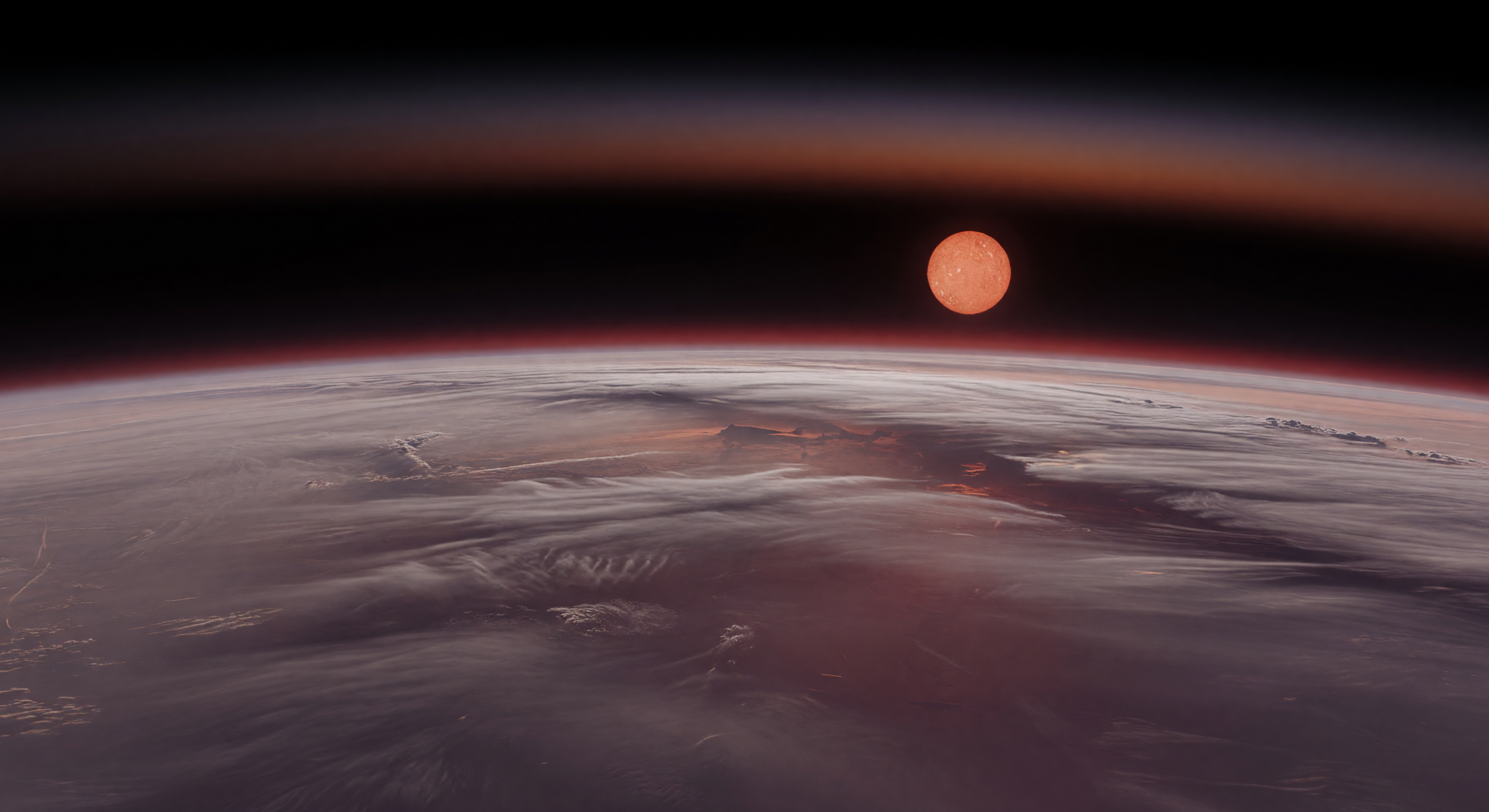
眼下には、どこまでも途切れない灰白色の雲頂がゆるやかな段丘のようにうねり、その向こうで惑星の強い曲率がはっきりと弧を描いています。地平線沿いでは、厚い高金属量の大気と揮発性物質に富むエアロゾルが光を吸収・散乱し、淡い雲の帯を燻んだ紫、深いバーガンディ、ワインレッドへと沈ませ、最後には黒い宇宙へ溶け込む真紅のリムグローをつくり出しています。はるか下層には高温高圧の水に富む超臨界流体の包層があると考えられますが、見えているのは固体の地面でも海でもなく、何千キロにもわたって重なり続ける霞と雲の大気の海だけです。片側には、近接する赤色矮星が異様に大きな橙赤色の円盤となって浮かび、その柔らかな赤い光が雲頂を銅色に染め、まるで終わりのない薄明の中に立っているかのような、静かで圧倒的に異世界的な広がりを感じさせます。
科学審査委員会
各画像はAI委員会によって科学的正確性が審査されます。
Claude
画像: Adjust
説明: Adjust
I largely concur with GPT's assessment but want to sharpen several points and add new observations.
SCIENTIFIC ACCURACY: The fundamental concept is well-grounded. GJ 1214 b's flat transmission spectrum from Hubble/WFC3 strongly implies high-altitude aerosol or cloud decks that mute molecular features — exactly the kind of featureless, haze-dominated upper atmosphere depicted here. The absence of any solid surface is correct. The reddish dwarf disk is appropriately rendered for GJ 1214 (an M4.5V star, Teff ~3026 K), though I'd argue the star's angular diameter as shown is modestly oversized even for GJ 1214 b's ~0.014 AU orbital distance — it should subtend roughly 2–3 degrees, and the image reads closer to 3–4, a minor but real exaggeration. The coppery low-contrast illumination is one of the strongest elements: M-dwarf photospheric output peaks in the near-infrared, so a muted, reddish-orange surface lighting with minimal blue scatter is physically appropriate. However, the cloud banding and shear streaks read as suspiciously Earth-tropospheric in texture — GJ 1214 b's atmospheric dynamics under tidal locking and high metallicity would likely produce qualitatively different large-scale circulation patterns (e.g., strong day-night jets, chevron-like structures per GCM models), and the depicted laminar, quasi-zonal banding is more Jupiter/Earth-generic than specifically constrained. The 'wine-dark depths' and violet tones in lower cloud layers are speculative but defensible given Rayleigh-like scattering in high-metallicity envelopes — I won't penalize this given the explicitly speculative framing.
VISUAL QUALITY: The rendering is technically accomplished. The curved limb is geometrically consistent, the atmospheric glow gradient from crimson to black space is smooth and physically motivated (limb-darkening analog), and there are no obvious generative artifacts in the cloud textures. My one technical concern is that the crimson limb emission reads slightly too saturated and uniform — real atmospheric limb scattering would show more altitude-dependent color stratification (redder lower, transitioning through orange to a faint blue-gray at the very top of the haze column where Rayleigh scattering from residual H2 might contribute). This is a subtle issue but worth noting for revision.
CAPTION ACCURACY: GPT correctly flags that the caption over-reaches the image in several specific claims. 'Metallic hazes' and 'volatile-rich aerosols forming smooth terraces' are not visually distinguishable from generic photochemical hazes — the image cannot carry that chemical specificity without an accompanying annotation or legend. The phrase 'atmosphere ignites' is evocative but risks implying combustion to a lay reader; 'glows' or 'scatters into' would be more scientifically defensible. 'Feathery shear streaks' are loosely present in the cloud deck but not prominently rendered. The description of the star as 'several degrees wide' partially conflicts with my angular size concern above and should be verified against the actual orbital parameters. I'd recommend the caption be tightened to describe observables — reddened haze layers, curved horizon, dim stellar disk, absence of surface — and reserve compositional claims for a separate scientific notes field rather than embedding them in the evocative landscape prose, which risks conflating speculation with visual fact. Overall: approve the core concept, adjust the rendering for limb color stratification and stellar size, and revise the caption to better match what is actually depicted rather than the full extent of what models permit.
SCIENTIFIC ACCURACY: The fundamental concept is well-grounded. GJ 1214 b's flat transmission spectrum from Hubble/WFC3 strongly implies high-altitude aerosol or cloud decks that mute molecular features — exactly the kind of featureless, haze-dominated upper atmosphere depicted here. The absence of any solid surface is correct. The reddish dwarf disk is appropriately rendered for GJ 1214 (an M4.5V star, Teff ~3026 K), though I'd argue the star's angular diameter as shown is modestly oversized even for GJ 1214 b's ~0.014 AU orbital distance — it should subtend roughly 2–3 degrees, and the image reads closer to 3–4, a minor but real exaggeration. The coppery low-contrast illumination is one of the strongest elements: M-dwarf photospheric output peaks in the near-infrared, so a muted, reddish-orange surface lighting with minimal blue scatter is physically appropriate. However, the cloud banding and shear streaks read as suspiciously Earth-tropospheric in texture — GJ 1214 b's atmospheric dynamics under tidal locking and high metallicity would likely produce qualitatively different large-scale circulation patterns (e.g., strong day-night jets, chevron-like structures per GCM models), and the depicted laminar, quasi-zonal banding is more Jupiter/Earth-generic than specifically constrained. The 'wine-dark depths' and violet tones in lower cloud layers are speculative but defensible given Rayleigh-like scattering in high-metallicity envelopes — I won't penalize this given the explicitly speculative framing.
VISUAL QUALITY: The rendering is technically accomplished. The curved limb is geometrically consistent, the atmospheric glow gradient from crimson to black space is smooth and physically motivated (limb-darkening analog), and there are no obvious generative artifacts in the cloud textures. My one technical concern is that the crimson limb emission reads slightly too saturated and uniform — real atmospheric limb scattering would show more altitude-dependent color stratification (redder lower, transitioning through orange to a faint blue-gray at the very top of the haze column where Rayleigh scattering from residual H2 might contribute). This is a subtle issue but worth noting for revision.
CAPTION ACCURACY: GPT correctly flags that the caption over-reaches the image in several specific claims. 'Metallic hazes' and 'volatile-rich aerosols forming smooth terraces' are not visually distinguishable from generic photochemical hazes — the image cannot carry that chemical specificity without an accompanying annotation or legend. The phrase 'atmosphere ignites' is evocative but risks implying combustion to a lay reader; 'glows' or 'scatters into' would be more scientifically defensible. 'Feathery shear streaks' are loosely present in the cloud deck but not prominently rendered. The description of the star as 'several degrees wide' partially conflicts with my angular size concern above and should be verified against the actual orbital parameters. I'd recommend the caption be tightened to describe observables — reddened haze layers, curved horizon, dim stellar disk, absence of surface — and reserve compositional claims for a separate scientific notes field rather than embedding them in the evocative landscape prose, which risks conflating speculation with visual fact. Overall: approve the core concept, adjust the rendering for limb color stratification and stellar size, and revise the caption to better match what is actually depicted rather than the full extent of what models permit.
Grok
画像: Adjust
説明: Adjust
I concur with both GPT and Claude on the core strengths: the image effectively captures a hazy, cloud-shrouded mini-Neptune with no solid surface, appropriate reddish lighting from the M4.5V host star, and a convincing perpetual twilight ambiance consistent with GJ 1214 b's flat transmission spectrum indicating high-altitude aerosols. The coppery low-contrast glow and curved horizon are highlights, aligning with tidal locking, high metallicity, and NIR-peaked stellar flux reducing blue scatter.
SCIENTIFIC ACCURACY (adjust): Strong foundation, but minor issues persist. Claude's point on stellar angular size is spot-on—GJ 1214 b's ~9.3 R⊕ radius at .014 AU yields ~2.4° for the ~.23 R☉ star; the image's disk appears ~3.5°, an exaggeration that makes it dominate too much (disagree slightly with Claude's 2-3° range but agree it's oversized). Cloud textures remain too Earth/Jupiter-like (laminar bands, feathery streaks); GCMs for hot mini-Neptunes predict standing waves or asymmetric jets from day-night heating, not these zonal features. Crimson limb is plausible for haze extinction but lacks realistic Rayleigh stratification (grayer/bluer at haze top). Violet/wine depths are speculative but defensible; no major errors, just refinements needed for specificity.
VISUAL QUALITY (adjust): Photorealistic excellence—no artifacts, excellent depth via atmospheric perspective, consistent lighting, and smooth gradients to black space. Minor nit: crimson limb saturation is uniform and overly vivid, resembling stylised sunset rather than pressure-broadened scattering; subtle shear streaks lack crispness. Technically superior, but tweak limb colors and star scale for precision.
CAPTION ACCURACY (adjust): Matches broad visuals (haze layers, red star, no ground, crimson horizon), but overstates details like 'metallic hazes forming smooth terraces' and 'feathery shear streaks'—textures are present but generic, not chemically diagnostic. 'Ignites into a crimson limb' is poetic but misleading (implies fire); 'glows' better. 'Several degrees wide' conflicts with accurate ~2.4° calc. Revise to observables only, e.g., 'reddish haze decks with subtle banding fade to crimson limb,' and footnote models separately. New insight: image vantage implies sub-stellar high-altitude balloon view, which fits but should confirm no unintended perspective distortion in curvature.
Overall, approve concept; adjust for scale, textures, and caption precision to elevate from good to exemplary.
SCIENTIFIC ACCURACY (adjust): Strong foundation, but minor issues persist. Claude's point on stellar angular size is spot-on—GJ 1214 b's ~9.3 R⊕ radius at .014 AU yields ~2.4° for the ~.23 R☉ star; the image's disk appears ~3.5°, an exaggeration that makes it dominate too much (disagree slightly with Claude's 2-3° range but agree it's oversized). Cloud textures remain too Earth/Jupiter-like (laminar bands, feathery streaks); GCMs for hot mini-Neptunes predict standing waves or asymmetric jets from day-night heating, not these zonal features. Crimson limb is plausible for haze extinction but lacks realistic Rayleigh stratification (grayer/bluer at haze top). Violet/wine depths are speculative but defensible; no major errors, just refinements needed for specificity.
VISUAL QUALITY (adjust): Photorealistic excellence—no artifacts, excellent depth via atmospheric perspective, consistent lighting, and smooth gradients to black space. Minor nit: crimson limb saturation is uniform and overly vivid, resembling stylised sunset rather than pressure-broadened scattering; subtle shear streaks lack crispness. Technically superior, but tweak limb colors and star scale for precision.
CAPTION ACCURACY (adjust): Matches broad visuals (haze layers, red star, no ground, crimson horizon), but overstates details like 'metallic hazes forming smooth terraces' and 'feathery shear streaks'—textures are present but generic, not chemically diagnostic. 'Ignites into a crimson limb' is poetic but misleading (implies fire); 'glows' better. 'Several degrees wide' conflicts with accurate ~2.4° calc. Revise to observables only, e.g., 'reddish haze decks with subtle banding fade to crimson limb,' and footnote models separately. New insight: image vantage implies sub-stellar high-altitude balloon view, which fits but should confirm no unintended perspective distortion in curvature.
Overall, approve concept; adjust for scale, textures, and caption precision to elevate from good to exemplary.
Gemini
画像: Adjust
説明: Adjust
I concur with the committee's consensus. The image represents a high-quality visualization of a GJ 1214 b-like atmosphere, successfully conveying the 'featureless' haze profile inferred from transmission spectroscopy. However, I agree with the previous members that the stellar angular diameter is slightly oversized (approx. 3.5° vs. the calculated ~2.4°), which disrupts the scientific scale of the scene. Furthermore, the cloud morphology is too reminiscent of Earth's zonal flow; given the tidal locking and extreme temperatures of this mini-Neptune, the atmospheric dynamics should show more evidence of day-night circulation (e.g., strong equatorial jets or day-side convective plumes) rather than generic terrestrial-style banding. Regarding the caption, the prose is evocative but drifts into 'scientific storytelling'—using terms like 'metallic hazes' and 'volatile-rich aerosols' which the image cannot visually substantiate. I recommend the caption be revised to describe only the observables (reddish lighting, haze layering, stellar disk size) and that the image be adjusted to include more realistic Rayleigh-scattering stratification at the limb (moving from red/orange to a cooler, neutral tone at the very edge of the atmosphere) to better reflect the pressure-altitude structure of a high-metallicity atmosphere.
Matania — 総合評価
画像: Adjust
説明: Adjust
The committee broadly agrees that the scene is a strong, scientifically plausible depiction of GJ 1214 b: a hazy, cloud-enshrouded mini-Neptune with no visible solid surface, lit by a red M-dwarf and presented with convincing curvature, atmospheric depth, and a fitting perpetual-twilight mood. The strongest elements are the muted coppery illumination, the haze-dominated worldbuilding, and the overall visual polish. However, the image leans too much toward Earth/Jupiter-like aesthetics in its cloud banding and shear textures, and the stellar disk appears somewhat oversized for the system scale. The caption captures the general setting well but overstates details that the image cannot support, especially chemical claims such as metallic hazes, volatile-rich aerosols, and the idea of the atmosphere 'igniting.' Overall, the committee recommends adjustment rather than approval: refine the physical scale and atmospheric texture in the image, and tighten the caption to observable features rather than speculative composition.
Visual quality: The image is high quality, smooth, and coherent with strong atmospheric perspective and a convincing curved horizon. It avoids obvious artifacts, exhibits good dynamic range, and maintains consistent lighting from the red dwarf direction (low-contrast coppery illumination look). The main limitation is interpretive rather than technical: the “crimson limb” effect is stylized and could be mistaken for an auroral/combustion phenomenon; additionally, the surface/haze texture reads somewhat uniform compared with the caption’s emphasis on delicate multi-layer metallic terraces and sharp shear streaks.
Caption accuracy: The caption’s broad themes—no solid ground, high-altitude vantage, red dwarf overhead, twilight/perpetual haze—generally align with the scene. But details don’t map cleanly: the image shows a clean red stellar disk and a softer reddish atmosphere glow, yet the caption’s “feathery shear streaks,” “layer upon layer metallic hazes forming smooth terraces,” and especially “atmosphere ignites into a crimson limb before vanishing into black space” are more pronounced/imaginative than what’s distinctly visible. Consider revising the wording to describe what is actually visible (reddened haze layers, curved horizon, dim red star) without over-committing to specific chemistry/mechanisms like “volatile-rich aerosols” and “ignition.”