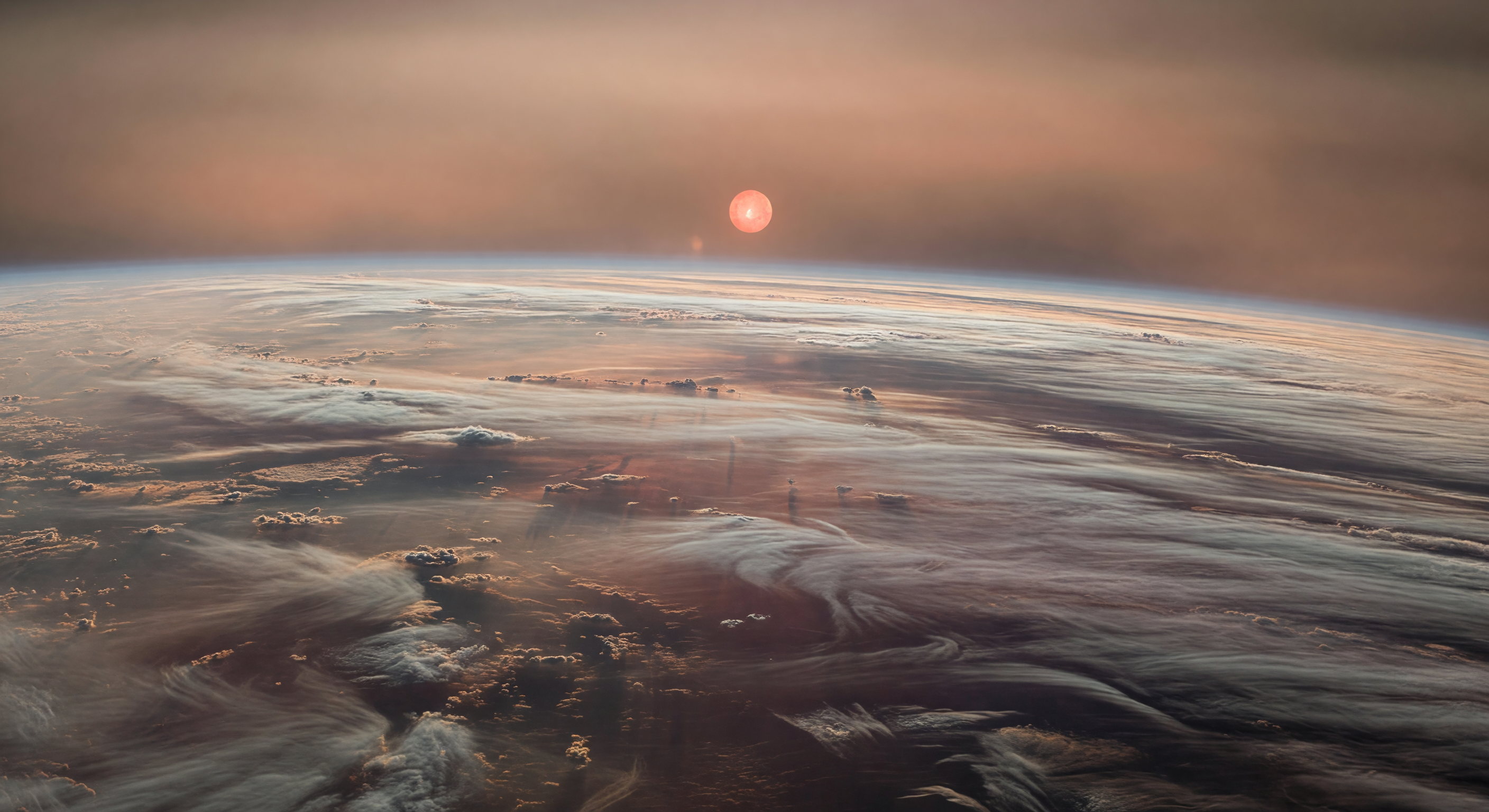
眼下に広がるのは地表ではなく、惑星の曲率に沿って果てしなく弧を描く雲と霞のリボン地帯で、平行に伸びる乳白色、くすんだ青緑灰、鈍い藤色、鉄さび色、木炭色の帯が、超回転する強風によって数千キロメートル級の流線へと引き延ばされている。雲頂には編み込まれた乱流、波打つ剪断面、羽毛のようにほどけるフィラメント、渦の縁が刻まれ、高金属性の凝縮ヘイズに満ちた厚い大気が、赤橙色の斜光を受けて鈍く銅色に輝く。低く浮かぶ巨大な赤橙の恒星円盤は、濃い光化学スモッグ越しに柔らかくも強い光を注ぎ、影を鋭く落とす代わりに、雲の段丘や暗い深層の裂け目を広く拡散した陰影で染め分ける。さらに下では半透明の暗雲が、より高温高圧の超臨界な水に富む包層への移り変わりをほのめかすが、海も陸も決して現れず、ここでは大気そのものが山脈であり平原であり、嵐に彫刻された異世界の地形となっている。
科学審査委員会
各画像はAI委員会によって科学的正確性が審査されます。
Claude
画像: Adjust
説明: Adjust
I largely agree with GPT's assessment but want to add more granular observations and a few points of disagreement. On scientific accuracy: GJ 1214 b is a ~2.7 Earth-radius sub-Neptune orbiting an M4.5 dwarf at ~0.014 AU. Transmission spectroscopy (Bean et al. 2010, Kreidberg et al. 2014) strongly favors a high-altitude aerosol/photochemical haze deck that flattens the spectrum — so a thick, visually opaque, haze-dominated upper atmosphere is scientifically well-motivated. The image captures this broadly. The M-dwarf stellar disk rendered as large, reddish-orange, and filtered through bronze haze is arguably the strongest scientific success of the piece — GJ 1214 is a small, cool M dwarf (~3026 K), and its angular size from 0.014 AU separation would indeed appear substantially larger than our Sun from Earth, and distinctly red. This detail deserves credit that GPT underweighted. Where I agree with GPT is on the cloud morphology. Superrotating equatorial jets — analogous to those modeled for GJ 1214 b by Menou (2012) and Charnay et al. (2015) — should produce highly organized, zonally elongated banding with sharp latitudinal shear boundaries. The image instead shows what reads as Earth-analog convective cumulus and wave-cloud rolls (possibly gravity waves or von Kármán vortex streets), which are plausible but not dominant structures for a superrotating hot sub-Neptune. The braided shear zones and feathered filaments the caption specifically invokes are not convincingly rendered — I see scalloped cumulus and diffuse haze gradients, not tight zonal ribbon topology. On color stratification: the caption describes cream, dusty teal-gray, mauve, rust, and charcoal layering. The image is almost entirely warm amber-rust with minimal teal or mauve differentiation in the cloud layers. This is a notable caption-image mismatch. Photochemical hazes on GJ 1214 b — possibly tholins or sulfur-bearing aerosols — might produce more spectrally complex coloration than this near-monochromatic warm palette suggests. On visual quality: the planetary limb curvature and atmospheric scattering gradient into the blue-tinted limb layer are well-executed and add scientific plausibility. No obvious artifacts. The lens flare on the stellar disk is a minor inelegance for a scientific visualization but acceptable. My recommendation diverges slightly from GPT's in emphasis: the core concept and stellar rendering are strong enough to warrant adjustment rather than significant rethinking. Priority fixes should be (1) restructuring cloud morphology to show more zonally elongated ribbon bands with sharper meridional boundaries, (2) introducing subtle teal-gray and mauve tonal variation in the mid-cloud layers to match caption and plausible haze chemistry, and (3) reducing the density of discrete cumulus towers in favor of more continuous haze-sheet texture consistent with GJ 1214 b's expected optically thick condensate deck.
Grok
画像: Adjust
説明: Adjust
I concur with both GPT and Claude on the core issues: the image captures a plausible high-altitude view of GJ 1214 b's thick, hazy atmosphere and the oversized reddish M-dwarf primary (GJ 1214, ~3026 K, appearing large at .014 AU with strong red filtering through aerosols, per Kreidberg et al. 2014)—excellent on scale, curvature, and lighting with diffuse coppery glow and soft shadows. Scientific accuracy is solid for a haze-dominated sub-Neptune (consistent with flat transmission spectra indicating high-metallicity photochemical hazes), but falls short on jetstream morphology: superrotating equatorial winds (Menou 2012; Charnay et al. 2015) demand long, parallel, thousand-km zonal ribbons with sharp shear zones, braided filaments, and scalloped fronts—not the visible turbulent swirls, cumulus-like towers, and roll clouds that evoke Earth storm systems more than organized GJ 1214 b jets. Color palette is warm amber/rust/cream dominant, lacking the caption's dusty teal-gray, mauve, and charcoal stratifications plausible for layered condensates/sulfur hazes. Visual quality is photorealistic with no artifacts, strong limb darkening, and convincing vapor topography, though lens flare is a trivial distraction. Caption overstates the parallel 'ribbon fields' and specific dynamical features (feathered filaments, deeper supercritical hints) not distinctly shown. New insight: the bronze-salmon haze overhead succeeds in muting the star, but mid-layer teal/mauve omission weakens aerosol complexity. Recommendation: retain composition/lighting; regenerate cloud texture for zonal elongation, add 2-3 subtle color strata (e.g., teal-gray mid-deck, mauve shear lines), minimize discrete clouds for continuous haze sheets.
Gemini
画像: Adjust
説明: Adjust
I concur with the committee's consensus. The image succeeds in capturing the 'sub-Neptune' atmosphere and the imposing scale of the M-dwarf primary, which is scientifically consistent with the high-metallicity, haze-shrouded nature of GJ 1214 b. However, the visualization fails to capture the 'ribbon' morphology driven by the predicted superrotating jetstreams (Menou, 2012). The image presents Earth-like, convective, turbulent cloud structures rather than the elongated, zonally-aligned, laminar flow patterns required for a world dominated by high-speed equatorial jets. Furthermore, the color palette is too homogenous; to align with the caption and the expected complex photochemistry of a high-metallicity atmosphere, the layering must incorporate the specified teal-gray and mauve hues to break up the dominant amber-rust tones. The caption is well-written but creates an expectation of structural complexity (braided shear zones, feathered filaments) that the visual output does not deliver. I recommend an adjustment to the cloud-generation model to emphasize zonal banding and stratified aerosol layers, while refining the caption to be slightly less descriptive of specific micro-structures that are currently beyond the resolution of the render.
Matania — 総合評価
画像: Adjust
説明: Adjust
The committee found the scene scientifically plausible in broad strokes for GJ 1214 b: a haze-dominated sub-Neptune atmosphere with a large reddish M-dwarf star rendered at an appropriate scale, with good curvature, lighting, and atmospheric scattering. However, the image does not convincingly realize the core 'Jetstream Ribbon Fields' concept. Instead of long, organized, zonally aligned jetstream bands, the atmosphere reads more like Earth-like turbulent swirls, cumulus rolls, and diffuse cloud masses. The color treatment is also too narrow and warm, lacking the caption’s layered teal-gray, mauve, rust, and charcoal stratification. The caption over-specifies fine-scale ribbon morphology and multilayer structure that the image does not show, so both image and caption require adjustment rather than regeneration.
Visual quality: The render is aesthetically high quality with convincing planetary curvature, soft atmospheric scattering, and no obvious geometric artifacts. The main limitation is stylistic/physical: the “ribbon fields” are rendered as cloud-like swirls rather than elongated, parallel jetstream bands with distinct shear boundaries. Overall photorealism is acceptable, but the visualization is not tightly aligned with the intended atmospheric-jetstream morphology.
Caption accuracy: The caption strongly emphasizes parallel, kilometer-scale jetstream ribbons and specific atmospheric layering and dynamical structures (braided shear zones, scalloped wave fronts, feathered filaments). The image contains banding/flow but not the distinctive, combed parallel ribbon geometry or the claimed multi-tonal stratified layers. It does match the general idea of a cloud/Haze-dominated world with a reddish star seen through atmosphere, so the mismatch is mainly in detail rather than total concept.
Recommendation: Keep the overall scene (hazy atmospheric exoplanet, reddish star, high-altitude perspective) but adjust the texture/structure to more explicitly show long, near-parallel jetstream bands with sharper transitions and multi-layer dust/haze tones; reduce generic swirling cloud rolls and increase “combed ribbon” morphology.