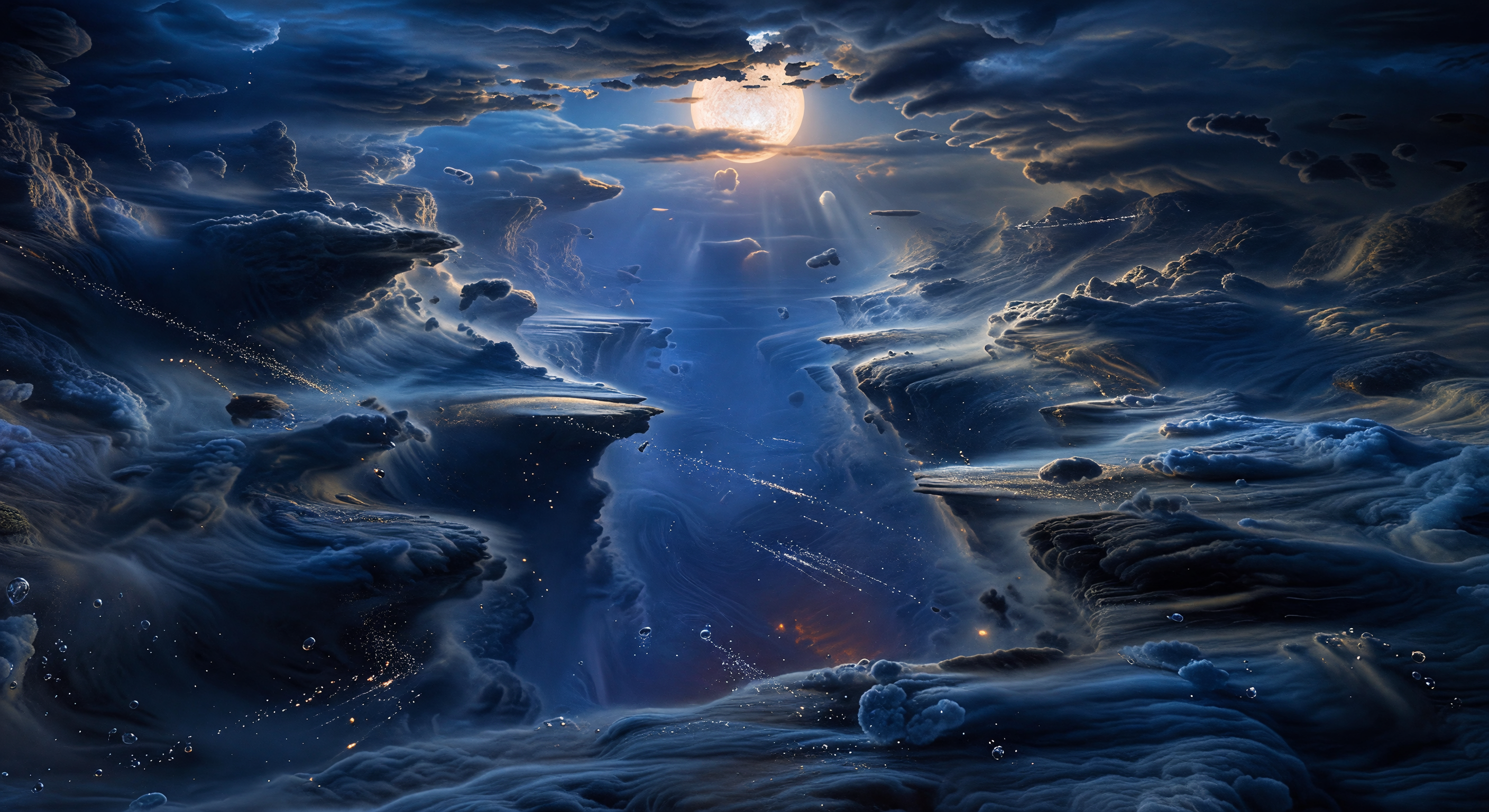
濃密な下層大気へ沈みこむにつれ、視界の両側には濃紺、コバルト、藍、木炭色の雲層が侵食された峡谷の絶壁のようにそそり立ち、足元のない空間はそのまま圧力に満ちた深淵へ落ちこんでいく。ここにある「地形」はすべて大気そのもの――張り出した雲の庇、波打つ乱流の棚、霧の裂け目、ちぎれた岩塊めいた雲塊が、毎秒数キロ級の超音速風によって刻まれ、横殴りの溶融ケイ酸塩の雨が発光する斜線となって駆け抜け、ガラス質の飛沫と浮遊粒子が渦の中で冷たい銀色に瞬く。上方の裂けた霞の切れ間からは、太陽よりはるかに大きく見える橙白色の恒星円盤がぼんやりとにじみ、その光は厚い青いヘイズで散乱されて、わずかな青琥珀色の薄明だけを峡谷へ注いでいる。固体の地表をまったく持たない巨大ガス惑星の内部では、見えている崖も谷もすべて雲と熱と流体の構造にすぎず、下方でかすかに滲む橙の熱光が、この世界が美しい青ではなく灼熱の嵐でできていることを静かに告げている。
科学審査委員会
各画像はAI委員会によって科学的正確性が審査されます。
Claude
画像: Adjust
説明: Adjust
I largely concur with GPT's assessment but want to add several specific observations and one respectful disagreement. On scientific accuracy: HD 189733 b's defining atmospheric characteristics include tidally locked circulation driving supersonic equatorial jets (~8,700 km/h), silicate and iron condensate clouds, and a deep blue color confirmed by polarimetry (Berdyugina et al. 2011, Evans et al. 2013) attributed to Rayleigh scattering and/or silicate aerosols rather than water vapor. The image's dominant indigo-navy palette is actually one of its stronger scientific merits — this is more chromatically defensible for HD 189733 b than most hot Jupiter renderings I've reviewed. Where I diverge from GPT: I'd argue the blue tones are not merely generic but are genuinely compatible with the planet's known scattering signature, so this deserves acknowledgment rather than soft dismissal. The amber-gold star illumination filtering from above is also plausible given HD 189733 (a K-type star, ~4,900K), though the circular glowing disk reads more like a full moon than a tidally proximate stellar body that would subtend a dramatically larger angular diameter and produce more diffuse, overwhelming irradiation rather than neat crepuscular rays. This is a meaningful inaccuracy — the star should feel overwhelming and proximate, not distant and lunar. The crepuscular ray geometry is cinematically appealing but physically wrong for a tidally locked planet where the substellar point receives near-constant irradiation without the angular geometry that produces such rays on Earth. On the cloud architecture: the canyon walls are too architecturally stable and stratified. HD 189733 b's atmospheric dynamics would produce chaotic, rapidly evolving structures rather than these almost sedimentary-looking terraced escarpments. The laminar flow textures on the cloud faces suggest slow, ordered deposition rather than supersonic shear turbulence. GPT correctly identifies this. The foreground spherical droplets are a significant artifact issue — they read unambiguously as Earth-like water droplets or soap bubbles, which undermines the silicate/iron condensate narrative entirely. Silicate rain at these temperatures would exist as partially molten glass droplets moving near-horizontally at extreme velocity, not hovering buoyantly as photogenic spheres. The luminous filament streaks visible in the mid-ground are the image's strongest attempt at representing the glass rain, but they're too sparse and too vertically oriented given that winds would drive them nearly horizontal. On caption accuracy: the description is evocative and directionally correct but overclaims visual specificity. 'Streaks of nearly horizontal molten glass rain that flash like luminous filaments' — these streaks exist in the image but are not clearly horizontal nor distinctly filamentous in character. The 'ultramarine void descending endlessly beneath' is reasonably represented. The phrase 'suspended silicate particles' is plausible but the image renders these as water-like bubbles, creating a material mismatch. I'd recommend targeted regeneration adjustments: correct the star scale and irradiation character, replace water-droplet foreground elements with more ambiguous high-temperature condensate forms, introduce stronger horizontal motion blur to suggest supersonic wind shear, and roughen the cloud wall textures to suggest turbulent rather than stratified formation. The compositional bones and color science are sound enough that full regeneration is not warranted.
Grok
画像: Adjust
説明: Adjust
I concur with both GPT and Claude on the core issues while adding targeted insights. Scientific accuracy (adjust): The indigo-navy cloud palette is a standout strength, aligning well with HD 189733 b's observed blue hues from silicate aerosols and Rayleigh scattering (e.g., Berdyugina et al. 2011); this merits explicit praise over GPT's generic dismissal. Amber starlight filtering through haze is plausible for the K5V host (~490K), but Claude correctly flags the star's lunar-scale appearance and crepuscular rays as major flaws—tidally locked hot Jupiters like HD 189733 b experience relentless, diffuse substellar irradiation with the star subtending ~10-20° angular diameter (not a small disk), precluding Earth-like ray geometry. Cloud 'canyon' walls evoke stratified condensates but lack supersonic wind chaos: textures are too smooth/terraced (sedimentary-like) vs. turbulent shears at 2-3 km/s (Showman et al. 2013 models). Foreground spherical droplets scream H2O/ice artifacts, incompatible with molten silicate condensates (~150-200K); midground streaks hint at glass rain but are vertically biased, not 'nearly horizontal' per zonal jet dominance. Scale feels mountain-range epic, consistent with gas giant depths, but no pressure-thickening haze gradient into the 'ultramarine void' below. Visual quality (adjust): Photorealistic at distance with excellent depth-of-field, god-ray glow on particles, and volumetric cloud rendering—no glaring artifacts like aliasing or seams. However, droplet bubbles are unrealistically crisp/buoyant (soap-bubble physics, not high-velocity silicates); cloud edges too crisply sculpted without motion blur or vorticity wisps for 870 km/h winds; star rays overly symmetrical/fantasy-like. Composition is immersive but tilts cinematic over diagnostic. Caption accuracy (adjust): Evocative and directionally sound ('no ground,' 'cloud escarpments,' 'endless void'), but mismatches visuals—'horizontal molten glass rain filaments' and 'suspended silicate particles' imply dynamic, unambiguous streaks/particulates the image only vaguely suggests amid watery droplets; 'torn upper haze' fits rays, but 'supersonic winds' and 'pressure-thick darkness' undersupported by static, stable forms. Constructive fixes: Enlarge/diffuse star to overwhelming proximity; swap droplets for blurred, horizontal silicate trails (orange-glowing for hot glass); add turbulent eddies/shock textures to walls; deepen lower haze gradient. Strong foundation warrants tweaks over full regen.
Gemini
画像: Adjust
説明: Adjust
I concur with the committee's consensus that the image offers a strong aesthetic foundation but fails on critical fluid dynamic and physical parameters. While the indigo palette is a sophisticated nod to the planet's Rayleigh scattering, the 'canyon' structure is fundamentally flawed: the terraced, sedimentary-like escarpments imply a static, terrestrial geological process, whereas HD 189733 b is a dynamic, high-pressure, supersonic environment. The 'water-droplet' artifacts are the most egregious visual failure; they suggest a cool, aqueous environment entirely at odds with the molten silicate rain predicted by atmospheric models. I disagree with the notion that these are minor; they are material misrepresentations. The star, as noted by Claude and Grok, is far too small and point-like. For a hot Jupiter, the host star should dominate the sky as a massive, diffused source of radiance, not a neat, lunar-sized disk casting Earth-like crepuscular rays. The caption, while poetic, suffers from 'descriptive dissonance'—it promises a violent, wind-swept, molten reality that the static, bubbly, and overly-structured image fails to deliver. I recommend an adjustment that replaces the stable cloud cliffs with chaotic, vorticity-rich shear layers and exchanges the spherical droplets for high-velocity, streak-like particulates to better reflect the extreme zonal jet conditions.
Matania — 総合評価
画像: Adjust
説明: Adjust
The committee finds the image visually strong and thematically aligned with HD 189733 b’s blue, irradiated hot-Jupiter identity, but not yet scientifically tight. The indigo palette is a genuine strength and broadly consistent with the planet’s observed blue scattering signature. However, the scene reads too much like a terrestrial storm canyon: the terraced, stable-looking cloud walls imply sedimentary geology rather than a volatile, high-speed atmospheric flow, and the foreground spherical droplets/bubbles strongly suggest water or soap-like artifacts instead of high-temperature condensates. The host star is also undersized and too neatly rendered, with Earth-like crepuscular rays that do not suit a tidally locked hot Jupiter’s overwhelming irradiation geometry. The caption is evocative and directionally correct about a surface-less, cloud-sheathed world, but it overstates visual specifics that are not clearly present, especially the nearly horizontal molten-glass rain and distinctly suspended silicate particles. Overall, the committee recommends adjustment rather than regeneration: the concept is sound, but the materials, motion, and stellar scale need to be brought into closer scientific alignment.
Visual quality: The artwork is high-resolution and visually compelling, with good lighting gradients, atmospheric perspective, and coherent cloud forms. There are some potential realism issues: the foreground contains obvious spherical droplets/bubbles that read as liquid water/ice artifacts; the canyon is too “cleanly sculpted” and geometric for turbulent supersonic wind carving without more evidence of shock/chaotic flow. The star illumination is plausible, but the overall composition leans toward cinematic fantasy rather than physically diagnostic exoplanet imagery.
Caption accuracy: The description emphasizes “no ground,” “dense condensate layers,” and “ultramarine void descending endlessly,” which are partially consistent with the lack of solid surface. But the caption’s specific claims—torn upper haze, suspended silicate particles, and streaks of nearly horizontal molten glass rain flashing as luminous filaments—are not clearly demonstrated in the provided image. The scene instead shows reflective/foamy droplets and particulate trails without unmistakable glass/silicate-rain behavior.
Overall: Strong atmosphere and good art quality, but the physical specifics in the caption (molten glass/silicate filaments) and the HD 189733 b constraints are not well matched by what’s depicted. Minor-to-moderate adjustments are needed to better align features and materials with what the image actually shows, and to ground color/lighting more explicitly in hot-Jupiter atmospheric expectations.