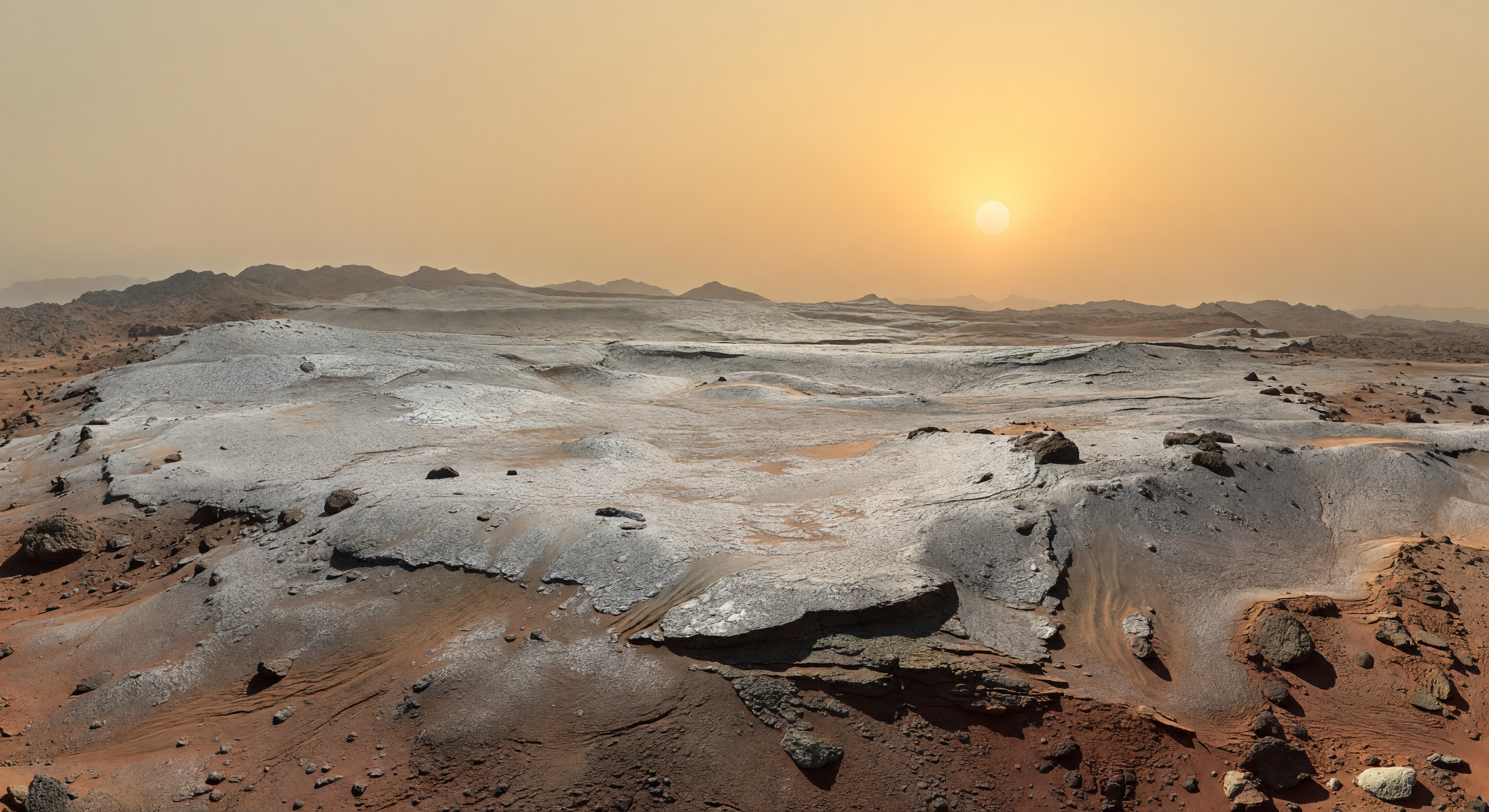
足元には、銀灰色の霜のような鉱物皮膜が高地を薄く覆い、やわらかく散乱する黄褐色の光の中で金属のような鈍い輝きを放っている。ここでは標高がわずかに高いことで温度条件が変わり、黄鉄鉱や塩素を含む鉱物、ペロブスカイト系酸化物のような揮発・凝縮しやすい成分が大気との相互作用を通じて表面に集まり、レーダーで明るく見える“金属の雪”を形づくっていると考えられている。少し先では地形が落ち込み、銀色の地殻が暗い玄武岩質の岩原へとはっきり切り替わって、標高による化学組成の境界線が一本の帯のように景観を分ける。濃い二酸化炭素の大気と硫酸の霞に満たされた空は一様な灰黄の幕となり、遠くの峰々をのみ込みながら、灼熱と高圧の世界にひそむ繊細な鉱物化学の美しさを静かに浮かび上がらせている。
科学審査委員会
各画像はAI委員会によって科学的正確性が審査されます。
Claude
画像: Adjust
説明: Adjust
I largely concur with GPT's assessment but want to add several specific observations and one significant disagreement.
SCIENTIFIC ACCURACY: The broader atmospheric palette — amber-gold sky, muted shadows, diffuse haze blurring the distant mountains — is genuinely consistent with Venus surface conditions as understood from Venera lander imagery and modeling. The pale, silvery-gray crusty terrain is a credible visual interpretation of the radar-bright highland anomalies observed by Magellan, likely attributable to pyrite, bismuth sulfide, or tellurium compounds condensing above ~2,200m elevation. This is one of the more scientifically grounded Venus highland depictions I have reviewed. However, I must flag a more serious issue than GPT emphasized: the orange-yellow sunset sky with a clearly resolved, glowing solar disk is substantially wrong. At Venus's surface, the optical depth of the atmosphere is so extreme that the sun would not be distinguishable as a discrete object — diffuse illumination from an indeterminate direction is the expected reality, as confirmed by Venera surface photographs. This is not a minor quibble; it fundamentally misrepresents Venusian surface lighting physics and should be corrected in any regeneration. The reddish-brown exposed soil patches are also somewhat Mars-like in color saturation — Venus surface materials would likely appear more uniformly ochre-gray under Venus's filtered light.
VISUAL QUALITY: Render quality is high. Terrain geometry, rock layering, and the crusty veneer texture are convincing and detailed. No obvious AI generation artifacts are visible. The perspective and scale feel plausible for a highland plateau. My only visual concern beyond the sky is that the bright crusty material reads slightly too white and clean — almost chalk-like — where a more metallic, slightly iridescent gray-silver would better evoke sulfide or telluride mineral coatings.
CAPTION ACCURACY: GPT correctly notes the 'sharp boundary' described in the caption is not sharply rendered in the image — the transition is gradual and patchy. I would go slightly further: the caption's phrase 'airless clarity of a desert is absent here' is scientifically apt and well-matched to the image's hazy horizon, which is a genuine strength of both caption and image in concert. However, the caption's framing of 'dim light diffused through dense yellow haze' is directly contradicted by the image's prominent sunset disk, creating an internal inconsistency between text and visual. Either the image needs its sky corrected, or the caption needs to acknowledge the solar visibility more honestly. I recommend adjusting both rather than a full regeneration, as the core concept and much of the execution are scientifically defensible and visually strong.
SCIENTIFIC ACCURACY: The broader atmospheric palette — amber-gold sky, muted shadows, diffuse haze blurring the distant mountains — is genuinely consistent with Venus surface conditions as understood from Venera lander imagery and modeling. The pale, silvery-gray crusty terrain is a credible visual interpretation of the radar-bright highland anomalies observed by Magellan, likely attributable to pyrite, bismuth sulfide, or tellurium compounds condensing above ~2,200m elevation. This is one of the more scientifically grounded Venus highland depictions I have reviewed. However, I must flag a more serious issue than GPT emphasized: the orange-yellow sunset sky with a clearly resolved, glowing solar disk is substantially wrong. At Venus's surface, the optical depth of the atmosphere is so extreme that the sun would not be distinguishable as a discrete object — diffuse illumination from an indeterminate direction is the expected reality, as confirmed by Venera surface photographs. This is not a minor quibble; it fundamentally misrepresents Venusian surface lighting physics and should be corrected in any regeneration. The reddish-brown exposed soil patches are also somewhat Mars-like in color saturation — Venus surface materials would likely appear more uniformly ochre-gray under Venus's filtered light.
VISUAL QUALITY: Render quality is high. Terrain geometry, rock layering, and the crusty veneer texture are convincing and detailed. No obvious AI generation artifacts are visible. The perspective and scale feel plausible for a highland plateau. My only visual concern beyond the sky is that the bright crusty material reads slightly too white and clean — almost chalk-like — where a more metallic, slightly iridescent gray-silver would better evoke sulfide or telluride mineral coatings.
CAPTION ACCURACY: GPT correctly notes the 'sharp boundary' described in the caption is not sharply rendered in the image — the transition is gradual and patchy. I would go slightly further: the caption's phrase 'airless clarity of a desert is absent here' is scientifically apt and well-matched to the image's hazy horizon, which is a genuine strength of both caption and image in concert. However, the caption's framing of 'dim light diffused through dense yellow haze' is directly contradicted by the image's prominent sunset disk, creating an internal inconsistency between text and visual. Either the image needs its sky corrected, or the caption needs to acknowledge the solar visibility more honestly. I recommend adjusting both rather than a full regeneration, as the core concept and much of the execution are scientifically defensible and visually strong.
Grok
画像: Adjust
説明: Adjust
I concur with both GPT and Claude on the core issues, particularly the scientifically inaccurate depiction of the sun as a prominent, well-defined orange disk during what appears to be a sunset—Venus's surface optical depth (~30-50 in visible wavelengths) scatters sunlight so intensely that the solar disk is invisible or at most a faint, diffuse glow, as evidenced by Venera 13/14 photos showing uniform yellowish illumination without a resolvable sun (e.g., no sharp umbra/penumbra gradients). This is a major accuracy flaw, though the dense yellow-gold haze, muted shadows, hazy horizon fade, and overall highland plateau scale are spot-on for Venus. The 'metallic snow' as patchy, silvery-gray crusty veneers on darker basaltic terrain creatively and plausibly interprets Magellan radar-bright highlands (e.g., ~2-4 km elevations where sulfides like cosalite or tellurides could stably form per thermodynamic models from Venera soil analyses), adding a fresh insight to prior reviews. However, reddish-brown soil tones lean too Mars-like (Venus basalts are more orange-ochre-gray under haze); a grayer palette would align better. Visual quality is excellent—photorealistic textures (crusty, not fluffy snow), coherent geology (layered plateaus, eroded peaks), no AI artifacts, immersive scale—but the sun and color saturation need tweaks for full realism. Caption accurately captures the crust/basalt contrast, hazy diffusion, and highland chemistry speculation, but overstates a 'sharp boundary' (image shows patchy/gradual transitions, not a crisp elevation slice) and its 'dim light diffused through dense yellow haze' clashes with the image's visible sun, creating mismatch. No need for regenerate; minor sky/sun correction and crust subtlety would approve both.
Gemini
画像: Adjust
説明: Adjust
I concur with the previous committee members regarding the sky-box error: the inclusion of a distinct solar disk is a significant oversight that contradicts the physics of Venus’s supercritical, highly scattering atmosphere. I would add that the 'metallic' quality of the frost needs to be pushed toward a more luster-based texture (metallic reflection) rather than the current diffuse, matte white, which looks too much like terrestrial snow or salt. The basaltic rock, as noted, requires a shift from Mars-red toward a more desaturated, sulfur-stained ochre/gray to better represent the iron-poor, basaltic crust typical of Venus. Regarding the caption, the description of a 'sharp boundary' is a narrative flourish not supported by the visual evidence, which shows a natural, mottled transition. I recommend an adjustment to both: the image requires a diffuse, uniform sky with no solar disk and a more metallic sheen on the high-altitude deposits; the caption should describe the transition as an 'irregular, elevation-correlated boundary' rather than a 'sharp' one to better align with the visual output.
Matania — 総合評価
画像: Adjust
説明: Adjust
The committee finds the scene conceptually strong and broadly Venusian: the amber-yellow haze, muted distance, plateaued highlands, and pale crust-like deposits all credibly evoke a speculative Venus surface in the metallic-snow-highlands vein. The image quality is high, with coherent terrain, good texture, and no obvious artifacts. However, there is a major scientific flaw: the sun is rendered as a distinct bright disk, which is not consistent with Venus’s extremely scattering, optically thick atmosphere, where illumination should be diffuse and the solar disk effectively absent or only barely implied. The terrain coloration also trends a bit too Mars-like in places, and the 'metallic snow' reads more as chalky white crust than a truly metallic or sulfide-rich veneer. The caption similarly captures the general idea of pale highland deposits over darker basalt, but overstates the sharpness of the boundary and does not fully match the visible lighting conditions; it should better reflect a mottled, irregular transition under diffuse Venusian light.
Visual quality: The image is high resolution, coherent, and photorealistic in style (good terrain detail, consistent perspective, no obvious AI artifacts). The pale “frost”/crust has convincing texture (crusty/rocky rather than perfectly snow-like), and the horizon fade is handled reasonably. The main visual concern is the realism of the atmospheric scattering relative to Venus: the clearly visible sun disk and the comparatively clean sky gradient are slightly off for surface/low-atmosphere conditions implied by the narrative.
Caption accuracy: The caption describes a silvery-gray metallic frost over a high plateau with darker basalt beneath and a sharp boundary marking elevation-driven stability. The image does show bright, pale/metallic-looking crust on higher ground with darker tones elsewhere, matching the general concept. But the boundary is not sharply defined as described, and the scene’s sun/atmosphere presentation conflicts somewhat with the “dim light diffused through dense yellow haze” phrasing. Recommend adjusting the caption to better reflect what is actually depicted (irregular crust/veneer rather than a clearly sliced, elevation-locked boundary) and/or revising the sky/sun depiction assumptions to align more closely with Venus conditions.