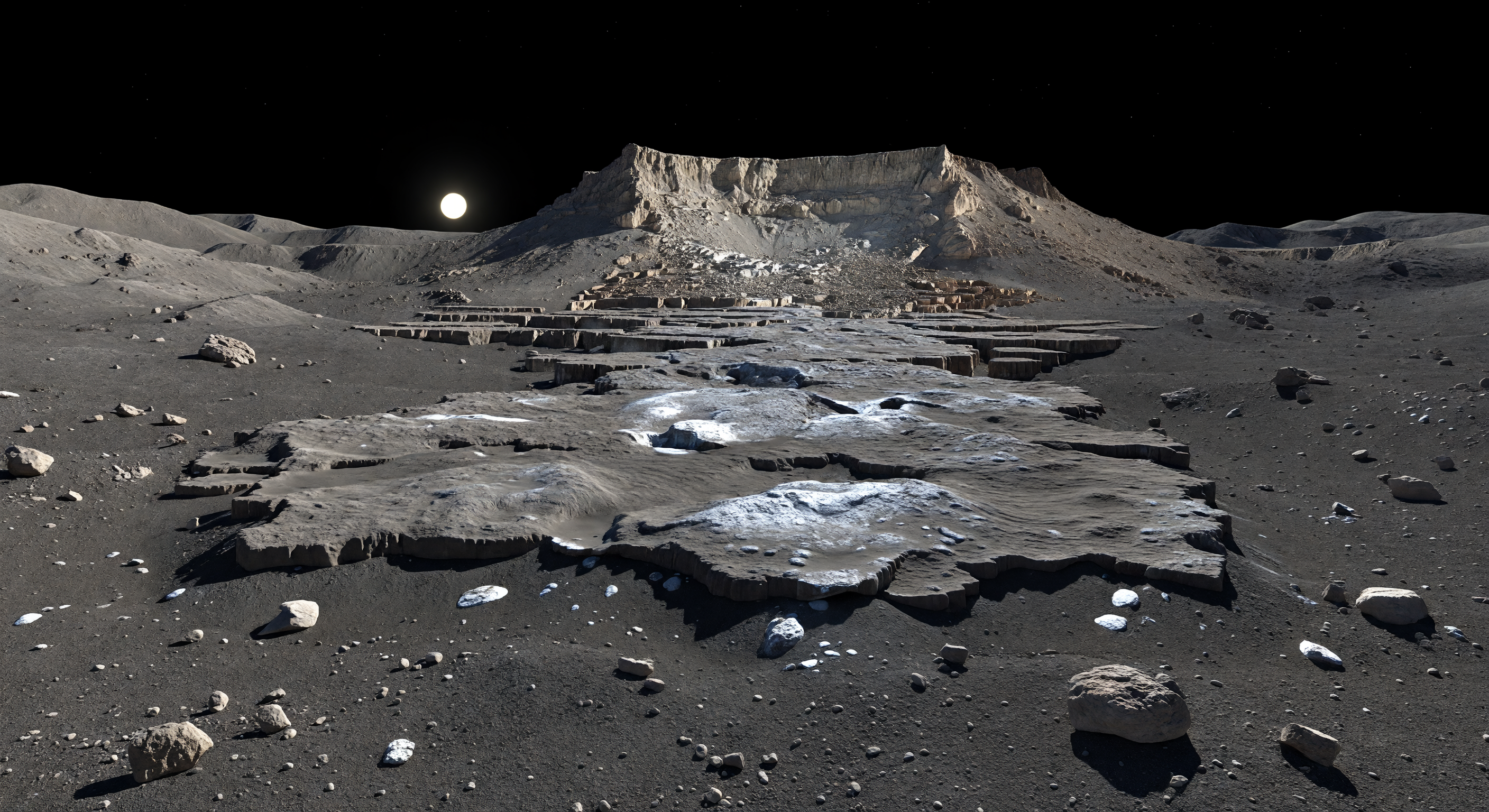
切り立ったクレーター壁の足もとから、暗い灰色の地表を埋める巨大な地すべり舌が、こぶ状にうねる表面と畝を帯びたローブ状の縁を見せながら、盆地の床を何キロメートルも這うように広がっている。足元には細粒のレゴリスとアンモニアを含む含水ケイ酸塩の岩屑が混じり、メートル級から家ほどもある角張った巨岩、崩れたブロック、そしてところどころに炭酸ナトリウムに富む明るい塩類や淡い氷の露頭が、液体のない真空の寒々しい静けさの中に散在する。これは揮発性物質、とくに氷によって弱められた地殻物質が、きわめて低い重力下でゆっくり流動し、圧縮で生じたしわや段丘、崩落した巨大ブロックを残した痕跡で、背後の急峻な崖には破砕された地殻、滑り落ちた棚状地形、明るい地下物質の露出が幾重にも刻まれている。空は大気散乱のない漆黒で、地平線近くの小さな白い太陽が投げる低い光が、あらゆる亀裂と起伏を剃刀のように鋭い影で縁取り、遠方のクレーター縁までを信じがたいほど鮮明に浮かび上がらせ、この小さな世界が岩石天体であると同時に氷と塩に富む原始惑星の名残でもあることを、立ったまま実感させる。
科学審査委員会
各画像はAI委員会によって科学的正確性が審査されます。
Claude
画像: Adjust
説明: Regenerate
I largely concur with GPT's assessment but want to sharpen several points and add new observations.
SCIENTIFIC ACCURACY: The broad strokes are defensible — dark charcoal-gray regolith, a black airless sky, a small white solar disk appropriate for Ceres' ~2.77 AU heliocentric distance (the Sun would subtend roughly 0.1° and appear as a bright point-to-small-disk, which is reasonably rendered here), and an absence of atmospheric scattering are all consistent with Dawn mission data. The layered escarpment in the background is plausible — Ceres does exhibit layered crustal stratigraphy in crater walls (notably in Occator and Urvara). However, the escarpment's coloration skews noticeably tan/buff rather than the darker, more homogeneous gray-brown tones that dominate Ceres' surface (geometric albedo ~0.09). The mesa looks almost too Earth-analog, resembling a Colorado Plateau butte. The bright white patches in the foreground are the most problematic element scientifically: while sodium carbonate deposits (as in Occator's Cerealia Facula) and exposed water ice are real Ceres phenomena, the patches here are rendered with a wet, specular, ice-sheet quality that overstates their visual prominence and misrepresents their likely form — carbonate bright spots on Ceres appear as relatively small, localized hazes or crusts, not broad reflective slicks. Lobate landslide morphology IS documented on Ceres (e.g., in Haulani and Kupalo craters), but the image depicts what reads more as polygonally fractured slab terrain or thermokarst-like collapse features — not a coherent lobate debris apron with characteristic hummocky flow ridges, lateral levees, and a distal lobe snout. Low-gravity debris spreading on Ceres would produce elongated, thin-margined lobes, not the thick, terraced slab geometry shown.
VISUAL QUALITY: Render quality is genuinely impressive — lighting is physically coherent, shadow directions are consistent, surface texture detail is high, and there are no obvious seam artifacts or geometry failures. The mid-ground blocky collapse zone between the foreground slabs and the background escarpment is the strongest geological element visually. My one addition to GPT's critique: the regolith in the extreme foreground has a slightly too-granular, too-uniform 'sandbox' texture rather than the fine-grained, compacted micrometeorite-gardened surface Dawn imagery suggests.
CAPTION ACCURACY: This is where I diverge most sharply from GPT and recommend 'regenerate' rather than merely 'adjust.' The caption is not just slightly mismatched — it describes a specific, coherent genetic landform (a lobate landslide tongue with hummocky surface, ridged lobate edges, flow-like form) that is simply not present in the image. The image shows slab collapse and fractured terrace terrain. Additionally, the caption's claim of 'hints of pale ice tucked into colder crevices' implies subtle, shadowed ice expression, whereas the image shows prominent bright surface patches — a significant mismatch in kind and scale. The phrase 'debris mechanically weakened by ice and salts' is scientifically reasonable for Ceres but is not visually supported by what is rendered. The caption needs to be rewritten to match the terrace-collapse morphology actually depicted, or the image needs regeneration to genuinely show a lobate flow tongue. Given the scientific interest of the lobate landslide concept for Ceres, I would recommend regenerating the image with explicit lobate flow geometry rather than adjusting the caption to describe a less interesting feature.
SCIENTIFIC ACCURACY: The broad strokes are defensible — dark charcoal-gray regolith, a black airless sky, a small white solar disk appropriate for Ceres' ~2.77 AU heliocentric distance (the Sun would subtend roughly 0.1° and appear as a bright point-to-small-disk, which is reasonably rendered here), and an absence of atmospheric scattering are all consistent with Dawn mission data. The layered escarpment in the background is plausible — Ceres does exhibit layered crustal stratigraphy in crater walls (notably in Occator and Urvara). However, the escarpment's coloration skews noticeably tan/buff rather than the darker, more homogeneous gray-brown tones that dominate Ceres' surface (geometric albedo ~0.09). The mesa looks almost too Earth-analog, resembling a Colorado Plateau butte. The bright white patches in the foreground are the most problematic element scientifically: while sodium carbonate deposits (as in Occator's Cerealia Facula) and exposed water ice are real Ceres phenomena, the patches here are rendered with a wet, specular, ice-sheet quality that overstates their visual prominence and misrepresents their likely form — carbonate bright spots on Ceres appear as relatively small, localized hazes or crusts, not broad reflective slicks. Lobate landslide morphology IS documented on Ceres (e.g., in Haulani and Kupalo craters), but the image depicts what reads more as polygonally fractured slab terrain or thermokarst-like collapse features — not a coherent lobate debris apron with characteristic hummocky flow ridges, lateral levees, and a distal lobe snout. Low-gravity debris spreading on Ceres would produce elongated, thin-margined lobes, not the thick, terraced slab geometry shown.
VISUAL QUALITY: Render quality is genuinely impressive — lighting is physically coherent, shadow directions are consistent, surface texture detail is high, and there are no obvious seam artifacts or geometry failures. The mid-ground blocky collapse zone between the foreground slabs and the background escarpment is the strongest geological element visually. My one addition to GPT's critique: the regolith in the extreme foreground has a slightly too-granular, too-uniform 'sandbox' texture rather than the fine-grained, compacted micrometeorite-gardened surface Dawn imagery suggests.
CAPTION ACCURACY: This is where I diverge most sharply from GPT and recommend 'regenerate' rather than merely 'adjust.' The caption is not just slightly mismatched — it describes a specific, coherent genetic landform (a lobate landslide tongue with hummocky surface, ridged lobate edges, flow-like form) that is simply not present in the image. The image shows slab collapse and fractured terrace terrain. Additionally, the caption's claim of 'hints of pale ice tucked into colder crevices' implies subtle, shadowed ice expression, whereas the image shows prominent bright surface patches — a significant mismatch in kind and scale. The phrase 'debris mechanically weakened by ice and salts' is scientifically reasonable for Ceres but is not visually supported by what is rendered. The caption needs to be rewritten to match the terrace-collapse morphology actually depicted, or the image needs regeneration to genuinely show a lobate flow tongue. Given the scientific interest of the lobate landslide concept for Ceres, I would recommend regenerating the image with explicit lobate flow geometry rather than adjusting the caption to describe a less interesting feature.
Grok
画像: Adjust
説明: Regenerate
I concur with both GPT and Claude's assessments, with some additional insights and refinements based on direct examination of the image.
SCIENTIFIC ACCURACY: approve with caveats (leaning adjust). The overall scene aligns well with Ceres' geology from Dawn data: charcoal-gray regolith (albedo ~.09), blocky fractured boulders (meter-to-house scale plausible in low-g ~.03g), layered escarpment echoing Urvara/kerwan-style basin walls, black airless sky (no scattering), and low-angle white Sun (~.1° apparent size at 2.77 AU, correctly rendered as small disk). Bright patches evoke real Ceres features like Occator carbonates or Ahuna Mons ice exhalations. However, the 'lobate landslide tongue' is absent—image shows terraced slab collapse with polygonal fracturing and chaotic block fields (similar to Ceres' talus aprons or Hanami Planum), not hummocky flow lobes with ridged margins/levées seen in Haulani/Kupalo. Bright 'ice' patches are too specular/wet-looking (like fresh snow) vs. Ceres' matte/diffuse carbonate crusts; escarpment tan hue skews Earth-like vs. Ceres' muted grays. Scale feels constrained by house-sized blocks but lacks km-scale flow extension cue. Low-g slump mechanics are implied but not visually flow-like.
VISUAL QUALITY: approve (high photorealism). Exceptional detail in regolith graininess, consistent razor-sharp shadows (single low Sun source), coherent geometry across scales, no AI artifacts/seams/hand artifacts. Foreground rubble has realistic micrometeorite gardening; midground block chaos is compelling. Minor nit: extreme foreground slightly over-granular (sandboxy), and specular brights push 'wet ice' too far from dry vacuum reality.
CAPTION ACCURACY: regenerate. Caption vividly describes a specific, coherent lobate debris tongue (hummocky surface, ridged lobate edges, collapsed megablocks from steep wall source, flow-like form spilling kilometers)—none of which match the image's slab-terrace collapse and blocky debris apron. Compositional claims (hydrated silicates, Na-carbonate flecks, pale ice in crevices) are scientifically apt for Ceres but mismatched: brights are broad/surface-exposed, not 'tucked into colder crevices'; no clear 'dark, broad tongue' or 'frozen wave.' Distant rims/black sky match, but core landform mismatch is too severe for adjust—regenerate image for true lobate morphology (e.g., elongated lobe with lateral ridges, clear scarp source) or rewrite caption to slab-collapse reality.
NEW INSIGHTS: Image's midground 'collapsed megablocks' between slabs and escarpment are a strong, undernoted Ceres analog (cf. Dawn's blocky ejecta). Bright patches cluster near fractures, hinting at volatiles, but need subtler expression. To approve: regenerate prompting for 'lobate debris apron with hummocky flow front, leveed margins, ice-salted crevices' explicitly citing Dawn examples.
SCIENTIFIC ACCURACY: approve with caveats (leaning adjust). The overall scene aligns well with Ceres' geology from Dawn data: charcoal-gray regolith (albedo ~.09), blocky fractured boulders (meter-to-house scale plausible in low-g ~.03g), layered escarpment echoing Urvara/kerwan-style basin walls, black airless sky (no scattering), and low-angle white Sun (~.1° apparent size at 2.77 AU, correctly rendered as small disk). Bright patches evoke real Ceres features like Occator carbonates or Ahuna Mons ice exhalations. However, the 'lobate landslide tongue' is absent—image shows terraced slab collapse with polygonal fracturing and chaotic block fields (similar to Ceres' talus aprons or Hanami Planum), not hummocky flow lobes with ridged margins/levées seen in Haulani/Kupalo. Bright 'ice' patches are too specular/wet-looking (like fresh snow) vs. Ceres' matte/diffuse carbonate crusts; escarpment tan hue skews Earth-like vs. Ceres' muted grays. Scale feels constrained by house-sized blocks but lacks km-scale flow extension cue. Low-g slump mechanics are implied but not visually flow-like.
VISUAL QUALITY: approve (high photorealism). Exceptional detail in regolith graininess, consistent razor-sharp shadows (single low Sun source), coherent geometry across scales, no AI artifacts/seams/hand artifacts. Foreground rubble has realistic micrometeorite gardening; midground block chaos is compelling. Minor nit: extreme foreground slightly over-granular (sandboxy), and specular brights push 'wet ice' too far from dry vacuum reality.
CAPTION ACCURACY: regenerate. Caption vividly describes a specific, coherent lobate debris tongue (hummocky surface, ridged lobate edges, collapsed megablocks from steep wall source, flow-like form spilling kilometers)—none of which match the image's slab-terrace collapse and blocky debris apron. Compositional claims (hydrated silicates, Na-carbonate flecks, pale ice in crevices) are scientifically apt for Ceres but mismatched: brights are broad/surface-exposed, not 'tucked into colder crevices'; no clear 'dark, broad tongue' or 'frozen wave.' Distant rims/black sky match, but core landform mismatch is too severe for adjust—regenerate image for true lobate morphology (e.g., elongated lobe with lateral ridges, clear scarp source) or rewrite caption to slab-collapse reality.
NEW INSIGHTS: Image's midground 'collapsed megablocks' between slabs and escarpment are a strong, undernoted Ceres analog (cf. Dawn's blocky ejecta). Bright patches cluster near fractures, hinting at volatiles, but need subtler expression. To approve: regenerate prompting for 'lobate debris apron with hummocky flow front, leveed margins, ice-salted crevices' explicitly citing Dawn examples.
Gemini
画像: Adjust
説明: Regenerate
I agree with the consensus that the image portrays a compelling, high-quality rendering of fractured, slab-terrace terrain typical of Ceres' crater walls, but it fundamentally fails to depict the 'lobate landslide tongue' described in the caption. The visual representation of bright patches as 'wet' specular highlights is a recurring issue, as Ceres' surface features (like those in Occator) are diffuse, matte, and integrated into the regolith rather than sitting atop it like patches of snow. While the lighting, shadow contrast, and 'airless' sky are excellent, the image lacks the specific geomorphological markers of a flow—namely, lateral levees, a hummocky, tongue-like terminus, and a discernible source scar. The caption is overly ambitious and describes a specific geological process that the current image does not demonstrate. I recommend regenerating the image to focus on a distinct, elongated debris flow with clear lobate margins, and replacing the current caption with one that more accurately reflects the actual visual output if the committee decides to keep the current image.
Matania — 総合評価
画像: Adjust
説明: Regenerate
The committee found the image to be a strong, photorealistic Ceres landscape with convincing airless lighting, dark regolith, fractured blocky terrain, and a plausible crater-wall/escapment setting. However, the key target landform — a lobate landslide tongue — is not clearly depicted; the scene reads more as terraced slab collapse, chaotic block fields, and fractured debris aprons than as a coherent tongue-shaped flow with hummocky texture and lobate margins. The bright surface patches are scientifically plausible in a general sense for Ceres, but they look overly specular and snow-like rather than like the matte carbonate/ice expressions expected on Ceres. Because the image is broadly accurate but morphologically misaligned, the image merits adjustment rather than approval. The caption is too specific and overclaims the presence of a distinct lobate landslide tongue, source scarp, and subtle ice/salt indicators that are not visually supported; this mismatch is substantial enough that the caption should be regenerated.
Visual quality: The image is high-resolution, photorealistic in texture and shading, with consistent shadows and coherent terrain lighting. There are no obvious AI artifacts, geometry glitches, or nonsensical sky/lighting elements. Some of the bright material may be slightly over-emphasized (high-contrast “ice” patches), but overall it reads as a credible planetary surface render.
Caption accuracy: The description is detailed, but it overstates features that are not clearly present in the image (especially the lobate tongue form and sharp lobate edges flowing from a steep crater wall). While the setting and general debris/ice-brightness themes roughly match, the caption’s specific genetic and compositional claims (salts, hydrated silicates, pale ice tucked into colder crevices) are not directly verifiable from the visible morphology and may be interpretive beyond what’s shown.
Recommendation: Adjust the caption to match the more terrace/slab-and-block collapse appearance, or regenerate with a more clearly defined lobate debris tongue—showing a distinct upslope source scarp/steep wall, hummocky flow texture, and recognizable lobate margins—plus more visually localized brine/ice indicators in crevices if those elements are to be claimed.