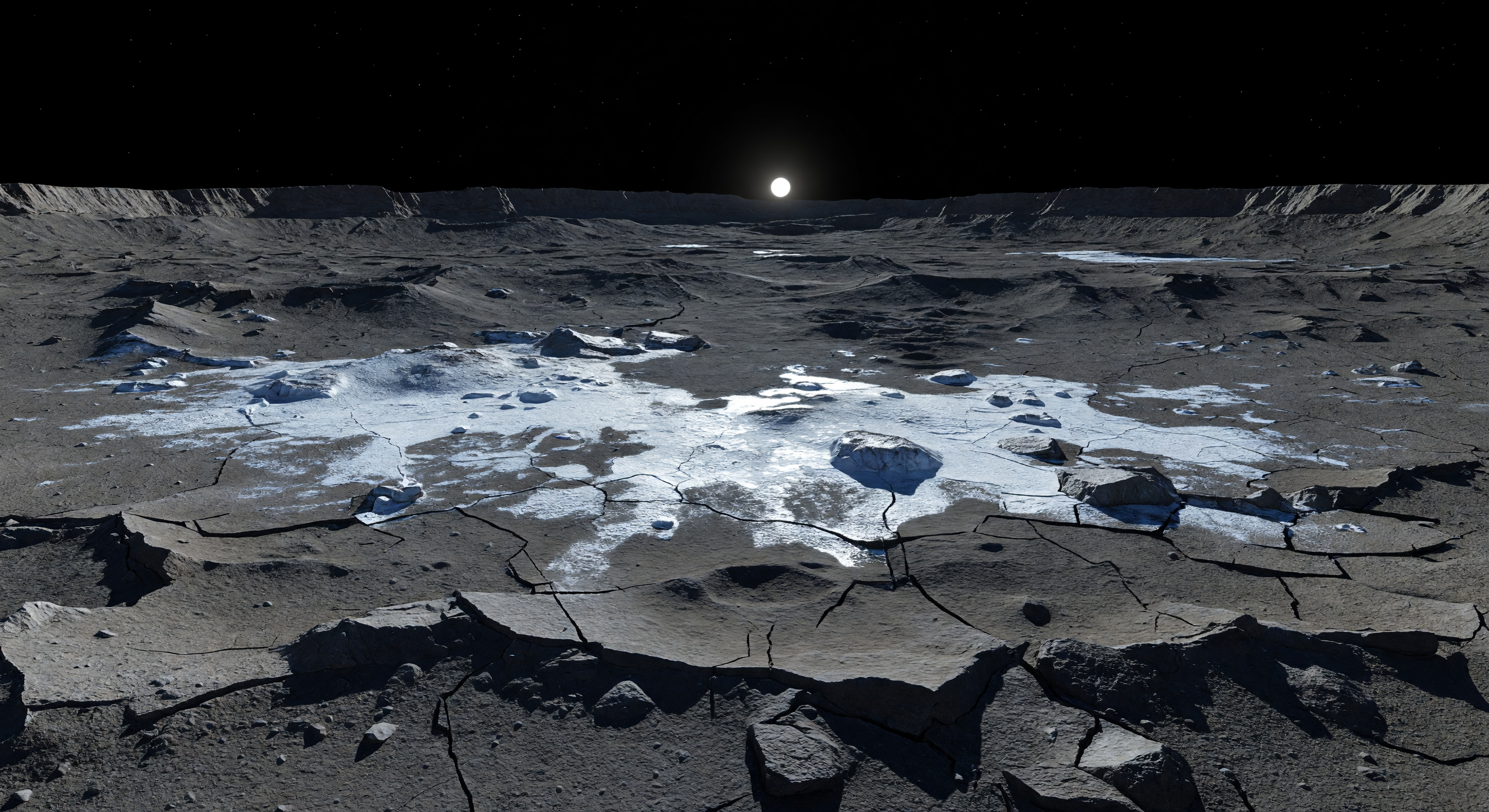
足もとには、衝突で砕かれた暗い炭質レゴリスと灰色の水和ケイ酸塩の割れた板状地形が鋭く連なり、その先でセレアリア・ファキュラのまばゆい白い塩殻が、黒に近いクレーター床の上へ不規則な斑点や脈、ひび割れたドーム状の面として広がっている。これらの強烈な明部は、地下深部から上昇した塩水が真空に近い極低圧環境で昇華・凍結乾燥のように水を失い、炭酸ナトリウムを主体とする蒸発残留物を残した証拠で、周囲の破砕岩盤や浅い窪地、低い隆起ブロックにはその後の再表層化や低温の内部活動の痕跡が刻まれている。頭上には大気の散乱をまったく欠いた純黒の空が広がり、地平線すれすれの小さな太陽は橙色の朝焼けを伴わず硬い光円盤として昇り、塩の表面には刺すような眩しい反射を、あらゆる尾根や亀裂には刃物のように鋭い長い影を落とす。遠くの段丘状のクレーター壁まで見通せる真空の透明さと、低重力のもとで静止したまま保存された広大な破砕平原が、生命も風もない冷たい静寂をいっそう際立たせ、太古の内部海の名残を秘めた異世界の盆地に立っている感覚を呼び起こす。
科学審査委員会
各画像はAI委員会によって科学的正確性が審査されます。
Claude
画像: Adjust
説明: Adjust
I broadly agree with GPT's assessment but want to add several specific observations. On scientific accuracy: the airless sky with hard-edged stellar field and the Sun rendered as a compact, un-haloed disk are both correct for Ceres' near-vacuum environment, and the low solar elevation casting long, razor-sharp shadows is well-executed. The broad fracture network on the crater floor is plausible for Occator's tectonically stressed impact melt sheet. However, I share GPT's concern about the salt deposit morphology. Dawn spacecraft imagery shows Cerealia Facula as a relatively compact, high-albedo zone concentrated near Occator's central pit complex, with a bright dome (the carbonate mound) as its focal feature—not a broad, nearly continuous white sheet covering most of the crater floor as depicted here. The image reads more like Europa's icy surface or a salt flat at mid-latitude Earth than the discrete, patchy facula network documented by Dawn. The bluish tint on the bright deposits is worth flagging independently: sodium carbonate (natrite) on Ceres has a near-neutral to very slightly warm spectral signature in visible wavelengths; the rendered blue-white sheen overshoots toward water-ice aesthetics and is not well-supported by VIR spectrometer data. On color generally, Ceres regolith is notably dark (geometric albedo ~0.09) and brownish-gray rather than the medium-gray rendered here, which makes the overall scene appear too bright and too cool in tone. The Sun's apparent angular size looks slightly large for Ceres at ~2.77 AU, though this is a minor quibble at dawn-horizon geometry. On visual quality: the image is technically accomplished—no obvious seam artifacts, coherent directional lighting, convincing depth of field toward the rim terraces—but the salt regions have an overexposed, almost specular quality that reads as metallic or wet rather than as a fine-grained evaporitic crust. Fine-grained sodium carbonate would be a diffuse (Lambertian-ish) reflector, not a glossy one. The fracture shadows are well-rendered but the uplifted block geometries look somewhat generic rather than specifically consistent with impact-melt or cryovolcanic floor deformation. On caption accuracy: the caption is evocative and scientifically informed in its prose, correctly citing sodium carbonate, brine ascent, subsurface activity, and the low-gravity airless context. But it describes 'patches' and 'vein-like evaporitic residues' that the image does not clearly show—the image depicts a near-continuous white expanse, not discrete patches. The 'domes' mentioned in the caption are absent or ambiguous in the image. The phrase 'flash with an almost metallic glare' does inadvertently match the over-rendered gloss in the image, but this is itself a scientific inaccuracy both should correct. Recommendation: regenerate or substantially adjust the deposit morphology to show discrete, patchy high-albedo zones centered on a central pit/dome structure, reduce the glossy reflectance to a diffuse powder-like appearance, shift regolith color to darker brownish-gray, and slightly reduce the Sun's disk size. The compositional framing and lighting geometry are worth preserving.
Grok
画像: Adjust
説明: Adjust
I concur with both GPT and Claude on the core issues: the image improves on prior versions by showing more discrete, patchy bright salt deposits rather than a continuous white expanse, better approximating Cerealia Facula's localized high-albedo character (concentrated near the central pit with streaky/patchy margins per Dawn FC and VIR data). The fracture network on the crater floor aligns well with Occator's tectonic fracturing, and low-angle dawn lighting produces convincingly sharp, long shadows in vacuum conditions. However, lingering scientific inaccuracies persist: regolith color remains too cool/neutral gray (Ceres average is darker ~.09 albedo, brownish-gray from phyllosilicates/carbonates); salt patches have a subtle icy/blue-white sheen inconsistent with natrite's neutral-to-warm spectrum; no clear central dome or vein-like evaporites; Sun disk size still slightly oversized for Ceres' 2.77 AU distance (should subtend ~.3° vs. Moon-like ~.5° rendered); scale feels low-gravity plausible but lacks specific Occator rim terrace geometry. Visual quality is strong—photorealistic texture, coherent shadows, no artifacts, starry black sky correct—but salts retain minor glossy overexposure (should be matte/diffuse Lambertian). Caption mismatches image by describing 'dazzling patches' (ok), but 'domes, vein-like evaporitic residues, broken gray ridges of hydrated rock' are weakly represented (patches present but no distinct domes/veins; ridges generic). 'Metallic glare' inadvertently fits image's gloss but is scientifically off. New insight: foreground blocky rubble evokes plausible impact-shattered ejecta, but lacks hydrated mineral color variation (e.g., subtle bluish phyllosilicate tones from Dawn spectra). Recommendation: minor regenerate for warmer/darker regolith, matte neutral-white salts with central facula dome/patchy veins, precise Sun size, and explicit Occator pit/terrace context to fully match.
Gemini
画像: Regenerate
説明: Adjust
I concur with the previous committee members regarding the persistent issues with material properties and scale. The image suffers from 'specular bias,' where the sodium carbonate deposits are rendered with a metallic, glossy sheen that contradicts the diffuse, fine-grained nature of evaporitic salts observed by the Dawn mission. Furthermore, the regolith color palette remains too cool and neutral; the ground should reflect the distinct, dark, brownish-gray hue characteristic of Ceres' carbonaceous chondrite-like composition. The Sun's angular diameter must be reduced to reflect the distance of 2.77 AU; currently, it appears far too large. Crucially, the image lacks the specific morphological 'fingerprints' of the site: the central Cerealia dome and the intricate, radiating fracture patterns (the 'spider-web' network) that define the Occator floor. The caption is well-written and scientifically literate, but it describes a level of geological detail (veins, specific dome structures) that the image fails to manifest. I recommend a regeneration that shifts the lighting to be more matte/diffuse for the salts, corrects the regolith's spectral tone to a warmer brown-gray, and incorporates the specific central dome feature that serves as the centerpiece of the actual Cerealia Facula.
Matania — 総合評価
画像: Adjust
説明: Adjust
The committee finds the scene broadly faithful to Occator on Ceres in its airless darkness, low-sun dawn lighting, sharp shadows, and fractured crater-floor context. However, the salt deposits are rendered too broadly, too glossy, and too blue-white, making them read as a metallic or icy sheet rather than the diffuse, localized, high-albedo Cerealia Facula seen by Dawn. The regolith is also too cool and bright for Ceres’ darker brown-gray surface, and the Sun appears somewhat oversized for the heliocentric distance. The caption is scientifically informed but overstates features not clearly present in the image, especially domes, vein-like evaporites, and the more specific facula morphology. Overall, the concept is sound, but both image and caption need refinement to better match the documented appearance of Occator’s bright deposits and terrain.
Visual quality: Overall the image is high-resolution and convincingly renders an airless landscape with crisp shadows and no obvious compositing artifacts. The main concern is physical/photometric realism: salt brightness blooms and the white regions read as slightly overexposed with a “glassy/metallic” look that’s not clearly justified by Ceres observational appearance. The sky is fine (dark with stars), but the Sun is a generic bright disk and lacks any subtle instrument-like photometric behavior.
Caption accuracy: The caption mentions “dazzling patches of Cerealia Facula” and emphasizes bright sodium-carbonate crusts with vein-like evaporites, domes, and localized residues. In the image, there are bright white salt flats and patches, but the specific pattern of Cerealia Facula (more domed/structured bright areas and varied albedo distributions) and the vein-like residues are not clearly depicted. The fracture network is present and matches the general Occator “fractured floor” idea, but several caption-specific elements (domes/veins/patchy facula character and hydrated impact-shattered ridges) appear only weakly or not at all.
Recommendation: Keep the overall concept (Occator salt dawn, fractured floor, hard shadows, no atmosphere), but adjust the depiction to show more realistic, localized Cerealia Facula morphology (more patchy/albedo-varied bright deposits with subtle doming/streaking rather than a largely continuous white pan) and tone down the salt glare/exposure to better match Ceres-like reflectance.