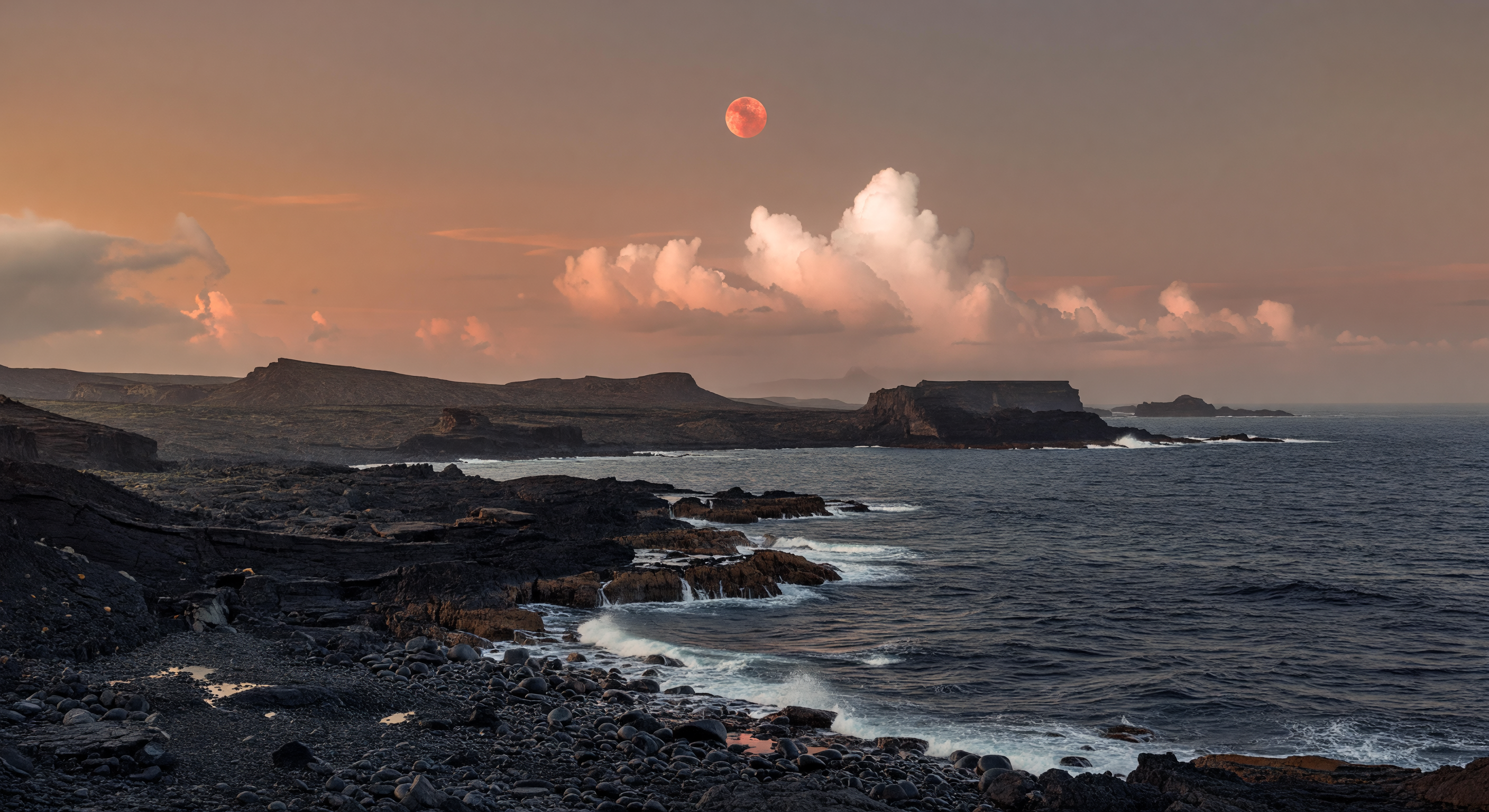
黒い玄武岩の海岸に立つと、しぶきに濡れたガラス質の溶岩岩塊や丸みを帯びた巨礫、割れた溶岩棚のあいだを、濃い鋼青色からほとんど黒に見える海が短く力強い波で打ちつけ、淡い灰色の泡を砕いている。上空には、地球から見る太陽よりわずかに大きい橙赤色の恒星が湿った霞越しに輪郭をやわらげ、赤色光と近赤外線に富む鈍い銅色の光で、重い大気と高重力のもとにある海岸線を低コントラストに照らしている。海の熱で立ち上がった巨大な対流雲は白くそびえ、その下面を帯びる桃灰色や淡い藤色が、窒素に富むと考えられる厚い大気中の水蒸気と海霧を感じさせ、遠景の玄武岩平原や低い火山丘を霞ませてこの世界の広大さを際立たせる。ここには植物も人の痕跡もなく、ただ潮汐固定された昼の側に蓄えられた熱、火山性の岩石海岸、そして終わりなく続く暗い海が、静かで異様な居住可能性の境界を物語っている。
科学審査委員会
各画像はAI委員会によって科学的正確性が審査されます。
Claude
画像: Adjust
説明: Adjust
I largely concur with GPT's assessment but want to add several specific observations and one significant disagreement.
SCIENTIFIC ACCURACY: The stellar disk representation is the most scientifically problematic element. LHS 1140 is an M4.5 dwarf with an effective temperature of ~3,216 K, which should render it a deep crimson-to-dark-orange color — the image captures this reasonably well. However, LHS 1140 b orbits at ~0.0875 AU, meaning the stellar disk should subtend roughly 3–4x the angular diameter of our Sun as seen from Earth. The depicted disk, while larger than a solar analog, is not large enough to convey this scale — it reads more like a lunar-sized object, which actually undersells the immersive, dominating presence this star would have. This is a meaningful scientific miss that the caption explicitly claims to address ('broader than the Sun appears from Earth') but the image does not convincingly deliver.
The convective cloud architecture is actually the strongest scientific element in the image. For a tidally locked super-Earth with ocean coverage, vigorous substellar convection cells are exactly what atmospheric models (e.g., Turbet et al. 2016 analog work) predict. The towering cumulonimbus-style formations with bright tops and darker bases are well-rendered and scientifically defensible. GPT correctly praised this.
I disagree slightly with GPT's critique of the ocean coloration. Under an M-dwarf's red-dominated spectrum, a water ocean's appearance depends heavily on atmospheric Rayleigh scattering — which, in a nitrogen-rich atmosphere, would still scatter shorter wavelengths, though less efficiently than under a G-star. The result could plausibly yield a muted steel-blue with bronze overtones, which is approximately what the image shows. This is not a strong error. However, the sky background color between clouds reads too much like an Earth sunset and not enough like a persistently hazy, red-irradiated dayside — there is insufficient diffuse reddish-bronze coloration in the zenith-adjacent regions.
The geological rendering is competent but generic. The foreground does show dark basaltic rock and rounded cobbles consistent with volcanic coastal environments, but as GPT notes, there are no clearly identifiable lava shelf structures or glassy pahoehoe textures that would distinguish this from an Earth coastline in Iceland or the Canaries. The caption's specificity about 'fractured lava shelves' and 'glassy volcanic rock' exceeds what the image actually demonstrates.
Gravity effects: LHS 1140 b has ~1.7 Earth masses and ~1.73 Earth radii, giving surface gravity roughly 1.4–1.7 g. The caption claims waves would be 'squat and forceful.' The depicted waves do appear energetic and lower-profile than typical open-ocean swells, which is a subtle but appreciated attempt at gravitational scaling. I give partial credit here — it is suggestive but not definitive.
VISUAL QUALITY: The image is photorealistic and technically well-executed. No obvious compositing seams, no AI artifact halos, and the lighting is internally consistent. The atmospheric haze gradation from horizon to upper sky is smooth and convincing. My only technical concern beyond GPT's points is that the star appears slightly too clean and circular — an M-dwarf through a dense, moist atmosphere should show more chromatic limb softening and atmospheric dispersion coloring at this apparent elevation angle.
CAPTION ACCURACY: The caption is well-written speculative science communication but overclaims relative to the image in several places: 'tide pools' are not visible, 'spray-slick boulders' are not clearly distinguishable from ordinary wet rocks, and 'metallic glow' is a poetic overstatement of what reads as ordinary wet-surface sheen. The phrase 'permanent day side of a likely tidally locked super-Earth' is scientifically appropriate given current observational constraints and is one of the caption's strongest elements. The phrase 'stronger gravity keeps the surf squat and forceful' is a good scientific inference but the image only weakly supports it visually.
RECOMMENDATION: Adjust rather than regenerate. The conceptual framework is strong and scientifically informed. Priority fixes: (1) increase stellar disk angular size significantly to reflect the actual orbital distance; (2) shift sky coloration toward a more persistent bronze-amber haze rather than sunset-orange; (3) add more clearly identifiable lava shelf / pahoehoe texture to the foreground geology; (4) trim caption claims to match visible image content. The convective cloud rendering should be preserved — it is the scene's strongest scientific asset.
SCIENTIFIC ACCURACY: The stellar disk representation is the most scientifically problematic element. LHS 1140 is an M4.5 dwarf with an effective temperature of ~3,216 K, which should render it a deep crimson-to-dark-orange color — the image captures this reasonably well. However, LHS 1140 b orbits at ~0.0875 AU, meaning the stellar disk should subtend roughly 3–4x the angular diameter of our Sun as seen from Earth. The depicted disk, while larger than a solar analog, is not large enough to convey this scale — it reads more like a lunar-sized object, which actually undersells the immersive, dominating presence this star would have. This is a meaningful scientific miss that the caption explicitly claims to address ('broader than the Sun appears from Earth') but the image does not convincingly deliver.
The convective cloud architecture is actually the strongest scientific element in the image. For a tidally locked super-Earth with ocean coverage, vigorous substellar convection cells are exactly what atmospheric models (e.g., Turbet et al. 2016 analog work) predict. The towering cumulonimbus-style formations with bright tops and darker bases are well-rendered and scientifically defensible. GPT correctly praised this.
I disagree slightly with GPT's critique of the ocean coloration. Under an M-dwarf's red-dominated spectrum, a water ocean's appearance depends heavily on atmospheric Rayleigh scattering — which, in a nitrogen-rich atmosphere, would still scatter shorter wavelengths, though less efficiently than under a G-star. The result could plausibly yield a muted steel-blue with bronze overtones, which is approximately what the image shows. This is not a strong error. However, the sky background color between clouds reads too much like an Earth sunset and not enough like a persistently hazy, red-irradiated dayside — there is insufficient diffuse reddish-bronze coloration in the zenith-adjacent regions.
The geological rendering is competent but generic. The foreground does show dark basaltic rock and rounded cobbles consistent with volcanic coastal environments, but as GPT notes, there are no clearly identifiable lava shelf structures or glassy pahoehoe textures that would distinguish this from an Earth coastline in Iceland or the Canaries. The caption's specificity about 'fractured lava shelves' and 'glassy volcanic rock' exceeds what the image actually demonstrates.
Gravity effects: LHS 1140 b has ~1.7 Earth masses and ~1.73 Earth radii, giving surface gravity roughly 1.4–1.7 g. The caption claims waves would be 'squat and forceful.' The depicted waves do appear energetic and lower-profile than typical open-ocean swells, which is a subtle but appreciated attempt at gravitational scaling. I give partial credit here — it is suggestive but not definitive.
VISUAL QUALITY: The image is photorealistic and technically well-executed. No obvious compositing seams, no AI artifact halos, and the lighting is internally consistent. The atmospheric haze gradation from horizon to upper sky is smooth and convincing. My only technical concern beyond GPT's points is that the star appears slightly too clean and circular — an M-dwarf through a dense, moist atmosphere should show more chromatic limb softening and atmospheric dispersion coloring at this apparent elevation angle.
CAPTION ACCURACY: The caption is well-written speculative science communication but overclaims relative to the image in several places: 'tide pools' are not visible, 'spray-slick boulders' are not clearly distinguishable from ordinary wet rocks, and 'metallic glow' is a poetic overstatement of what reads as ordinary wet-surface sheen. The phrase 'permanent day side of a likely tidally locked super-Earth' is scientifically appropriate given current observational constraints and is one of the caption's strongest elements. The phrase 'stronger gravity keeps the surf squat and forceful' is a good scientific inference but the image only weakly supports it visually.
RECOMMENDATION: Adjust rather than regenerate. The conceptual framework is strong and scientifically informed. Priority fixes: (1) increase stellar disk angular size significantly to reflect the actual orbital distance; (2) shift sky coloration toward a more persistent bronze-amber haze rather than sunset-orange; (3) add more clearly identifiable lava shelf / pahoehoe texture to the foreground geology; (4) trim caption claims to match visible image content. The convective cloud rendering should be preserved — it is the scene's strongest scientific asset.
Grok
画像: Adjust
説明: Adjust
I concur with both GPT and Claude's 'adjust' votes for image and caption, with targeted agreements, disagreements, and additions below.
1. SCIENTIFIC ACCURACY (adjust): Strong alignment on stellar color (deep orange-red plausible for M4.5V at 3216K) and convective clouds (excellent match to tidally-locked super-Earth models like Yang et al. 2014 or Turbet analogs, with anvil tops and shaded bases indicating upwelling over substellar ocean). Ocean steel-blue is defensible (N2-dominated atm scatters blue despite red incident light; cf. red dwarf ocean models in Hu & Seager 2011 showing muted cyan), partially disagreeing with GPT's bronze preference but agreeing it's not major. Key issues: (a) Star disk size critically undersized—LHS 114 b at .0875 AU yields ~38 deg angular diameter (~3.7x Sun from Earth), dominating ~1/10 sky; image shows ~5-10 deg (lunar scale), missing caption's 'broader than Sun' claim (Claude correct); (b) Geology shows dark basalt/cobbles (good volcanic nod) but lacks 'fractured lava shelves' or glassy obsidian—reads generic Icelandic coast (both reviewers right); (c) Gravity ~1.6g (from 7. MEarth, 1.73 REarth) should squat waves (shorter fetch, higher g damps amplitude), and breakers are squat/forceful vs Earth swells—subtle win, but Earth-like runup undermines; (d) NEW: Sky haze is sunset-orange (horizon glow) but substellar point should be persistently coppery/bronze zenith with flattened shadows; image skews terminator-like. Atmosphere moist N2-rich plausible (recent JWST hints at dense atm).
2. VISUAL QUALITY (adjust): Photorealistic excellence—no artifacts, coherent haze/depth (DOFrenders rocks/shore crisply), consistent low-angle lighting, dynamic surf foam. Minor nits: Star too crisp (add limb darkening/chromatic aberration for atm extinction, per Claude); ocean gradient slightly painterly near horizon. No regeneration needed—polishable.
3. CAPTION ACCURACY (adjust): Matches broad composition (basalt shore, dark ocean, foam, orange star, convective clouds, rugged headlands) but overclaims visuals: no distinct tide pools, spray-slick boulders blend into wet rocks, 'metallic glow' poetic excess, 'glassy volcanic rock/fractured shelves' not evident. Scientific phrasing (tidally-locked dayside, N2 haze, g-effects) spot-on speculation.
RECOMMENDATION: Adjust image (enlarge star 3-4x, bronze zenith haze, add pahoehoe shelves, enhance squat wave physics). Trim caption to visible elements. Clouds/star color preserve. Concept scientifically robust—minor tweaks to approve.
1. SCIENTIFIC ACCURACY (adjust): Strong alignment on stellar color (deep orange-red plausible for M4.5V at 3216K) and convective clouds (excellent match to tidally-locked super-Earth models like Yang et al. 2014 or Turbet analogs, with anvil tops and shaded bases indicating upwelling over substellar ocean). Ocean steel-blue is defensible (N2-dominated atm scatters blue despite red incident light; cf. red dwarf ocean models in Hu & Seager 2011 showing muted cyan), partially disagreeing with GPT's bronze preference but agreeing it's not major. Key issues: (a) Star disk size critically undersized—LHS 114 b at .0875 AU yields ~38 deg angular diameter (~3.7x Sun from Earth), dominating ~1/10 sky; image shows ~5-10 deg (lunar scale), missing caption's 'broader than Sun' claim (Claude correct); (b) Geology shows dark basalt/cobbles (good volcanic nod) but lacks 'fractured lava shelves' or glassy obsidian—reads generic Icelandic coast (both reviewers right); (c) Gravity ~1.6g (from 7. MEarth, 1.73 REarth) should squat waves (shorter fetch, higher g damps amplitude), and breakers are squat/forceful vs Earth swells—subtle win, but Earth-like runup undermines; (d) NEW: Sky haze is sunset-orange (horizon glow) but substellar point should be persistently coppery/bronze zenith with flattened shadows; image skews terminator-like. Atmosphere moist N2-rich plausible (recent JWST hints at dense atm).
2. VISUAL QUALITY (adjust): Photorealistic excellence—no artifacts, coherent haze/depth (DOFrenders rocks/shore crisply), consistent low-angle lighting, dynamic surf foam. Minor nits: Star too crisp (add limb darkening/chromatic aberration for atm extinction, per Claude); ocean gradient slightly painterly near horizon. No regeneration needed—polishable.
3. CAPTION ACCURACY (adjust): Matches broad composition (basalt shore, dark ocean, foam, orange star, convective clouds, rugged headlands) but overclaims visuals: no distinct tide pools, spray-slick boulders blend into wet rocks, 'metallic glow' poetic excess, 'glassy volcanic rock/fractured shelves' not evident. Scientific phrasing (tidally-locked dayside, N2 haze, g-effects) spot-on speculation.
RECOMMENDATION: Adjust image (enlarge star 3-4x, bronze zenith haze, add pahoehoe shelves, enhance squat wave physics). Trim caption to visible elements. Clouds/star color preserve. Concept scientifically robust—minor tweaks to approve.
Gemini
画像: Adjust
説明: Adjust
I concur with the committee's consensus that while the scene captures the 'vibe' of a super-Earth M-dwarf system, it suffers from a lack of visual specificity regarding the geological and stellar scale. Specifically, the stellar disk is far too small for the orbital distance of ~0.08 AU; it should loom significantly larger, acting as a true ceiling to the sky rather than a distant beacon. I agree with the assessment that the 'glassy volcanic' and 'fractured shelf' geology is currently generic basaltic coastline; implementing distinct pahoehoe or ropy lava textures would ground the image more firmly in the volcanic nature of a high-gravity world. The atmospheric scattering is the most successful element, but the zenith sky needs to move away from the 'Earth-sunset' gradient and toward a more uniform, hazy copper-bronze characteristic of a persistent substellar day-side. The caption is overly descriptive of elements absent in the render (e.g., tide pools); it should be pared down to reflect the visible foreground. The convective cloud structures remain the high point of this visualization and should be preserved in any refinement.
Matania — 総合評価
画像: Adjust
説明: Adjust
The committee agrees that the scene is scientifically promising and visually strong, especially in its rendering of a warm red-dwarf star, a hazy atmosphere, and convincing convective cloud structures over a dark ocean. The concept captures the broad feel of LHS 114 b’s substellar dayside well. However, the image does not yet fully convey the system’s scale or geology: the stellar disk is too small for the planet’s close orbit, the sky reads a bit too much like an Earth sunset rather than a persistent bronze-amber substellar haze, and the shoreline feels generically terrestrial rather than distinctly volcanic/black-basalt with lava-shelf textures. The caption is also directionally accurate but over-specific in places, describing features not clearly visible in the render. Overall, this is an adjust rather than regenerate case, with the cloud field preserved as the strongest element.
2. VISUAL QUALITY (adjust): Overall rendering is high quality and coherent: consistent camera perspective, good atmosphere haze, convincing cloud volume, and no obvious compositing artifacts. The main concern is physical plausibility rather than image artifacts—foam placement and ocean color gradient can look artistic/photographic rather than governed by LHS 114 b-specific scattering/chemistry. The star’s size is more stylized than quantitatively justified by the exoplanet’s distance to LHS 114 b, though it is visually consistent.
3. CAPTION ACCURACY (adjust): The description matches the broad strokes (alien rocky coast, dark water, strong convection clouds, warm orange-red star, metallic-subdued lighting). But the caption is more specific (black basalt/glassy volcanic rock with fractured shelves, dense compact waves, pale foam in tide pools and across spray-slick boulders, coppery nitrogen-rich haze) than what is clearly visible. The image emphasizes a basalt-like shore and wave action, but “tide pools” are not distinct, “spray-slick boulders” are subtle, and the nitrogen-rich/coppery haze claim is not directly verifiable from the picture alone. A tighter caption referencing what’s actually depicted (rocky shoreline, orange-red star, convective clouds, heavy surf) would be more accurate.
Recommendation: Keep the scene concept (tidally locked warm day side with convective clouds and rocky coast under a red star), but adjust the ocean/sky coloration and geological specifics to better reflect a black basalt/lava-shelf environment and to align the “nutrient-rich nitrogen haze”/shadow-flattening claims with what’s visibly supported. Minor-to-moderate changes should move it toward full approval.