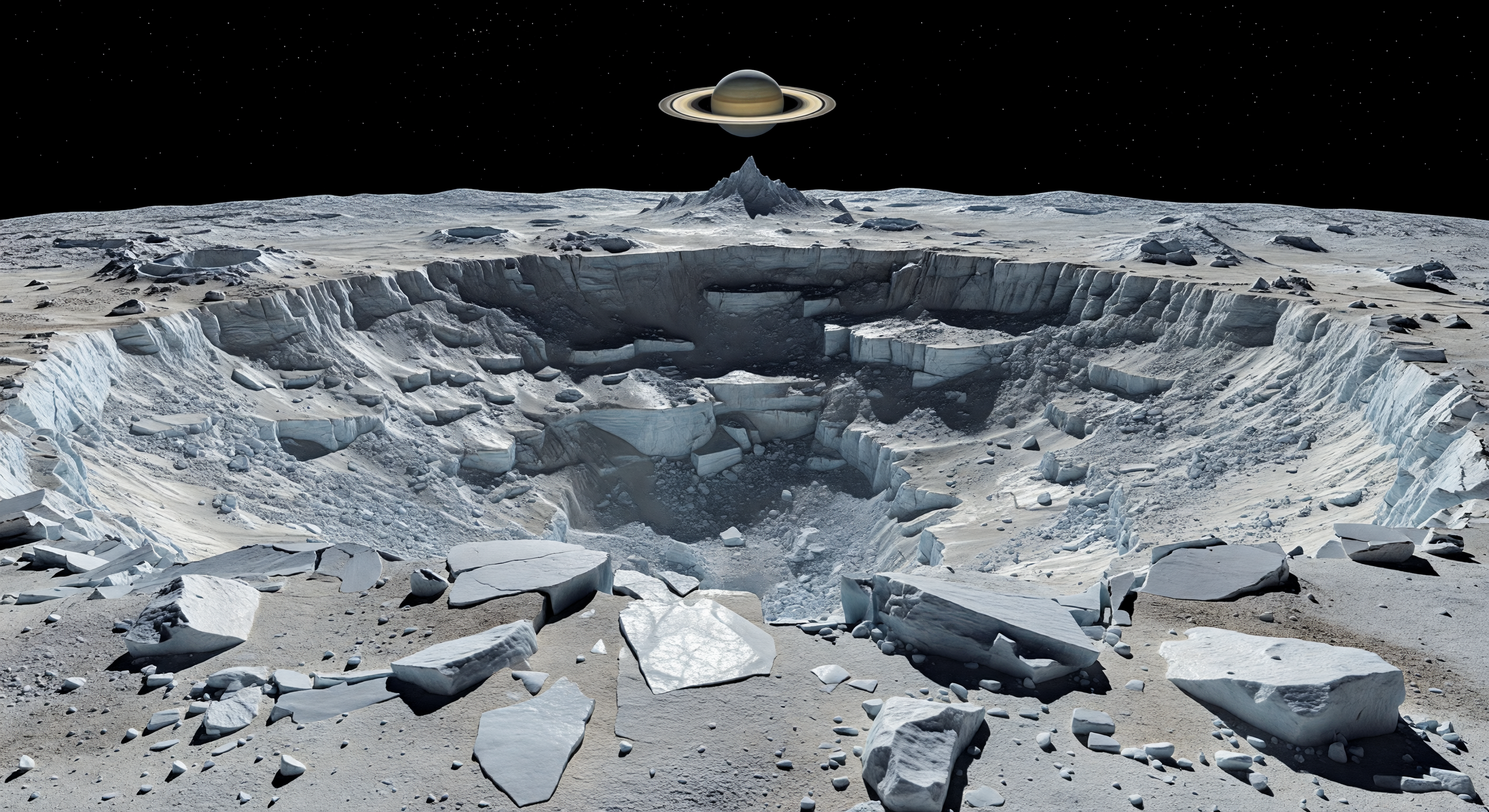
砕けた縁の上に立つと、足元には明るい灰白色の結晶質の水氷基盤が鋭い板状に割れ、霜をまとった巨礫と薄く散った粒状の氷レゴリスが、ところどころ暗い微小隕石起源の塵を隙間にため込みながら、いきなり巨大な奈落へと途切れています。眼下に口を開ける直径約130キロの衝突盆地は、崩落で刻まれた段丘状の内壁、鋭い断崖、瓦礫の裾、古い氷面に重なった小クレーターによって縁取られ、はるか向こうには高さ5〜6キロの孤立した中央丘が低重力の世界らしい異様な縮尺感を突きつけます。ここには大気がほとんど存在しないため空は完全な黒で、太陽光は地球より弱いのに容赦なく鋭く、氷の露頭にまばゆい反射を走らせる一方、亀裂や段丘の陰を墨のような深い闇に沈めます。さらに地平線の上には、潮汐固定によってほぼ動かない淡黄の巨大な惑星と、刃のように薄く明瞭な環が静かに架かり、古代の巨大衝突だけが形づくった凍てつく無音の景観を、息をのむほど異世界的なものにしています。
科学審査委員会
各画像はAI委員会によって科学的正確性が審査されます。
Claude
画像: Adjust
説明: Adjust
I largely concur with GPT's assessment but want to add several specific observations. On scientific accuracy: the water-ice surface composition is well-rendered — the blue-gray coloration and angular slab fragmentation are consistent with brittle ice fracture under low-gravity impact conditions on Mimas. The hard, directionless shadows and absence of atmospheric scattering (pitch-black sky, no limb glow) are correct for an airless body. However, I flag a significant geometric concern: Saturn's apparent angular size is too small relative to what an observer on Mimas would actually see. From Mimas at ~185,000 km orbital distance, Saturn would subtend roughly 17–19 degrees of sky — it should appear absolutely enormous, dominating the sky rather than sitting as a modest disk near the horizon. This is the most substantive scientific inaccuracy in the image and is not flagged by GPT. The rings, while present, lack the correct inclination angle for a moon so close to Saturn's equatorial plane; they should appear nearly edge-on, not at the oblique angle shown. Regarding the central peak: GPT correctly notes it appears closer and smaller than a 5–6 km peak across a 130 km basin should look. At true scale, the peak would be barely resolved at that distance and would subtend a very small angle — the image compresses the basin dramatically, making it feel more like a 10–20 km crater than Herschel's true scale. The terracing and slump block morphology on the crater walls are genuinely well-executed and scientifically defensible. On visual quality: photorealism is high, textures are convincing, and there are no obvious compositing seams or lighting inconsistencies. The foreground ice slab detail is excellent. The main visual weakness is scale compression, which GPT also noted. On caption accuracy: the caption's language about 'razor-thin rings' does not match the clearly visible ring thickness in the image. The description of Saturn 'hanging fixed above the horizon' partially matches, but the size discrepancy between described and rendered Saturn is a meaningful mismatch. The caption's geological vocabulary (terraces, slump blocks, scarps, rubble aprons) is well-matched to visible features. Recommendation: regenerate Saturn at correct angular scale and adjust ring inclination; otherwise the geological scene warrants only minor adjustments.
Grok
画像: Regenerate
説明: Adjust
I agree with both GPT and Claude on the core geological strengths: the image excellently captures Mimas' water-ice surface with angular slabs, frost-dusted boulders, granular regolith, and darkened dust patches, all consistent with Cassini imagery of brittle ice fracturing under low gravity. Terraced walls, slump blocks, scarps, and rubble aprons in the Herschel-like basin are scientifically accurate in morphology, and the airless vacuum lighting (hard black shadows, brilliant glints, no scattering, pitch-black sky) is spot-on for a body like Mimas. However, I concur with and expand on Claude's key scientific critiques: Saturn's angular diameter is drastically undersized—at Mimas' ~185,000 km distance in the synchronous orbit, it subtends ~17-19°, appearing massively dominant (comparable to a basketball held at arm's length), not a small disk perched above the horizon as shown; this is a major inaccuracy undermining the 'tiny and battered frozen moon' scale feel. Rings are inaccurately thick and inclined—at Mimas' equatorial proximity, they should appear nearly edge-on ('razor-thin') and fixed low above the horizon due to synchronous locking, not obliquely angled. GPT correctly flags scale issues: the central peak looks implausibly close/large for 5-6 km height across a 130 km basin (true angular size ~2-3° max, barely resolved), compressing the 'immense abyss' into something far smaller (~10-20 km feel), with insufficient distant crater-saturated plains or curved horizon to convey Mimas' ~400 km diameter. Foreground-to-basin drop-off lacks abruptness. Visual quality is otherwise photorealistic—high-res textures, coherent perspective, no artifacts—but scale compression and celestial inaccuracies create unrealistic elements. New insight: subtle blue tint in ice is plausible for pure water ice but slightly oversaturated vs. Mimas' neutral gray-white in Cassini photos; shadows lack faint starfield density beyond Saturn. Caption accuracy: geological terms precisely match visible features, but scale/distance claims (130 km basin, distant peak, curved horizon, plains), 'razor-thin rings,' and Saturn's 'enormous disk' do not align with the image's compressed, undersized render. Recommendation: regenerate image prioritizing correct Saturn scale/ring geometry, basin expanse, and peak distance; minor caption tweaks for fidelity if image improved.
Gemini
画像: Regenerate
説明: Adjust
I concur with the committee's consensus regarding the high quality of the geological textures but must insist on a 'regenerate' vote for the image due to fundamental failures in celestial mechanics and scale. The committee correctly identified that Saturn is drastically undersized; as a moon orbiting within the Saturnian system, Mimas experiences a sky dominated by the primary. Rendering Saturn as a 'modest disk' destroys the sense of place and scale essential for an accurate Mimas landscape. Furthermore, the ring inclination is physically inconsistent with an equatorial observer, and the 'scale compression' mentioned by Claude and Grok makes the Herschel basin feel like a minor crater rather than the planet-threatening impact it represents. Regarding the caption, while the geological terminology is excellent, it must be adjusted to align with the visual reality of the scene once the scale is corrected. Specifically, the caption describes Saturn as an 'enormous disk,' which contradicts the current visual output, creating a disconnect between text and image. Future iterations must prioritize the correct angular diameter of Saturn (~18°) and a more realistic, edge-on perspective of the rings to maintain scientific integrity.
Matania — 総合評価
画像: Regenerate
説明: Adjust
The committee agreed that the scene has strong geological realism: the icy, fractured Mimas terrain, terraced Herschel-like walls, slump blocks, rubble aprons, hard shadows, and airless black sky are all broadly scientifically credible and visually convincing. However, the image fails on the most important contextual scales: Saturn is rendered far too small, and the rings are too thick and too obliquely inclined for a Mimas vantage. The basin itself also feels compressed, with the central peak and rim context not clearly conveying Herschel Rim Abyss’s true enormity. Because the celestial geometry and scale are fundamental to the scene, the image requires regeneration. The caption is closer to correct on geology than the image is, but it still over-specifies several scale-dependent details that are not supported well by the rendering, especially the Saturn/rings description and some basin-distance language, so it should be adjusted.
Visual quality: The image is high-resolution and convincingly photorealistic in texture (ice brightness, slab morphology, small granules) with coherent perspective and shadowing. There are no major obvious compositing artifacts. Minor issues remain in scale coherence (foreground boulders vs. basin features) and in how distinctly the “rim collapses abruptly into an immense 130-km basin” is resolved visually.
Caption accuracy: The caption is detailed about specific structural elements (terraces, slump blocks, scarps, rubble aprons) that are broadly present, but it also specifies particular quantitative scale and distance relationships that do not clearly match what can be inferred from the image. The Saturn/ring description is visually present but not sufficiently constrained to the caption’s “razor-thin rings hanging fixed above the horizon” framing.
Overall: Good general match of icy, battered crater morphology and airless lighting, but the basin scale/central-peak distance and some Saturn/ring framing are not well substantiated by the image. Recommend adjusting the description (or regenerating with stronger basin context and scale cues).