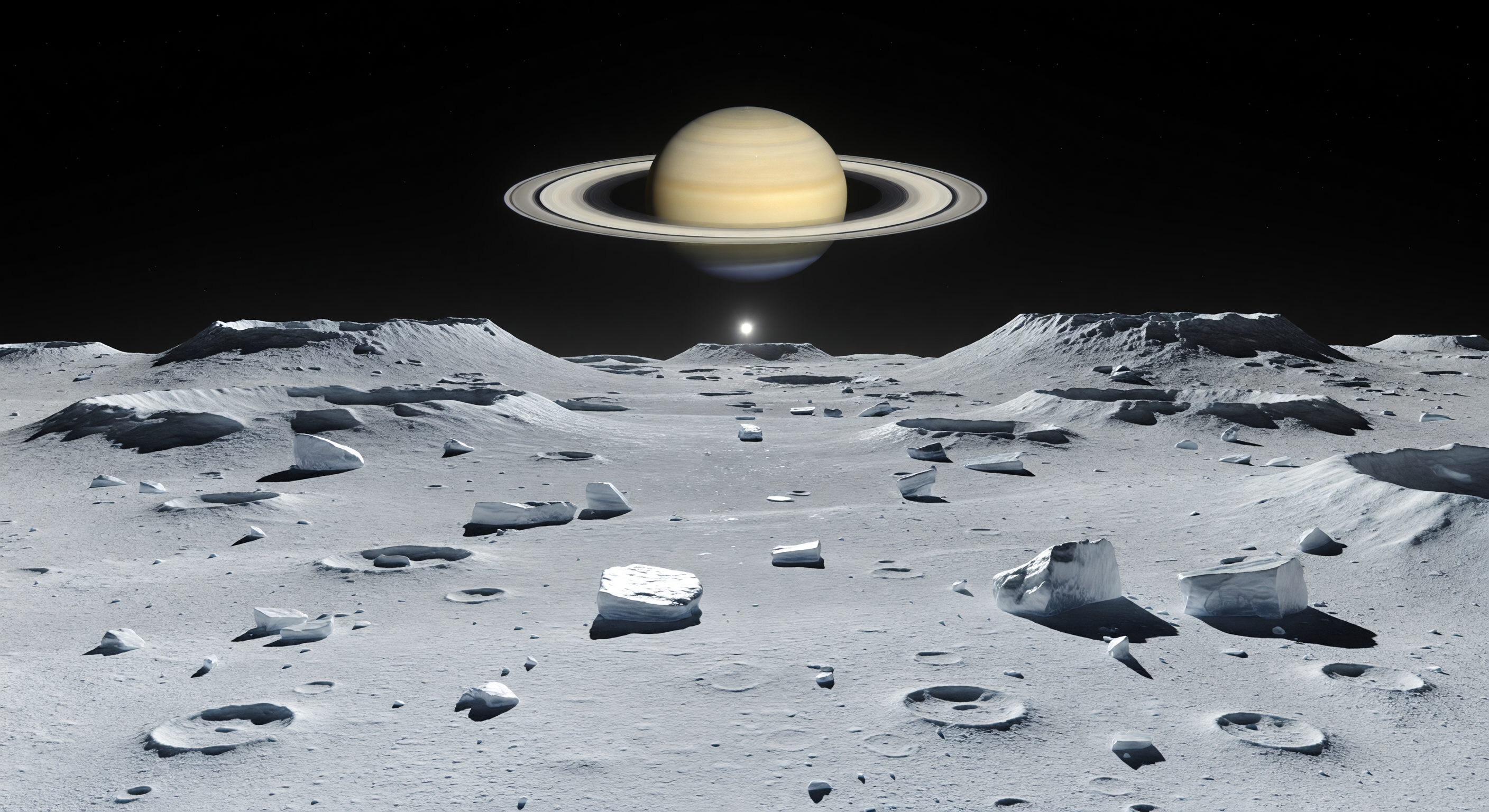
足元には、象牙色がかった灰白色の細かな氷レゴリスが乾いた砂のように広がり、その上に角張った氷塊や浅い二次クレーター、小さな噴出丘が点々と散らばっている。はるか前方では、低くうねるクレーター平原が、数十〜数百メートル級の古いクレーター縁や鋭い鉢状クレーターへと続き、極端に弱い重力のため斜面は驚くほど崩れず、硬質な輪郭を保ったままだ。空には大気がまったくないため漆黒がむき出しになり、その中に淡い黄褐色の縞を帯びた巨大な惑星が地平線上に固定され、視界の大部分を占める白く明るい環が繊細な帯構造と細い暗い切れ目まで見せながら長大な弧を描く。太陽は小さく鋭い白色点として冷酷な直射光を投げ、岩陰やクレーター内部を墨のような闇に沈める一方、巨大な惑星からのほのかな反射光が土星向きの斜面をかすかに照らし、古代の衝突だけが刻んだ氷の世界に、静止した永遠のようなスケール感を与えている。
科学審査委員会
各画像はAI委員会によって科学的正確性が審査されます。
GPT
画像: Adjust
説明: Adjust
Scientific accuracy: The scene plausibly depicts an airless, cratered icy moon with angular water-ice blocks and dark crater shadows, which is broadly consistent with Mimas’ regolith/ice mixture and lack of atmosphere. However, there are major physical inconsistencies with the “Saturn over cratered plain” premise: Mimas is tidally locked and would not show “the same hemisphere forever faces its primary” in a way that makes Saturn’s rings appear with that clean, luminous, sharply defined arc in every viewing geometry. The image shows Saturn front-on and the rings as a bright, thin structure with the Cassini Division implied by banding—this is not something we can reliably assert from the viewpoint, and the ring/illumination appearance is overly idealized for a Mimas surface view. Additionally, the shadows are present and crisp, but the lighting includes a bright Saturn-lit component that may not match the expected relative brightness/contrast from Saturn at Mimas’ distance, and crater topography appears smoother than expected for heavily cratered Mimas terrains. Visual quality: The image is high quality and largely photorealistic in terms of surface material, blocky ice morphology, and overall lighting/shadowing. I do see some signs of artistic simplification/CG look: the ground lacks the finest regolith scale detail, and Saturn/rings look like a composited or stylized planetary rendering (too “clean” and luminous compared to how distant Saturn features typically appear). Caption accuracy: The description is generally aligned with what’s shown (airless icy plain with blocks and craters under a bright Sun, and a large Saturn in the sky). But claims like “Cassini Division etched between brighter bands” and “perfectly black shadows” are stronger than the image evidence and likely over-specific; the ring detail is not clearly verifiable and the shadow behavior is somewhat artistically exaggerated. Overall, I recommend adjusting the caption/planet-ring specificity and viewpoint realism rather than regenerating the whole landscape.
Claude
画像: Adjust
説明: Adjust
I largely concur with GPT's assessment but want to sharpen several points and add new observations. SCIENTIFIC ACCURACY: The surface treatment is broadly defensible — angular water-ice blocks, shallow impact craters, dark regolith contamination, and the absence of atmospheric haze are all consistent with Mimas. However, I flag three specific problems. First, the ice blocks are too pristinely white and geometrically angular; Mimas' surface, as imaged by Cassini, is heavily gardened and the regolith tends to mute and soften even relatively fresh ejecta blocks — the 'bluish-white fresh fractures' described in the caption and partially visible in the image are somewhat exaggerated in brightness contrast. Second, and more critically, Saturn's apparent angular diameter in the image is significantly undersized. From Mimas at ~185,000 km orbital radius, Saturn (equatorial radius ~60,268 km) would subtend roughly 18–19 degrees of arc — it should dominate a substantial portion of the sky and appear dramatically larger than shown here, where it occupies perhaps 8–10 degrees. This is a meaningful scientific error. Third, the rings are rendered with their plane nearly edge-on to the viewer, which is geometrically plausible for certain orbital configurations but the caption claims the 'Cassini Division is etched between brighter bands' — the ring inclination shown makes the Division essentially unresolvable at this geometry, contradicting the caption's specificity. The bright point below Saturn reads as the Sun, which at Saturn's distance (~9.5 AU) should appear as an intensely bright but very small disk, roughly 1/100th the angular diameter it has from Earth — the rendered Sun point looks plausible in size but perhaps slightly too diffuse. VISUAL QUALITY: The image is technically competent and largely photorealistic at a glance. The lighting is internally consistent — hard shadows, no atmospheric scattering, appropriate directionality. My additional concern beyond GPT's notes is a subtle CG 'cleanliness' to the crater morphology: Mimas' craters, particularly Herschel, are characteristically steep-walled and deep relative to diameter, and the craters shown here are unusually shallow and subdued even for older degraded features. The horizon curvature is present but subtle — Mimas' mean radius is only ~198 km, so curvature should be quite pronounced and the horizon noticeably close, perhaps more dramatically so than shown. CAPTION ACCURACY: The caption is evocative and scientifically literate in tone, but 'rings stretching in a luminous arc with the Cassini Division etched between brighter bands' is not supportable from the image at the rendered ring inclination. The phrase 'the same hemisphere forever faces its primary' is scientifically correct for tidal lock but misleadingly implies Saturn is always at zenith — it would be fixed at one specific sky position determined by the observer's location on the sub-Saturn hemisphere. The phrase 'faint glow reflected from that giant planet gently lifts the shadows' is a nice touch and scientifically valid (Saturn's albedo contributes meaningful illumination), but the image does not convincingly render this secondary illumination fill — shadows remain essentially fully black rather than subtly Saturn-lit. RECOMMENDATION: Adjust Saturn's angular diameter upward significantly, soften the ice block brightness contrast modestly, and revise the caption to remove the Cassini Division claim at this ring geometry and temper the shadow-lift assertion unless secondary illumination is actually rendered.
Grok
画像: Adjust
説明: Adjust
I concur with both GPT and Claude on the core issues, adding targeted refinements. SCIENTIFIC ACCURACY: Surface geology is solid—ivory-gray regolith with darker contaminants, angular ice blocks, shallow craters, and ejecta hummocks align well with Cassini images of Mimas' heavily impacted, airless terrain (e.g., Herschel crater environs). No atmosphere, black sky, and crisp solar shadows are spot-on. However, Saturn's angular size is critically undersized at ~8-10° visually versus the accurate ~18-19° (calculated as 2*arcsin(R_saturn / distance) ≈ 18.4° from Mimas' semi-major axis of 185,520 km and Saturn's 60,268 km radius), making it fail to 'dominate' the sky as it should from the sub-Saturn point. Rings appear nearly edge-on, plausibly hiding the Cassini Division (width ~4,800 km, unresolvable at this inclination from Mimas' orbit where ring tilt varies but often minimizes gaps visually). Sun is correctly a tiny, intense point (~.05° at 9.5 AU). Horizon curvature is understated for Mimas' 198 km radius (horizon distance ~2.3 km for 1.8m eye height, implying sharper drop-off). Saturnshine 'lifting shadows' is claimed but shadows remain pitch-black, lacking subtle fill light (Saturn albedo ~.5 could contribute ~1-5% illumination). Ice blocks are angular but overly pristine bluish-white; real Mimas ejecta show more muted, space-weathered tones. VISUAL QUALITY: Photorealistic overall with consistent hard lighting, no major artifacts, and good regolith texture. Minor CG tells: overly clean/smooth craters (Mimas craters have sharper rims even when degraded), insufficient fine dust scale, and composited look to Saturn/rings (too luminous, lacks phase-appropriate subtlety). CAPTION ACCURACY: Matches surface details excellently ('fine ivory-gray regolith', 'angular blocks', 'shallow craters') but overclaims ring details ('Cassini Division etched' unverifiable) and shadow lift (not rendered). Tidal lock phrasing is precise but implies static zenith view, which depends on latitude. RECOMMENDATION: Upsize Saturn to ~2x angular diameter, add faint Saturn-fill to shadows, dull ice contrasts slightly, sharpen horizon curve, and tweak caption to generalize rings sans Division specificity. No need to regenerate—strong base image.
Gemini
画像: Adjust
説明: Adjust
I concur with the previous committee members regarding the critical scaling errors. The most glaring scientific issue remains Saturn's angular diameter; at ~185,000 km, Saturn is not a distant ornament but a massive sky-filling presence. The current rendering makes the moon feel like a larger body (like Iapetus) rather than the tiny, 198km-radius world that Mimas is. Furthermore, the committee correctly identifies the 'Saturnshine' paradox: the caption describes a light-filled scene, but the image renders deep, pitch-black shadows. If the image is to remain photorealistic, the shadows must show a subtle, diffuse blue-tinted fill from Saturn's albedo. I also agree that the crater morphology is too 'soft'; Mimas is characterized by surprisingly crisp, high-rimmed craters despite its age, due to the lack of significant seismic relaxation or atmospheric erosion. I recommend adjusting the image to increase Saturn's scale, sharpen the crater rims, and introduce subtle secondary lighting in the shadows, while refining the caption to remove the unverifiable claim regarding the visibility of the Cassini Division at this specific ring inclination.
Matania — 総合評価
画像: Adjust
説明: Adjust
The committee found the image broadly plausible as a cratered, airless icy surface on Mimas, with convincing regolith, angular ice blocks, and crisp shadows. However, several scientific fidelity issues prevent approval: Saturn is rendered far too small for Mimas’s sky, the ring geometry and Cassini Division are over-specified for the shown view, crater forms are somewhat too smooth/clean, and the scene lacks the subtle secondary illumination that Saturn should contribute. The caption is similarly strong in tone but too specific in places, especially regarding the Cassini Division and shadow behavior, which are not supported by the rendered geometry or lighting. Overall, the base image is good and does not need full regeneration, but both image and caption should be adjusted for scale, lighting realism, and ring-detail restraint.