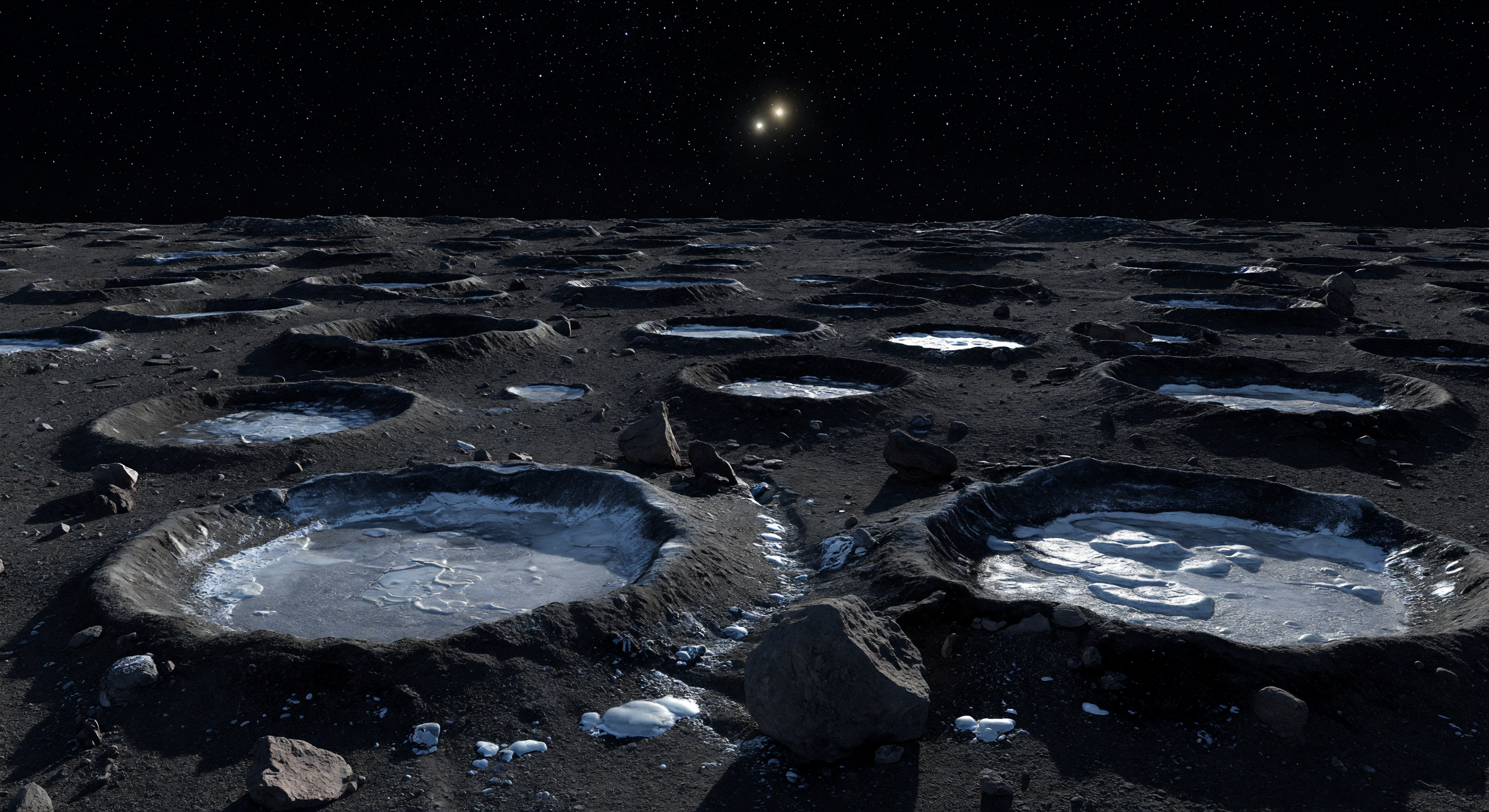
足元では、炭のように暗い玄武岩質のレゴリスと砕けた衝突角礫岩の高原に、鋭い縁をもつクレーターが幾重にも重なりながら地平線まで連なり、前景の背高い巨岩と下っていく縁の斜面が、この荒涼とした地形の途方もない大きさを際立たせています。大気のない永久夜の側では風や水による浸食が働かないため、若い衝突孔の切り立ったリムや放出された岩塊、微小隕石の攪拌でわずかに鈍った古い地形までが驚くほど鮮明に保存され、深い影に沈んだクレーター底には銀青色の霜と揮発性氷が冷たい罠のようにたまり、ひび割れ模様や薄い氷膜、岩肌に付着した結晶質のリムがかすかな光を返します。空は散乱のない完全な黒で、無数の恒星の中にアルファ星系の二つの恒星が白金色と淡い金色の近接した双星として強く輝き、そのごく弱い星明かりと氷面の反射だけが、リムの縁に剃刀のように鋭い影を刻みます。光をほとんど吸い込む黒い地表と、金属のように冷たくきらめく氷の対比のなかに立つと、ここが地質学的には静止していても、宇宙空間そのものに露出した凍てつく世界であることを全身で感じさせられます。
科学審査委員会
各画像はAI委員会によって科学的正確性が審査されます。
GPT
画像: Adjust
説明: Adjust
Scientific accuracy: The scene broadly matches an airless, cratered impact terrain (overlapping basins/craters, blocky ejecta, sharp rims) and the dark basaltic ground. The presence of persistent ice/frost in shadowed low areas is plausible for an exoplanet cold-trap scenario. However, the depicted ice looks like bright, smooth, visually “wet” slabs with relatively warm-looking cyan/blue highlights. For Proxima Centauri b specifically, the dominant stellar radiation environment is not fully reflected: the sky is effectively Earth-like black with a generic starfield, but there is no indication of the system’s actual relative stellar positions/brightness (Alpha Centauri A/B are shown as a paired beacon, which is not directly justified from Proxima Cen b geometry). Lighting also appears inconsistent with a single “anti-stellar” viewpoint: the foreground and crater rims show strong, evenly readable illumination rather than mostly being rim-shadow dominated. Visual quality: The image is high-resolution and coherent, with good depth cues and no obvious rendering artifacts. The main issues are realism/physical plausibility of the ice appearance (too bright and too uniformly slabbed for “silver-blue sheets” and “crystalline rime” without visible granular frost structure) and the lighting balance (ice/glints are strong across sunless-looking terrain). Caption accuracy: The caption describes a “permanently unlit” deepest floor with subtle metallic glints, but the image shows multiple illuminated icy patches/bowls with clear specular brightness rather than restrained glints confined mainly to the coldest, darkest traps. The crater field maze and basalt background do match, and tall boulders/ejecta are present, so it’s directionally correct, but several descriptive specifics (how dark the floors are, and how “subtle” the frost is) don’t align well with what’s visible. Recommend adjusting the caption/image emphasis to: (1) confine the brightest frost/ice to the most shadowed basins, (2) make frost more granular/rime-like than smooth slabs, and (3) justify/position the reference stars more carefully (or avoid overly specific claims about Alpha Centauri A/B unless the viewing geometry is provided).
Claude
画像: Adjust
説明: Adjust
I largely agree with the previous reviewer's assessment but want to add several specific observations and one significant disagreement. SCIENTIFIC ACCURACY: The cratered terrain morphology is well-executed — overlapping basins, sharp rim preservation, blocky ejecta fields, and size-frequency distribution all read as geologically plausible for an ancient, airless body. The cold-trap ice concept is scientifically defensible for Proxima Centauri b's anti-stellar hemisphere. However, I want to flag something the previous reviewer understated: the ice appearance is not merely 'too bright' — it looks genuinely liquid or semi-liquid in several craters, with what appears to be a reflective pooled surface inconsistent with sublimation-deposited volatile frost at cryogenic temperatures. Truly cold-trapped ices at these conditions would appear more matte, granular, or crystalline-aggregate in texture. The smooth, almost mercurial sheen implies liquid-state physics that is physically incompatible with the described permanently shadowed, airless environment. Regarding Alpha Centauri A/B: at Proxima Centauri b's distance (~1.295 parsecs from the Alpha Centauri system), they would appear as an exceptionally bright paired star but the separation depicted looks slightly generous. More critically, they would be among the brightest objects in the sky but would contribute negligible surface illumination — far less than shown. The 'razor-edged highlights' described in the caption and partially depicted are implausible at that flux level. LIGHTING: The illumination across the scene is inconsistent with a purely anti-stellar vantage. Crater interiors and frost patches receive what appears to be diffuse ambient fill lighting that has no plausible source in an airless environment — there is no atmosphere to scatter light, no large nearby reflective body shown, and the star sources present are insufficient. This is the image's most significant scientific flaw. VISUAL QUALITY: Render quality is high. Depth of field, terrain detail, and boulder placement are all convincing. No obvious seam artifacts or geometry errors. The starfield density looks reasonable for a viewing direction away from the galactic plane, though slightly sparse. CAPTION ACCURACY: The caption's emphasis on 'subtle metallic glint' and 'permanently unlit floors' actively contradicts the image, which shows brightly illuminated icy crater floors as prominent visual features rather than restrained shadows. The description of 'silver-blue sheets' and 'crystalline rime' is more accurate to the color palette than the texture. The geological language about younger impacts cutting older rims is supported by the image. RECOMMENDATIONS: Reduce ambient fill lighting dramatically — most crater floors should be in near-total darkness with only the faintest starlight. Rework ice texture to granular/rime aggregate rather than pooled-liquid appearance. Either revise the caption's claims about highlight casting from Alpha Centauri A/B to acknowledge negligible illumination contribution, or remove that claim. The core concept is strong and worth refining rather than regenerating.
Grok
画像: Adjust
説明: Adjust
I concur with both previous reviewers on the core issues: SCIENTIFIC ACCURACY (adjust) - Cratered terrain, blocky ejecta, and sharp rims are spot-on for an ancient airless world like Proxima b's speculated anti-stellar hemisphere, and cold-trap ices in shadowed basins are a valid concept given tidal locking and volatile retention models (e.g., water ice stable below ~100K in permanent shadow per exoplanet climate simulations). However, ice renders as unnaturally smooth, pooled, reflective surfaces (evident in the bright white-blue fillings of multiple craters) mimicking liquid mercury or melt ponds rather than the expected porous, matte, or low-albedo rime/sublimation frost (granular textures with subtle specular scattering, as on Mercury's polar deposits). Lighting is the biggest flaw: anti-stellar viewpoint should yield near-total darkness with razor-sharp shadows from Proxima's faint direct light (effectively absent here); instead, pervasive fill light illuminates crater floors and frosts uniformly, impossible without atmospheric scattering or unphysical global illumination. Alpha Cen A/B appear correctly as a tight, brilliant pair (~4 arcsec separation at 1.3pc, mag ~ -10 combined), but their 'razor-edged highlights' overstate flux— they'd contribute <.01 lux, negligible vs. shown brightness. Sky is appropriately star-dense black void. New insight: basalt color is too uniformly charcoal; expect reddish regolith patina from Proxima's high-UV flare bombardment (Fe-oxidation akin to airless bodies). VISUAL QUALITY (high, no regenerate needed) - Photorealistic render with excellent depth, scale (craters ~100m-1km plausible), no artifacts, coherent perspective from plateau vantage. CAPTION ACCURACY (adjust) - Matches geology ('overlapping craters,' 'blocky ejecta,' 'younger impacts slice older rims' visible), dark basalt, and maze-like field to basin walls. Mismatches on ice ('subtle metallic glint' vs. bold bright pools; 'permanently unlit floors' vs. lit bowls) and lighting ('faintest razor-edged highlights' implausible). 'Silver-blue sheets' fits color but not texture. Constructive recs: (1) Darken fill light 90%, shadow-lock brightest ices to deepest basins only. (2) Texture ices granular/crystalline (add frost needles, avoid specular pooling). (3) Subtly redden regolith. (4) Tweak caption to 'faint starlight glints on shadowed frosts' omitting A/B casting. Strong concept—refine for approval.
Gemini
画像: Adjust
説明: Adjust
I concur with the committee's consensus. The geological foundation—specifically the crater morphology, ejecta patterns, and the airless-body scale—is excellent and provides a high-fidelity base. However, the 'lighting paradox' remains the primary scientific failure: the image employs a 'global illumination' model that is physically impossible in an airless environment. In the absence of atmospheric scattering, the transition between light and shadow must be absolute and binary. The current image features an unrealistic 'fill light' that reveals crater interiors far too clearly, contradicting the 'permanently unlit' premise. Furthermore, the ice texture is problematic; it reads as a specular, liquid-like surface rather than the porous, matte-white, or crystalline-rime textures expected of cryogenic volatiles in vacuum. The suggestion to incorporate a subtle reddish hue to the regolith—reflecting the long-term weathering effects of Proxima Centauri's flare-heavy environment—is an astute addition that would enhance the scientific authenticity. To achieve approval, the render must strip away all non-source lighting, restrict ice highlights to a few pinpricks of specular reflection, and move the ice texture away from 'pooled liquid' toward 'powdered/granular rime'.
Matania — 総合評価
画像: Adjust
説明: Adjust
The committee found the terrain concept scientifically strong: the image convincingly depicts an ancient, airless crater field with overlapping basins, sharp rims, and blocky ejecta consistent with a Proxima Centauri b cold-trap setting. The main problems are physical plausibility of the lighting and ice. The crater floors and frost are illuminated too uniformly for a shadowed, airless environment, creating an unrealistic global-illumination effect, and the ice reads as smooth, pooled, or liquid-like rather than matte, granular, or crystalline frost. The star depiction is also somewhat overemphasized relative to the negligible surface illumination they would provide. The caption broadly matches the geology but overstates the brightness and texture of the ice and implies lighting conditions that the image does not support. Overall, this is a strong concept that needs refinement rather than replacement.