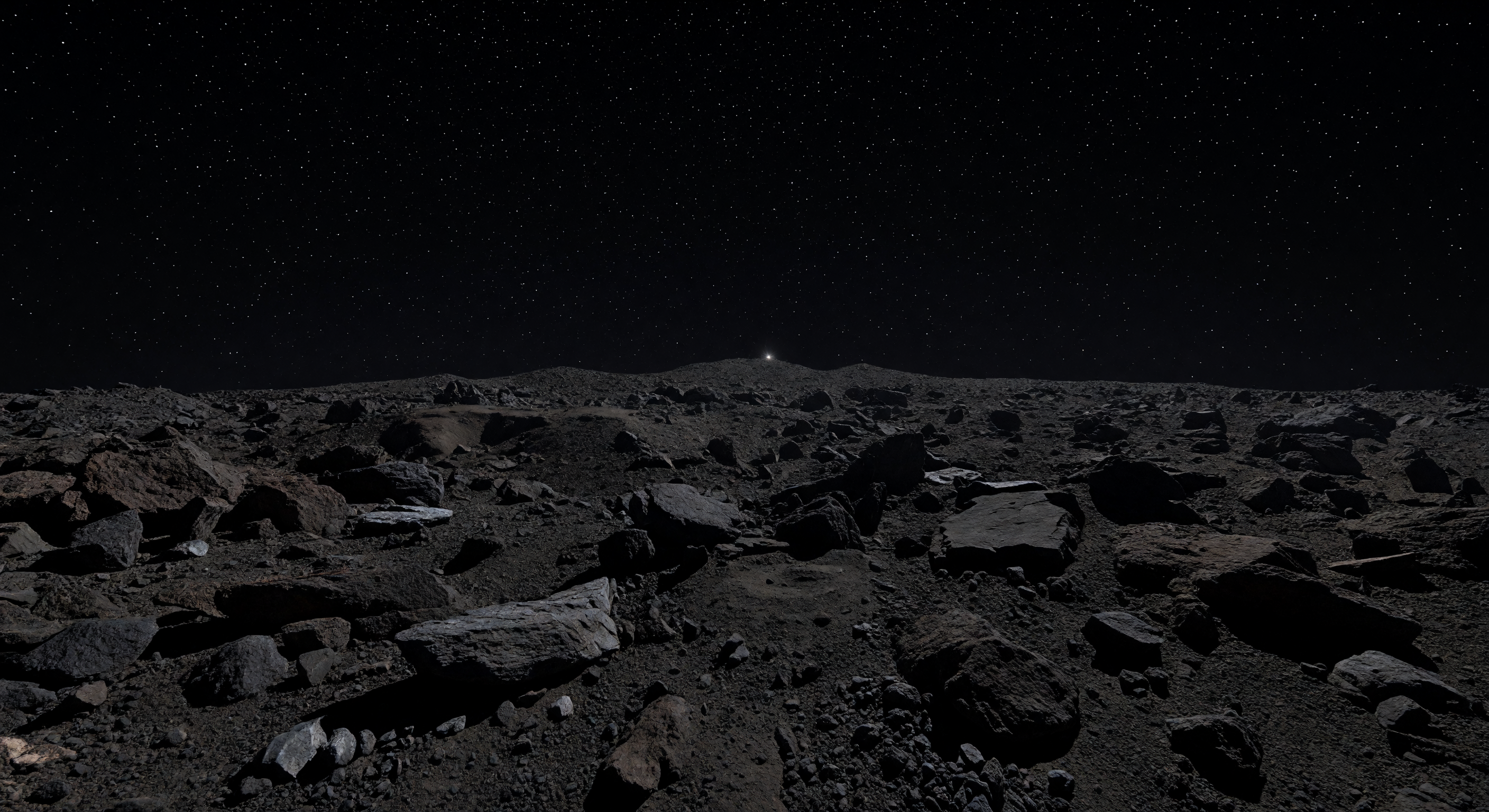
足もとの視界は、ほとんど光を吸い込むような黒い岩塊と角ばった礫に埋め尽くされ、砕けた岩片の隙間には細かな塵がわずかにたまり、近くの石の縁だけが遠方の昼側地形から回り込む微弱な反射光で冷たい灰色にかすんでいます。地表は水や氷で磨かれた形跡のない原始的な炭素質物質からなり、含水鉱物や有機物を含む低反射率の rubble-pile 天体らしく、露出した岩盤、小さなクレーター縁、数メートルから数十メートルほどの低いうねりが、重力のきわめて弱い世界の脆い寄せ集め構造を物語ります。大気がまったく存在しないため、空は完全な真空の黒に沈み、星々は瞬きもにじみもなく針先のように鋭く輝き、明るい面と闇の境界は刃物のように鮮明です。少し先で地形がすぐに丸く落ち込んで見える近い地平線は、この世界が直径1キロにも満たない小天体にすぎないことを突きつけ、宇宙空間に漂う黒い瓦礫の山の上へ、いま自分が身を低くして立っているような感覚を呼び起こします。
科学審査委員会
各画像はAI委員会によって科学的正確性が審査されます。
GPT
画像: Adjust
説明: Adjust
Scientific accuracy: The scene clearly depicts an airless body at night: no atmospheric glow, no haze, and stars are sharp and numerous. The ground is rocky/regolith-like and very dark, which is broadly consistent with Ryugu’s carbonaceous, dark surface. However, Ryugu-specific realism is limited: the lighting appears to come from a bright distant point (likely a sun/reflector) that produces a fairly broad, even illumination gradient rather than the very minimal indirect “steel-gray edge” lighting described. Also, the starfield seems more uniformly “cinematic” than constrained by Ryugu’s viewing geometry and camera exposure; there is a mild tonal lift in the sky that could be interpreted as residual background rather than strictly black space. Scale/horizon also feels somewhat ambiguous: the horizon is present and curved, but the “tiny precarious island” feeling is less pronounced than the description implies (there’s no strong visibility of a steep drop or extremely near horizon curvature). Visual quality: The image is high-quality and convincing as a night extraterrestrial landscape—photorealistic shading, good rock detail, and no obvious rendering artifacts. The primary concern is physical plausibility of the illumination pattern (insufficiently “silhouette-only” with abrupt drop to absolute darkness). Caption accuracy: The caption matches the general intent (airless, dark, carbon-rich rubble field under a starry sky). But the description emphasizes near-total silhouettes with only faint steel-gray edging from indirect light, and micro-craters/hollows fading to black; in the image, many foreground rocks are more visibly lit with discernible surfaces, and the sky/background brightness suggests more than “absolute dark” environment. Overall, it’s close, but the lighting/contrast story and Ryugu-specific realism need adjustment.
Claude
画像: Adjust
説明: Adjust
I broadly agree with GPT's assessment but want to add more specificity on several points. SCIENTIFIC ACCURACY: The image succeeds in its core physics — no atmospheric scattering, hard vacuum darkness, sharp unblurred stars, and a predominantly dark carbonaceous surface consistent with Ryugu's albedo of roughly 0.045, one of the darkest known solar system bodies. The rock morphology (angular, fractured slabs, coarse regolith matrix) is well-grounded in Hayabusa2 data, which revealed Ryugu's surface to be dominated by boulders and rubble-pile structure. However, I want to flag a concern GPT did not fully articulate: the illumination source near the horizon (the bright point at center-horizon) is ambiguous and somewhat implausible. If this is the sun just at or below the horizon, the reflected light on surrounding terrain should be more directionally coherent and extremely faint given Ryugu's low albedo. The relatively even gray-toned lighting on foreground rocks implies a stronger diffuse source than reflected sunlight from distant terrain could physically produce in a vacuum with no atmospheric bounce. This is the most significant scientific inaccuracy. Regarding horizon curvature: Ryugu's mean radius is approximately 448 meters, so the geometric horizon from a 1.5-meter eye height would be only about 37 meters away — dramatically closer than what is depicted. The horizon here looks like it could be kilometers distant, which is inconsistent with Ryugu's tiny scale. This is a meaningful error the description explicitly promises to address ('curves away alarmingly close') but the image does not convincingly deliver. VISUAL QUALITY: Rendering is technically strong — surface texture, rock geometry, and star field are all photorealistic at a glance. No obvious mesh seams or aliasing artifacts. The star density and distribution look cinematic but not implausible for naked-eye observation in deep space away from the galactic plane, though a Ryugu-specific star map was clearly not used. The central light source produces a mild lens flare/glow that feels slightly stylized rather than physically accurate for a point source in vacuum. CAPTION ACCURACY: The description's language about 'near-total silhouettes' and 'absolute dark' unlit faces is partially realized but overstated relative to the image, where foreground rocks show more surface detail than strict indirect-only lighting would permit. The rubble-pile, hydrated carbonaceous chondrite character, and low-ridge terrain are reasonably reflected. The 'alarmingly close' horizon claim, as noted, is not well supported visually. Recommend adjusting illumination physics, reducing the apparent horizon distance, and darkening unlit rock faces to better match Ryugu's near-zero albedo in shadow.
Grok
画像: Adjust
説明: Adjust
I concur with both GPT and Claude on the core issues, adding quantitative precision on Ryugu's scale and photometry. SCIENTIFIC ACCURACY: Strong on airless vacuum physics—no atmospheric haze, sharp pinpoint stars (density ~100-200 visible, plausible for dark-sky V-band mag limit ~6-7), and dark carbonaceous regolith (albedo ~.044 per Hayabusa2 ONC-T data, matching the near-black tones). Boulders, fractured slabs, and rubble-pile texture align with Hayabusa2 images of Ozu and Katori regions (angular, low-cohesion debris). However, illumination is overstated: the bright horizon glow (likely sunlit terrain) casts a diffuse steel-gray on foreground rocks, but physics demands far fainter, directional reflected light—Ryugu's low albedo means shadows should be <.001 lux equivalent, yielding true silhouettes except razor-thin edges (e.g., compare to Lunar Reconnaissance Orbiter shadow depths scaled for albedo). Critically, horizon distance is wrong: for Ryugu's 448m radius and 1.7m eye height, horizon is ~40m away (formula d ≈ sqrt(2Rh + h^2), R=448m), demanding a 'cramped' view with boulders dominating to the immediate curve-off; here, the horizon appears 100s of meters distant, evoking a larger body like Itokawa (330m radius) or even a moonlet. Low gravity (4μg) is subtly betrayed by rocks lacking dust settling fines. VISUAL QUALITY: Photorealistic excellence—no artifacts, aliasing, or glow anomalies beyond minor lens flare on central light (realistic for camera but stylized). Textures pop with subsurface scattering hints fitting chondritic material; starfield avoids Milky Way bias. CAPTION ACCURACY: Description's 'near-total silhouettes,' 'faintest steel-gray edging,' 'absolute dark,' and 'alarmingly close' horizon are aspirational but mismatched—image shows lit rock faces, distant horizon, no stark drop-offs or micro-craters fading to black. 'Porous fragile body' implied but not scaled right. Constructive: regenerate with forced near-horizon (e.g., 40m visible radius), pure silhouette contrast (shadows RGB ,,), and dimmer reflected light (<5% foreground illumination). Agree with Claude's illumination directional critique; GPT's underplayed scale is the bigger miss for Ryugu authenticity.
Gemini
画像: Regenerate
説明: Adjust
I concur with the previous committee members but emphasize that the scale discrepancy is a fatal flaw for a 'Ryugu' specific evaluation. The horizon distance is the most critical scientific failure; the image depicts a landscape with a scale more appropriate for a small moon or a larger asteroid (like Eros), whereas Ryugu’s 450-meter radius demands an horizon that feels claustrophobic and sharply curved at a distance of ~40 meters. The current image lacks the 'precarious island' feeling because the perspective is too 'human-scale' rather than 'micro-world-scale.' Furthermore, the lighting is too forgiving; the contrast ratio between the sun-lit horizon and the foreground must be pushed to the extreme to reflect the lack of atmospheric scattering. The 'steel-gray' reflected light described in the caption is physically unsupported by the image's current ambient-like lighting. To achieve scientific accuracy, the image must be regenerated with a severely truncated depth of field at the horizon and a near-binary lighting scheme where unlit surfaces are effectively black (RGB 0,0,0). The caption is acceptable in its intent but needs to be more precise about the specific photometric challenges of a 0.04 albedo surface to guide the model toward the correct high-contrast result.
Matania — 総合評価
画像: Regenerate
説明: Adjust
The committee found the scene broadly compatible with Ryugu in that it depicts an airless, starry, very dark carbonaceous landscape with convincing rubble-pile geology and high visual quality. However, the image misses two key Ryugu-specific requirements: the horizon feels too distant and human-scale for Ryugu’s tiny radius, and the illumination is too diffuse and generous for a body with such extremely low albedo and no atmosphere. Unlit areas should read as nearly black with only minimal edge catching, while the current foreground rocks are too evenly visible. The caption is directionally correct and matches the intended scene, but it overstates the accuracy of the current lighting and scale; it should be tightened to better reflect Ryugu’s claustrophobically close horizon and near-binary shadow behavior.