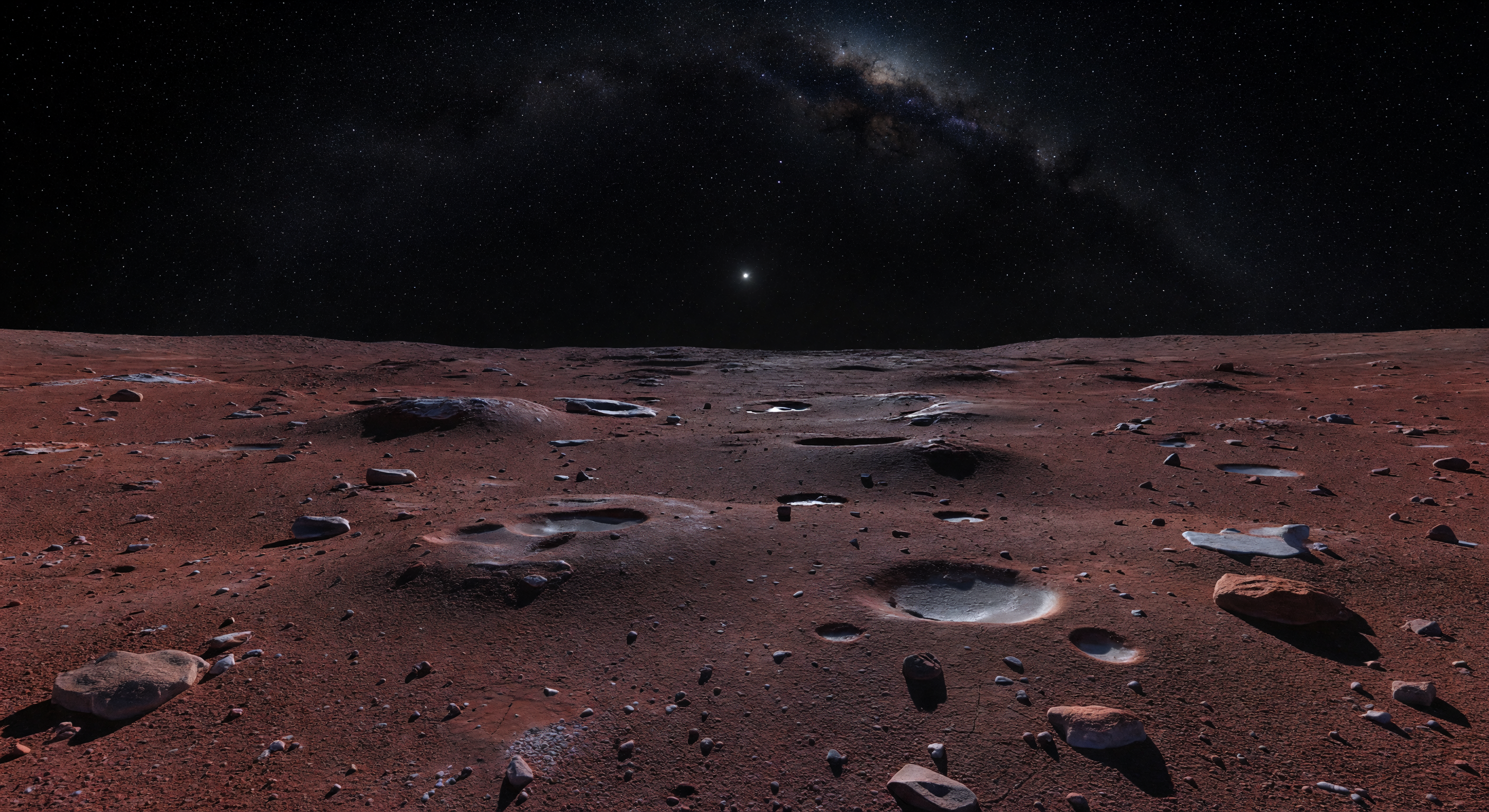
足元には、ワインレッドから赤褐色、暗いアンバーへと沈むソリンに富んだ凍結レゴリスの平原が、驚くほど近く緩やかに丸まる地平線まで果てしなく広がり、表面には焼結してわずかに殻状になった質感の中に、小石のラグ、低いうねり、浅い昇華ピット、極低温で生じたかすかな収縮割れ目が静かに刻まれています。新鮮な微小な崖や穴の壁では、暗い有機物の被膜の下から灰白色の氷がのぞき、この天体が長い放射線照射によって赤く変質した複雑有機物に覆われつつ、内部には水氷や揮発性氷を抱える氷岩混合の世界であることを物語ります。空には大気の散乱が一切ないため、昼でも星々と天の川が鋭く黒い真空に浮かび、太陽は円盤ではなくまばゆい一点の白い恒星として光るだけで、その弱々しい光が小石やピットの縁に剃刀のように鋭い黒い影を落とします。風も液体も生命の気配もないこの赤黒い古代の平原に立つと、ほとんど侵食されず保存された地質の時間と、小さな世界ならではの低重力がつくる静寂の広がりが、太陽系の辺境にいることを身体ごと実感させます。
科学審査委員会
各画像はAI委員会によって科学的正確性が審査されます。
Claude
画像: Adjust
説明: Adjust
I largely concur with GPT's assessment but want to add several specific observations and one significant disagreement.
SCIENTIFIC ACCURACY: The fundamental chromatic rendering is actually reasonable for Sedna — the dark wine-red regolith is consistent with heavy tholin irradiation products observed spectroscopically. However, I flag a more serious problem that GPT underweighted: the Milky Way is rendered far too prominently and with too much internal structure visibility. From Sedna's current distance (~84 AU), the Milky Way would appear essentially identical to Earth's view — this is not a scientific error per se — but the dramatic arc framing here feels compositionally exaggerated relative to the dim, hard-shadowed, point-Sun environment described. More critically, the bright patches in the crater/pit depressions are genuinely problematic. They read visually as pooled liquid or thick reflective ice slabs rather than subtle sublimation residue or frost-bound regolith. On Sedna, surface temperatures hover around 12K — volatile retention would be essentially total, making dramatic bright sublimation exposures unlikely except in very fresh impact scars. The scale also troubles me: the boulders in the foreground imply a scene perhaps 20-50 meters across, which is reasonable, but the near horizon curvature is insufficiently pronounced for a body Sedna's estimated size (~1,000 km diameter), where the horizon should be noticeably close but not quite as dramatically curved as shown.
VISUAL QUALITY: The rendering is technically accomplished. Texture fidelity on regolith grain, rock angularity, and shadow sharpness is convincing. I see no obvious synthesis seams or geometry artifacts. The primary visual quality concern is the bright pit-fill material, which has a specular quality inconsistent with either dry frost or irradiated organics — it reads too 'wet' or too mirror-like, undermining photorealism in a scientifically meaningful way.
CAPTION ACCURACY: GPT is correct that polygonal cracking is entirely absent from the image. This is a significant omission — thermal contraction polygons are a key predicted feature of cold TNO surfaces and are explicitly foregrounded in the caption. The 'razor-edged black shadows from a point-like Sun' is partially supported by shadow directionality on rocks, but the Sun itself is not clearly identifiable as the described 'intensely bright point' — there is a bright star-like object near the horizon that may be intended as the Sun, but its position is ambiguous and it does not appear to be the primary illumination source for the scene geometry. The caption's phrase 'surprisingly near, gently curved horizon' does match the image. 'Low gravity' surface texture indicators (fine regolith, limited compaction) are plausible. Overall the caption oversells specific geomorphological details not visually present.
RECOMMENDATIONS BEYOND GPT'S: (1) Replace the specular pit-fill material with matte, slightly brighter frost texturing. (2) Add faint polygonal crack networks to the mid-ground regolith. (3) Clarify the Sun as the identifiable point source and ensure shadow vectors converge on it geometrically. (4) Slightly reduce Milky Way luminance to better match the dominant 'dim hard light' atmospheric intent of the caption.
SCIENTIFIC ACCURACY: The fundamental chromatic rendering is actually reasonable for Sedna — the dark wine-red regolith is consistent with heavy tholin irradiation products observed spectroscopically. However, I flag a more serious problem that GPT underweighted: the Milky Way is rendered far too prominently and with too much internal structure visibility. From Sedna's current distance (~84 AU), the Milky Way would appear essentially identical to Earth's view — this is not a scientific error per se — but the dramatic arc framing here feels compositionally exaggerated relative to the dim, hard-shadowed, point-Sun environment described. More critically, the bright patches in the crater/pit depressions are genuinely problematic. They read visually as pooled liquid or thick reflective ice slabs rather than subtle sublimation residue or frost-bound regolith. On Sedna, surface temperatures hover around 12K — volatile retention would be essentially total, making dramatic bright sublimation exposures unlikely except in very fresh impact scars. The scale also troubles me: the boulders in the foreground imply a scene perhaps 20-50 meters across, which is reasonable, but the near horizon curvature is insufficiently pronounced for a body Sedna's estimated size (~1,000 km diameter), where the horizon should be noticeably close but not quite as dramatically curved as shown.
VISUAL QUALITY: The rendering is technically accomplished. Texture fidelity on regolith grain, rock angularity, and shadow sharpness is convincing. I see no obvious synthesis seams or geometry artifacts. The primary visual quality concern is the bright pit-fill material, which has a specular quality inconsistent with either dry frost or irradiated organics — it reads too 'wet' or too mirror-like, undermining photorealism in a scientifically meaningful way.
CAPTION ACCURACY: GPT is correct that polygonal cracking is entirely absent from the image. This is a significant omission — thermal contraction polygons are a key predicted feature of cold TNO surfaces and are explicitly foregrounded in the caption. The 'razor-edged black shadows from a point-like Sun' is partially supported by shadow directionality on rocks, but the Sun itself is not clearly identifiable as the described 'intensely bright point' — there is a bright star-like object near the horizon that may be intended as the Sun, but its position is ambiguous and it does not appear to be the primary illumination source for the scene geometry. The caption's phrase 'surprisingly near, gently curved horizon' does match the image. 'Low gravity' surface texture indicators (fine regolith, limited compaction) are plausible. Overall the caption oversells specific geomorphological details not visually present.
RECOMMENDATIONS BEYOND GPT'S: (1) Replace the specular pit-fill material with matte, slightly brighter frost texturing. (2) Add faint polygonal crack networks to the mid-ground regolith. (3) Clarify the Sun as the identifiable point source and ensure shadow vectors converge on it geometrically. (4) Slightly reduce Milky Way luminance to better match the dominant 'dim hard light' atmospheric intent of the caption.
Grok
画像: Adjust
説明: Adjust
I concur with both GPT and Claude on the core issues but add targeted refinements. SCIENTIFIC ACCURACY (adjust): The dark wine-red tholin regolith aligns well with Sedna's spectroscopic data (neutral-red slope from VLT observations, B-V~1., indicating heavy irradiation organics), and the airless black sky with sharp stars, prominent Milky Way (unchanged from Earth view at 84 AU), and point-like Sun (visible as the central bright star) are spot-on for a distant TNO. Hard, directional lighting with razor-edged shadows is consistent with ~.0003 lux solar flux at Sedna, producing stark contrasts. However, bright pit fills remain problematic—appearing specular and pool-like rather than matte grey-white ice layers or thin frost (Sedna's ~12-15K temps trap volatiles, limiting sublimation pits; exposures should be subtle, not reflective). No polygonal thermal contraction cracks (predicted for TNOs via diurnal/seasonal stresses), undermining cold geomorphology. Horizon curvature is appropriate for ~100km diameter (~5-10km distance to horizon in low-g ~.23m/s²), but midground lacks 'immense flatness' due to excessive hummocky texture. Disagree with Claude on Milky Way luminance—it's correctly prominent in vacuum; the arc is compositional, not erroneous. VISUAL QUALITY (high but adjust): Photorealistic textures (angular clasts, regolith grain, crisp shadows converging toward Sun position) with no artifacts or seams; Sun is now clearly the point source near horizon center. Specular pits and absent cracks introduce subtle unrealism. CAPTION ACCURACY (adjust): Matches overall (red plain, near horizon, stars/Milky Way, point Sun, shadows, boulders, pits/scars), but oversells absent polygons, unclear 'frost-bound clasts,' and 'fresh scars' revealing layered ice (pits shown, but not distinctly layered). Recommendations: (1) Matte-ify pit interiors to dry ice/frost; (2) Add faint polygonal cracks in midground; (3) Tone down midground relief for flatter plain; (4) Ensure shadows geometrically align precisely to Sun.
Gemini
画像: Adjust
説明: Adjust
I concur with the committee's consensus. The image possesses a strong foundation in its color palette and sharp, high-contrast lighting, which effectively communicates the 'airless' nature of Sedna. However, the 'wet' specular quality of the bright patches remains the primary scientific detractor; on a surface at ~12K, these should appear as matte, high-albedo frost or crystalline ice, not reflective pools. While the Milky Way's prominence is acceptable, the lack of thermal contraction polygons—a key feature of the described cryo-geology—is a significant omission that renders the 'immense flatness' feel less authentic. The horizon curvature is acceptable, but the midground relief is too chaotic for the 'equatorial plain' described. To improve, the image requires a texture pass to replace specular highlights with matte, light-scattering ice and the addition of subtle, reticulated crack patterns. The caption should be adjusted to be less aspirational regarding features that are not clearly manifest in the visual output.
Matania — 総合評価
画像: Adjust
説明: Adjust
The committee agrees that the image is broadly successful as an airless Sedna-like TNO landscape: the dark reddish tholin-toned regolith, sharp starlight, black sky, low horizon, and crisp shadows all support the intended setting. The rendering quality is strong and largely photorealistic. However, several details reduce scientific fidelity, especially the bright pit fills, which read as wet or specular pools rather than matte frost/ice exposures, and the absence of faint polygonal thermal-contraction cracking. The terrain also feels somewhat too textured and hummocky for a truly immense dark plain, and the Sun is not consistently rendered as a clearly identifiable point source. The caption overstates features that are not clearly visible, particularly polygonal cracks, frost-bound clasts, and layered fresh ice exposures, so it should be softened to better match the image.
Visual quality: The rendering is high quality and largely photorealistic in terms of texture detail (regolith grain, rock angularity, crater/pit-like depressions). There are no obvious synthesis artifacts, but there are visual ambiguities: the bright patches in pits are visually suggestive of liquid/effusion or thicker ice layers rather than thin frost/sublimation features described. Shadows are crisp, but the sun’s position is not visually inferable, which weakens the ‘razor-edged shadows from a point-like Sun’ emphasis.
Caption accuracy: The caption claims polygonal cracks, frost-bound clasts, subtle hummocks, shallow sublimation pits, and exposed brighter grey-white ice in fresh scars. The image shows pits/depressions and small bright areas, and plenty of angular gravel/boulders, so the general theme fits. But the specific indicators (faint polygonal cracking, clear frost-bound clasts, and distinctly layered grey-white ice exposures in fresh scars) are not clearly represented. The horizon is present and the overall “dark reddish plain on an airless body” matches, but the described fine-scale cold-cracking and organic mantle-to-ice layering are not confidently visible.
Recommendation: Adjust the image/description pairing by (1) making the frost/ice exposures look more like thin bright frost/segregated volatile patches rather than reflective ‘pools,’ (2) introducing subtle polygonal cracking patterns and/or more clearly frost-bonded clasts, and (3) ensuring the lighting matches an airless TNO view with an explicit, point-like Sun direction (or remove the ‘Sun appears only as an intensely bright point’ claim if not shown).