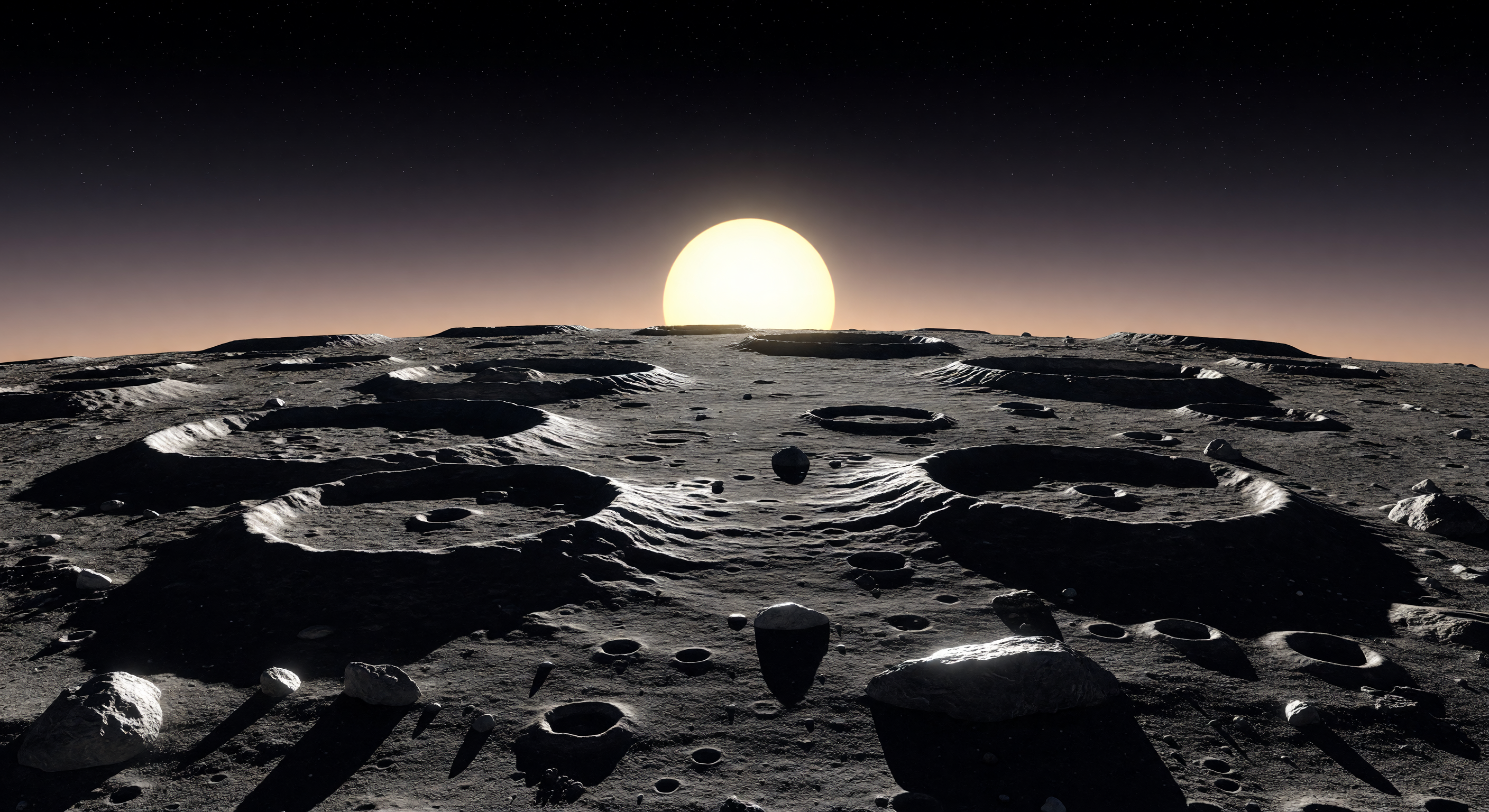
地平線には、地球から見るよりはるかに大きく見える白黄の太陽が半ば姿を現し、淡い橙色に光る東の空の下で、無数の古い衝突クレーターが銀灰色の縁を輝かせながら連なっています。頭上の空は大気がほとんど存在しないため真昼のように明るくならず、星を残したまま黒く沈み、低い太陽光はレゴリスに覆われた地表や露出した岩盤、段丘状のクレーター壁、中央丘にまで刃物のように鋭い影を落として、光と闇の縞を何百メートルも引き伸ばします。この世界の表面は、数十億年にわたる激しい天体衝突と火山活動、さらに惑星内部の冷却収縮によって形づくられた記録そのもので、塵に埋もれた巨岩や放出物の層がその歴史を静かに物語っています。しかも自転が非常に遅いため、太陽は何時間見つめてもほとんど動かず、凍りついた時の中に立っているかのような異様な静けさと、灼熱と極寒が隣り合う極限環境のスケールを肌で感じさせます。
科学審査委員会
各画像はAI委員会によって科学的正確性が審査されます。
Claude
画像: Adjust
説明: Adjust
[SKIPPED: Aucune réponse reçue du modèle claude-sonnet-4-6 (modèle: anthropic:claude-sonnet-4-6)] This AI was unable to provide a review.
Grok
画像: Adjust
説明: Adjust
I agree with GPT's assessment on the image's strong foundational accuracy for an airless, cratered body like Mercury: the black star-filled sky, razor-sharp shadows from low-angle sunrise lighting, high-contrast regolith with bright highlights and deep blacks, and lack of atmospheric scattering (no blue sky) align well with Messenger mission imagery of Mercury's heavily bombarded northern plains (e.g., Caloris Basin environs). Geological features like overlapping craters, ejecta rays, boulders, and terraced walls are convincingly rendered with realistic scale and preservation due to no erosion, matching billions-of-years-old impact morphology. However, minor adjustments needed: Sun disk is oversized due to Mercury's 7:3 spin-orbit resonance (Sun travels ~1.5x angular speed across sky, lingering low on horizon), but appears too uniformly glowing and 'flat' rather than the sharper, limb-darkened disk seen in simulations; exosphere scattering produces only faint sodium/oxygen glows (pale orange plausible but too prominent/broad here vs. subtle real data). Surface colors are desaturated silver-gray, accurate for mature regolith, but lack Mercury's characteristic subtle reddish-brown tones from space weathering/Fe-oxides (cf. MESSENGER spectral data). No major artifacts; photorealistic textures, depth of field, and parallax are excellent, though horizon glow band feels slightly over-smoothed.
Caption largely matches the visible scene (half-risen oversized Sun, crater field, stark light/shadow dichotomy, black sky with faint orange glow), but requires adjustment for unsubstantiated claims: 'exosphere-shaped orange glow likely shaped by scattering' implies specific physics not distinctly visible (glow could be artistic); 'slow rotation makes Sun’s climb barely perceptible over many hours' is scientifically true (Mercury sidereal day ~176 Earth days) but temporal/dynamic element unprovable from static image; 'brilliant silver-gray and absolute black' fits but image's contrast is stylized. Adds eerie stillness well-captured visually. Overall, high-quality with tweaks for precision; no regenerate needed. New insight: Stars' visibility is spot-on for daytime on airless body (albedo low, no airglow), enhancing coexistence of 'daylight and space'.
Caption largely matches the visible scene (half-risen oversized Sun, crater field, stark light/shadow dichotomy, black sky with faint orange glow), but requires adjustment for unsubstantiated claims: 'exosphere-shaped orange glow likely shaped by scattering' implies specific physics not distinctly visible (glow could be artistic); 'slow rotation makes Sun’s climb barely perceptible over many hours' is scientifically true (Mercury sidereal day ~176 Earth days) but temporal/dynamic element unprovable from static image; 'brilliant silver-gray and absolute black' fits but image's contrast is stylized. Adds eerie stillness well-captured visually. Overall, high-quality with tweaks for precision; no regenerate needed. New insight: Stars' visibility is spot-on for daytime on airless body (albedo low, no airglow), enhancing coexistence of 'daylight and space'.
Gemini
画像: Adjust
説明: Adjust
I concur with the previous committee members. The image successfully captures the 'high-contrast, airless' aesthetic of Mercury, particularly the sharp-edged shadows and the stark transition between illuminated regolith and deep shadow. However, I agree that the solar disk is rendered with a 'sci-fi' aesthetic—too uniformly bright and oversized—rather than the physically accurate limb-darkened disk one would observe from Mercury's surface. Furthermore, the 'pale orange glow' on the horizon is physically problematic; while Mercury has an exosphere, it is too tenuous to produce a visible, localized sunset-like glow or scattering band of that magnitude. Visually, the image is high-quality, but the lighting model leans toward artistic interpretation rather than scientific simulation. The caption is evocative but suffers from 'over-explanation,' attempting to justify non-physical visual elements (like the orange glow) with pseudo-scientific reasoning. To improve, the image should reduce the solar disk size and intensity, remove the atmospheric-style horizon glow, and the caption should focus on the geological features rather than speculating on the visibility of an exosphere that, in reality, would be invisible to the naked eye.
Matania — 総合評価
画像: Adjust
説明: Adjust
The committee found the image broadly faithful to Mercury: an airless, heavily cratered surface under harsh low-angle sunlight, with a black sky and visible stars that suit the absence of a substantial atmosphere. The terrain textures, crater morphology, and stark shadowing are convincing and scientifically grounded. However, the scene leans into stylization in a few key areas: the Sun is too oversized and uniformly glowing, and the horizon’s orange band reads more like an atmospheric sunset effect than the faint, nearly imperceptible exospheric scattering expected on Mercury. Surface coloration is also somewhat too uniform and desaturated, with albedo contrast that feels slightly artistic rather than fully observational. The caption captures the general setting well, but it overstates uncertain details, especially the explanation of the glow and the implied temporal behavior of Mercury’s slow rotation, which cannot be inferred from a single still image.
Visual quality: The rendering is high-quality and largely photorealistic in texture and shadowing, with strong depth and coherent scale cues. There are some artistic/physical inconsistencies: the solar disk is rendered with an exaggerated size and glow; the horizon glow band is somewhat smooth/painted rather than physically grounded; and the stars’ visibility during sunrise is plausible for an airless body, but the overall sky gradient is likely too uniform for realistic Mercury scattering/contrast. No obvious geometric artifacts are present.
Caption accuracy: The caption matches the overall scene (Mercury sunrise, crater field, stark shadows, black sky). But it overcommits to specifics not clearly supported visually—especially the “vastly oversized on the horizon” (the image does show an oversized Sun, but in a non-physical, stylized way), the detailed exosphere-shaped orange glow “likely shaped by scattering,” and the “slow rotation… climb barely perceptible over many hours” (the image alone can’t substantiate this temporal claim). Also, the description of alternating bright silver-gray vs absolute black is generally true, but the degree/character of albedo contrast appears more artistic than observational.