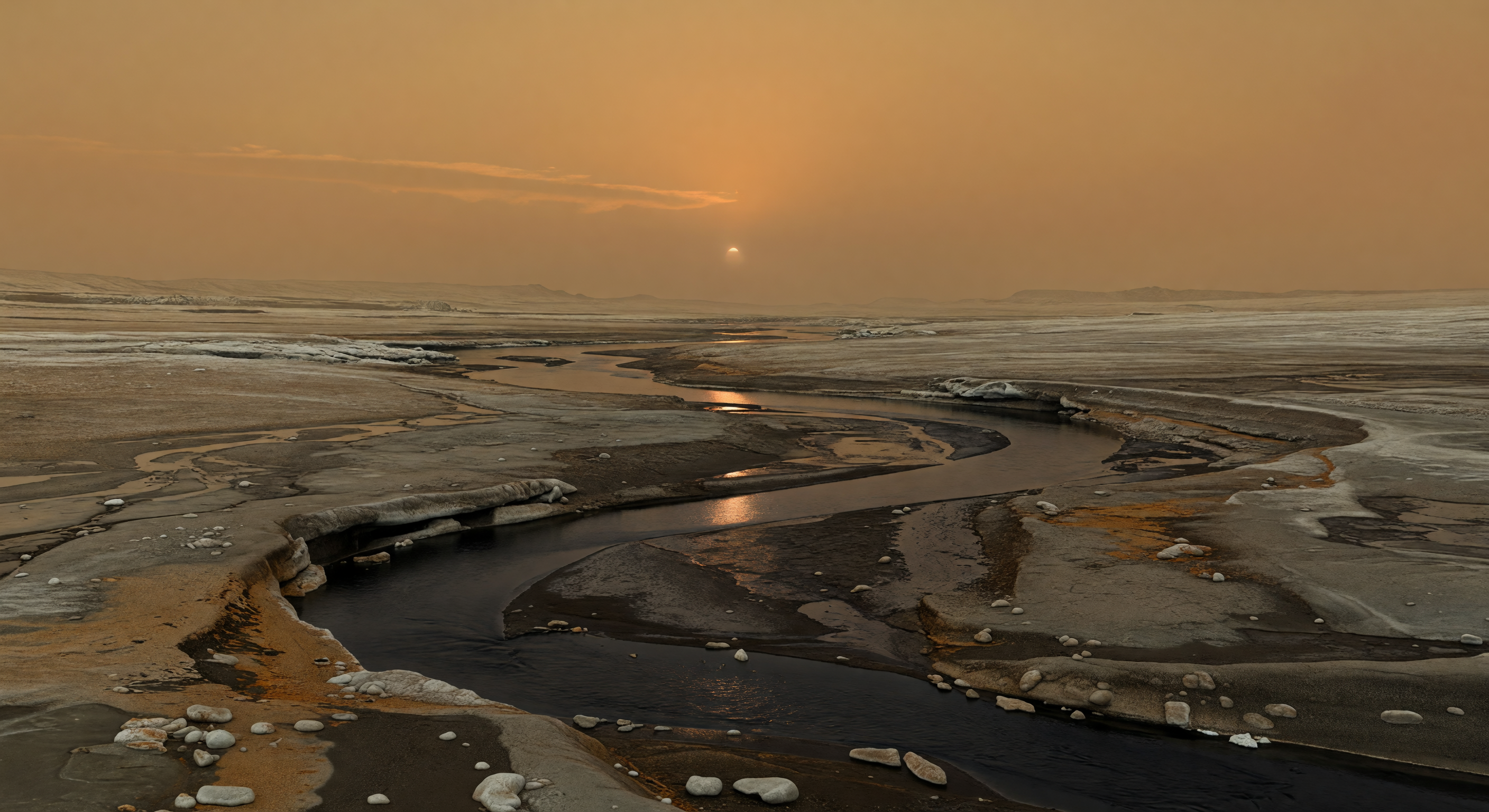
눈앞에는 거의 검게 보이는 액체 메탄의 강이 넓고 완만한 평원을 얕게 파고들며 크게 굽이쳐 흐르고, 더러운 회색의 얼음질 둑과 어두운 사주 위로 희미한 은주황빛 반사가 가늘게 번뜩입니다. 이곳의 기반암은 물얼음이지만 약 94 K의 극저온에서는 암석처럼 단단하게 거동하며, 둑을 이루는 갈회색 얼음 풍부 퇴적물과 둥근 자갈 같은 얼음 덩이, 얼어붙은 진흙 껍질, 그리고 주황갈색 톨린 먼지가 메탄-에탄 순환이 빚은 침식과 퇴적의 흔적을 드러냅니다. 주 수로로 합류하는 얕은 망상 물길, 얼어붙은 둑에 새겨진 다각형 균열, 축축해 보이는 탄화수소 젖은 가장자리는 이 낯선 하천 지형이 지구의 강과 닮았으면서도 전혀 다른 화학으로 작동함을 보여 줍니다. 머리 위 하늘은 짙은 질소 대기와 광화학 연무 때문에 버터스카치색에서 황토빛으로 흐리게 번지고, 태양은 그 안에서 작고 흐릿한 밝은 원반으로만 보여 빛은 차갑고 몹시 확산되어 있습니다. 멀리 낮은 얼음 구릉은 안개 속으로 스러지고, 별도 물도 생명도 없는 침묵 속에서 이 검은 강은 거대한 시간과 느린 날씨가 조각한 외계의 풍경을 끝없이 휘돌아 사라집니다.
科学審査委員会
各画像はAI委員会によって科学的正確性が審査されます。
Claude
画像: Adjust
説明: Adjust
I largely concur with GPT's assessment but want to add several specific observations that nuance the evaluation. On scientific accuracy: the most significant issue is the color and albedo of the liquid channel itself. Titan's hydrocarbon lakes and rivers are expected to have very low radar reflectance and should appear nearly black or very dark brown, not the somewhat reflective, water-like dark gray seen here. The specular highlights on the channel surface are plausible in principle — Cassini VIMS did detect specular reflections from Ligeia Mare — but they appear too bright and too water-like in quality. The sky color (amber-orange, diffuse sun disk barely visible through haze) is one of the stronger successes: this is broadly consistent with Cassini/Huygens imagery, particularly the Huygens descent images. However, the sun disk appears slightly too large and too centrally luminous; at Saturn's distance (~9.5 AU), the solar disk subtends roughly 3.5 arcminutes and should appear as an almost stellar point even through haze. The bank materials are where the image most underperforms the caption: the white rounded blocks are a reasonable attempt at water-ice clasts, but they appear too uniformly white and too 'snowy' — on Titan, surface materials would be heavily coated with tholins (reddish-brown organics), making them appear much darker and more ochre-tinted. The complete absence of visible polygonal fractures or organic sediment layering is a notable gap relative to the caption's specifics. The geomorphology of the meander itself — point bars, cut banks, low terraces — is actually the strongest scientific element and reads as genuinely plausible braided/meandering channel morphology analogous to terrestrial or Titan river systems. The distant icy rises fading into haze work well for scale. On visual quality: the render is technically accomplished with no obvious artifacts, good atmospheric perspective, and coherent lighting. The main photorealism issue is material rendering — the ice and channel surfaces look too much like their terrestrial analogs. On caption accuracy: GPT correctly identifies that the caption over-specifies features not clearly rendered. I would add that the phrase 'nearly black ribbon' is actively contradicted by what is shown (the channel is dark but not nearly black), and 'polygonal fractures' are entirely absent. The description of 'rounded blocks of water ice' and 'organic-rich sediment' somewhat matches the intent but the visual execution doesn't convey the tholin-stained, alien material quality described. Recommendation: adjust the image to darken and desaturate the channel liquid significantly, apply tholin-orange toning to all surface materials including the ice blocks, reduce the sun disk apparent size, and add subtle polygonal cracking patterns to flat ice surfaces. The caption should either be trimmed to match what is actually shown or the image needs to be regenerated to match the caption's level of geological specificity.
Grok
画像: Adjust
説明: Adjust
I concur with both GPT and Claude's assessments on the core issues: the methane channel appears too reflective and water-like (dark gray-brown with prominent specular glints) rather than the nearly black, low-albedo hydrocarbon liquid expected from Cassini radar/VIMS data, which should have minimal sheen except in precise specular conditions. The white, snowy ice blocks on banks contradict Titan's tholin-coated reality—actual water ice clasts would be darkened to gray-brown by pervasive orange-red organics, as seen in Huygens landing site spectra. Polygonal fractures, braided rills, and organic dustings are absent, weakening geological fidelity despite plausible meander morphology, point bars, and atmospheric perspective (ochre haze fading distant rises is a strong match to Huygens/DIS images). Sun disk is improved from prior critiques but still subtly oversized (~5-10 arcmin apparent vs. true ~3.5 arcmin at 9.5 AU) and centrally bright; diffuse orange lighting and blurred shadows are otherwise accurate for ~1% Earth insolation. Scale conveys 'immense plain' well via haze depth. Visual quality is excellent—photorealistic render with no artifacts, coherent geometry, and strong depth—but material shaders need Titan-specific tweaks (desaturate/darken liquids, tholin-tint ices/sediments). Caption over-describes unrendered details (polygonal fractures, rills, 'dirty gray' banks, 'nearly black ribbon') while 'thin silver-orange glint' partially matches but channel isn't 'smooth' enough. New insight: banks show subtle mud cracks (not polygons), a nice touch, but organic 'dustings' implied by texture are too pale. Constructive: adjust image by blackening channel (albedo ~.05-.1), staining ices orange-brown, adding faint polygons/rills, shrinking sun; trim caption to visible elements or regenerate for full match.
Gemini
画像: Adjust
説明: Adjust
I concur with the committee's consensus. The image is a strong artistic interpretation of a Titanian landscape, but it fails to capture the specific spectral realities of the moon. Scientifically, the primary issue remains the 'terrestrialization' of the materials: the methane channel lacks the near-zero albedo expected of hydrocarbons, and the ice clasts are far too bright and 'clean,' ignoring the pervasive tholin-tinting caused by atmospheric organic settling. While the meander morphology is geologically sound, the lack of visible polygonal fractures—a key feature of Titan's desiccated icy crusts—makes the caption's specific claims feel disconnected from the visual output. The sun disk, while better handled than in earlier iterations, still retains a terrestrial 'glow' that belies the extremely low optical depth of the sun at Saturn's distance. I recommend an 'adjust' vote for both: the image requires a material shader overhaul (darker, more saturated tholin-red/browns, and a near-black liquid surface), and the caption should be pruned to remove features (like specific braided rills) that are not clearly resolved in the current render.
Matania — 総合評価
画像: Adjust
説明: Adjust
The committee agrees the scene is a strong Titan-inspired render with convincing meandering channel geometry, atmospheric haze, and good overall visual coherence, but it falls short on Titan-specific material realism. The liquid channel reads too water-like and reflective rather than nearly black and low-albedo, while the bright white bank clasts and pale surface textures are too clean and terrestrial, lacking the expected tholin-darkened orange-brown tones. The hazy amber sky and distant low-contrast terrain are broadly plausible, but the sun appears slightly too large and luminous for Titan’s true solar scale. In parallel, the caption over-specifies several features that are not clearly visible in the image, especially polygonal fractures, braided rills, and heavily organic-dusted banks. Overall, the image and caption match in broad concept but not in detail, so both should be adjusted rather than approved or regenerated.
Visual quality: The render is high quality and visually coherent (no obvious seams, warped geometry, or glaring artifacts). The atmosphere is consistent and the meander geometry reads well. The main visual concern is plausibility of materials/fluids—methane on Titan is typically very dark and non-watery in appearance in many depictions; here the liquid looks more like dark water with an amber tint. Still, these are interpretive realism issues rather than rendering defects.
Caption accuracy: The caption matches the broad theme (Titan, methane channel, meandering flow, hazy amber sky), but it over-specifies details that are not clearly visible (polygonal fractures, rounded blocky ice/organic crust texture, braided rills seeping across margins). The “thin silver-orange glint” from a tiny weak Sun is somewhat present as sun glow/reflections, but the channel surface and bank textures do not clearly correspond to the described ice-rich/dust-crusted features. Overall: minor-to-moderate mismatch—adjust rather than regenerate.