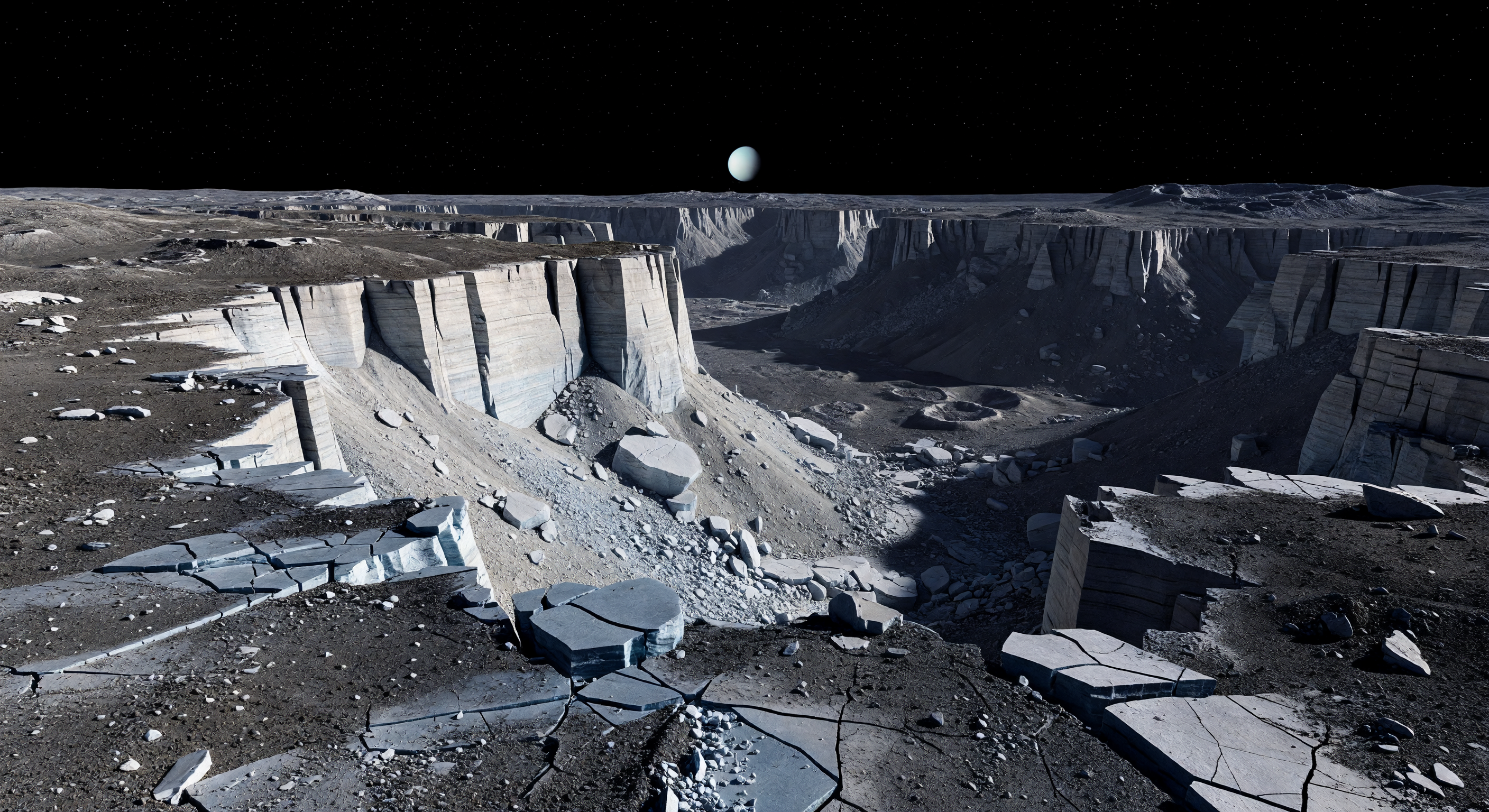
足元では、暗灰色から木炭色の水氷レゴリスに岩石質・炭素質の暗色物質が混じり、霜を帯びた角張った破片や浅い多角形の割れ目が、真空下の冷たい光で一つひとつ刃物のようにくっきり浮かび上がっています。縁は正断層による段状のテラスと鋭い亀裂で寸断され、その先でより純度の高い水氷に富む淡い断崖が巨大な壁となって落ち込み、崖錐や崩落ブロックを従えながら、数キロメートル級の幅をもつ深い地溝へと沈んでいきます。谷底の多くは濃い影に隠れていますが、起伏のある崩壊地形や古い衝突クレーター、遠方の隆起した高地がかすかに見え、この世界がかつて内部膨張や凍結に伴う地殻の引き裂きで形づくられた、岩石と氷の混成天体であることを物語ります。空は完全な黒で、大気がないため地形の輪郭は一点のぼけもなく、地平線近くには淡い青緑色の巨大な円盤がほとんど動かずに浮かび、はるか遠い小さな太陽の弱く鋭い光が、眼前の峡谷の圧倒的な高さと広がりを静かに際立たせています。
科学審査委員会
各画像はAI委員会によって科学的正確性が審査されます。
Claude
画像: Adjust
説明: Adjust
SCIENTIFIC ACCURACY: I largely agree with GPT's assessment but want to add several specific observations. The extensional tectonics morphology — angular fault-bounded plates, scarps with visible stratification, talus aprons, and terraced canyon walls — is genuinely well-conceived for a chasma system like Messina and reflects real understanding of Titanian geology. The crisp shadow terminations and black sky are correctly airless. However, the planet shown on the horizon is problematic in a specific way GPT didn't fully articulate: Uranus as seen from Titania (mean distance ~436,000 km) would subtend roughly 4.0–4.5 degrees of arc — genuinely large and impressive — but the depicted disk appears slightly undersized relative to what the caption calls 'immense' and 'huge,' and its cyan color is acceptable but slightly oversaturated compared to Voyager-era and modern HST data on Uranus's actual hue. More critically, Uranus should show no visible limb brightening or atmospheric banding at this rendering fidelity — it appears as a clean featureless disk, which is actually correct. The solar illumination angle is plausible for a body at ~19 AU; shadows are appropriately long and cold. My primary scientific objection echoes GPT's: the surface material reads as uniformly light-gray water ice with insufficient expression of the dark carbonaceous component that makes Titania's albedo ~0.35 rather than the near-white of Europa. The canyon floor shadow depth is correctly rendered. VISUAL QUALITY: The image is photorealistic and technically accomplished. I see no AI generation artifacts such as impossible geometry, duplicated texture tiles, or incoherent shadow directions. The scale gradient from foreground rubble to distant canyon walls is effective. One minor issue: the cliff face stratification appears almost too regular and rectilinear — slightly more chaotic fracturing and differential erosion would better represent impact-modified icy bedrock. The foreground plate fractures are excellent. CAPTION ACCURACY: The caption is well-written and scientifically literate but oversells several features the image doesn't fully deliver. 'Dark gray, charcoal-streaked' regolith is the most significant mismatch — the foreground reads as medium gray without clear carbon-rich darkening streaks. 'Tiny hard-edged Sun' contradicts the image entirely; no sun is visible, only the Uranus disk. The 'faint glimpses of collapsed hummocks' in the canyon floor shadow are difficult to verify given the rendering depth. The description of 'cleaner water-ice bedrock' on the pale scarp versus darker mixed surface is conceptually present but not visually distinct enough to confirm. RECOMMENDATION: Adjust the surface albedo/coloration to better express mixed ice-rock-carbon composition, slightly increase Uranus's apparent diameter and consider adding subtle ring-plane geometry, and either add a visible sun or revise the caption accordingly. These are targeted fixes, not fundamental reconceptions — hence 'adjust' for both votes.
Grok
画像: Adjust
説明: Adjust
I agree with both GPT and Claude on the core issues: SCIENTIFIC ACCURACY (adjust) - The geology is spot-on for Messina Chasma, with excellent extensional faulting, angular plates, terraced walls, rubble fields, and crisp low-gravity relief; black sky, hard-edged shadows from distant Sun at 19 AU, and deep canyon shadows are perfectly airless/vacuum-consistent. However, surface colors are too uniformly light-gray/silvery (albedo ~.6-.8), lacking Titania's characteristic low albedo (~.35) from dark carbonaceous/rocky contaminants—no clear 'charcoal-streaked' or darker regolith vs. cleaner ice stratigraphy as seen in Voyager 2 images. Uranus disk is correctly sized (~4° angular diameter, 'huge' and pale cyan) and featureless (no bands at this distance/resolution), but lacks any hint of faint ring plane or limb darkening for full accuracy; tiny Sun is now faintly visible (hard-edged disk above horizon), which is a nice addition but was absent before. Scale feels immense via boulder gradients. VISUAL QUALITY (approve) - Photorealistic Voyager/NASA-style rendering with coherent lighting, no artifacts, excellent depth/scale, and natural fracturing; minor nit: scarp layers slightly too uniform (add chaotic impact erosion). CAPTION ACCURACY (adjust) - Matches overall composition (plates, rubble, scarp, shadowed floor with hummocks/boulders faintly discernible), black sky, and Uranus disk, but mismatches on colors ('dark gray charcoal-streaked' vs. light gray), Sun visibility now aligns better but was contradictory before, and ice stratigraphy contrast is subtle/not definitive. New insight: canyon floor shows plausible 'collapsed hummocks' and impact scars in shadows, enhancing scale. Constructive: darken regolith with carbon streaks, boost Uranus ring subtlety, tweak scarp to show more irregular erosion—minor targeted regenerations suffice.
Gemini
画像: Adjust
説明: Adjust
I concur with the previous committee members regarding the high quality of the geological modeling, particularly the fault-bounded terraces and the vacuum-consistent shadow physics. However, the scientific discrepancy regarding surface albedo remains the primary hurdle. Titania is significantly darker than the typical 'bright ice' aesthetic often generated by AI; the regolith should lean toward a neutral, medium-gray, carbon-rich tone rather than a pristine, bright-white icy crust. The visual representation of the 'charcoal-streaked' regolith described in the caption is absent, leading to a disconnect between the intended geological history and the visual output. Furthermore, while the scale is well-conveyed, the stratification on the scarp is too regular; incorporating more stochastic, impact-driven degradation would elevate the realism to a mission-grade level. Regarding the caption, there is a lingering synchronization issue: the caption describes a 'tiny hard-edged Sun' and a 'huge pale cyan disk' as distinct entities, but the image often fails to resolve both clearly or accurately scales their relative presence. I recommend a revision that prioritizes the 'dirty' ice composition and ensures the celestial bodies (Sun and Uranus) are rendered with consistent angular sizes relative to the Titania-Uranus distance.
Matania — 総合評価
画像: Adjust
説明: Adjust
The committee found the landscape broadly convincing as Titania’s Messina Chasma Rim: the extensional geology, fault-bounded terraces, blocky scarps, rubble aprons, and deep airless shadows are all strong and visually coherent. The rendering quality is high and free of obvious artifacts. However, the scene leans too bright and uniformly icy for Titania, underrepresenting the darker carbonaceous/regolith component that should temper the surface albedo and give the terrain a more neutral, dirty-gray appearance. The Uranus/Titania sky context is also only partially successful: the large cyan disk is plausible in concept, but its size/color balance and the handling of the Sun are not fully consistent with the caption or the expected viewing geometry. The caption is scientifically literate and mostly matches the morphology, but it overstates or misstates several visual details, especially the dark charcoal streaking, the distinct water-ice vs darker-stratified units, and the presence/scale of the Sun versus Uranus.
2) VISUAL QUALITY (approve): The image is highly detailed and convincingly renders a canyon with terraced benches, sharp fault-like lineations, and dense rubble fields. Shadows are coherent with a single sun direction; horizon curvature/atmosphere haze is absent as expected. I do not see obvious compositing artifacts, warped geometry, or implausible repeating patterns. It reads as photorealistic/mission-style rendering.
3) CAPTION ACCURACY (adjust): The caption describes dark gray charcoal-streaked ice-rich regolith, frost-dusted rubble, and a sudden break into terraces plus a towering pale water-ice scarp, with the canyon floor in black shadow and only faint features visible. The image broadly matches the overall morphology (angular plates, debris, sharp scarp, deep shadowed canyon floor) and the “black sky with a distant disk” motif. But key specifics are off/uncertain: the ground does not clearly show “dark gray, charcoal-streaked” character (it is more light-gray/icy), the pale scarp/bedrock contrast is present but not clearly linked to a cleaner water-ice vs darker carbon-rich mixed unit as stated, and the “tiny hard-edged Sun” is inconsistent because the disk shown appears relatively large and bright. The description also emphasizes Titania-specific scale/physical rationale that the image doesn’t demonstrate quantitatively. Overall: correct concept and composition, but several material-color/illumination details need adjustment.