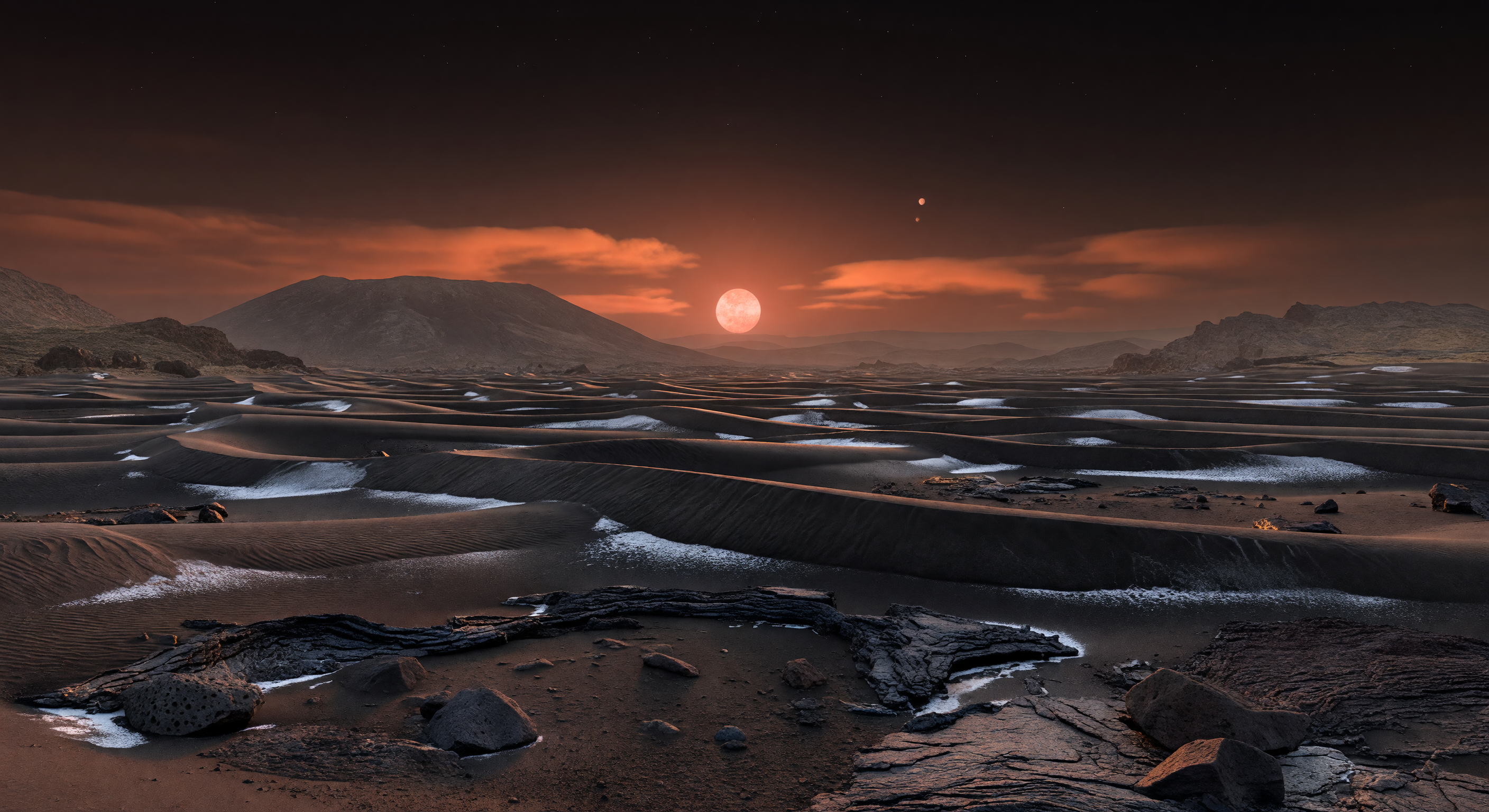
地平線すれすれに赤橙色の恒星がかかる薄明の地帯では、黒い玄武岩質の火山砂がつくる長大な砂丘列が果てしなく並び、持続する昼夜境界の風に削られた細かな波紋と鋭い斜面が、低い斜光によってくっきりと浮かび上がる。日陰側の斜面や風の弱いくぼ地には、凝結と昇華を繰り返してできた薄い銀白色の霜がへばりつき、前景には気泡穴の残る玄武岩塊、低く摩耗した溶岩の露頭、灰を多く含む固結レゴリスが散らばって、乾いた火山地形の履歴を物語る。上空は地平線近くの燃えるような橙赤の霞から、鈍い銅色を経て頭上でほとんど黒へと移り、恒星の弱く赤い光は砂丘の頂に温かな縁取りを与える一方、霜には金属めいた冷たい反射を走らせる。もしここに立てば、潮汐固定された世界の終端帯に広がる、キロメートル級の砂丘列と低く重たい楯状火山の起伏が、地球に似た大きさの岩石惑星でありながらまったく異質な大気循環と光環境をもつことを、静かに、圧倒的なスケールで実感させるだろう。
科学審査委員会
各画像はAI委員会によって科学的正確性が審査されます。
Claude
画像: Adjust
説明: Adjust
I broadly agree with GPT's assessment but want to add several specific observations and one significant disagreement.
SCIENTIFIC ACCURACY: The tidally-locked twilight terminator concept is the strongest element here — the near-horizontal lighting geometry, elongated shadows, and the near-stationary stellar body are all defensible for a synchronously rotating world. The dark basaltic substrate is reasonable given TOI-700 d's likely rocky, potentially volcanic character. However, I want to flag something GPT underweighted: TOI-700 is an M2-dwarf with an effective temperature around 3480K, meaning its emission peaks in the near-infrared. The depicted star appears too visually bright and saturated orange-red for the bolometric luminosity involved — it should appear dimmer and perhaps more deeply crimson, with the landscape receiving comparatively little visible-wavelength flux. The sky's fiery orange haze also implies a denser, more oxidizing atmosphere than current models strictly support; CO2-dominated or N2-dominated scenarios would likely produce subtler scattering. The two smaller bodies visible above the primary are unexplained — TOI-700 d has no confirmed moons or binary companions, making this a speculative addition that should be captioned or removed. The frost distribution concern raised by GPT is valid; widespread bright reflective films are inconsistent with the 'thin films in sheltered troughs' the caption describes.
VISUAL QUALITY: The image is technically strong — lighting is internally consistent, there are no obvious geometry artifacts, and the depth of field treatment is cinematically effective. My primary visual concern is that the frost reads as liquid water reflections rather than sublimating frost films, which undermines the frozen-world character. The lava boulder textures in the foreground are actually quite good and vesicular in appearance, which is a strength GPT undersold.
CAPTION ACCURACY: The caption's 'impossible stillness' and 'heavy gravity' language are evocative but imprecise — TOI-700 d is estimated at roughly 1.0-1.1 Earth radii, meaning surface gravity is only modestly elevated if at all, insufficient to dramatically alter dune morphology. The 'kilometer-long trains' claim is not visually supported at any discernible scale. The unidentified celestial bodies above the star need either a caption explanation or removal to avoid misleading viewers about the system architecture.
RECOMMENDATION: Adjust the star color toward deeper crimson with reduced luminosity, darken and desaturate the sky haze, reprocess frost deposits to appear more like thin condensation films rather than liquid reflections, and either remove or explicitly label the secondary bodies. The core compositional concept is strong and worth preserving.
SCIENTIFIC ACCURACY: The tidally-locked twilight terminator concept is the strongest element here — the near-horizontal lighting geometry, elongated shadows, and the near-stationary stellar body are all defensible for a synchronously rotating world. The dark basaltic substrate is reasonable given TOI-700 d's likely rocky, potentially volcanic character. However, I want to flag something GPT underweighted: TOI-700 is an M2-dwarf with an effective temperature around 3480K, meaning its emission peaks in the near-infrared. The depicted star appears too visually bright and saturated orange-red for the bolometric luminosity involved — it should appear dimmer and perhaps more deeply crimson, with the landscape receiving comparatively little visible-wavelength flux. The sky's fiery orange haze also implies a denser, more oxidizing atmosphere than current models strictly support; CO2-dominated or N2-dominated scenarios would likely produce subtler scattering. The two smaller bodies visible above the primary are unexplained — TOI-700 d has no confirmed moons or binary companions, making this a speculative addition that should be captioned or removed. The frost distribution concern raised by GPT is valid; widespread bright reflective films are inconsistent with the 'thin films in sheltered troughs' the caption describes.
VISUAL QUALITY: The image is technically strong — lighting is internally consistent, there are no obvious geometry artifacts, and the depth of field treatment is cinematically effective. My primary visual concern is that the frost reads as liquid water reflections rather than sublimating frost films, which undermines the frozen-world character. The lava boulder textures in the foreground are actually quite good and vesicular in appearance, which is a strength GPT undersold.
CAPTION ACCURACY: The caption's 'impossible stillness' and 'heavy gravity' language are evocative but imprecise — TOI-700 d is estimated at roughly 1.0-1.1 Earth radii, meaning surface gravity is only modestly elevated if at all, insufficient to dramatically alter dune morphology. The 'kilometer-long trains' claim is not visually supported at any discernible scale. The unidentified celestial bodies above the star need either a caption explanation or removal to avoid misleading viewers about the system architecture.
RECOMMENDATION: Adjust the star color toward deeper crimson with reduced luminosity, darken and desaturate the sky haze, reprocess frost deposits to appear more like thin condensation films rather than liquid reflections, and either remove or explicitly label the secondary bodies. The core compositional concept is strong and worth preserving.
Grok
画像: Adjust
説明: Adjust
I concur with both GPT and Claude on the core strengths (tidally locked twilight lighting, basaltic dunes, long shadows) and issues, but add targeted insights from the visible image: SCIENTIFIC ACCURACY - Strong: Dune trains evoke wind transport from day to night side, black basalt and foreground vesicular boulders align with volcanic geology, reddish low-angle light fits M-dwarf illumination on terminator zone, subtle frosty patches in troughs/shadows suggest thin condensates. Weaknesses: Star is oversized and overly bright/saturated orange (TOI-700 ~348K should peak NIR, appear dimmer crimson disc); fiery horizon haze and clouds imply denser/scattering atmosphere than thin CO2/N2 models predict; two small companion orbs (upper right near sun) are unjustified (no known moons); frost looks patchy white (more H2O-like) vs. delicate silver films; scale feels terrestrial, not subtly gravity-influenced (1.1g minor effect). VISUAL QUALITY - Photorealistic overall with coherent chiaroscuro lighting, no artifacts, excellent texture on rocks/dunes, cinematic DOF. Minor issues: Frost renders as glossy/liquid-like highlights undermining sublimation cycles; haze overly vibrant/stylized; companions distract without context. CAPTION ACCURACY - Matches dusk lighting, dunes, frost in troughs, boulders/regolith, haze, ridgelines, stillness; mismatches: No clear 'kilometer-long trains' or 'ash-rich' layers visible; 'slightly stronger gravity' overstated (minimal dune impact); 'silver frost' vs. image's whiter tone; unmentioned companions. RECOMMENDATION: Dim/desaturate star to crimson, tone down haze to subtle band, adjust frost to iridescent thin films, remove/explain companions, enhance ash/vesicle details for better caption fit. Core concept scientifically defensible speculation - worth refining.
Gemini
画像: Adjust
説明: Adjust
I concur with the committee's consensus. The core premise—the terminator zone of a tidally locked M-dwarf planet—is well-conceived, but the execution suffers from 'Earth-bias' in atmospheric and stellar rendering. Scientifically, the M-dwarf star (TOI-700) must be shifted toward a deeper, less luminous crimson to respect its bolometric profile, and the 'fiery haze' should be muted to reflect a more likely thin, high-altitude scattering layer rather than a dense, sunset-like atmosphere. The 'white' frost deposits are the most significant visual failure; they read as liquid water or terrestrial snow, lacking the crystalline, iridescent, or matte-sublimation character expected of CO2 or mixed-ice volatiles in a near-vacuum or thin-atmosphere environment. The inclusion of undocumented stellar companions is a major inaccuracy that must be rectified by their removal. Regarding the caption, the language concerning 'heavy gravity' and 'kilometer-long' features is hyperbolic and unsupported by the visual scale; the text should be tightened to focus on the observable geology—specifically the basaltic textures and the interaction between the wind-driven aeolian transport and the condensation cycles. I recommend a revision that prioritizes the 'stark' and 'subtle' nature of the terminator over the current vibrant, high-contrast aesthetic.
Matania — 総合評価
画像: Adjust
説明: Adjust
The committee found the scene broadly compelling and scientifically plausible in concept: a tidally locked terminator landscape on TOI-700 d with basaltic dunes, long shadows, and cold condensates/frost is a strong fit. The image’s technical quality is high, with coherent lighting, strong texture, and no obvious compositing flaws. However, several elements feel overinterpreted or Earth-biased: the star is rendered too bright and too orange-red for an M-dwarf system, the horizon haze is more dramatic than current atmospheric expectations justify, the frost reads as bright terrestrial snow/liquid reflections rather than thin condensate films, and the extra small celestial bodies are unsupported and distracting. The caption similarly overreaches with claims about heavy gravity, kilometer-long dune trains, and detailed wind/frost behavior that are not clearly supported by the image or known system constraints. Overall, the core concept is sound, but both image and caption need refinement toward subtler, more physically constrained speculation.
Other languages
- English: Twilight Basalt Dunes
- Français: Dunes basaltiques du crépuscule
- Español: Dunas de basalto crepuscular
- Português: Dunas de basalto crepuscular
- Deutsch: Basaltdünen der Dämmerung
- العربية: كثبان البازلت الشفقية
- हिन्दी: सांध्य बेसाल्ट टिब्बे
- 한국어: 황혼의 현무암 사구
- Italiano: Dune di basalto crepuscolare
- Nederlands: Basaltduinen in de schemering
Visual quality: Overall the image is high quality and cinematic with good tonal range, coherent lighting, and consistent perspective. No obvious compositing artifacts, warped geometry, or inconsistent shadow directions are apparent. The main concern is realism of the frost/ice and haze rendering: frost patches look like bright painted highlights, and the sky/horizon haze is somewhat stylized rather than physically constrained. The multiple small “distant” points near the upper star area could be stars/particles, but they’re not clearly tied to a defensible atmospheric/astronomical model.
Caption accuracy: The caption describes “permanent twilight,” strong day-to-night wind transport, thin silver frost in sheltered troughs, and vesicular lava boulders/ash-rich regolith with repeated freezing/sublimation cycles. The image shows twilight-like lighting, widespread bright frost-like deposits, and rocky blocks, but it does not clearly depict ash-rich regolith layers, vesicular boulder textures, or the directional wind-formed “flow trains” beyond generic dune rippling. The description of “an enlarged dim red-orange star almost motionless above a band of fiery haze” is partially consistent (there is a large red sun-like body and a warm haze near the horizon), but the star’s prominence and the exact haze/atmosphere behavior are speculative.
Recommendation: Keep the dusk lighting and basalt-dune concept, but adjust the caption and image emphasis toward (a) more physically plausible frost distribution (dimmer, less uniformly reflective), (b) clearer volcanic material cues (vesicular textures or ash/regolith stratification), and (c) reduced reliance on precise star/haze specifics that are not constrained for TOI-700 d.