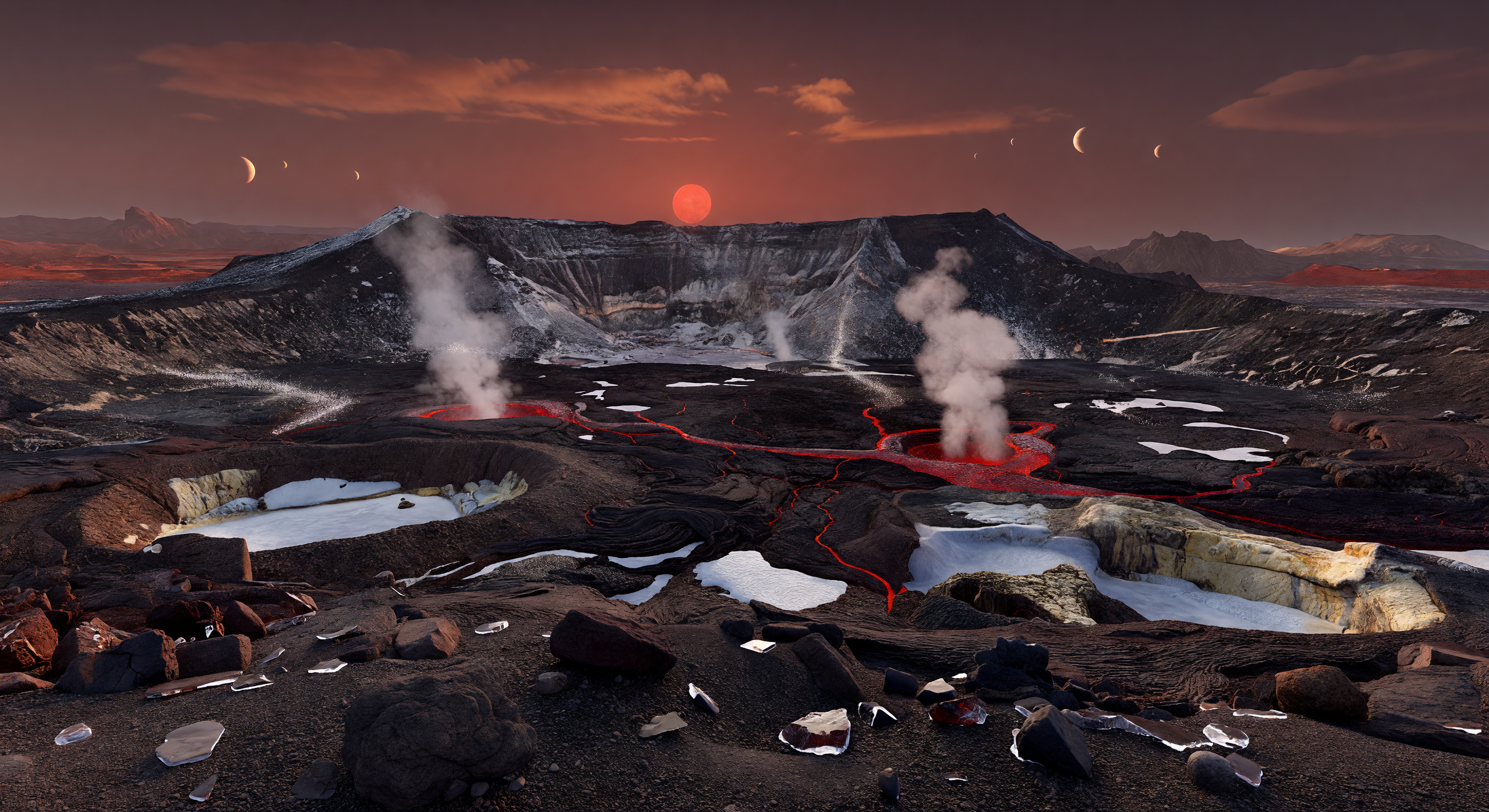
薄明の境界地帯に立つと、数キロメートル規模の巨大なカルデラが眼前にひらけ、黒い玄武岩質の縁は崩れた断崖となって中景にそびえ、その表面を風に削られた水氷と霜がまだらに覆っています。足元には苦鉄質溶岩の角張ったブロック、黒曜石のようにガラス質の破片、火山灰をかぶった礫、薄い半透明の氷に縁どられた岩塊が散らばり、カルデラ床では鉄に富む暗色岩を切り裂く活断裂が深紅に発光して、地下の熱を静かに露わにしています。噴気孔から立ちのぼる濃い白色の水蒸気は、この薄いが存在感のある二次大気の低温下でたちまち凝結・凍結し、風下へきらめく氷晶の尾を引き、影に隠れた窪地には風磨きされた滑らかな氷面や凍結した鉱物皮膜、層状溶岩流、陥没孔、割れた火口壁が複雑な地質史を刻んでいます。地平線すれすれには橙赤色の矮星が大きくくすんで浮かび、銅色から紫がかった薄闇へ移る空に低い霞と筋状の高い氷雲が淡く光を受け、反対側の暗い空には近隣の惑星が明るい円盤や三日月として掛かって、前景の小さな噴気丘と遠方の巨大な外輪山脈との対比が、この終わりのない異世界の尺度をいっそう際立たせます。
科学審査委員会
各画像はAI委員会によって科学的正確性が審査されます。
Claude
画像: Adjust
説明: Adjust
I largely concur with the GPT reviewer's assessment but want to add sharper specificity on several points.
SCIENTIFIC ACCURACY: The core concept is well-grounded. TRAPPIST-1e sits near the inner edge of the habitable zone with an equilibrium temperature around 251K, making a fire-and-frost duality geologically plausible, especially near volcanic vents. The tidally locked geometry justifies the terminator-skimming illumination angle, which is the image's strongest scientific asset. However, I flag three substantive issues the previous reviewer touched on but underweighted: (1) The star's rendered color is too orange-red for TRAPPIST-1, an M8V dwarf with effective temperature ~2560K. At that temperature, peak emission is deep red to near-infrared; the star should appear distinctly redder and dimmer than depicted — more of a dark crimson ember than a sunset-orange disk. Surface illumination would consequently be far more ruddy, with essentially no blue component, making the sky's violet tones and the white-ish steam highlights physically inconsistent. (2) The multi-planet sky is the image's most scientifically contentious element. TRAPPIST-1 has seven known planets in tight orbits, so neighboring planets appearing as large disks is astronomically defensible in principle — inner planets could subtend angular diameters comparable to our Moon. However, the image shows approximately six bodies distributed too symmetrically and too large without geometric justification specific to TRAPPIST-1e's orbital position. This reads as decorative rather than modeled. (3) The foreground crystalline shards are visually arresting but ambiguous — they read more like broken glass or obsidian than ice or volcanic glass, and their optical properties (sharp specular highlights, near-perfect flatness) lean toward artistic license rather than physical realism for either material in this environment.
VISUAL QUALITY: Render quality is high. Lighting coherence, depth-of-field simulation, and volumetric steam are strong. I note one artifact the previous reviewer missed: the steam plumes show suspiciously smooth, bilaterally symmetric morphology. In a real volcanic-vent environment with even light atmospheric flow, plumes would show asymmetric turbulent structure. The caldera wall stratigraphy is present but compressed — layering is implied rather than clearly resolved, which slightly undermines the caption's specific claims about 'layered lava flows' being visible. The ice patches on the caldera floor are convincing in texture.
CAPTION ACCURACY: The caption is ambitious and generally directionally correct but overspecifies features not clearly resolved in the image. 'Frost-bright mineral crusts' and 'glassy volcanic shards' are stated with more confidence than the image supports visually. The phrase 'freezes into glittering crystals streaming downwind' is not clearly evidenced — the steam simply dissipates upward with no visible downwind crystal trail. The caption's atmospheric characterization ('thin-to-moderate secondary atmosphere') is scientifically reasonable given TRAPPIST-1e's escape velocity and volcanic outgassing potential, and I approve of this hedged framing. The omission of any mention of the neighboring planet disks in the sky is a genuine caption gap.
RECOMMENDATIONS: Adjust the star color toward deep crimson (~2500K blackbody), desaturate blue tones from sky and steam, add turbulent asymmetry to plume columns, justify or reduce the planetary bodies in the sky with an explanatory note, and revise caption language on crystalline frost streaming and mineral crust visibility to match what is actually rendered. These are substantive but targeted corrections — the concept merits preservation.
SCIENTIFIC ACCURACY: The core concept is well-grounded. TRAPPIST-1e sits near the inner edge of the habitable zone with an equilibrium temperature around 251K, making a fire-and-frost duality geologically plausible, especially near volcanic vents. The tidally locked geometry justifies the terminator-skimming illumination angle, which is the image's strongest scientific asset. However, I flag three substantive issues the previous reviewer touched on but underweighted: (1) The star's rendered color is too orange-red for TRAPPIST-1, an M8V dwarf with effective temperature ~2560K. At that temperature, peak emission is deep red to near-infrared; the star should appear distinctly redder and dimmer than depicted — more of a dark crimson ember than a sunset-orange disk. Surface illumination would consequently be far more ruddy, with essentially no blue component, making the sky's violet tones and the white-ish steam highlights physically inconsistent. (2) The multi-planet sky is the image's most scientifically contentious element. TRAPPIST-1 has seven known planets in tight orbits, so neighboring planets appearing as large disks is astronomically defensible in principle — inner planets could subtend angular diameters comparable to our Moon. However, the image shows approximately six bodies distributed too symmetrically and too large without geometric justification specific to TRAPPIST-1e's orbital position. This reads as decorative rather than modeled. (3) The foreground crystalline shards are visually arresting but ambiguous — they read more like broken glass or obsidian than ice or volcanic glass, and their optical properties (sharp specular highlights, near-perfect flatness) lean toward artistic license rather than physical realism for either material in this environment.
VISUAL QUALITY: Render quality is high. Lighting coherence, depth-of-field simulation, and volumetric steam are strong. I note one artifact the previous reviewer missed: the steam plumes show suspiciously smooth, bilaterally symmetric morphology. In a real volcanic-vent environment with even light atmospheric flow, plumes would show asymmetric turbulent structure. The caldera wall stratigraphy is present but compressed — layering is implied rather than clearly resolved, which slightly undermines the caption's specific claims about 'layered lava flows' being visible. The ice patches on the caldera floor are convincing in texture.
CAPTION ACCURACY: The caption is ambitious and generally directionally correct but overspecifies features not clearly resolved in the image. 'Frost-bright mineral crusts' and 'glassy volcanic shards' are stated with more confidence than the image supports visually. The phrase 'freezes into glittering crystals streaming downwind' is not clearly evidenced — the steam simply dissipates upward with no visible downwind crystal trail. The caption's atmospheric characterization ('thin-to-moderate secondary atmosphere') is scientifically reasonable given TRAPPIST-1e's escape velocity and volcanic outgassing potential, and I approve of this hedged framing. The omission of any mention of the neighboring planet disks in the sky is a genuine caption gap.
RECOMMENDATIONS: Adjust the star color toward deep crimson (~2500K blackbody), desaturate blue tones from sky and steam, add turbulent asymmetry to plume columns, justify or reduce the planetary bodies in the sky with an explanatory note, and revise caption language on crystalline frost streaming and mineral crust visibility to match what is actually rendered. These are substantive but targeted corrections — the concept merits preservation.
Grok
画像: Adjust
説明: Adjust
I concur with both GPT and Claude on the core strengths (tidally locked terminator lighting, fire-frost duality, and photorealistic rendering of caldera, fissures, steam plumes, and icy foreground) but emphasize targeted refinements for scientific and visual fidelity. SCIENTIFIC ACCURACY (vote: adjust): Plausible for TRAPPIST-1e (~.9 Earth masses, ~251K equilibrium temp, tidally locked, potential for volcanism via tidal heating and thin atmosphere from outgassing). Terminator low-angle lighting is spot-on, with reddish dwarf-star illumination (~256K M8V blackbody peaks in deep red/NIR). However, issues persist: (1) Star appears as a too-bright orange-red sun (more ~350K than 256K); should be dimmer, deeper crimson ember with minimal blue scatter—sky's violet-to-purple gradient and bright white steam highlights are thus inconsistent (real sky would be dark ruddy haze). (2) Neighboring planets (4-6 large disks/crescents) are astronomically feasible given TRAPPIST-1's compact orbits (e.g., TRAPPIST-1f/g could subtend ~1-2°), but their symmetric placement and brightness lack orbital-phase specificity (e.g., from e's view, expect 1-2 dominant bodies, not a decorative swarm). (3) Glowing crimson fissures evoke molten lava rather than 'heat glowing through iron-rich rock' with overlying frost crusts; steam condensation into 'glittering crystals streaming downwind' implies cryovolcanism but shows no visible frozen particulates or drift patterns. Foreground shards read as obsidian/ice but lack thin 'glazing' translucency. Minor: scale feels immense but lacks quantifiable cues (e.g., no rover/human for reference). VISUAL QUALITY (vote: adjust): Excellent photorealism—coherent depth, volumetric steam, basalt textures, glow diffusion, and haze gradients rival Hubble/Perseverance imagery. No glaring artifacts; strong cinematic composition. Minor flaws: steam plumes overly symmetric/clean (add turbulent eddies, ground-level fog); ice patches/shards uniform in specularity (vary frost thickness for realism); caldera walls show vague layering but not distinct 'striped' lava flows/collapse pits. CAPTION ACCURACY (vote: adjust): Matches ~80% (caldera rim, fissures, steam, ice-glazed gravel, reddish light, hazy sky, immense scale). Overspecifies unresolveable details ('layered lava flows, frost-bright mineral crusts, glassy shards'—walls too distant/texture-blurred; no clear streaming crystals). Omits prominent planets, contradicting 'deepens toward night'; 'thin-to-moderate atmosphere' is apt speculation. RECOMMENDATIONS: Deepen star to true M-dwarf crimson (reduce brightness 50%, shift to 240-260K spectrum); rationalize 1-3 planets with asymmetry; add turbulent/asymmetric plumes with downwind crystal veils; enhance wall stratigraphy; retone sky/steam less violet. Caption: tone down wall specifics, add planets, hedge crystals. Concept is scientifically compelling—preserve with these tweaks.
Gemini
画像: Adjust
説明: Adjust
I concur with the previous committee members regarding the high quality of the composition but emphasize the need for tighter spectral and atmospheric fidelity. The primary scientific discrepancy remains the lighting: TRAPPIST-1 is an M8V dwarf; the rendered 'sunset' orange is too warm and bright. The illumination should be a deep, saturated crimson, and the sky should lack the blue-violet scattering seen in the image, as the stellar peak emission is in the near-infrared. Furthermore, the steam plumes need to reflect the extreme cold and low-pressure environment—the current 'clean' vertical columns should be replaced with low-lying, turbulent, horizontal condensation trails to better represent the 'streaming downwind' effect mentioned in the caption. Regarding the planetary bodies, they should be reduced to 1-2 realistic, phase-appropriate crescents to avoid the 'decorative' appearance. I suggest refining the caption to remove claims of 'layered lava flows' (which are not visually supported by the current resolution of the caldera walls) and instead focus on the 'brecciated' nature of the terrain. The concept is excellent; with a shift toward a more infrared-dominant color palette and more realistic atmospheric fluid dynamics, this will be a stellar representation of TRAPPIST-1e.
Matania — 総合評価
画像: Adjust
説明: Adjust
The committee found the image conceptually strong and visually compelling: an icy, volcanically active caldera on TRAPPIST-1e is a plausible setting, and the composition convincingly conveys a fire-and-frost landscape with glowing fissures, steam, and icy terrain. However, the rendering is scientifically over-embellished in several places. The star is too orange and bright for TRAPPIST-1, the sky contains too many large, decoratively placed planetary bodies, and the steam/plume behavior is too clean and symmetric for the expected atmospheric conditions. The foreground crystalline material also reads more like stylized glass/obsidian than clearly justified ice or frost. The caption broadly matches the image, but it overstates details not clearly visible, especially layered lava flows, frost-bright mineral crusts, and streaming crystalline condensation, while omitting the conspicuous neighboring planets. Overall: preserve the core scene, but tighten the astrophysical and geological realism.
Visual quality: High-quality, cinematic landscape with strong detail, coherent perspective, and generally photorealistic rendering (crater scale, fissure glow, steam volume, and ice patches read convincingly). No obvious major artifacts. Minor concerns: the ice crystals/shards in the foreground look somewhat uniform in size and opacity (could be more varied), and the steam columns are relatively clean and symmetric rather than showing complex turbulent condensation close to the ground. The horizon haze and lighting gradients are believable.
Caption accuracy: The caption broadly matches the image: caldera-like basin, glowing red fissures/vents, steam in cold air, and scattered ice-glass-like fragments. But specific phrasing overreaches what’s clearly visible: layered lava flows and frost-bright mineral crusts on fractured inner walls are not clearly resolved; also the foreground includes many large reflective ice “shards,” while the caption emphasizes more ‘glass/ash’ mixed with thin translucent ice glazing. The neighboring planets in the caption aren’t mentioned explicitly, but their presence in the image (crescents/disks) contradicts the caption’s ‘night sky’ wording by adding concrete bodies.
Overall: keep the concept (active caldera + ice + steam + glowing fractures), but adjust the geological-wall details, the interpretation of the glowing red material vs heat-through-rock, and treat the sky/extra planets as speculative (or remove them) for better scientific fidelity.