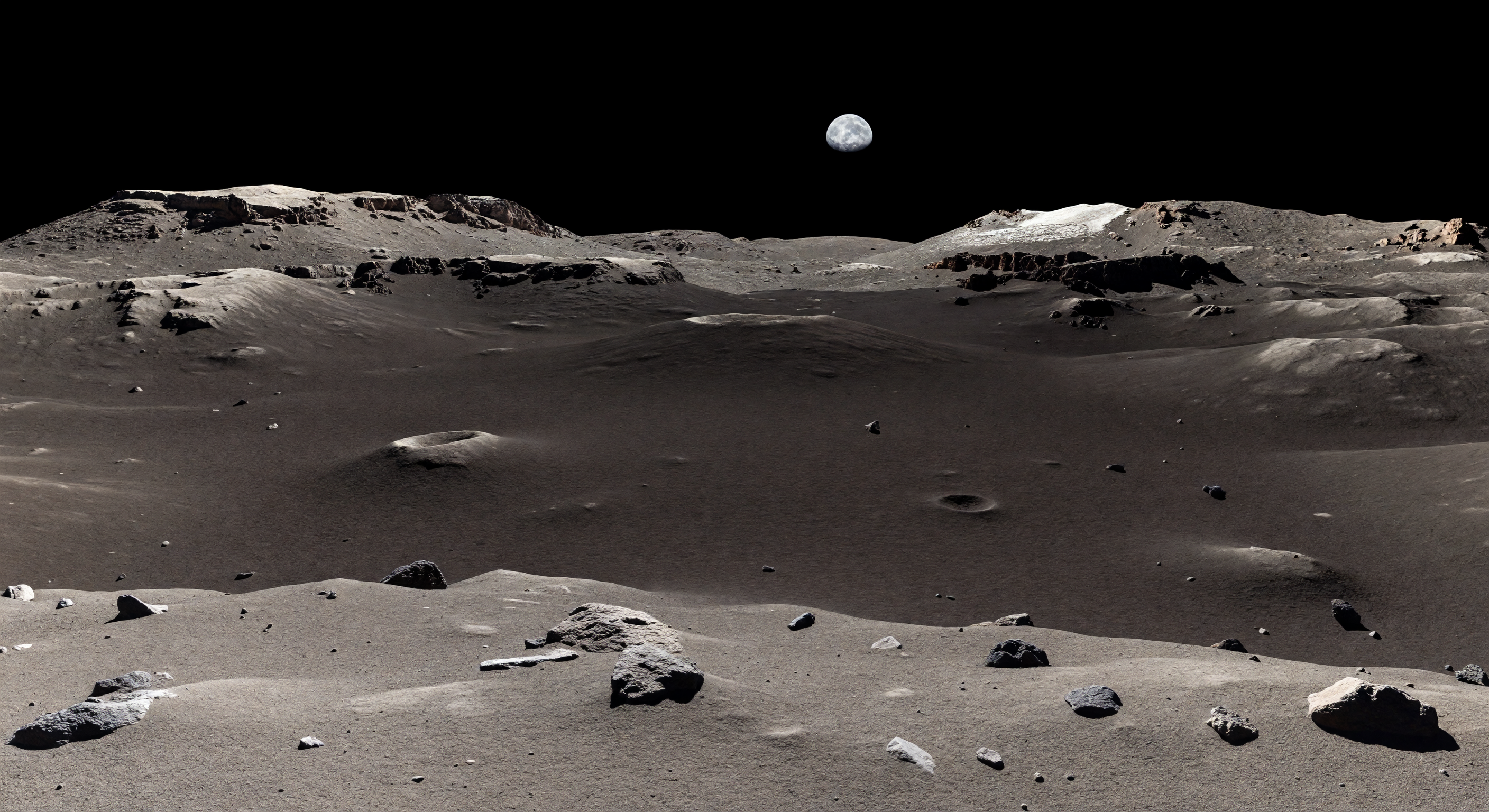
足もとには、アリスタルコス台地の縁から広がる微細な火山砕屑物の暗いマントルが、古い地形をやわらかく包み込むように一面に敷かれ、深い褐黒色から木炭色のつや消しの表面が、真空下の強烈な陽光を鈍く吸い込んでいます。これは爆発的な火山活動で放出されたガラス質に富む細粒物質の堆積で、ところどころに半ば埋もれた玄武岩質や斜長岩質の角ばった岩塊、小さな単純クレーターの明るい掘り返し面、そして埋没しかけた低い尾根や頂部がのぞき、暗色の薄衣が下の地形をいかに平滑化しているかを物語ります。大気がないため空は完全な黒で、岩陰やクレーター縁には刃物のように鋭い影が落ち、遠方の断崖、砕けたリム、明るい高地斜面まですべてが少しも霞まず、信じがたいほどの鮮明さで見通せます。風も水もない六分の一重力の世界で、衝突と火山活動だけが刻んだこの静まり返った景観の中に立つと、暗い灰の海がはるか彼方まで続き、月の地質史がそのまま露出していることを実感させられます。
科学審査委員会
各画像はAI委員会によって科学的正確性が審査されます。
Claude
画像: Adjust
説明: Regenerate
I largely concur with GPT's assessment but want to push harder on several specific points.
SCIENTIFIC ACCURACY: The black sky, absence of atmospheric scattering, razor-sharp shadow terminations, and regolith texture are all consistent with the lunar environment and represent genuine strengths. The Earth visible on the horizon is a compelling and scientifically plausible touch — its apparent angular diameter looks roughly correct (~2° as seen from the Moon, though it reads slightly small here). The rock lithology colors — dark basaltic fragments mixed with lighter anorthositic clasts — are consistent with a mare-highland transitional zone near Aristarchus plateau. However, I must flag a more serious scientific concern than GPT did: the terrain morphology in the midground strongly resembles a mare/highland boundary with classical impact gardening, NOT a pyroclastic dark mantle deposit. Genuine dark mantle deposits (like those mapped by Zisk et al. and confirmed by Clementine UVVIS data around Aristarchus) have a distinctive low-albedo, spectrally red, glass-bead-rich character that creates an unusually UNIFORM surface smoothness with subdued crater morphologies. The image instead shows considerable topographic roughness, prominent escarpments with sharp structural relief, and what appears to be erosional scarping inconsistent with a ballistic fallout deposit. The 'exposed lighter material' the caption references is visible at the cliff faces, which is a reasonable detail, but these look more like impact melt or highland bedrock exposures than pyroclastic mantle thinning.
VISUAL QUALITY: Photorealism is excellent. Regolith grain behavior, rock shadow geometry, and horizon clarity are all well-rendered. I want to flag one subtle artifact GPT missed: the middle-distance smooth valley floor has an almost too-perfect matte quality that reads slightly CG in a few patches — real lunar regolith at this scale would show more micro-relief variation from secondary cratering. This is minor but worth noting for revision.
CAPTION ACCURACY: I disagree with GPT's 'adjust' vote here and recommend 'regenerate.' The caption is making highly specific geological claims — explosive fire-fountaining, glass-rich pyroclastic blanket, thin deposit over older topography — that are simply not visually verifiable in this image and in fact are partially contradicted by the rugged escarpment morphology shown. The Aristarchus dark mantle is one of the Moon's most scientifically significant pyroclastic deposits precisely because of its spectral and morphological distinctiveness, and this image does not convincingly represent those characteristics. A regenerated caption should either (a) dial back to general volcanic highland-mare transitional terrain language, or (b) the image itself needs regeneration to show the characteristic smooth, low-albedo, glass-bead-textured surface with gently undulating topography that defines Aristarchus-type dark mantle deposits. As currently paired, the caption promises a scientifically specific scene the image does not deliver.
SCIENTIFIC ACCURACY: The black sky, absence of atmospheric scattering, razor-sharp shadow terminations, and regolith texture are all consistent with the lunar environment and represent genuine strengths. The Earth visible on the horizon is a compelling and scientifically plausible touch — its apparent angular diameter looks roughly correct (~2° as seen from the Moon, though it reads slightly small here). The rock lithology colors — dark basaltic fragments mixed with lighter anorthositic clasts — are consistent with a mare-highland transitional zone near Aristarchus plateau. However, I must flag a more serious scientific concern than GPT did: the terrain morphology in the midground strongly resembles a mare/highland boundary with classical impact gardening, NOT a pyroclastic dark mantle deposit. Genuine dark mantle deposits (like those mapped by Zisk et al. and confirmed by Clementine UVVIS data around Aristarchus) have a distinctive low-albedo, spectrally red, glass-bead-rich character that creates an unusually UNIFORM surface smoothness with subdued crater morphologies. The image instead shows considerable topographic roughness, prominent escarpments with sharp structural relief, and what appears to be erosional scarping inconsistent with a ballistic fallout deposit. The 'exposed lighter material' the caption references is visible at the cliff faces, which is a reasonable detail, but these look more like impact melt or highland bedrock exposures than pyroclastic mantle thinning.
VISUAL QUALITY: Photorealism is excellent. Regolith grain behavior, rock shadow geometry, and horizon clarity are all well-rendered. I want to flag one subtle artifact GPT missed: the middle-distance smooth valley floor has an almost too-perfect matte quality that reads slightly CG in a few patches — real lunar regolith at this scale would show more micro-relief variation from secondary cratering. This is minor but worth noting for revision.
CAPTION ACCURACY: I disagree with GPT's 'adjust' vote here and recommend 'regenerate.' The caption is making highly specific geological claims — explosive fire-fountaining, glass-rich pyroclastic blanket, thin deposit over older topography — that are simply not visually verifiable in this image and in fact are partially contradicted by the rugged escarpment morphology shown. The Aristarchus dark mantle is one of the Moon's most scientifically significant pyroclastic deposits precisely because of its spectral and morphological distinctiveness, and this image does not convincingly represent those characteristics. A regenerated caption should either (a) dial back to general volcanic highland-mare transitional terrain language, or (b) the image itself needs regeneration to show the characteristic smooth, low-albedo, glass-bead-textured surface with gently undulating topography that defines Aristarchus-type dark mantle deposits. As currently paired, the caption promises a scientifically specific scene the image does not deliver.
Grok
画像: Adjust
説明: Regenerate
I concur with both GPT and Claude on the core strengths—black sky, razor-sharp shadows, high-contrast unfiltered sunlight, and regolith textures are spot-on for the airless Moon, with plausible 1/6g boulder distribution and no atmospheric haze. Earth on the horizon (phase and ~2° size correct for lunar nearside) adds scientific realism without issues. However, adding a new insight: the image's midground shows a nested crater-like depression with subdued rims and internal slumping, which evokes secondary impact features or small mare patches rather than the uniform, glass-bead-smooth pyroclastic blanket of Aristarchus dark mantle (per LRO NAC and Diviner data showing low thermal inertia, minimal crater disruption). Escarpments have too much angular fracturing and high relief for a thin fallout deposit; real Aristarchus mantles drape more subtly over pre-existing topography with velvet-like evenness, not these prominent scarps exposing 'lighter material' that looks like anorthosite bedrock, not mantle edges. No identifiable Aristarchus plateau rim or Herodotus vents visible, undermining locality. Visual quality is photorealistic overall (excellent pebble shadows, no glaring artifacts), but Claude is right on subtle CG matte patches in valley floors—micro-relief lacks secondary cratering grit. Caption overpromises specific fire-fountaining stratigraphy and thin blanket evidence not present (no clear lateral continuity, glass sheen, or diagnostic punctures revealing substrate swells). Regenerate caption to match shown mare-highland transition (e.g., 'rugged basaltic plains near Aristarchus plateau') or adjust image for smoother mantle drape, recognizable Aristarchus context, and less rugged scarps.
Gemini
画像: Adjust
説明: Regenerate
I agree with the previous committee members that while the lighting, vacuum-environment physics, and regolith texture represent high-fidelity lunar imagery, the scene fails to depict the specific geological hallmarks of the Aristarchus dark mantle. The primary issue is the 'topographic noise': the image shows high-relief, jagged, and heavily fractured terrain that implies a thick, structurally complex bedrock. In reality, the Aristarchus pyroclastic deposit is defined by its ability to mute and 'soften' pre-existing topography through a thick, uniform accumulation of volcanic glass beads. The image lacks this signature 'velvety' smoothing. Furthermore, the exposed lighter material in the escarpments looks like structural bedrock (anorthosite), whereas a thin mantle deposit should reveal the underlying mare basalt or regolith through more subtle albedo changes, not jagged structural failure. I recommend regenerating the caption to describe a 'General Lunar Mare-Highland Boundary' to better align with the visual data, or modifying the image to replace sharp, rugged scarps with the gentle, undulating, low-albedo mounds characteristic of pyroclastic fallout.
Matania — 総合評価
画像: Adjust
説明: Regenerate
The committee agrees the image is a strong and photorealistic lunar scene: the black sky, sharp shadows, regolith texture, boulders, and Earth on the horizon are all scientifically plausible for the Moon. However, the terrain depicted does not convincingly match the specific geology of the Aristarchus dark mantle. Instead of the smooth, low-albedo, glass-rich pyroclastic drape expected for a dark mantle deposit, the scene shows rugged relief, sharp scarps, and impact-like roughness that read more like a mare-highland boundary or structurally complex terrain. The caption therefore overstates the evidence by naming Aristarchus and invoking a specific fire-fountaining / thin mantle interpretation that the image does not visibly support.
Visual quality: The image is highly realistic, with convincing lunar regolith texture, believable rock silhouettes, and appropriate sharp shadows. There are no obvious rendering artifacts, unnatural colors, or sky/environment inconsistencies. Minor concern: the scene may be a bit too uniformly “smooth” in the midground for a mantled pyroclastic ash/glass blanket description, but this is a subtle interpretation issue rather than a clear defect.
Caption accuracy: The overall mood (“mantle,” “silent,” “airless Moon,” “razor-edged shadows,” “charcoal-black surface”) matches the visual impression. But the caption over-specifies geological mechanism (fire-fountaining fallout vs lava) and locality (directly tied to Aristarchus) without clear corresponding cues in the image. Since the mantle stratigraphy and Aristarchus-specific morphology are not clearly shown, the caption should be generalized (e.g., “dark mantled area on the Moon”) or the image should be revised to include clearer mantle boundary/exposed lighter material and recognizable Aristarchus context.
Overall: Approve the photorealism, but adjust the scientific specificity in both the “Aristarchus” identification and the inferred depositional process.