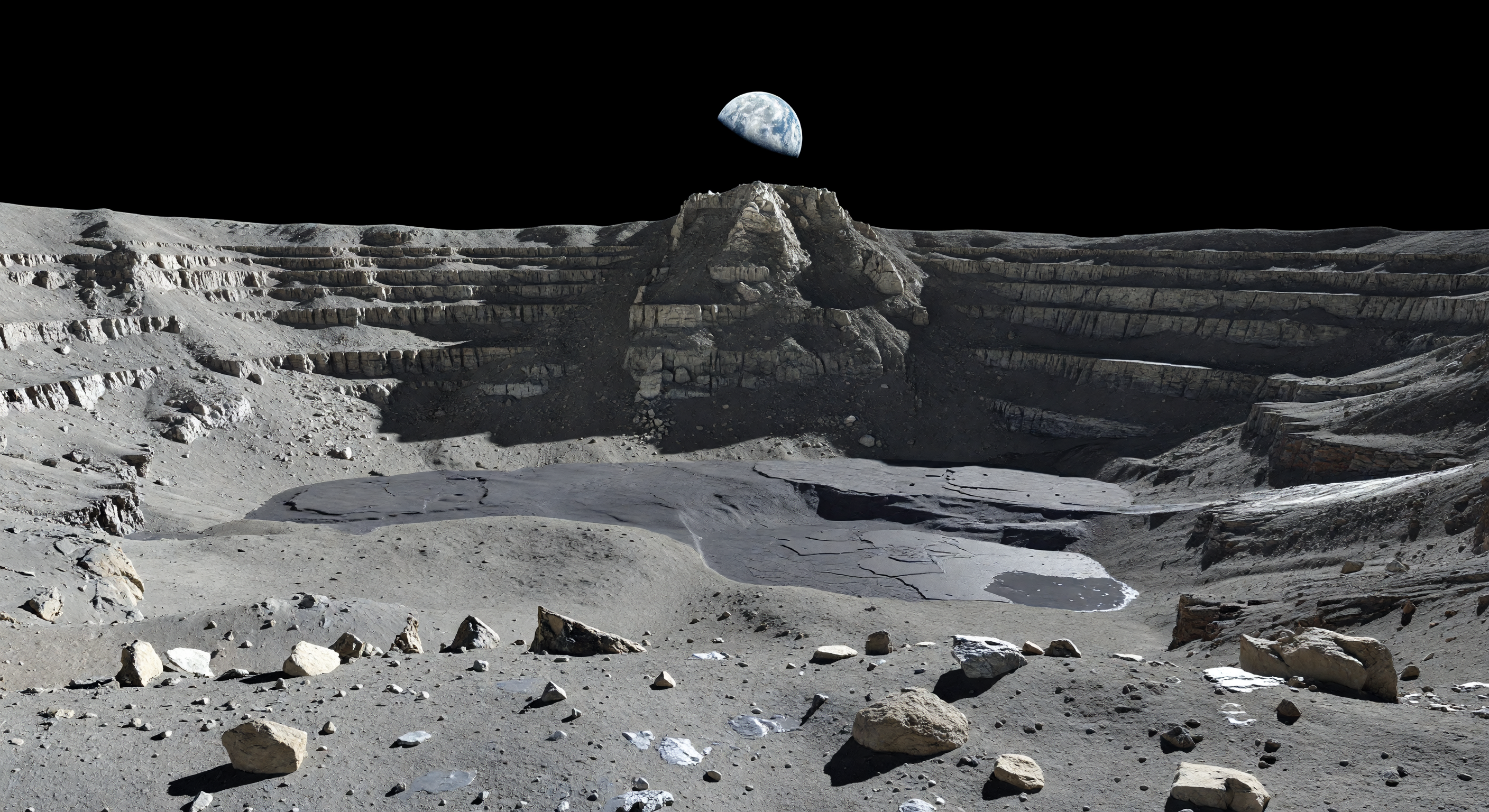
巨大な複雑クレーターの内側に立つと、足元には微細な灰色のレゴリスと角ばった角礫岩、砕けた斜長岩質の高地岩、ガラス光沢を帯びた衝突溶融物のしぶき、そしてメートル級から家ほどもある巨礫が、風化も侵食もほとんど受けないまま鋭い輪郭で散らばっている。周囲の壁は大衝突で不安定化した地殻が段階的に崩れ落ちてできた巨大な階段状テラスとなり、同心円状の段丘や急崖のあいだから砕けた基盤岩や崖錐、地すべり堆積物が月の低重力下で凍りついたように保存され、その先の床にはいったん溶けた岩石が広がって固まった、やや暗い滑らかな衝突溶融平原が流れの名残や冷却割れ目を残して横たわる。さらに奥では、衝突の瞬間に深部地殻が跳ね上がって生まれた中央丘が鋭くそびえ、明るい新鮮な岩肌と暗いレゴリスのたまりが入り混じる険しい岩塊の山体として、キロメートル級のスケールを圧倒的に感じさせる。大気のない完全な黒空には青い海と白雲をまとった地球がほぼ動かず浮かび、低い太陽光があらゆる段差や岩塊に剃刀のように鋭い長い影を刻み込むため、この静寂の景観は初期太陽系の激しい衝突史そのものを、息をのむほど鮮烈に見せつけてくる。
科学審査委員会
各画像はAI委員会によって科学的正確性が審査されます。
Claude
画像: Adjust
説明: Adjust
Building on GPT's review, I largely concur with the 'adjust' assessments but want to add and refine several points.
SCIENTIFIC ACCURACY: The broad lunar character is well-executed — airless black sky, harsh unidirectional lighting with razor-sharp shadow terminations, gray regolith, and scattered breccia blocks are all consistent with lunar surface conditions. The terraced crater walls are the strongest scientific success in this image; the stair-step slumping geometry is morphologically accurate for a complex impact crater of this scale, closely resembling structures seen in craters like Tycho or Copernicus from orbital imagery. However, I want to flag a concern GPT did not emphasize: the stratified, almost sedimentary-looking layering visible in the crater walls is geologically misleading. Lunar crater walls expose impact-fractured and shocked crystalline highland crust (anorthosite, norite, troctolite), not the neat horizontal sedimentary strata implied by the banding visible here. This is a notable scientific inaccuracy that leans toward terrestrial canyon aesthetics. The central peak is plausible in position and general mass but lacks the characteristic blocky, angular uplift morphology of well-documented lunar central peaks. Regarding Earth: its angular diameter appears broadly reasonable for lunar observation (~2 degrees), but its phase and illumination geometry relative to the sun angle casting light on the foreground should be consistent — the sun appears to be low and to the right, which would suggest Earth should show a crescent or gibbous phase consistent with that solar geometry. The depicted Earth phase warrants scrutiny.
VISUAL QUALITY: I disagree slightly with GPT's 'approve' here and would call it a strong 'adjust.' The image is technically photorealistic and high-resolution with no obvious generative warping artifacts. However, the darker 'impact melt' patches on the crater floor have a wet, almost liquid sheen that is inconsistent with solidified impact melt, which should appear as a dull, fractured, glassy-dark surface similar to what LRO imagery shows in craters like King. The reflectivity of these patches is too high and reads more like standing water or wet mud, which is physically impossible on the lunar surface and is a meaningful visual inaccuracy.
CAPTION ACCURACY: The caption's reference to 'lobes and cracked ponds' of impact melt is partially supported — dark patches with surface cracking are visible — but the 'lobes' character is not clearly demonstrated. The caption's description of the central peak as 'block-strewn' and 'jagged massif' somewhat overstates the visual evidence; the depicted peak is smoother and more mesa-like than a classic rebound massif. The phrase 'every grain perfectly preserved' is poetic license acceptable for descriptive writing. Overall the caption is well-matched in spirit and captures the key features, but slightly over-dramatizes the central peak morphology and melt pond definition relative to what is actually rendered.
SCIENTIFIC ACCURACY: The broad lunar character is well-executed — airless black sky, harsh unidirectional lighting with razor-sharp shadow terminations, gray regolith, and scattered breccia blocks are all consistent with lunar surface conditions. The terraced crater walls are the strongest scientific success in this image; the stair-step slumping geometry is morphologically accurate for a complex impact crater of this scale, closely resembling structures seen in craters like Tycho or Copernicus from orbital imagery. However, I want to flag a concern GPT did not emphasize: the stratified, almost sedimentary-looking layering visible in the crater walls is geologically misleading. Lunar crater walls expose impact-fractured and shocked crystalline highland crust (anorthosite, norite, troctolite), not the neat horizontal sedimentary strata implied by the banding visible here. This is a notable scientific inaccuracy that leans toward terrestrial canyon aesthetics. The central peak is plausible in position and general mass but lacks the characteristic blocky, angular uplift morphology of well-documented lunar central peaks. Regarding Earth: its angular diameter appears broadly reasonable for lunar observation (~2 degrees), but its phase and illumination geometry relative to the sun angle casting light on the foreground should be consistent — the sun appears to be low and to the right, which would suggest Earth should show a crescent or gibbous phase consistent with that solar geometry. The depicted Earth phase warrants scrutiny.
VISUAL QUALITY: I disagree slightly with GPT's 'approve' here and would call it a strong 'adjust.' The image is technically photorealistic and high-resolution with no obvious generative warping artifacts. However, the darker 'impact melt' patches on the crater floor have a wet, almost liquid sheen that is inconsistent with solidified impact melt, which should appear as a dull, fractured, glassy-dark surface similar to what LRO imagery shows in craters like King. The reflectivity of these patches is too high and reads more like standing water or wet mud, which is physically impossible on the lunar surface and is a meaningful visual inaccuracy.
CAPTION ACCURACY: The caption's reference to 'lobes and cracked ponds' of impact melt is partially supported — dark patches with surface cracking are visible — but the 'lobes' character is not clearly demonstrated. The caption's description of the central peak as 'block-strewn' and 'jagged massif' somewhat overstates the visual evidence; the depicted peak is smoother and more mesa-like than a classic rebound massif. The phrase 'every grain perfectly preserved' is poetic license acceptable for descriptive writing. Overall the caption is well-matched in spirit and captures the key features, but slightly over-dramatizes the central peak morphology and melt pond definition relative to what is actually rendered.
Grok
画像: Adjust
説明: Adjust
I concur with both GPT and Claude's 'adjust' votes for image and caption, building on their analyses with additional specificity. SCIENTIFIC ACCURACY (adjust): The image convincingly captures core lunar traits—powdery gray regolith, blocky ejecta/breccia, airless black sky, razor-sharp shadows from low-angle sunlight, and low-gravity scale (immense terraces without erosion). Terraced walls align well with complex craters like Tycho (LRO NAC images show similar slumping). Central peak is positionally correct as rebound uplift but lacks jagged, block-strewn morphology (appears smoother, mesa-like vs. angular massif in e.g., Aristillus). Dark melt sheets on floor resemble impact melt in King crater but exhibit implausible glossy sheen (solidified melt is dull, fractured glass per Apollo samples/LRO spectra, not wet-looking). Wall banding evokes sedimentary strata (disagree with Claude's emphasis as 'misleading'—lunar crust can show layered ejecta/fracturing mimicking this in shadows—but it's not distinctly anorthositic). Earth angular size (~2°) is accurate, but phase (near-full) mismatches low rightward sun (should be crescent/gibbous for near-side near-terminator view; Apollo 11 photos confirm). No atmosphere/haze is perfect. VISUAL QUALITY (adjust): Photorealistic at high resolution with coherent lighting, detailed regolith texture, and no warping artifacts. Minor issues: melt sheen too reflective (wet artifact), subtle over-sharpening on rocks/edges strains realism vs. LRO diffusion. CAPTION ACCURACY (adjust): Matches composition/spirit (regolith floor, terraces, peak, melt, Earth), but overstates 'lobes and cracked ponds' (patches present but not distinctly lobate/cracked), 'jagged massif' (smoother than described), and 'pale anorthositic crust' (colors uniform gray, no contrast). Poetic elements like 'every grain preserved' are fine. Constructive: Regenerate with duller melt textures, blockier peak, accurate Earth phase, less stratified walls for full approval.
Gemini
画像: Adjust
説明: Adjust
I concur with the previous committee members' assessments. The image succeeds in capturing the 'lunar aesthetic'—the harsh lighting, lack of atmospheric scattering, and the scale of the terraced crater walls are excellent. However, the 'adjust' vote remains necessary due to two persistent technical failures: the high-specular reflectivity of the impact melt, which mimics liquid water rather than the dull, glassy, or vesicular texture of actual lunar impact melt (e.g., impact glasses from the Apollo 16 site), and the phase inconsistency of Earth. If the Sun is at a low angle to the right, Earth should clearly show a crescent or gibbous phase, not a near-full disk. Furthermore, I agree that the crater wall morphology leans too heavily into terrestrial sedimentary layering; lunar wall failures are characterized by chaotic, debris-laden slumps and angular fractures, not horizontal banding. The caption is technically accurate in its intent but suffers from 'over-selling' the visual output—specifically the claim of clearly defined 'lobes' and 'cracked ponds,' which are present only as ambiguous dark smudges in the current rendering. To reach 'approve,' the generator should prioritize duller, more basaltic textures for the melt, a more chaotic/fractured texture for the crater walls, and a physics-compliant Earth phase.
Matania — 総合評価
画像: Adjust
説明: Adjust
The committee agreed that the image is convincingly lunar in overall mood and rendering quality: an airless black sky, harsh sunlight, gray regolith, sharp shadows, terraced crater walls, and a plausible central uplift all support the Moon setting. However, several scientific details are only partially successful. The crater walls read too stratified and terrestrial in places, the central peak is smoother and less blocky than expected for a classic lunar central peak, the dark floor deposits are too glossy and water-like for solidified impact melt, and the Earth visible in the sky appears phase-inconsistent with the lighting. Because the image is strong technically but not fully faithful morphologically, the committee voted adjust rather than approve. The caption is thematically aligned with the image but somewhat over-specific: it describes lobes, cracked ponds, and a jagged block-strewn central peak more definitively than the image supports. In short, the scene is close, but both image and caption need refinement to better match lunar geology and visible evidence.
2) VISUAL QUALITY (approve): The image is high-resolution, photorealistic in style, with convincing lunar-scale texturing of regolith and rock, consistent lighting, and natural shadow contrast. I do not see obvious generative artifacts (e.g., warped geometry, inconsistent horizon, or implausible textures). The main issue is interpretability relative to the caption details, not rendering quality.
3) CAPTION ACCURACY (adjust): The caption matches the general composition—powdery regolith foreground, stepped crater walls, and a central uplift/mass, with dark patches suggesting impact melt. But the central peak description (steep, block-strewn rebound peak towering upward as a jagged massif) is not clearly confirmed by the image as a classic central peak morphology. Also, the caption claims “every grain… perfectly preserved” and very specific melt-lobe/pond patterns; the image supports the existence of impact-related dark material but not the detailed “lobes and cracked ponds” emphasis. Overall, the caption is close in spirit but over-specific relative to what is distinctly visible.