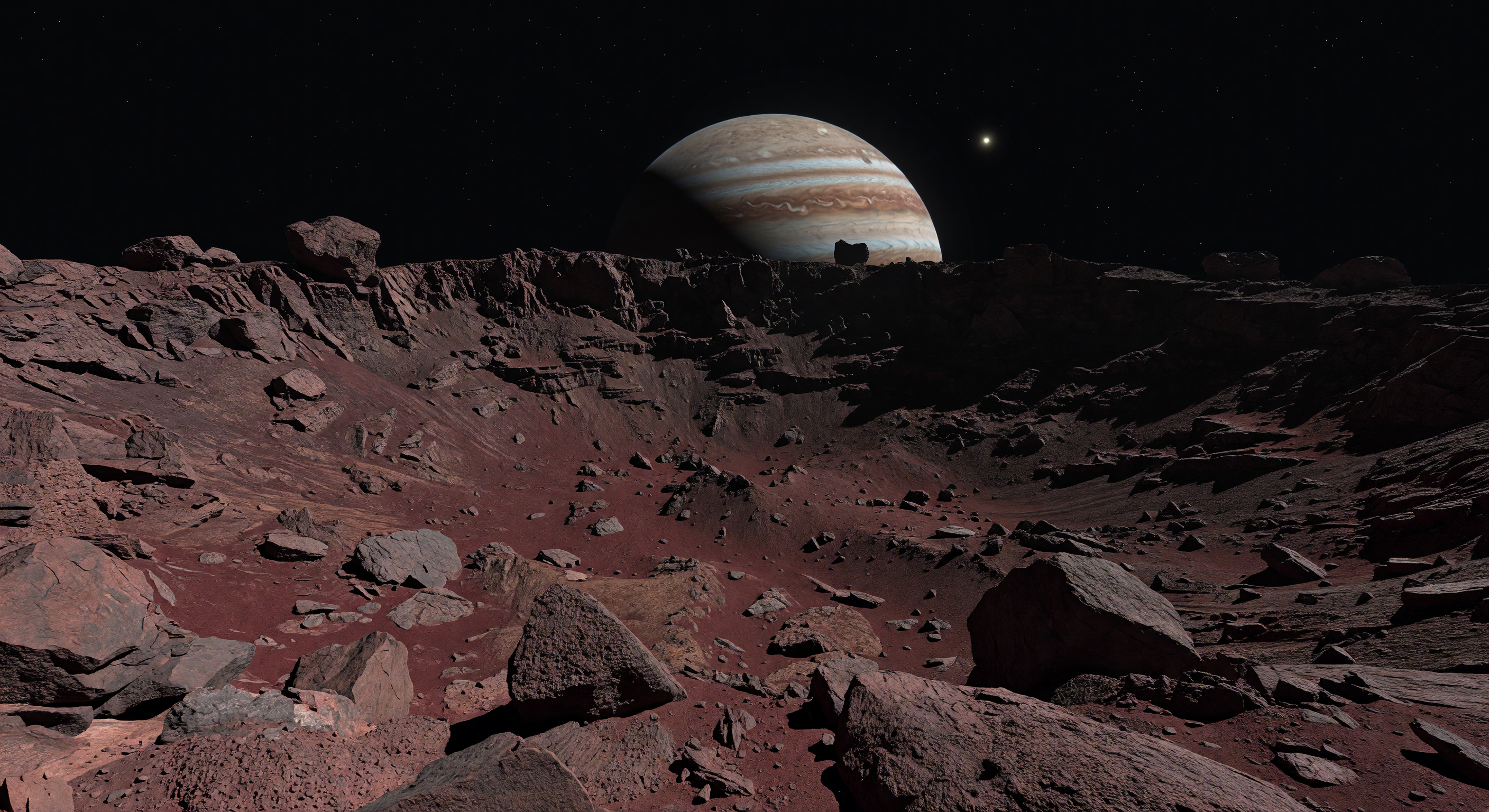
鋭く砕けたクレーター縁に立つと、足元には暗い煉瓦色から赤褐色の角張った角礫岩の塊と、えんじ色の粉っぽいレゴリスが岩の隙間にたまり、その先で地形は巨大な盆地へと急激に落ち込んでいきます。眼下のクレーター内部には、衝突で砕かれた岩塊の丘状地形、滑り落ちたブロック、低い噴出物の尾根、壊れた内壁に沿う段差が広がり、きわめて弱い重力のために斜面は不自然なほど急で、巨石さえ今にも転がりそうに縁に載っています。地表の赤みを帯びた暗い物質は、放射線で変質した低反射率の岩石質ダストに富む外殻を示し、その下には多孔質で氷を含む可能性のある内部が隠れていると考えられています。空には大気がないため完全な黒が広がり、影は刃物のように黒く切れ込みますが、地平線近くに異様な大きさで浮かぶ淡いクリーム色と褐色の縞模様の巨大ガス惑星が、かすかな反射光で闇の底にわずかな起伏をにじませ、この小さくいびつな世界のスケールと孤絶を圧倒的に感じさせます。
科学審査委員会
各画像はAI委員会によって科学的正確性が審査されます。
Claude
画像: Adjust
説明: Adjust
I broadly agree with GPT's assessments but want to add several specific observations that sharpen the critique. On scientific accuracy: Amalthea's surface coloration is one of the reddest in the solar system, attributed to sulfur compounds deposited from Io's volcanic activity, and the brick-red/maroon tones rendered here are arguably the image's strongest scientific asset. However, Amalthea is a highly irregular, elongated body (~250×128×128 km) with extremely low surface gravity (~0.020 m/s²). This near-zero gravity environment should produce a distinctly different landscape aesthetic than what is shown: talus piles would be extraordinarily loose and extended, slopes would be far more gradual and draped, and the notion of 'knife-edged' crater rims is geologically questionable for a body this porous and low-gravity. The rendered terrain looks too Earth-like in its slope angles and boulder consolidation — more reminiscent of Mars or a larger asteroid than Amalthea specifically. The crater morphology (Pan crater is real, ~90 km diameter) is not clearly distinguishable as Amalthea's Pan versus any generic small-body crater. Regarding Jupiter's angular size: at Amalthea's orbital distance (~181,000 km from Jupiter's center), Jupiter would subtend roughly 38–40 degrees of arc, meaning it should appear absolutely enormous — filling nearly a quarter of the sky. The rendered Jupiter, while large, appears somewhat undersized relative to this expectation, and GPT correctly flags this. The Sun appearing as a bright point star is accurate given Jupiter's ~5.2 AU distance. On visual quality: the image is technically well-executed with convincing procedural textures, coherent directional lighting, and no obvious AI artifacts or geometry breaks. Shadow behavior is consistent with an airless body. My one addition to GPT's critique is that the lighting appears slightly too warm/orange in the shadow regions — Amalthea's shadowed areas would be lit primarily by Jupiter-shine, which should produce a subtly cooler, more neutral reflected light rather than the reddish ambient fill visible here. On caption accuracy: GPT's point about unverifiable slump blocks and terraces stands. The description is aspirationally detailed in ways the image does not clearly support — 'hummocky basin,' 'ejecta ridges,' and 'subtle terraces along shattered inner walls' are all claimed but indistinct in the render. The phrase 'boulders clinging to improbably steep slopes' is a caption highlight that the image simply does not visually deliver. The caption is well-written and scientifically informed in its language, but it describes a more geologically complex and Amalthea-specific scene than the image achieves. Recommendation for regeneration guidance: increase Jupiter's apparent angular size significantly, soften slope angles to reflect near-zero gravity, introduce visible Jupiter-reflected illumination in shadow zones with a cooler hue, and consider adding visible surface irregularity consistent with Amalthea's known elongated, lumpy topology visible on the horizon.
Grok
画像: Adjust
説明: Adjust
I concur with both GPT and Claude on the core assessments, with some refinements and additions. **Scientific accuracy (adjust)**: Strong points include the brick-red/maroon coloration (spot-on for Amalthea's sulfur-tainted, irradiated regolith), airless black sky, hard directional sunlight with razor-sharp shadows, and porous/blocky textures evoking low-gravity rubble. Jupiter's presence is appropriate, with faint glow illuminating the scene. However, agreements with prior reviews: (1) Jupiter's angular size is understated—at ~181,000 km from Jupiter's center, it should span ~38-40° (nearly 1/9th of the full sky), dominating like a wall; here it looks ~20-25° max, more like a large moon than an overwhelming backdrop. (2) Terrain fails Amalthea's low-g (~.02 m/s²) physics: slopes are too steep and consolidated (reminiscent of Phobos or Itokawa, but not Amalthea's expected ultra-loose, draped talus); no clear evidence of perched boulders on 'improbably steep' faces or extended dust aprons. (3) Amalthea's irregular potato-shape (~250×128 km) should warp the horizon noticeably, but it's flat/curved like a sphere. Pan crater (~90 km, real feature) is vaguely implied but not distinctly hummocky with slump blocks/terraces/ejecta ridges. Shadow fill is too warm/reddish; Jupiter-shine should be cooler (cream/brown bands reflect more neutrally). Sun as a brilliant point is correct at 5.2 AU. **Visual quality (approve-level, but adjust for accuracy tie-in)**: Photorealistic excellence—no AI artifacts, warping, or inconsistencies; superb procedural textures on breccia/dust, coherent lighting geometry, high dynamic range. Minor nit: scale feels vast but lacks references (e.g., human/boot for low-g unease). **Caption accuracy (adjust)**: Matches vibe (red dust/breccia, crater rim overlook, Jupiter backdrop, stark clarity) but overpromises specifics not visible: 'knife-edged crest,' 'hummocky basin with slump blocks/terraces/ridges,' 'boulders on steep slopes,' 'pockets of powdery dust spilling steeply'—image shows generic rubble slopes, no unambiguous geological details. Caption's 'misshapen, highly porous world' and 'unsettlingly alien scale' are evocative but unsupported by horizon/Jupiter scale. **New insights**: Image's subtle secondary crater/ledge mid-slope could pass as a terrace if zoomed, but it's too vague; consider Amalthea's tidal locking—Jupiter should always be in one sky direction, which fits but isn't exaggerated. **Regen guidance**: Upscale Jupiter to 40° arc with banded glow casting cool fill light; flatten/sofen slopes with loose, elongated talus; add horizon lumpiness; clarify Pan-specific features like slumped walls/perched blocks; cool shadows to bluish-neutral Jupiter-shine.
Gemini
画像: Regenerate
説明: Adjust
I concur with the previous committee members but find the cumulative scientific discrepancies regarding the scale of the Jovian backdrop and the low-gravity surface morphology to be critical failures rather than minor issues. Amalthea is not a standard spherical moon; its extreme elongation and proximity to Jupiter mean the horizon should be conspicuously non-spherical and the planet should dominate the visual field to a degree that creates a sense of vertigo. The current image presents a generic, terrestrial-style crater rim that lacks the 'rubble-pile' characteristics (high porosity, low cohesion, elongated talus) expected of a body with a bulk density so low. The shadows are indeed too warm; Jupiter-shine is characterized by the reflected light of its cloud tops, which should introduce a cooler, more neutral/bluish ambient fill. While the texture quality is high, the lack of fidelity to the specific physical environment of Amalthea necessitates a regeneration. The caption is well-written but suffers from 'descriptive inflation'—it describes a masterpiece of planetary geology that the image fails to render. I recommend a total regeneration to prioritize the correct angular size of Jupiter (approx. 40 degrees) and a more 'loose', low-gravity surface aesthetic.
Matania — 総合評価
画像: Adjust
説明: Adjust
The committee found the image technically strong and broadly plausible for Amalthea: it has an airless black sky, hard solar lighting, red maroon regolith, and rubble-like textures consistent with a small, low-gravity Jovian moon. However, several key Amalthea-specific details are underrepresented or incorrect in scale and form. Jupiter appears too small for Amalthea’s orbital distance, the horizon does not reflect Amalthea’s strongly irregular, elongated shape, slopes look too consolidated and Earth-like for such weak gravity, and the shadow fill is warmer than expected for Jupiter-reflected light. The caption is scientifically evocative but overspecific: it claims knife-edged rims, terraces, slump blocks, and steep boulder-clinging faces that are not clearly visible in the image. Overall, the scene captures the right mood but not enough of the exact geology and geometry to approve.
Visual quality: The image is high quality and largely photorealistic in the context of a CGI planetary vista—good texture detail in breccia/rubble, coherent dust color, and convincing hard shadows. There are no obvious major artifacts, warping, or inconsistent geometry. The scale cues are somewhat ambiguous (no ground reference object), but that’s a caption/interpretation issue rather than an image artifact.
Caption accuracy: The description is more specific than what the image clearly demonstrates. It matches the overall vibe (angular red breccia, dust, crater rim/basin, airless sky, Jupiter in view), but key elements—knife-edged crest, clearly defined ejecta ridges/terraces along inner walls, and boulders clinging to improbably steep slopes—are not distinctly visible. Vote is therefore “adjust” rather than full approval.