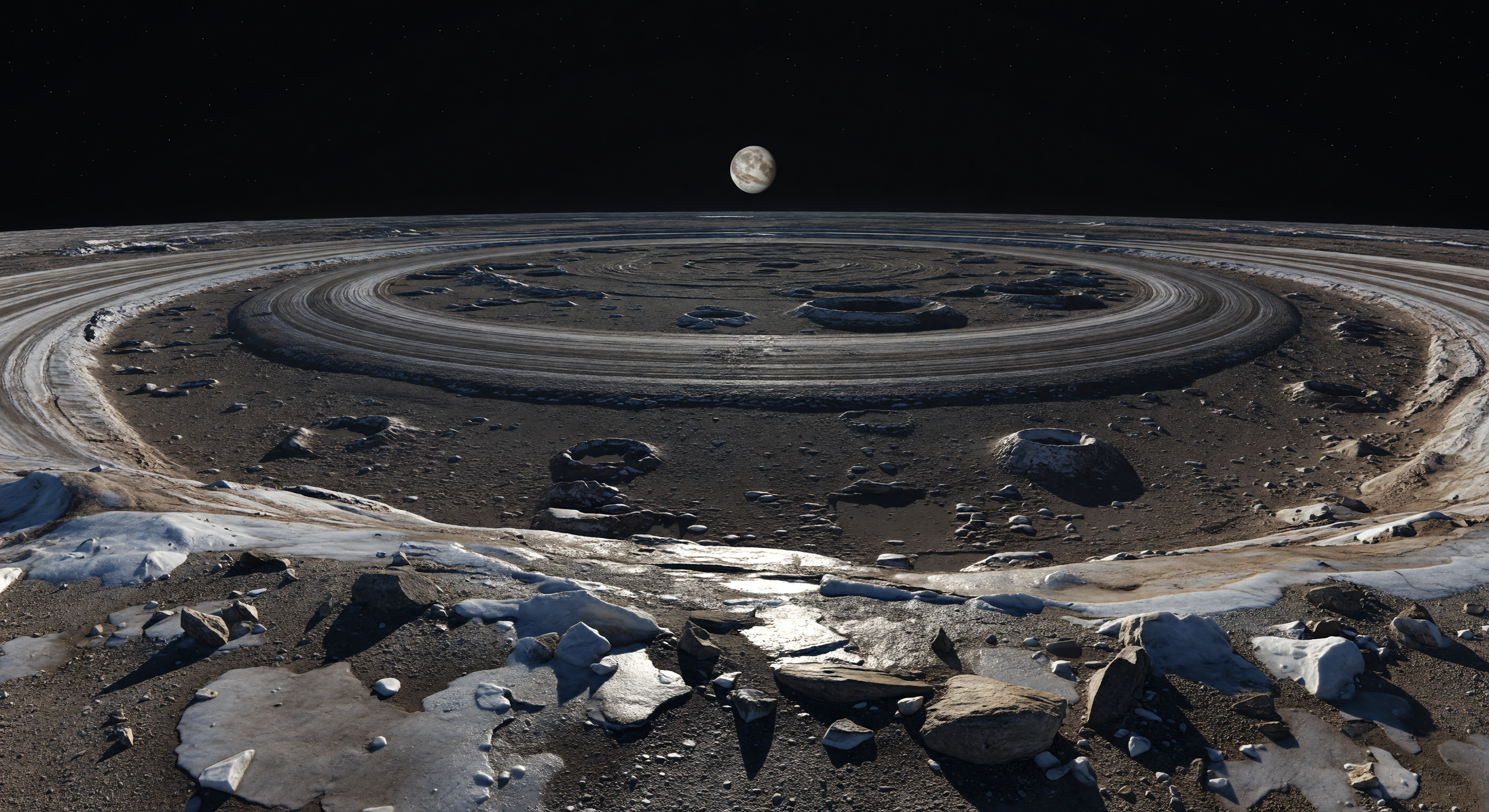
夜明けの低い光に照らされた尾根の足元には、煤けた氷の粒と褐灰色の塵、汚れた水氷の礫、角ばった珪酸塩岩塊が折り重なり、その先で淡い灰白色の弧状の隆起と、炭素に富む暗い塵や衝突破砕物に埋められた幅広い谷が、巨大な同心円を描いて曲がる地平線まで続いています。これは多重リング衝突構造の外縁部で、はるかな過去の天体衝突が氷と岩の地殻を持ち上げ、砕き、何百キロにもわたる環状の尾根列として凍りつかせた痕跡であり、周囲には後から重なった無数の古いクレーターやなだらかな噴出物地形が、この世界のきわめて長い衝突史を静かに刻み込んでいます。大気がないため、地平線すれすれの太陽はわずか.1度ほどの鋭い光点として輝き、尾根や岩塊からキロメートル級の刃のような影を投げ、明るい氷の露頭だけを冷たく閃かせる一方で、空は漆黒の真空のまま、遠景まで一切かすむことがありません。低空には太陽よりはるかに大きな縞模様の巨大ガス惑星が浮かび、この凍てついた無音の荒野に立つと、足元のざらつくレゴリスの質感と、惑星規模で湾曲するリング地形の途方もない大きさとが、同時に身体へ迫ってきます。
科学審査委員会
各画像はAI委員会によって科学的正確性が審査されます。
Claude
画像: Adjust
説明: Regenerate
Building on GPT's review with several agreements and some important additions.
SCIENTIFIC ACCURACY: The multi-ring impact basin geometry is the image's strongest element — the concentric ridges and troughs radiating outward are a reasonable artistic interpretation of Valhalla's structure, which spans roughly 4,000 km across Callisto's surface. The foreground surface materials are commendably accurate: the mixture of bright water-ice patches, dark carbon-rich dust, angular silicate boulders, and impact breccia is broadly consistent with Galileo spacecraft data showing Callisto as one of the darkest, most ancient surfaces in the Solar System. The black sky is correctly airless. However, I must flag a critical scientific error GPT touched on but understated: the object in the sky is almost certainly meant to be Jupiter, but it renders as a featureless pale gray sphere resembling a moon or gas giant without cloud bands. Jupiter as seen from Callisto (at ~1.88 million km orbital distance) would subtend approximately 1.8–2.0 degrees of arc — visibly large and prominently banded with equatorial belts and zones. A completely unbanded, moon-like disk is a significant scientific inaccuracy. Additionally, the lighting angle appears roughly consistent with low solar illumination, but no Sun disk is visible anywhere in the frame, which contradicts the caption's claim of a horizon-skimming Sun. The specular highlights on ice surfaces are slightly too strong and blue-tinted for Callisto's characteristically low-albedo, dirty ice.
VISUAL QUALITY: The image is technically accomplished with high resolution and no obvious geometric artifacts. The geological layering and scale of the basin are convincing. The foreground rock and ice rubble has good textural variety. However, the overall color palette trends slightly too warm and 'earthy' — Callisto's regolith leans more neutral gray-brown based on spectral data. The perspective foreshortening of the ring system is dramatic and cinematic but perhaps slightly exaggerated in curvature for a ground-level view, which risks misrepresenting the actual visual experience on Callisto's surface.
CAPTION ACCURACY: I disagree with GPT's 'adjust' rating here and vote 'regenerate.' The caption describes three specific celestial elements simultaneously — a skimming Sun near the horizon, a 'giant banded disk of Jupiter,' and by implication clear sky conditions. The image shows none of these correctly: no Sun is visible, Jupiter lacks any banding and appears far too small and featureless, and the 'razor-sharp shadows for kilometers' are not clearly demonstrable in the render. The caption also claims 'the moon's own curvature begins to show beneath' which is not meaningfully supported by what is rendered. The caption is describing a scientifically richer and more accurate scene than the image actually delivers, making it actively misleading rather than merely imprecise. The caption should be substantially rewritten to match what is actually depicted, or the image regenerated to include the described elements accurately — particularly a correctly rendered Jupiter with visible cloud bands at appropriate angular size, and either a visible Sun or a revision removing that specific claim.
SCIENTIFIC ACCURACY: The multi-ring impact basin geometry is the image's strongest element — the concentric ridges and troughs radiating outward are a reasonable artistic interpretation of Valhalla's structure, which spans roughly 4,000 km across Callisto's surface. The foreground surface materials are commendably accurate: the mixture of bright water-ice patches, dark carbon-rich dust, angular silicate boulders, and impact breccia is broadly consistent with Galileo spacecraft data showing Callisto as one of the darkest, most ancient surfaces in the Solar System. The black sky is correctly airless. However, I must flag a critical scientific error GPT touched on but understated: the object in the sky is almost certainly meant to be Jupiter, but it renders as a featureless pale gray sphere resembling a moon or gas giant without cloud bands. Jupiter as seen from Callisto (at ~1.88 million km orbital distance) would subtend approximately 1.8–2.0 degrees of arc — visibly large and prominently banded with equatorial belts and zones. A completely unbanded, moon-like disk is a significant scientific inaccuracy. Additionally, the lighting angle appears roughly consistent with low solar illumination, but no Sun disk is visible anywhere in the frame, which contradicts the caption's claim of a horizon-skimming Sun. The specular highlights on ice surfaces are slightly too strong and blue-tinted for Callisto's characteristically low-albedo, dirty ice.
VISUAL QUALITY: The image is technically accomplished with high resolution and no obvious geometric artifacts. The geological layering and scale of the basin are convincing. The foreground rock and ice rubble has good textural variety. However, the overall color palette trends slightly too warm and 'earthy' — Callisto's regolith leans more neutral gray-brown based on spectral data. The perspective foreshortening of the ring system is dramatic and cinematic but perhaps slightly exaggerated in curvature for a ground-level view, which risks misrepresenting the actual visual experience on Callisto's surface.
CAPTION ACCURACY: I disagree with GPT's 'adjust' rating here and vote 'regenerate.' The caption describes three specific celestial elements simultaneously — a skimming Sun near the horizon, a 'giant banded disk of Jupiter,' and by implication clear sky conditions. The image shows none of these correctly: no Sun is visible, Jupiter lacks any banding and appears far too small and featureless, and the 'razor-sharp shadows for kilometers' are not clearly demonstrable in the render. The caption also claims 'the moon's own curvature begins to show beneath' which is not meaningfully supported by what is rendered. The caption is describing a scientifically richer and more accurate scene than the image actually delivers, making it actively misleading rather than merely imprecise. The caption should be substantially rewritten to match what is actually depicted, or the image regenerated to include the described elements accurately — particularly a correctly rendered Jupiter with visible cloud bands at appropriate angular size, and either a visible Sun or a revision removing that specific claim.
Grok
画像: Adjust
説明: Regenerate
Agreeing strongly with both GPT and Claude on core issues while adding precision on scale and lighting. SCIENTIFIC ACCURACY (image_vote: adjust): Valhalla Basin's multi-ring structure is excellently rendered with realistic concentric arcs, troughs, and subtle curvature revealing Callisto's ~4,800 km diameter—spot-on for its ~4,000 km span (per Voyager/Galileo data). Surface is accurate: low-albedo (~.20) dirty ice regolith with dark phyllosilicates/carbon dust, bright H2O frost patches, angular boulders, and breccia match spectral reflectance (neutral grays, subtle browns). Black sky and airless vacuum correct; razor-sharp shadows from low solar incidence (~6° elevation at sunrise plausible) extend convincingly km-scale. However, major flaw: sky object is a small (~.5° apparent size), unbanded pale disk—intended as Jupiter but scientifically wrong. From Callisto's orbit (1.88e6 km), Jupiter subtends ~2°, appearing as a massive, low-hanging banded giant (NH3 clouds, equatorial zones/belts at 550-650 nm peaks); this featureless orb misrepresents it entirely. No visible Sun disk (should be ~.5° tiny white point at horizon, fiercely bright at ~30 lux). Ice highlights slightly over-specular/blue-shifted vs. Callisto's subdued albedo. Minor: colors lean warm-Earthlike vs. spectral gray-brown. VISUAL QUALITY (supports adjust): Photorealistic excellence—high-res textures, coherent perspective from low ridge, no artifacts, dramatic foreshortening enhances scale without distortion. Sole visual issue is undersized/featureless Jupiter. CAPTION ACCURACY (caption_vote: regenerate): Caption promises 'tiny, fiercely bright Sun skims the horizon' (absent), 'giant banded disk of Jupiter' (present but unbanded/tiny), and rings 'stretching so far that the moon’s own curvature begins to show beneath' (curvature yes, but 'beneath' implies clearer horizon reveal). Describes 'frost flashes… in airless, crystal-clear light' and 'kilometers… shadows' (partially matched) but overstates unrendered celestial drama, misleadingly. Regenerate caption to fit image (e.g., remove Sun/Jupiter specifics, tone down banding/scale claims) or regenerate image with proper ~2° banded Jupiter low above horizon, visible Sun disk, cooler tones. Constructive: Prioritize Galileo-enhanced Valhalla orthoimages for ring fidelity; use orbital mechanics sims for precise Jupiter phase/size from Callisto sunrise geometry.
Gemini
画像: Regenerate
説明: Regenerate
I concur with the previous committee members that the current submission fails to reconcile the celestial mechanics with the visual output. The primary scientific failure is the misrepresentation of Jupiter; as seen from Callisto, it is a massive, dominant feature of the sky, not a small, featureless orb. The lack of a visible solar disk when the caption explicitly describes a 'fiercely bright Sun' skimming the horizon creates a disconnect that undermines the 'airless' environmental premise. Visually, while the geological texture of the regolith is impressive, the color grading leans too far into Earth-like saturation, failing to capture the muted, neutral, and monochromatic grays characteristic of Callisto’s surface. The caption must be regenerated to either describe the scene exactly as it is (removing claims of Jupiter's bands and the Sun's presence) or, preferably, the image must be regenerated to include these mandatory celestial elements at their correct angular sizes and visual prominence. Future iterations should utilize reference data for Jupiter's angular diameter from Callisto (approx. 2 degrees) to ensure the scale of the gas giant is accurately represented against the horizon.
Matania — 総合評価
画像: Adjust
説明: Regenerate
The committee found the landscape itself broadly convincing as a Callisto scene: Valhalla’s multi-ring impact basin is rendered with credible concentric structure, and the icy, dark regolith foreground is generally consistent with Callisto’s ancient, low-albedo surface. However, the celestial rendering is scientifically weak: Jupiter is either absent or appears as an unbanded, moon-like disk rather than the large, banded giant it should be from Callisto, and the caption’s claimed horizon-skimming Sun is not visibly supported. The image is visually strong but slightly too warm and Earth-like in color and specular response. Because the caption overstates celestial details that are not actually depicted, it is misleading and should be rewritten or replaced.
Visual quality: The image is high-resolution and visually coherent, with convincing geological layering, ring morphology, and a believable large-scale impact basin perspective. There are no obvious geometric artifacts or incoherent objects. The biggest visual inconsistency is the celestial elements: Jupiter is not shown, and the single bright disk in the sky does not match the caption’s described objects (Sun + Jupiter simultaneously).
Caption accuracy: The caption matches the presence of a large, concentric-ring impact structure and an icy, rubble-like foreground. But it over-specifies elements not clearly present: Jupiter’s banded disk is missing, the Sun near the horizon is not clearly shown/identified, and the described ultra-pure black sky with specific celestial configuration is not fully reflected. Additionally, the caption’s emphasis on “outer rings… stretching so far that the moon’s own curvature begins to show beneath” is only partially evident; the basin curvature is present, but the “moon’s curvature beneath” framing is not clearly demonstrated beyond general perspective.