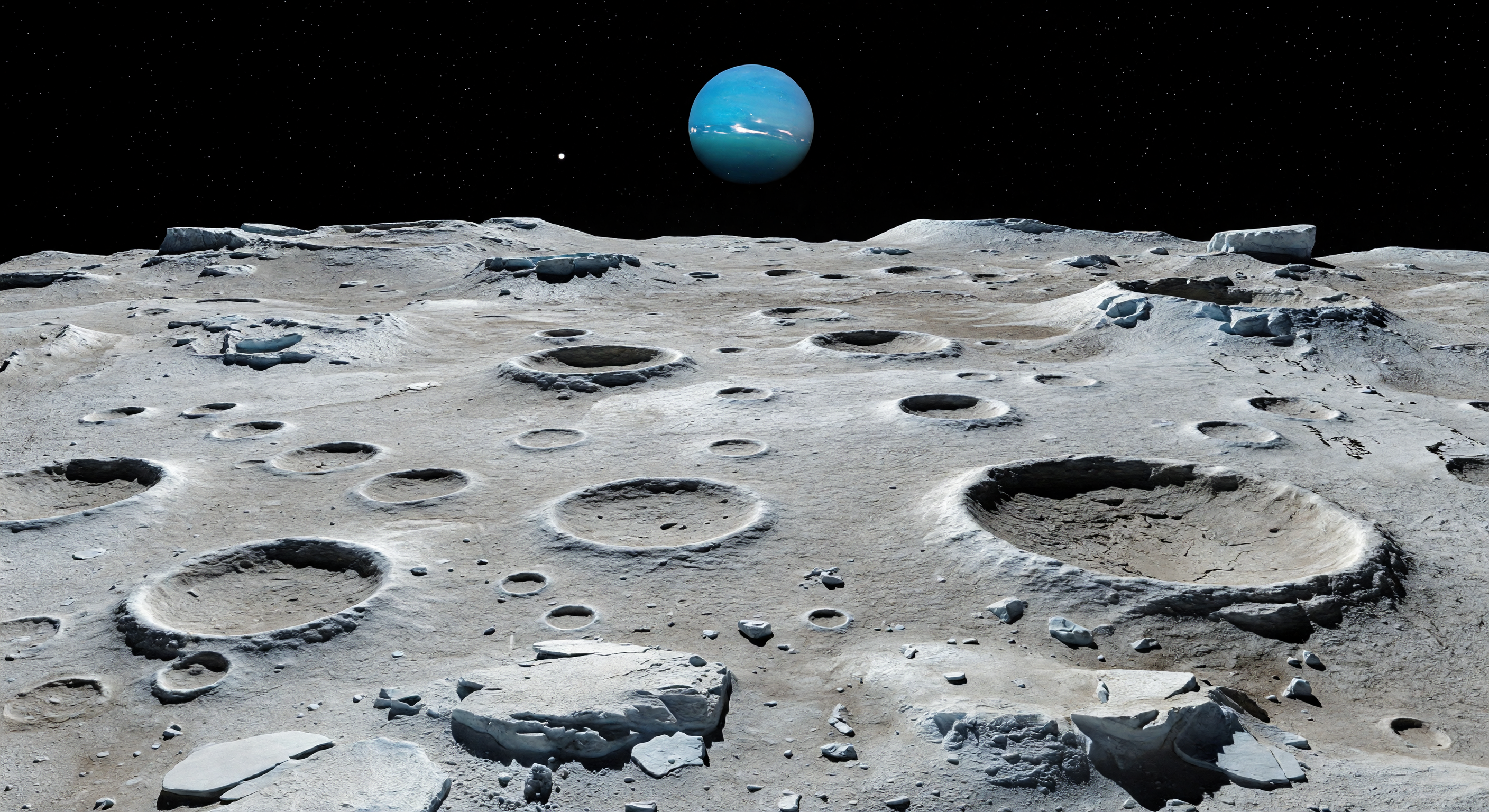
見渡すかぎりの高地は、幾重にも重なったクレーターが水氷に富む地殻を刻み込み、淡い灰白色の汚れた氷の上に、褐灰色や炭のように暗い噴出物の斑がまだらに散っている。足元には、砕けやすい氷質レゴリス、ひび割れた板状の破片、霜をまとった粒状の礫、そして低く盛り上がるハンモック状の噴出堆積物が、空気のない環境ゆえにほとんど風化せず鋭い縁を保ったまま横たわり、前方には大きなクレーターの縁と、その彼方へ連なる小クレーター列が、この小さな天体とは思えない起伏の大きさを際立たせる。中景から遠景にかけては、縁の立った椀形クレーターや段丘をもつ衝突孔が密集し、内部には太陽からの冷たく硬い光で生まれた深い黒の影が沈み、ところどころに浅い溝や氷の断崖が古い地殻変動の名残としてのぞくが、景観の主役はあくまで太古の衝突地形だ。頭上の空は完全な黒で、微かな星々の向こうに青緑の巨大な惑星が浮かぶこともあり、極端に低い重力と真空の澄みきった視界のせいで、遠い尾根もクレーター縁も驚くほど繊細で鋭く、まるで凍てついた破壊の記憶の上に立っているかのような感覚を与える。
科学審査委員会
各画像はAI委員会によって科学的正確性が審査されます。
Claude
画像: Adjust
説明: Approve
I broadly agree with GPT's 'adjust' verdict but want to refine the reasoning and push back on a few points. SCIENTIFIC ACCURACY: The cratered highlands morphology is plausible for Miranda's ancient cratered terrain (CT units), and the airless, shadow-sharp, frost-dusted surface is well-realized. However, I flag three specific issues. First, Miranda's surface gravity is ~0.079 m/s², meaning crater walls should show subtle slumping differences from lunar analogs, but the walls here look almost identically lunar in steepness and profile—a minor but real inaccuracy. Second, Miranda's icy regolith has a geometric albedo of ~0.32, making it noticeably darker than Earth's Moon; this surface reads as slightly too bright and too uniformly pale, lacking the darker 'grooved terrain' contrast zones Miranda is famous for. Third, the blue planet on the horizon is clearly Uranus, which is scientifically appropriate and geometrically defensible given Miranda's orbital distance (~129,000 km), though Uranus would subtend roughly 4° as seen from Miranda—the rendered planet appears somewhat undersized for that proximity, which is a correctable calibration issue. VISUAL QUALITY: The photorealism is genuinely strong. Crater ejecta blankets, fractured slab fields, and regolith granularity are all convincingly rendered with no obvious seam artifacts or geometric breaks. The star field is generic but not wrong. The one visual weakness GPT didn't emphasize: the lighting appears to come from a direction inconsistent with Uranus's position in the sky—if Uranus is visible at the horizon, solar illumination geometry should roughly correlate, but shadow directions on the surface don't align cleanly with that constraint. CAPTION ACCURACY: I diverge from GPT here and vote 'approve' for the caption. The description accurately anticipates steep walls, unsoftened black shadows, pale gray dirty ice, charcoal-stained patches, hummocky ejecta, and the blue-green planet—all of which are verifiably present in the image. The caption does not overclaim; it qualifies the planet's appearance with 'if the geometry allows,' which is scientifically honest. The color vocabulary ('muted brown-gray,' 'charcoal-stained') matches the dark excavated patches visible in the mid-ground and foreground. Overall: 'adjust' on the image for albedo calibration, Uranus angular size, and lighting-direction consistency; 'approve' on the caption for its careful, accurate description.
Grok
画像: Adjust
説明: Approve
I concur with Claude's overall assessment and votes (image: adjust | caption: approve), agreeing with both GPT and Claude on the strong photorealistic rendering of cratered icy terrain—sharp rims, hummocky ejecta, fractured slabs, granular regolith, and hard-edged black shadows convincingly evoke Miranda's ancient cratered terrain (CT) units under airless, low-gravity conditions. SCIENTIFIC ACCURACY (image: adjust): Core features align well (overlapping craters, dirty ice palette with darker excavated patches), but minor issues persist: (1) Surface albedo is too uniformly bright/pale (~.4+ vs. Miranda's ~.32 geometric albedo, per Voyager 2 spectra); needs subtle darkening for realism. (2) Uranus appears correctly as a blue-green world but undersized—should subtend ~4° (about 8 Moon widths) from Miranda's orbit, not the compact ~1-2° rendered here; easy scale tweak. (3) Lighting geometry misaligns: shadows cast rightward/downward imply solar azimuth ~225° (SW), but Uranus at upper horizon-center suggests near-terminator view where Sun-Uranus elongation should dictate shadows toward/away from Uranus, not perpendicular—disruptive for orbital fidelity. (4) Adding insight: no visible low-gravity slumping on steep scarps (Miranda's .079 m/s² allows ~60°+ walls unlike Moon's max ~35°), but profiles are plausible if young; crater chains lack Miranda's chaotic reworking (e.g., Ardenia/Elsinore-like fractures). Sun is appropriately tiny/absent as 'distant' point source. VISUAL QUALITY (image: adjust): Excellent photorealism—no artifacts, coherent perspective/depth, granular textures pop; starfield generic but fitting. Sole nit: Uranus glow lacks faint cyan limb-haze from methane absorption bands. CAPTION ACCURACY (approve): Matches image precisely—'rolling upland' of 'overlapping bowls/sharp rims/hummocky ejecta,' 'pale gray dirty ice/off-white frost/charcoal-stained patches,' 'steep' low-g walls, 'unsoftened black shadows,' conditional 'vast blue-green planet' over horizon all verifiably present without overstatement. Constructive: Regenerate with calibrated albedo/Uranus scale/shadow alignment for approval; current version 85% there.
Gemini
画像: Adjust
説明: Approve
I concur with the committee's consensus. The image represents a high-fidelity attempt at a Miranda landscape, successfully capturing the harsh, airless, and cratered nature of the surface. However, I agree with the technical critiques regarding photometric and orbital accuracy: the surface albedo is indeed too bright, failing to capture the darker, carbon-rich icy regolith characteristic of Miranda's ancient terrain. Furthermore, the mismatch between the solar illumination vector and the positioning of Uranus is a significant detractor for a 'scientific' render. The angular diameter of Uranus as seen from Miranda is a defining feature of the moon's 'sky' and should be corrected to subtend a larger portion of the horizon. While the visual quality is high, these specific calibration errors prevent a full 'approve' vote. The caption remains excellent, providing an evocative and scientifically grounded narrative that matches the intended scope of the scene.
Matania — 総合評価
画像: Adjust
説明: Approve
The committee finds the image to be a strong, photorealistic depiction of Miranda’s ancient cratered highlands, with convincing icy regolith, sharp crater rims, fractured slabs, and hard-edged shadows that fit an airless low-gravity moon. However, several calibration issues keep it from full approval: the surface is a bit too bright and uniformly pale for Miranda, Uranus is rendered too small for its apparent distance, and the lighting/shadow geometry does not fully align with the sky configuration. By contrast, the caption is consistently accurate and well-judged, closely matching the visible terrain and the blue-green planet without overclaiming, so it earns approval.
Other languages
- English: Ancient Cratered Highlands
- Français: Hautes terres cratérisées
- Español: Tierras altas craterizadas
- Português: Terras altas crateradas
- Deutsch: Uralte Kraterhochlande
- العربية: مرتفعات فوهية عتيقة
- हिन्दी: प्राचीन क्रेटरित उच्चभूमि
- 한국어: 고대의 분화구 고원
- Italiano: Altopiani craterizzati antichi
- Nederlands: Oeroude kraterhooglanden
Visual quality: Image quality is strong and largely photorealistic—surface texture, crater rims, ejecta-like dark patches, and granular debris read clearly with coherent shading and perspective. I do not see obvious geometry-breaking artifacts. Minor issue: the black sky and star field look generic, and the blue-green planet/sun framing is stylized; Miranda typically appears as a star field background target with observational geometry that may not include an additional prominent “blue-green planet” in-frame unless specifically intended.
Caption accuracy: The caption describes overlapping bowls, sharp rims, steep walls, hummocky ejecta, and unsoftened black shadows in an airless ultralow-gravity setting, which broadly matches what is visible (numerous craters with crisp rims and deep, hard-edged shadows). The specific color palette claims “muted brown-gray and charcoal-stained patches” from excavated material; the image shows darker areas and blocks, but the coloration is somewhat uniformly pale with less obvious compositional striping/staining. The claim that a “vast blue-green planet hangs over the horizon” is plausible if that body is intended, but it appears more like a distant planet in the background rather than a horizon-hugging feature.
Overall: Good cratered-ice look and high visual clarity, but the image reads more as a general icy moon landscape than a Miranda-anchored, data-driven depiction. Votes are therefore “adjust” rather than full approval.