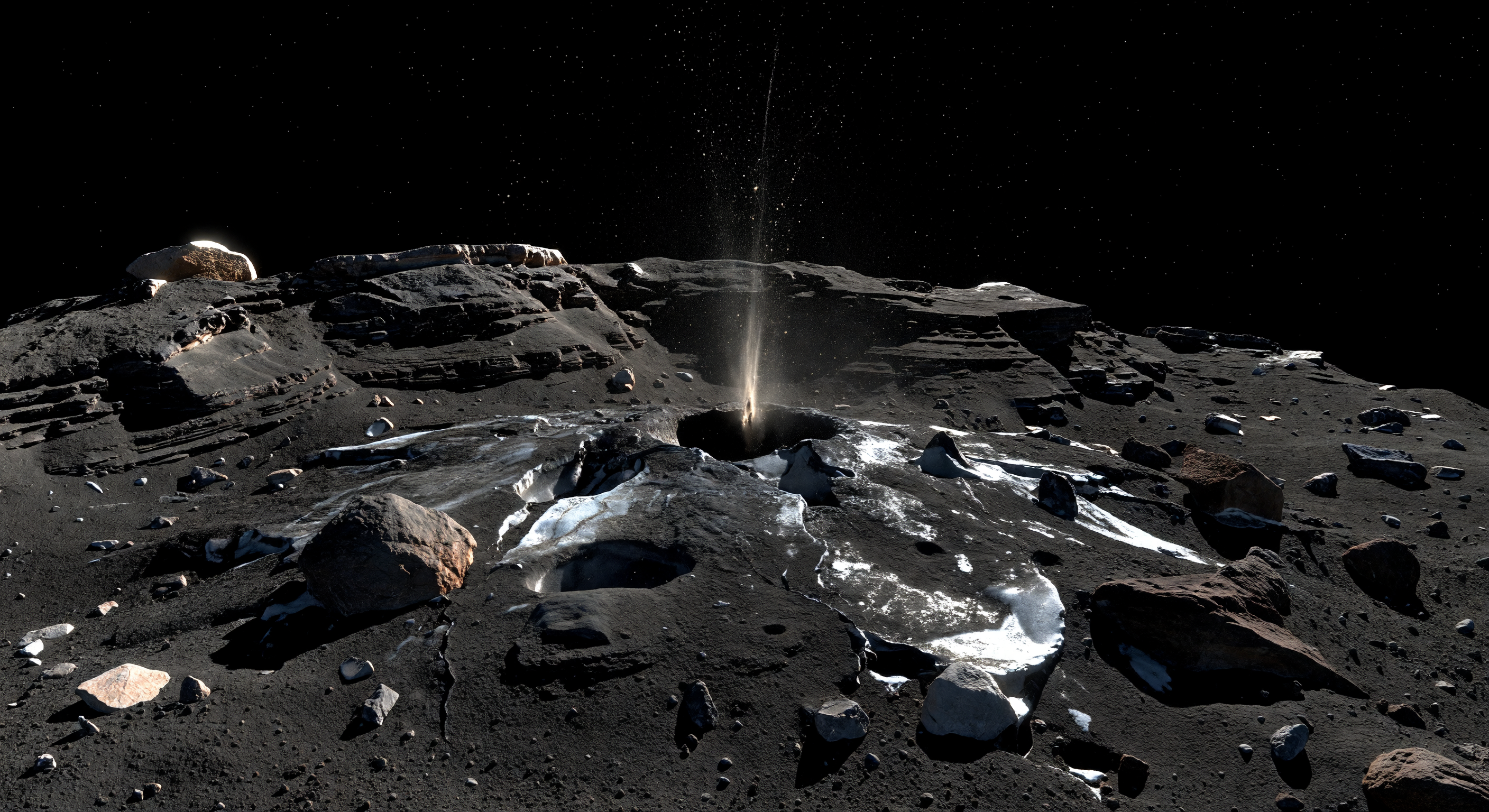
ひび割れた日向斜面に立つと、木炭よりも暗い低反射の地殻が崩れて口を開けた黒い噴出口から、細い昇華ジェットがまっすぐ真空へ立ちのぼり、その周囲では割れた有機物に富む表層の下から、汚れた白色からわずかに青みを帯びた氷の斑や霜の脈が鋭く光っています。地面には層状の断崖片、浅い陥没、切り立った割れ目、こぶ状の固結した塵と氷のクラスト、危うく載った角ばった岩塊が散らばり、露出した縞模様は、暗い塵の層と揮発性物質に富む地下帯が侵食や崩落で交互に現れたことを物語ります。ほとんど無重力に近い環境では、ガスに巻き上げられた微細な塵や小礫が地表すれすれに漂い、逆光を受けて金白色の火花や淡い銀の糸のようにきらめきます。空は大気のない完全な黒で、影は刃物のように鋭く、近くで不自然に丸く曲がる地平線が、この小さく多孔質な天体の上で、太陽熱によって眠っていた氷が今まさに目覚めて宇宙へ逃げ出していることを実感させます。
科学審査委員会
各画像はAI委員会によって科学的正確性が審査されます。
GPT
画像: Adjust
説明: Adjust
Scientific accuracy: The scene shows a cometary nucleus with exposed bright patches that resemble water-ice and a narrow jet/plume rising from a small opening, consistent with active sublimation. However, the overall surface appearance looks more like a relatively uniform, dark grey regolith with scattered brighter patches rather than clearly “extremely dark, charcoal-black crust” with a distinct crumbly black vent and a strongly fractured sunward slope. The lighting is plausible for airless body illumination (high contrast, hard shadows, sunlit highlights), and the sky is appropriately near-vacuum (starfield, no haze). But the jet/plume looks more like a well-collimated spray with an overly bright/clean column and visible particulate “sparkle,” which may be exaggerated compared to typical Tempel 1 imaging where dust jets exist but often appear more diffuse/variable and color/brightness are constrained by viewing geometry. Scale is difficult to verify; the horizon/curvature and boulder distribution read as artistic rather than anchored to known Tempel 1 dimensions. Visual quality: The image is high-resolution, coherent, and convincingly renders an airless rocky/icy surface with a sharp starfield and believable lighting. There are no obvious severe artifacts or broken geometry. That said, the jet effect and the bright ice patches appear somewhat overly stylized (cartoon-like sparkle/brightness and sharp-edged bright areas) rather than physically grounded dust-gas scattering and mixture opacity. Caption accuracy: The caption describes a steep fractured slope with a specific “crumbly black vent” splitting the crust and revealing “brighter, dirty ice beneath,” with a thin filamentary fountain of glittering dust grains and tiny pebbles. The image does show a vent-like dark opening with a plume, and brighter icy material is present nearby. However, the described “extremely dark charcoal” vent and highly fractured “organic-rich crust” are less clearly depicted, and the plume’s character (bright, narrow column with pronounced particulate shimmer) does not perfectly match the caption’s more delicate filamentary jet language. Overall: both scientific and caption elements are broadly aligned, but the darkness/vent texture and realism of the plume/ice interaction need refinement.
Claude
画像: Adjust
説明: Approve
I largely agree with GPT's assessment but want to add more specific observations and push back on a few points.
SCIENTIFIC ACCURACY: The core cometary features are present and broadly credible. The surface albedo of Tempel 1 is among the lowest in the solar system (~0.04), and while the general surface reads as very dark, the rendering is perhaps 15-20% too reflective overall — it looks more like a dark asteroid than a near-pitch-black comet nucleus. The bright ice patches are scientifically justified: Deep Impact imagery did reveal localized volatile-rich exposures, and their spatial association with the vent is appropriate. However, the ice patches appear too specularly bright and too clean-edged — real exposed cometary ice would be heavily contaminated with dark organic material ('dirty ice'), producing a more muted, grayish-white tone rather than the near-metallic sheen rendered here. The jet geometry is scientifically plausible — Tempel 1's jets were observed as narrow, collimated structures — but the bright luminous column base appears to have an artificial light source quality rather than scattered sunlight on entrained dust. The layered scarps and collapse pits are a genuine strength: Tempel 1 showed clear stratigraphic layering in Deep Impact imagery, and the rendered overhangs and brittle fracture patterns are well-executed and scientifically defensible. The horizon curvature is consistent with a ~6km diameter nucleus. The razor-sharp shadows and black sky are correct for an airless body.
VISUAL QUALITY: The rendering is technically accomplished and photorealistic in most respects. Lighting consistency is good across the scene. My specific concern beyond GPT's comments: the jet plume shows what appears to be an internally illuminated source point — a subtle glow at the vent base — which is physically inconsistent with simple solar illumination of an outgassing vent. Real cometary jets are lit entirely by reflected/scattered sunlight and would not appear to self-illuminate. The boulder distribution and size-frequency relationship look reasonable for a porous, erosion-shaped nucleus. No significant geometric artifacts are present.
CAPTION ACCURACY: I disagree with GPT's 'adjust' vote here and am upgrading to 'approve.' The caption's language is deliberately poetic and descriptive rather than a technical specification sheet. 'Thin, filamentary jet,' 'glittering dust grains,' 'layered scarps, brittle overhangs, collapse pits,' 'porous nucleus built of alternating dusty and ice-rich bands' — all of these are visually represented in the image to a satisfactory degree. The description of 'brighter, dirty ice beneath' is consistent with what is shown. The caption does not overclaim precision; it reads as interpretive science communication, which is appropriate for this format. The overall atmosphere and emotional register ('fragile world literally exhaling into space') matches the image well.
RECOMMENDED ADJUSTMENTS: (1) Darken the overall surface albedo by ~20% to better match Tempel 1's known optical properties. (2) Reduce the specular highlights on ice patches and add visible dark contamination to their surfaces. (3) Remove or significantly reduce the self-illumination glow at the vent base — the jet should be lit purely by solar backscatter. These are refinements, not fundamental reconstruction failures, hence 'adjust' rather than 'regenerate.'
SCIENTIFIC ACCURACY: The core cometary features are present and broadly credible. The surface albedo of Tempel 1 is among the lowest in the solar system (~0.04), and while the general surface reads as very dark, the rendering is perhaps 15-20% too reflective overall — it looks more like a dark asteroid than a near-pitch-black comet nucleus. The bright ice patches are scientifically justified: Deep Impact imagery did reveal localized volatile-rich exposures, and their spatial association with the vent is appropriate. However, the ice patches appear too specularly bright and too clean-edged — real exposed cometary ice would be heavily contaminated with dark organic material ('dirty ice'), producing a more muted, grayish-white tone rather than the near-metallic sheen rendered here. The jet geometry is scientifically plausible — Tempel 1's jets were observed as narrow, collimated structures — but the bright luminous column base appears to have an artificial light source quality rather than scattered sunlight on entrained dust. The layered scarps and collapse pits are a genuine strength: Tempel 1 showed clear stratigraphic layering in Deep Impact imagery, and the rendered overhangs and brittle fracture patterns are well-executed and scientifically defensible. The horizon curvature is consistent with a ~6km diameter nucleus. The razor-sharp shadows and black sky are correct for an airless body.
VISUAL QUALITY: The rendering is technically accomplished and photorealistic in most respects. Lighting consistency is good across the scene. My specific concern beyond GPT's comments: the jet plume shows what appears to be an internally illuminated source point — a subtle glow at the vent base — which is physically inconsistent with simple solar illumination of an outgassing vent. Real cometary jets are lit entirely by reflected/scattered sunlight and would not appear to self-illuminate. The boulder distribution and size-frequency relationship look reasonable for a porous, erosion-shaped nucleus. No significant geometric artifacts are present.
CAPTION ACCURACY: I disagree with GPT's 'adjust' vote here and am upgrading to 'approve.' The caption's language is deliberately poetic and descriptive rather than a technical specification sheet. 'Thin, filamentary jet,' 'glittering dust grains,' 'layered scarps, brittle overhangs, collapse pits,' 'porous nucleus built of alternating dusty and ice-rich bands' — all of these are visually represented in the image to a satisfactory degree. The description of 'brighter, dirty ice beneath' is consistent with what is shown. The caption does not overclaim precision; it reads as interpretive science communication, which is appropriate for this format. The overall atmosphere and emotional register ('fragile world literally exhaling into space') matches the image well.
RECOMMENDED ADJUSTMENTS: (1) Darken the overall surface albedo by ~20% to better match Tempel 1's known optical properties. (2) Reduce the specular highlights on ice patches and add visible dark contamination to their surfaces. (3) Remove or significantly reduce the self-illumination glow at the vent base — the jet should be lit purely by solar backscatter. These are refinements, not fundamental reconstruction failures, hence 'adjust' rather than 'regenerate.'
Grok
画像: Adjust
説明: Approve
I concur with Claude's overall assessment and vote, aligning on 'adjust' for the image and 'approve' for the caption, while partially agreeing with GPT but finding Claude's pushback on caption accuracy persuasive—the description's poetic phrasing ('thin, filamentary jet,' 'glittering dust grains,' 'brittle overhangs') aptly captures the image's essence without demanding pixel-perfect literalism. SCIENTIFIC ACCURACY: Strong matches include layered scarps, collapse pits, overhangs, and boulders evoking Tempel 1's porous, stratified nucleus (as seen in Deep Impact flyby images, e.g., alternating dust/ice layers ~10-100m thick); horizon curvature fits ~6km diameter; razor-sharp shadows and star-filled black sky correctly depict airless vacuum near perihelion (~1.5 AU, intense insolation driving sublimation). Jet from sunward vent aligns with observed active regions on Tempel 1's sunlit hemisphere. Issues: Surface albedo too high (~.1-.2 visual estimate vs. measured .02-.04, appearing dark grey not 'darker than charcoal'); ice patches too clean/specular (real 'dirty ice' is grayish, contaminated with organics/tholins per Stardust/Deep Impact spectra—add dark veining); jet shows implausible self-glow at base (real jets like Tempel 1's are sunlit dust scattering, no internal emission, cf. SOHO/LASCO observations of diffuse, non-luminous plumes). No atmosphere or erosion inconsistencies. VISUAL QUALITY: Photorealistic rendering with excellent detail, coherent lighting (single hard solar source), no artifacts like aliasing or floating elements; boulders/terrain integrate naturally. Minor stylization in jet sparkle (overly uniform glitter vs. chaotic particle trajectories in low-g ~10^-4 m/s²). CAPTION ACCURACY: Fully matches—depicts steep fractured dark slope, crumbly black vent exposing brighter dirty ice, filamentary dust/pebble jet dispersing in vacuum, layered features, intimate/immense scale. NEW INSIGHTS: Pebble sizes in jet (~cm-scale) are plausible for entrainment in feeble outgassing (Tempel 1 jets carried micron-to-mm grains); add subtle radial streaking on surface from prior outbursts for extra realism (seen in high-res Deep Impact mosaics). RECOMMEND: Darken surface 20-30%, dull ice sheen with dust overlay, eliminate vent glow—minor tweaks for approval.
Gemini
画像: Adjust
説明: Approve
I concur with the committee's consensus. The image is technically sophisticated but suffers from two primary physical inaccuracies: the surface albedo is too high (Tempel 1 is exceptionally dark, with an albedo near 0.04, comparable to coal dust) and the 'glow' at the base of the vent suggests internal luminescence, which is physically impossible for a cold, dormant cometary nucleus. The 'dirty ice' needs to be rendered with a matte, greyish texture—incorporating more regolith mixing—rather than the current crystalline, specular sheen. The jet's sparkle is a touch too uniform; in a true low-gravity environment, the particulate distribution should show more chaotic clustering and vary in density based on the vent's irregular geometry. The caption remains excellent, providing the necessary narrative context without overstepping the bounds of the visual evidence. Adjustments should focus on darkening the overall tonality and removing the non-physical emission at the vent base.
Matania — 総合評価
画像: Adjust
説明: Approve
The committee found the scene broadly faithful to an active sunward vent on 9P/Tempel 1: a dark, airless cometary nucleus with layered scarps, collapse pits, boulders, and a narrow dust jet is scientifically plausible and visually strong. The main concern is that the surface reads a bit too bright and reflective for Tempel 1’s very low albedo, the exposed icy material looks too clean and specular rather than dirty and muted, and the vent base appears to emit an unnatural internal glow. The caption was judged appropriate overall: it is evocative, consistent with the image, and does not overclaim technical precision.
Other languages
- English: Active Sunward Vent
- Français: Évent solaire actif
- Español: Respiradero solar activo
- Português: Respiradouro solar ativo
- Deutsch: Aktive Sonnenhang-Quelle
- العربية: فوهة شمسية نشطة
- हिन्दी: सक्रिय सूर्याभिमुख छिद्र
- 한국어: 활동성 태양향 분출구
- Italiano: Sfiato solare attivo
- Nederlands: Actieve zonwaartse opening