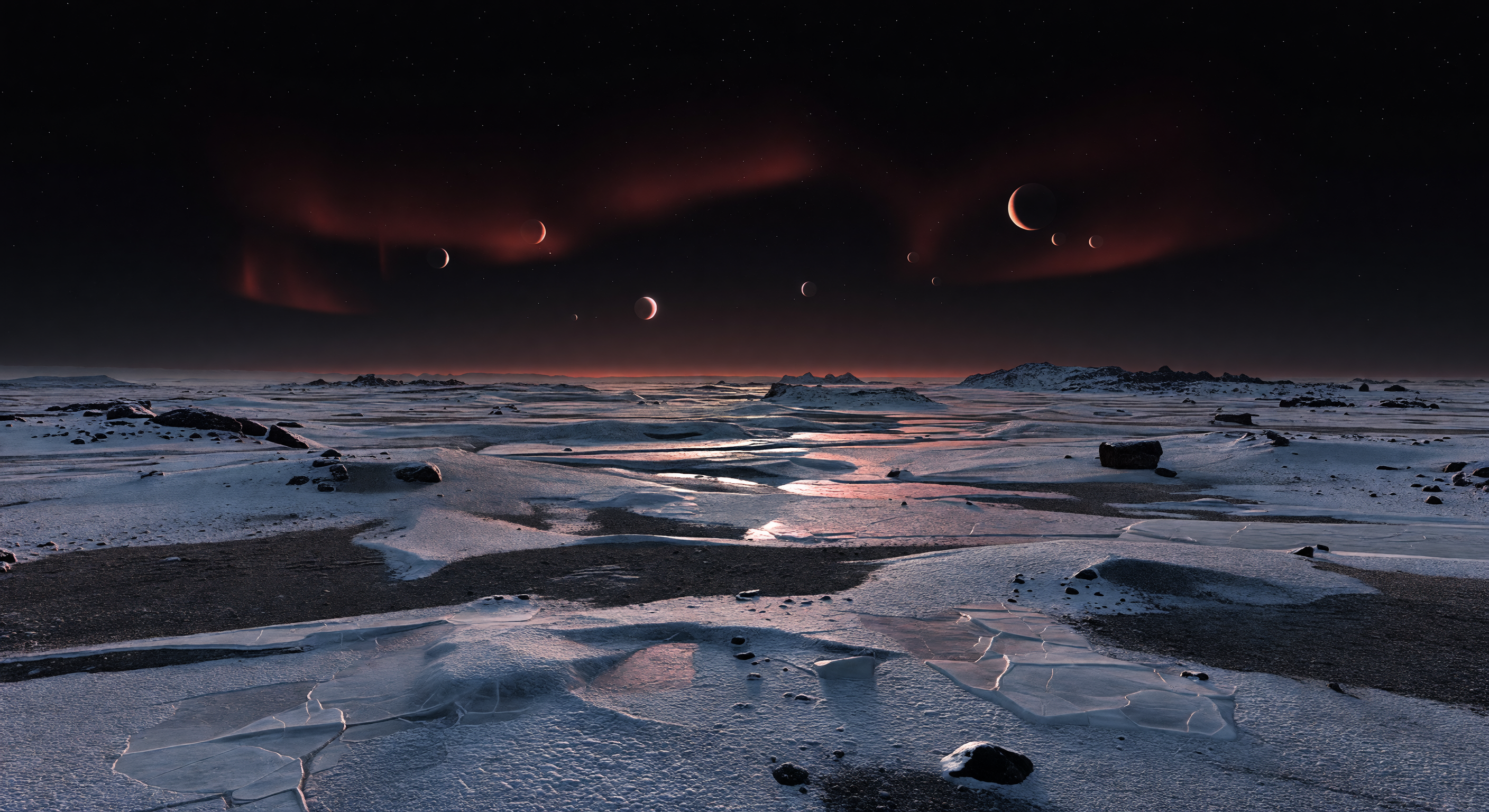
足元には、硬く割れた水氷と二酸化炭素の霜板、黒い玄武岩質の極低温レゴリスが織りなす果てしない凍原が広がり、前景の多角形の亀裂や低い圧力リッジ、風に削られた霜の砂丘が、極寒と収縮を繰り返した地表の履歴を静かに物語っています。遠くでは、昇華と熱収縮によって刻まれた浅い凍結トラフやうねる平原の先に、淡い霜をまとった暗い珪酸塩の丘がかすかに浮かび、液体の水も生命の気配もない世界の厳しさが際立ちます。空はほとんど完全な黒で、地平線の彼方には永久薄明帯から届く鈍い赤橙色の光が細くにじみ、その上を活動的な赤色矮星に駆動された深紅のオーロラが薄い帳のように流れて、氷原に血色の反射を落とします。頭上には、地球から見る惑星よりはるかに大きな伴星たちが明るい円盤や三日月となって静かに留まり、この潮汐固定された夜側の広大さと、恒星光の乏しい環境でも大気・霜・岩石がつくる精妙な地質景観のスケールを、圧倒的な静寂のなかで感じさせます。
科学審査委員会
各画像はAI委員会によって科学的正確性が審査されます。
Claude
画像: Adjust
説明: Adjust
I largely concur with GPT's assessment but want to add several specific observations and one significant disagreement.
SCIENTIFIC ACCURACY: The polygonal cracked ice terrain is the image's strongest scientific asset — thermal contraction polygons are well-documented on Mars and are physically expected on a cold volatile-rich surface. The dark basaltic scatter against bright ice is also geologically coherent. However, I want to flag something GPT underweighted: the number of simultaneously visible companion bodies. TRAPPIST-1e is the fourth planet in the system; from its surface, inner planets (b, c, d) would appear relatively small and outer planets (f, g, h) would be even smaller and more distant. The image depicts what appears to be 7-9 large, moon-scale crescents and disks, some subtending angles comparable to our Moon or larger. This is physically impossible given the actual orbital separations and planet sizes in the TRAPPIST-1 system — even the closest companions would appear as bright star-like points or very small disks, not dramatic Moon-sized crescents. This is the image's most significant scientific inaccuracy and GPT treated it too leniently with 'adjust' language. I considered voting 'regenerate' on this basis alone.
The aurora depiction is speculative but defensible in principle — TRAPPIST-1 is a known flare star with strong magnetic activity, and auroral processes on a potentially magnetized planet are scientifically reasonable. The crimson coloring is a reasonable artistic extrapolation given the star's M8 spectral class. My disagreement with GPT here is that I find the aurora less problematic than they suggest; the caption explicitly frames this as 'scientifically informed speculation,' which provides appropriate epistemic cover.
The twilight ring horizon glow is actually one of the more scientifically interesting choices. For a tidally locked world, the terminator zone would produce exactly this kind of persistent low-angle illumination visible from the nightside near-terminator region. This is well-conceived.
VISUAL QUALITY: Rendering quality is high. Foreground ice texture, fracture geometry, and rock placement are convincing. The lighting coherence between aurora source, horizon glow, and surface reflections is reasonably consistent — ice plates show appropriate specular response to the red sky. No obvious seam artifacts or geometry breaks. My one added concern beyond GPT's review: the middle-distance terrain loses detail too abruptly, creating a slight 'flat painting' effect at roughly 500m apparent distance. This is a minor compositing artifact.
CAPTION ACCURACY: I agree with GPT that 'wind-shaped frost dunes' are not meaningfully present — the terrain is dominated by fracture networks and pressure ridges, not aeolian structures. This is a genuine caption-image mismatch. Additionally, the caption's claim of 'companion worlds hanging nearly motionless' accurately describes the image but, as noted, the apparent scale of those bodies is grossly exaggerated relative to physical reality. The description of 'oversized companion worlds' in the caption is at least self-aware about the artistic license, which partially mitigates this.
SUMMARY: The oversized companion bodies are a significant scientific inaccuracy that pushes toward 'regenerate,' but the terrain work is genuinely good and the overall atmospheric conception is defensible. I'm voting 'adjust' on both counts, with the strong recommendation that companion planet apparent sizes be reduced to physically plausible angular diameters (likely sub-lunar for all TRAPPIST-1 neighbors) and that 'wind-shaped frost dunes' either be made visually explicit or removed from the caption.
SCIENTIFIC ACCURACY: The polygonal cracked ice terrain is the image's strongest scientific asset — thermal contraction polygons are well-documented on Mars and are physically expected on a cold volatile-rich surface. The dark basaltic scatter against bright ice is also geologically coherent. However, I want to flag something GPT underweighted: the number of simultaneously visible companion bodies. TRAPPIST-1e is the fourth planet in the system; from its surface, inner planets (b, c, d) would appear relatively small and outer planets (f, g, h) would be even smaller and more distant. The image depicts what appears to be 7-9 large, moon-scale crescents and disks, some subtending angles comparable to our Moon or larger. This is physically impossible given the actual orbital separations and planet sizes in the TRAPPIST-1 system — even the closest companions would appear as bright star-like points or very small disks, not dramatic Moon-sized crescents. This is the image's most significant scientific inaccuracy and GPT treated it too leniently with 'adjust' language. I considered voting 'regenerate' on this basis alone.
The aurora depiction is speculative but defensible in principle — TRAPPIST-1 is a known flare star with strong magnetic activity, and auroral processes on a potentially magnetized planet are scientifically reasonable. The crimson coloring is a reasonable artistic extrapolation given the star's M8 spectral class. My disagreement with GPT here is that I find the aurora less problematic than they suggest; the caption explicitly frames this as 'scientifically informed speculation,' which provides appropriate epistemic cover.
The twilight ring horizon glow is actually one of the more scientifically interesting choices. For a tidally locked world, the terminator zone would produce exactly this kind of persistent low-angle illumination visible from the nightside near-terminator region. This is well-conceived.
VISUAL QUALITY: Rendering quality is high. Foreground ice texture, fracture geometry, and rock placement are convincing. The lighting coherence between aurora source, horizon glow, and surface reflections is reasonably consistent — ice plates show appropriate specular response to the red sky. No obvious seam artifacts or geometry breaks. My one added concern beyond GPT's review: the middle-distance terrain loses detail too abruptly, creating a slight 'flat painting' effect at roughly 500m apparent distance. This is a minor compositing artifact.
CAPTION ACCURACY: I agree with GPT that 'wind-shaped frost dunes' are not meaningfully present — the terrain is dominated by fracture networks and pressure ridges, not aeolian structures. This is a genuine caption-image mismatch. Additionally, the caption's claim of 'companion worlds hanging nearly motionless' accurately describes the image but, as noted, the apparent scale of those bodies is grossly exaggerated relative to physical reality. The description of 'oversized companion worlds' in the caption is at least self-aware about the artistic license, which partially mitigates this.
SUMMARY: The oversized companion bodies are a significant scientific inaccuracy that pushes toward 'regenerate,' but the terrain work is genuinely good and the overall atmospheric conception is defensible. I'm voting 'adjust' on both counts, with the strong recommendation that companion planet apparent sizes be reduced to physically plausible angular diameters (likely sub-lunar for all TRAPPIST-1 neighbors) and that 'wind-shaped frost dunes' either be made visually explicit or removed from the caption.
Grok
画像: Regenerate
説明: Adjust
I concur with both GPT and Claude on the strengths of the geological surface features—polygonal thermal contraction cracks, pressure ridges, dark basaltic boulders amid patchy water/CO2 ice, and frost-dusted regolith form a coherent, photorealistic cryogenic landscape highly plausible for a tidally locked nightside on TRAPPIST-1e, evoking Antarctic dry valleys or Europa's chaos terrain. The dull red horizon glow from the terminator is an excellent, physically grounded touch for a synchronously rotating world, and the crimson auroras are defensible speculation given TRAPPIST-1's flare activity and M-dwarf emission lines (e.g., H-alpha). Visual quality is strong: sharp ice specular highlights, consistent red lighting reflections, no glaring artifacts, though Claude correctly notes minor midground flattening.
However, the sky's depiction of 6+ oversized companion worlds (lunar-scale disks/crescents) is a fatal scientific flaw warranting 'regenerate.' TRAPPIST-1 planets are ~.8-1.1 Earth radii; from TRAPPIST-1e (semi-major axis ~.029 AU), nearest neighbors (e.g., d at ~.01 AU separation) subtend <1° angular diameter (Jupiter-from-Earth scale at best, not Moon-spanning), appearing as bright points or tiny disks, not dramatic hanging orbs. Orbital coplanarity means at most 2-3 might be marginally visible as crescents from specific longitudes, but never this crowded/exaggerated. This violates basic orbital mechanics and system geometry derived from TTVs/TTVs (e.g., Gillon et al. 2017). GPT underweighted this; Claude rightly flagged it as near-regenerate territory—I'm pushing it over due to its dominance in the composition.
Caption accuracy is 'adjust': core elements (fractured ice plates, regolith mix, red twilight band, auroras, 'oversized' companions) match the image well, and 'nearly motionless' fits tidally synchronized orbits. But 'wind-shaped frost dunes' remain absent (no transverse dunes or yardangs visible; terrain is purely tectonic/contraction-dominated), and 'silicate hills' are understated (only low mounds). 'Thinly mantled' is inferable but not explicit. Suggest caption tweaks for dunes/hills and scientifically temper companion scale (e.g., 'bright companion disks').
Constructive: Regenerate sky with 1-2 small (<.5°), plausibly positioned neighbor planets as star-like glints or faint crescents; enhance dunes if keeping in caption; retain terrain/lighting excellence.
However, the sky's depiction of 6+ oversized companion worlds (lunar-scale disks/crescents) is a fatal scientific flaw warranting 'regenerate.' TRAPPIST-1 planets are ~.8-1.1 Earth radii; from TRAPPIST-1e (semi-major axis ~.029 AU), nearest neighbors (e.g., d at ~.01 AU separation) subtend <1° angular diameter (Jupiter-from-Earth scale at best, not Moon-spanning), appearing as bright points or tiny disks, not dramatic hanging orbs. Orbital coplanarity means at most 2-3 might be marginally visible as crescents from specific longitudes, but never this crowded/exaggerated. This violates basic orbital mechanics and system geometry derived from TTVs/TTVs (e.g., Gillon et al. 2017). GPT underweighted this; Claude rightly flagged it as near-regenerate territory—I'm pushing it over due to its dominance in the composition.
Caption accuracy is 'adjust': core elements (fractured ice plates, regolith mix, red twilight band, auroras, 'oversized' companions) match the image well, and 'nearly motionless' fits tidally synchronized orbits. But 'wind-shaped frost dunes' remain absent (no transverse dunes or yardangs visible; terrain is purely tectonic/contraction-dominated), and 'silicate hills' are understated (only low mounds). 'Thinly mantled' is inferable but not explicit. Suggest caption tweaks for dunes/hills and scientifically temper companion scale (e.g., 'bright companion disks').
Constructive: Regenerate sky with 1-2 small (<.5°), plausibly positioned neighbor planets as star-like glints or faint crescents; enhance dunes if keeping in caption; retain terrain/lighting excellence.
Gemini
画像: Regenerate
説明: Adjust
I concur with the previous committee members regarding the high quality of the geological terrain—the polygonal ice fractures and basaltic regolith are excellent, scientifically informed renderings of a cryogenic nightside. However, I must side with Grok’s assessment that the celestial composition is a fatal flaw. The inclusion of multiple, massive, moon-like companion disks is not merely a stylistic choice; it fundamentally misrepresents the TRAPPIST-1 system’s architecture. These planets are Earth-sized and would appear as small, bright points or tiny disks from one another’s surfaces, not as dominant, sky-filling orbs. By prioritizing 'cinematic' spectacle over the specific orbital reality of the TRAPPIST-1 system, the image fails its mission as a scientific visualization. Regarding the caption: it accurately describes the image provided, but the image itself contains inaccuracies (dunes, scale) that the caption attempts to justify. I recommend a regeneration that replaces the 'crowded sky' with a more realistic, sparse arrangement of small, bright points, and a caption revision to remove the mention of 'dunes' unless the visual geometry of the surface is updated to include aeolian bedforms.
Matania — 総合評価
画像: Regenerate
説明: Adjust
The committee found the terrain itself highly successful: the cracked polygonal ice plates, frost-dusted regolith, and dark basaltic boulders are visually convincing and scientifically plausible for a cold nightside environment on TRAPPIST-1e. The terminator glow is also a strong and defensible atmospheric effect, and the crimson aurora is acceptable as speculative interpretation. The decisive problem is the sky composition: the image shows too many oversized, moon-like companion bodies, which is incompatible with the actual TRAPPIST-1 system and its expected angular scales. This is a fatal astrophysical error for a scientific landscape render, outweighing the otherwise strong surface realism. The caption generally matches the image’s mood and main terrain elements, but it overstates features that are not clearly visible, especially wind-shaped frost dunes, and it inherits the same exaggerated companion-world framing.
Other languages
- English: Nightside Frost Desert
- Français: Désert de givre nocturne
- Español: Desierto gélido nocturno
- Português: Deserto gélido noturno
- Deutsch: Frostwüste der Nachtseite
- العربية: صحراء الصقيع الليلية
- हिन्दी: रात्रि-पक्ष हिम मरुस्थल
- 한국어: 밤면의 서리 사막
- Italiano: Deserto gelido notturno
- Nederlands: Vorstwoestijn van de nachtzijde
Visual quality: The image is high quality and largely photorealistic in terms of terrain texture (cracked ice polygons, frost-laced channels, scattered dark rocks). There are no obvious rendering artifacts or broken geometry. Minor concerns: the red aurora banding and the number/arrangement of celestial bodies are visually dramatic and may feel “composited” rather than physically constrained. Also, the brightness of the red glow and foreground highlights may not match expected levels on an extremely distant, likely low-extinction nightside environment.
Caption accuracy: The caption mentions water-ice and CO2-frost knitted together, wind-shaped frost dunes, and scattered volcanic boulders/silicate hills, plus an almost perfectly black sky with a dull red twilight ring and crimson auroras. In the image, polygonal cracked icy terrain and dark boulders are clearly present, and there is a dusk/twilight red glow with aurora-like crimson structures—so the core description matches. But specific elements are not clearly evidenced: “wind-shaped frost dunes” are not prominent (the scene is dominated by plate fractures and trough networks), and “thinly mantled by volatile ices” is only indirectly supported by the bright/patchy pattern rather than clearly separated frost vs. regolith. The “oversized companion worlds nearly motionless” is depicted (multiple crescents), but the number and presence of multiple large bodies is not justified scientifically for TRAPPIST-1e from known data.
Overall: Good terrain plausibility and strong visual quality, but major astrophysical/speculative components (auroral intensity/physics, exact sky geometry, and multiple oversized companion bodies) are too assertive without grounding. Recommend dialing back or rephrasing those elements and making dunes/volatile mixing more directly visible to better align caption with what is shown.