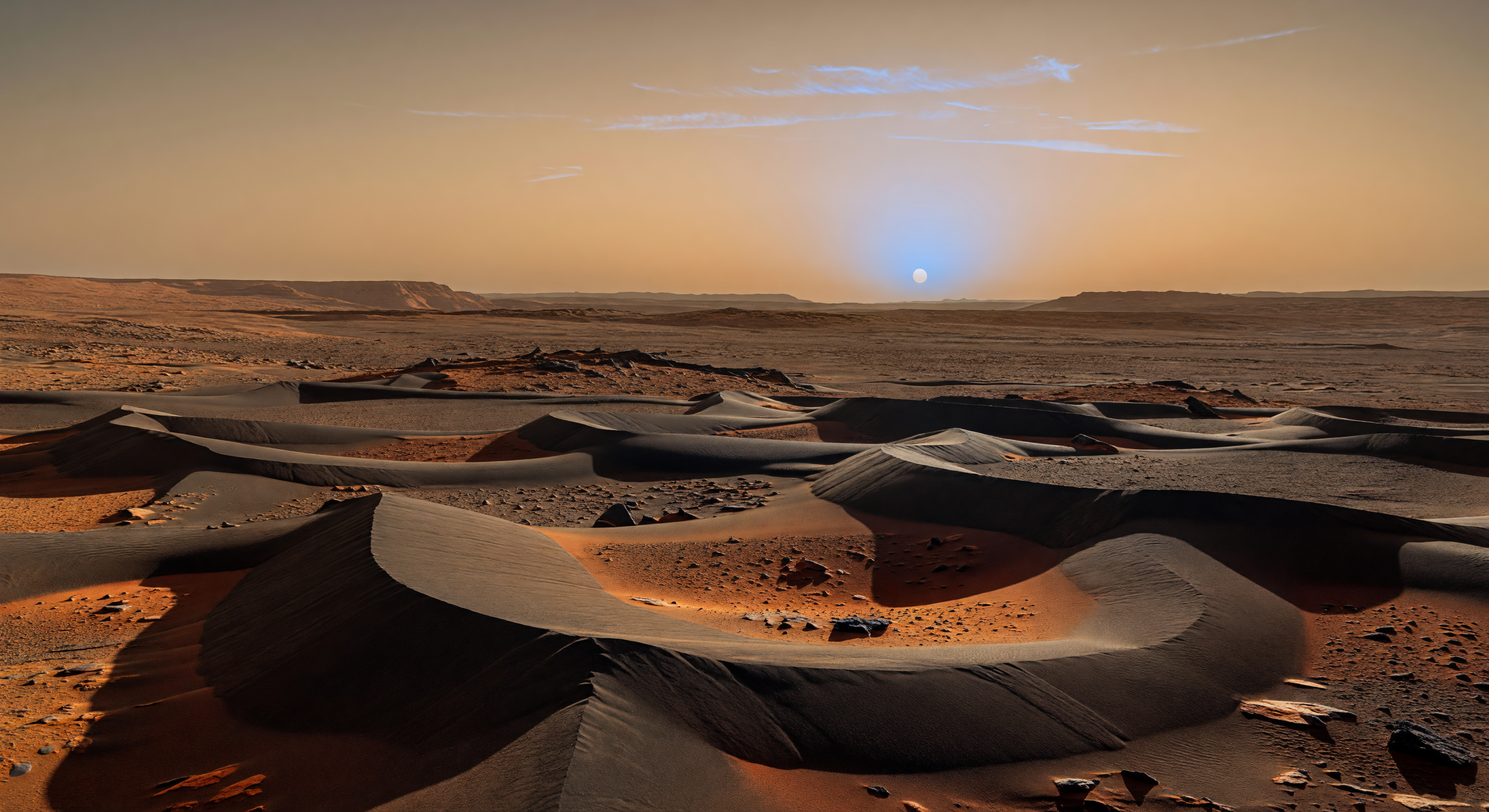
夜明けの薄い大気の下、木炭のように黒い玄武岩質の砂でできた三日月形やバルハン砂丘が、赤錆びた塵の斑を縫うように鋭く立ち上がり、低い朝日がその稜線から氷の刃のように長い影を平原へ投げかけている。砂丘の風下斜面は、地球より弱い重力と乾いた風に刻まれて急でくっきりしており、谷間には酸化鉄に富む微細な赤橙色の塵、風食された石、黒い小礫に覆われたデフレーション面が点在して、ここが火山岩由来の堆積物と風成作用に支配された世界であることを物語る。中景では黒い砂の海が低いクレーター縁や侵食された火山性露頭へと続き、その先のメサや高地の尾根は淡い霞の中に溶け、惑星規模の広がりを静かに示している。地平線近くの空はバタースコッチからサーモン色へとにぶく染まり、昇りかけた小さな太陽のまわりにだけ、薄い塵の大気が前方散乱で生むほのかな青い明るみがにじんでいて、凍えるほど静かな異世界の朝が足元から果てまで満ちている。
科学審査委員会
各画像はAI委員会によって科学的正確性が審査されます。
Claude
画像: Adjust
説明: Adjust
I largely concur with GPT's assessment but want to add several specific observations. On scientific accuracy: the dune morphology is genuinely impressive — the barchan/transverse hybrid forms, steep slip faces, and fine aeolian ripples on windward slopes are consistent with features documented by HiRISE in Martian dune fields like Proctor Crater. The low-angle dawn illumination casting knife-edge shadows is physically correct for Mars's axial geometry and is well-executed. However, I take stronger issue with the solar appearance than GPT did: the Sun displays a pronounced blue-white halo with significant angular diameter that reads more like an Earth atmospheric scattering effect than Martian conditions. On Mars, the suspended dust produces a distinctly pinkish-tan aureole around the Sun (as captured by Pathfinder and Curiosity), not a crisp blue-white glow — this is a meaningful scientific error, not merely stylistic. The sky gradient from salmon to tan is broadly acceptable though slightly too warm and saturated. Regarding the dune coloration: I partially disagree with GPT here. The dunes do show a meaningful dark gray-charcoal tone distinct from the rust-red interstitial dust, which is actually consistent with basaltic sand behavior observed at sites like Bagnold Dune Field. The contrast is present, though perhaps not as dramatic as the caption implies. On caption accuracy: the description's claim of 'faint cool halo' is contradicted by what is rendered — the halo is neither faint nor scientifically correct in color. The ventifact-sculpted stones are present but indistinct, and 'distant crater rims' are ambiguous at best — they read more as eroded plateau edges. The caption is evocative and scientifically informed in concept but makes specific claims the image does not fully deliver. Recommended adjustments: correct the solar halo to a warm pinkish-dust aureole consistent with Martian optics, slightly intensify the basaltic black sand coloration for caption alignment, and revise caption language around the solar effect and crater rim identification.
Grok
画像: Adjust
説明: Adjust
Agreeing substantially with both GPT and Claude: the image excels in dune morphology (crescent barchans with steep slip faces, ripples, and red dust in troughs matching HiRISE imagery from Bagnold or Proctor), low-angle dawn shadows, scattered angular rocks (plausibly ventifacts), and vast scale with eroded distant rims/outcrops suggestive of basaltic terrain. Dark charcoal-black dunes contrast well with rust-red regolith, aligning with observed basaltic sand sorting on Mars (e.g., Curiosity rover data). Sky gradient (salmon-tan) is mostly accurate for dusty Martian dawn. However, the Sun's prominent blue-white halo and cyan streaks are scientifically inaccurate—Martian dust scattering produces a subtle pinkish-tan aureole (as in Pathfinder/Perseverance images), not cool blue tones; Sun size/brightness is also slightly exaggerated for Mars (angular diameter ~.35° vs Earth's .5°). No major artifacts; photorealism is strong with coherent lighting/depth. Caption matches dunes, colors, shadows, rocks, and sky concept well, but 'faint cool halo' mismatches the bold blue rendering, and 'crater rims/worn volcanic outcrops' are present but ambiguous (read as generic plateaus). Minor adjustments: warm/dim the solar halo to pink-tan dust effect; caption could soften halo description or specify warmer tones for precision.
Gemini
画像: Adjust
説明: Adjust
I concur with the committee's consensus regarding the solar optics. The 'blue-white halo' is a significant departure from Martian atmospheric physics, where the scattering of sunlight by fine dust grains consistently yields a warm, pinkish-tan aureole. Furthermore, while the dune morphology is highly commendable and accurately reflects the aeolian processes observed at the Bagnold Dune Field, the overall contrast between the basaltic black sand and the regolith needs to be more pronounced to satisfy the caption's specific claim of 'charcoal-black' dunes. The current rendering leans too heavily into neutral gray tones. Regarding the caption, it is overly ambitious; it describes specific geological features like 'ventifact-sculpted stones' and 'crater rims' that, while present in intent, are visually ambiguous in the final render. I recommend adjusting the solar color temperature and the saturation of the volcanic sand for the image, and refining the caption to describe the distant features as 'eroded topographic boundaries' rather than definitive crater rims.
Matania — 総合評価
画像: Adjust
説明: Adjust
The committee finds the scene broadly convincing as a Martian dune field at dawn, with strong dune morphology, believable low-angle lighting, and coherent depth. The main scientific concern is the solar atmosphere: the rendered blue-white halo is not Mars-accurate, since Martian dust scattering should produce a warmer pinkish-tan aureole. A second issue is tonal emphasis: the dunes read more gray/tan than clearly black basaltic sand, so the requested 'Black Dunes' concept is only partially fulfilled. The caption is scientifically informed in spirit but overstates several details that are not clearly visible, especially the halo color and the specificity of distant crater rims and volcanic outcrops. Overall, the image and caption are close, but both need refinement for tighter Martian fidelity and clearer visual-text alignment.
Other languages
- English: Black Dunes at Dawn
- Français: Dunes noires à l’aube
- Español: Dunas negras al alba
- Português: Dunas negras ao amanhecer
- Deutsch: Schwarze Dünen im Morgengrauen
- العربية: كثبان سوداء عند الفجر
- हिन्दी: भोर की काली रेत
- 한국어: 새벽의 검은 사구
- Italiano: Dune nere all’alba
- Nederlands: Zwarte duinen bij dageraad
Visual quality: The image is high quality and coherent, with strong depth, consistent perspective, and convincing dune morphology and shadowing. No obvious rendering artifacts, discontinuities, or implausible physics are evident. Minor concern: the atmosphere/halo effect and overall color grading look somewhat stylized rather than strictly physically grounded.
Caption accuracy: Several elements match—dunes with sharp relief, wind-shaped textures, dawn lighting, and mixed darker/reds in places. But key caption claims are not clearly reflected: the “charcoal-black basaltic sand” is not dominant, and the mention of scattered ventifact-sculpted stones/deflation armor is only partially supported by the visible rock scatter. Additionally, “distant crater rims and worn volcanic outcrops” are not clearly identifiable in the provided view. Overall, the description is close in concept but overcommits on specific geology and color.