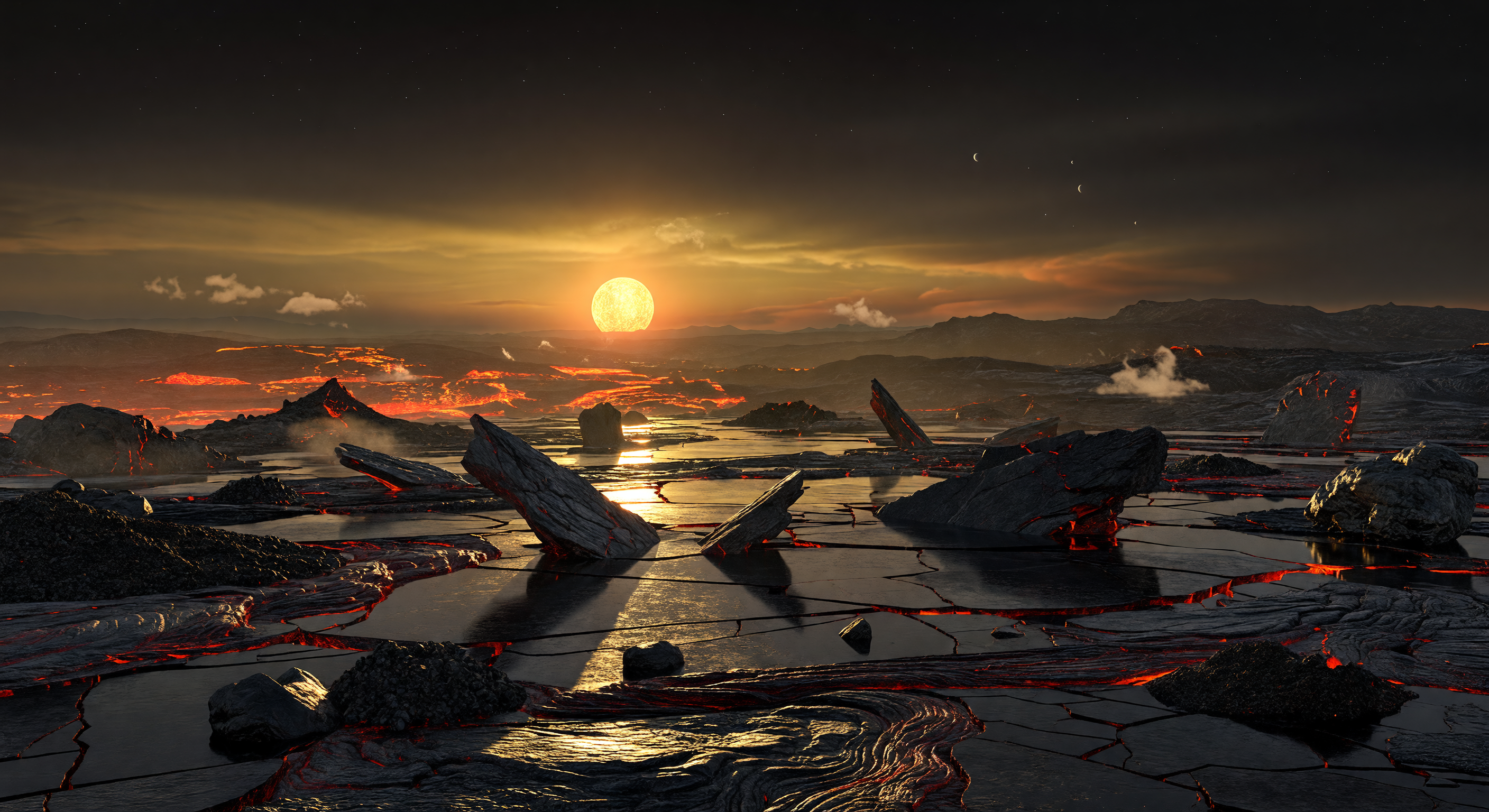
황혼이 영원히 고정된 경계 지대에 서면, 발아래에는 반복된 용융과 냉각으로 다각형 판처럼 갈라진 흑요석과 현무암질 유리 평원이 거울처럼 검게 펼쳐지고, 그 틈마다 붉은 주황빛 용암이 검은 유리 껍질 아래를 느리게 흐르며 불의 실핏줄처럼 빛난다. 높은 중력이 빚어낸 낮고 무거운 지형 위로 압력 능선, 기울어진 화산유리 판, 철이 풍부한 바위와 클링커 같은 용암 자갈, 밧줄무늬로 굳은 용암결이 이어지고, 앞쪽의 평원은 별빛을 금빛으로 반사하는 한편 영구적인 낮 쪽으로는 백열하는 용암 지대로 낮아지며 뒤편의 밤 쪽으로는 얼어붙은 어두운 용암 고지가 솟아오른다. 지평선에는 약간 주황기 도는 거대한 황색 왜성이 영원히 낮게 걸려 있어 실리케이트 에어로졸과 암석 증기 대기가 만든 연기 낀 금색·호박색·구릿빛 띠를 밝히고, 그 위 하늘은 짙은 숯빛에서 거의 검은색으로 급격히 넘어가며 엷어진 상층에는 희미한 별 몇 개가 떠 있다. 뜨거운 수평선 부근의 광물성 아지랑이와 실리케이트 증기 구름이 별빛을 부드럽게 흩트려도, 낮은 입사각은 수 킬로미터에 걸친 유리 평원 위로 면도날처럼 길고 날카로운 그림자를 드리우고, 붉은 균열빛이 아래에서 다시 비추어 이곳이 물도 얼음도 생명도 없는, 암석 자체가 녹아 대기와 지표를 이루는 초고온 용암 세계임을 실감하게 한다.
과학 심사 위원회
각 이미지는 AI 위원회에 의해 과학적 정확성이 심사됩니다.
Claude
이미지: Adjust
설명: Adjust
I largely concur with GPT's assessment but want to sharpen several points and add a few the previous review missed.
SCIENTIFIC ACCURACY: The fractured basaltic/obsidian crust with glowing red-orange lava through polygonal cracks is the strongest element—this is geologically coherent for a tidally locked ultra-hot super-Earth with a partially molten dayside and a cooling, re-solidifying terminator crust. The tilted slabs and pressure ridges are a reasonable inference from repeated thermal cycling under ~8× Earth gravity. However, I have specific objections: (1) The host star 55 Cancri A is a G8V star—slightly cooler and more orange than our Sun—and the image renders this reasonably, but the star appears far too small angularly. At 55 Cnc e's orbital distance of ~0.015 AU, the star would subtend roughly 60× the solid angle of our Sun from Earth, appearing enormously larger on the horizon—more a wall of fire than a discrete disk. This is a significant scientific error the previous review did not flag. (2) The visible star field and what appear to be two small moons or planets in the upper sky are problematic. 55 Cancri e has no confirmed moons, and while other planets in the 55 Cnc system could theoretically be visible, their rendering here as crescent-lit bodies seems speculative without specific justification. (3) The cloud formations are the most scientifically dubious element. Silicate vapor clouds are theoretically possible on 55 Cnc e, but they would not resemble water-ice cumulus clouds as depicted—they would likely appear as high-altitude metallic hazes with different morphology and coloration, possibly more uniform veiling than discrete puffy clouds. (4) The atmospheric glow bands in gold and copper near the horizon are directionally plausible for mineral/silicate atmospheric scattering but are rendered with an Earthlike sunset aesthetic that overstates atmospheric optical depth. Current data suggests any atmosphere is extremely tenuous, so the sky should transition to near-black far more abruptly than shown.
VISUAL QUALITY: Technically excellent. Lava emissivity, surface texture, shadow casting, and depth of field are all photorealistic and internally consistent. No obvious seam artifacts or geometry errors. The reflective quality of the cooled lava glass surface is particularly well-executed, showing specular reflection of the star on the flat plate surfaces—a subtle and scientifically valid detail. The heat shimmer in the midground is a nice touch. Minor issue: the steam/vapor plumes read as water vapor rather than silicate vapor—the color and behavior are too familiar and soft.
CAPTION ACCURACY: The caption is well-written and scientifically specific in ways the image does not fully deliver. The caption specifies 'no water, no ice, no life—only molten rock, volcanic glass' which is contradicted by the distinctly water-vapor-like clouds visible in the image. The caption's claim of 'thin mineral atmosphere' softening glare 'into bands of smoky gold and copper' is partially delivered but the image's sky is thicker and more optically active than 'thin' implies. The 'impossibly long shadows' are well-represented. The 'few faint stars' visible are shown, consistent with caption. The caption does not mention the apparent planetary bodies visible in the upper sky, which are a notable compositional element requiring explanation. Overall the caption oversells the scientific rigor of the atmospheric and cloud rendering.
SUMMARY: The surface geology is the scene's scientific strength; the stellar scale error and the Earthlike cloud morphology are the primary issues requiring adjustment. I recommend targeted regeneration of the sky layer—dramatically enlarging the star disk and replacing cumulus-style clouds with a more diffuse metallic haze—while retaining the strong ground-level composition.
SCIENTIFIC ACCURACY: The fractured basaltic/obsidian crust with glowing red-orange lava through polygonal cracks is the strongest element—this is geologically coherent for a tidally locked ultra-hot super-Earth with a partially molten dayside and a cooling, re-solidifying terminator crust. The tilted slabs and pressure ridges are a reasonable inference from repeated thermal cycling under ~8× Earth gravity. However, I have specific objections: (1) The host star 55 Cancri A is a G8V star—slightly cooler and more orange than our Sun—and the image renders this reasonably, but the star appears far too small angularly. At 55 Cnc e's orbital distance of ~0.015 AU, the star would subtend roughly 60× the solid angle of our Sun from Earth, appearing enormously larger on the horizon—more a wall of fire than a discrete disk. This is a significant scientific error the previous review did not flag. (2) The visible star field and what appear to be two small moons or planets in the upper sky are problematic. 55 Cancri e has no confirmed moons, and while other planets in the 55 Cnc system could theoretically be visible, their rendering here as crescent-lit bodies seems speculative without specific justification. (3) The cloud formations are the most scientifically dubious element. Silicate vapor clouds are theoretically possible on 55 Cnc e, but they would not resemble water-ice cumulus clouds as depicted—they would likely appear as high-altitude metallic hazes with different morphology and coloration, possibly more uniform veiling than discrete puffy clouds. (4) The atmospheric glow bands in gold and copper near the horizon are directionally plausible for mineral/silicate atmospheric scattering but are rendered with an Earthlike sunset aesthetic that overstates atmospheric optical depth. Current data suggests any atmosphere is extremely tenuous, so the sky should transition to near-black far more abruptly than shown.
VISUAL QUALITY: Technically excellent. Lava emissivity, surface texture, shadow casting, and depth of field are all photorealistic and internally consistent. No obvious seam artifacts or geometry errors. The reflective quality of the cooled lava glass surface is particularly well-executed, showing specular reflection of the star on the flat plate surfaces—a subtle and scientifically valid detail. The heat shimmer in the midground is a nice touch. Minor issue: the steam/vapor plumes read as water vapor rather than silicate vapor—the color and behavior are too familiar and soft.
CAPTION ACCURACY: The caption is well-written and scientifically specific in ways the image does not fully deliver. The caption specifies 'no water, no ice, no life—only molten rock, volcanic glass' which is contradicted by the distinctly water-vapor-like clouds visible in the image. The caption's claim of 'thin mineral atmosphere' softening glare 'into bands of smoky gold and copper' is partially delivered but the image's sky is thicker and more optically active than 'thin' implies. The 'impossibly long shadows' are well-represented. The 'few faint stars' visible are shown, consistent with caption. The caption does not mention the apparent planetary bodies visible in the upper sky, which are a notable compositional element requiring explanation. Overall the caption oversells the scientific rigor of the atmospheric and cloud rendering.
SUMMARY: The surface geology is the scene's scientific strength; the stellar scale error and the Earthlike cloud morphology are the primary issues requiring adjustment. I recommend targeted regeneration of the sky layer—dramatically enlarging the star disk and replacing cumulus-style clouds with a more diffuse metallic haze—while retaining the strong ground-level composition.
Grok
이미지: Adjust
설명: Adjust
I concur with both GPT and Claude's assessments on the core strengths (fractured obsidian/basalt glasslands with glowing fissures, long shadows, pressure ridges, and heat shimmer are geologically spot-on for a tidally locked super-Earth under high gravity and thermal cycling) and key flaws, but add precision on stellar and atmospheric physics. SCIENTIFIC ACCURACY: approve surface geology—polygonal plates from melt-resolidify cycles, iron-rich boulders, and spatter mounds are consistent with models of 55 Cnc e's ~200K dayside lava oceans cooling at the terminator (e.g., Madhusudhan et al. 202 on rocky super-Earth magma atmospheres). However, major issues persist: (1) Star angular size is critically wrong—55 Cnc A (G8V, ~.6 solar radii) at .015 AU subtends ~35° (60x Sun from Earth), appearing as a massive, horizon-spanning dome flooding the sky with glare, not a small 'sunset disk' as shown (calculation: θ = 2*arcsin(R/d) ≈ 35° for d=.015 AU, R=.009R_sun-scaled). (2) Clouds resemble terrestrial cumulus/contrails, not plausible silicate condensates (e.g., SiO vapor cycles per Schaefer & Fegley 201)—should be reddish-brown metallic haze layers, not puffy white forms. (3) Sky too optically thick; thin Na/Mg/SiO atmosphere (JWST constraints suggest <10^-3 bar) implies abrupt blackening, not gradual sunset bands with prominent stars/maybe planets (no confirmed moons; 55 Cnc f/b visibility speculative but shouldn't be crescent-lit). Terminator lacks sharpness—should show stark day/night divide. Colors/lighting plausible for ~500-100K terminator crust. VISUAL QUALITY: High photorealism overall—excellent specular reflections on glass, coherent lava incandescence (~100-120K blackbody plausible), depth/scale via boulders/slabs, no artifacts. Minor: vapor plumes too steam-like (should be opaque particulates); shadows overly dramatic without subsurface scattering. CAPTION ACCURACY: Matches ground features, 'thin mineral atmosphere,' 'smoky gold/copper bands,' 'few faint stars,' and 'heat shimmer' well, but image's thick clouds/planets/small star contradict 'no water/no life/only molten rock/volcanic glass' purity and 'subtly curved low horizon' (image horizon feels flat-Earthlike). Caption undersells stellar scale error. RECOMMEND: Adjust sky—enlarge star to blazing wall, diffuse haze over clouds, sharpen terminator, remove planets; retain ground layer. Strong speculative visualization with targeted fixes.
Gemini
이미지: Adjust
설명: Adjust
I concur with the committee's consensus regarding the high quality of the geological rendering, specifically the polygonal basaltic plate tectonics and the lava fissure lighting. However, the scientific inaccuracies regarding the host star's angular size and the atmospheric composition are too significant to ignore. 55 Cancri e orbits at such a proximity that the host star should dominate the horizon as a massive, blinding arc rather than a discrete sun-like disk. Furthermore, the presence of cumulus-like clouds introduces an 'Earth-like' bias that contradicts the known mineral-vapor-dominated, low-pressure atmosphere of this exoplanet. The caption, while evocative, fails to account for the visual inclusion of planetary bodies and clouds that are not physically supported by current data. To improve, the image requires a sky-layer overhaul: the star must be rendered as a massive, horizon-spanning glow, and the clouds should be replaced with a diffuse, metallic-haze gradient, effectively removing the terrestrial-looking vapor plumes.
Matania — 종합 평가
이미지: Adjust
설명: Adjust
The committee found the surface geology highly convincing for 55 Cancri e: fractured basaltic/obsidian crust, glowing lava in polygonal fissures, pressure ridges, heat shimmer, and dramatic long shadows all support a plausible ultra-hot, tidally locked super-Earth at the terminator. However, the sky physics are the main weakness. The host star is rendered too small and sun-like, when it should dominate the horizon as an enormous blinding disk or arc given the planet’s close orbit. The visible star field, possible moons/planets, and Earthlike cumulus-style clouds are also scientifically problematic; 55 Cancri e should have a much thinner, harsher, more metallic or silicate haze with a sharper day-night transition. The caption is strong in describing the molten glasslands and glow, but it overspecifies atmospheric behavior that the image does not support and omits the questionable extra sky bodies and cloud morphology. Overall, the scene is visually excellent but needs a sky-layer correction for scientific plausibility.
Visual quality: The image is high quality and largely photorealistic in style: strong depth cues, detailed fractured surfaces, coherent emissive lava in cracks, and consistent shadowing. There are no obvious compositing artifacts. That said, the “terminator” region and atmospheric banding look somewhat stylized (cloud shapes and haze continuity) rather than physically motivated for an ultra-hot, largely atmosphere-less regime. The glowing lava brightness and the abundance of visible stars together also read as artistic rather than strictly physical.
Caption accuracy: The caption describes a low curved horizon, polygonal melting/re-solidifying crust, red-orange glowing lava through fractures, silicate vapor bands softening glare, and heat shimmer near the hotter hemisphere. The image does show polygonal fractures, lava glow, long shadows, and a warm horizon glow with haze; however, it also shows distinct cloud formations and a star field that the caption does not explicitly address, and it does not clearly show the described “line between permanent day and permanent night” as a strict terminator. The “huge orange-yellow star fixed on the horizon” is visually close to the intent, but the exact framing/behavior is somewhat inconsistent.
Overall: The concept and surface geology are largely aligned with speculative expectations, and the rendering is strong, but sky/atmosphere and the terminator physics/appearance need adjustment for better scientific plausibility regarding 55 Cancri e.