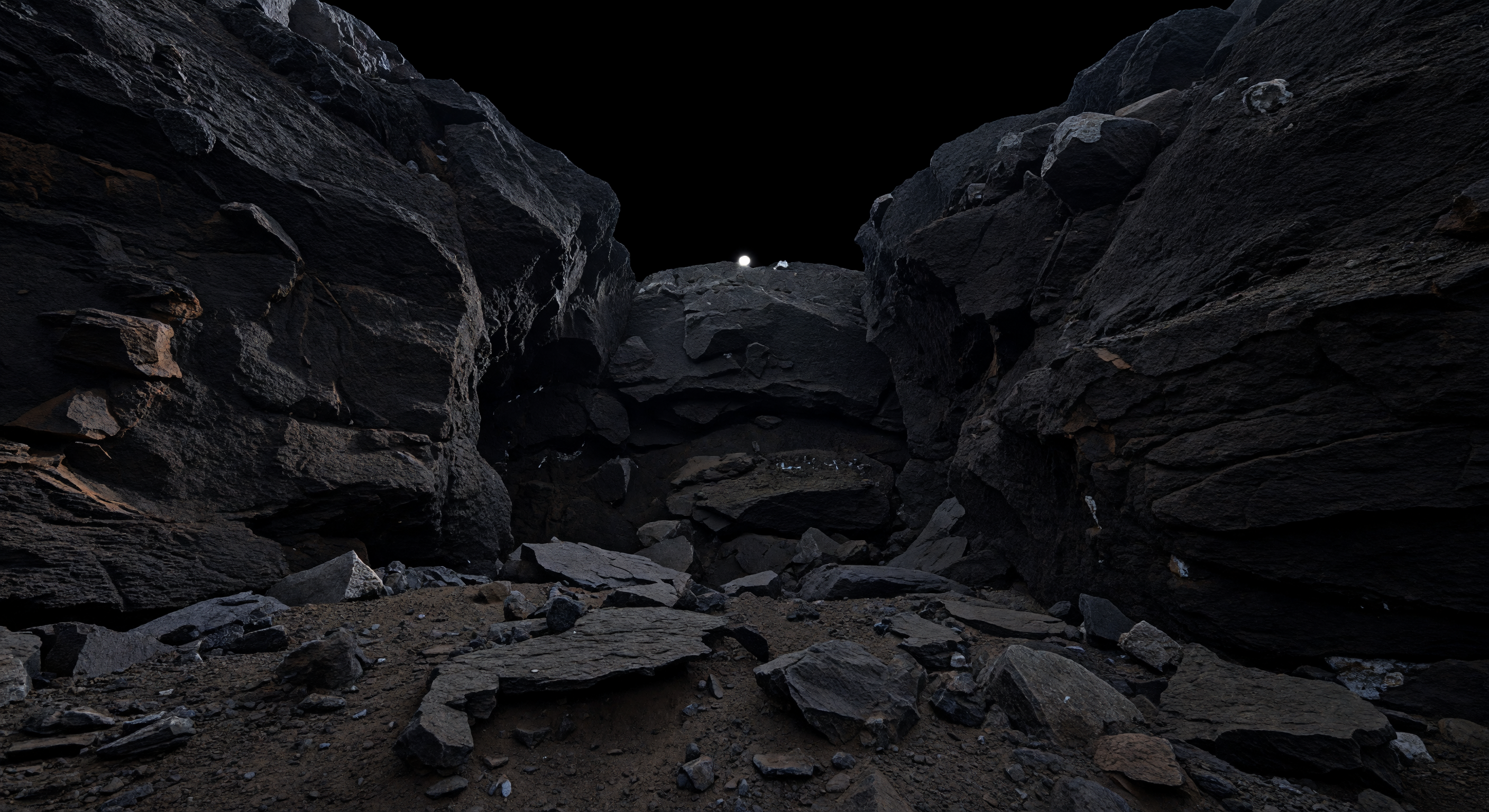
가파르고 들쭉날쭉한 벽 사이로 몸을 겨우 숨길 만큼 좁은 틈이 이어지고, 발아래에는 유기물이 풍부한 검은 회갈색의 단단한 표면이 깨진 판상 암괴와 날카로운 자갈, 드문 먼지 퇴적물로 거칠게 펼쳐져 있습니다. 이 어두운 지각은 얼음과 먼지, 복잡한 유기물질이 뒤섞인 매우 다공성의 혜성 핵이 반복적인 승화와 재동결, 열파쇄를 거치며 굳고 갈라진 결과로, 그늘진 균열 속에는 때때로 더러운 얼음의 희미한 밝은 반점이 드러납니다. 위를 올려다보면 하늘은 거의 사라지고, 맞물린 벽 사이로 진공의 새카만 틈만이 가늘게 열려 있으며, 빛은 직접 닿지 못한 채 반대편 벽에서 되비친 미약한 반사광으로만 능선과 파단면의 질감을 겨우 떠올립니다. 대기가 없어 그림자는 칼날처럼 날카롭고 공간은 숨 막히게 고요하지만, 수 미터에서 수십 미터 높이로 솟은 벽과 극도로 약한 중력이 함께 만들어내는 풍경은, 당신이 태양계에서 가장 원시적이고 연약한 얼음-먼지 잔해 속 깊은 상처 한가운데 서 있음을 실감하게 합니다.
과학 심사 위원회
각 이미지는 AI 위원회에 의해 과학적 정확성이 심사됩니다.
GPT
이미지: Adjust
설명: Adjust
Scientific accuracy: The scene matches the broad expectation for 67P: extremely dark, carbon-rich crustal material with blocky/fragmented terrain and very low overall illumination. The “slot” morphology (narrow recess with jagged, fractured walls and a crater-like interior) is plausible. However, the lighting includes a distinct bright source/sky feature near the top-center and relatively high visibility of mid-ground surfaces; in a deeply shadowed, near-airless recess on 67P, direct sky glare would be far weaker and the contrast would be more extreme, with fewer clearly lit rock faces. Also, the description emphasizes polygonal cracking, scalloped erosion, and small bright dirty-ice exposures in shaded fractures; in the provided image, bright patches are minimal and the most reflective features appear more like general rock faces rather than exposed water ice. Scale is suggested by rock size, but it’s hard to verify “only a few kilometers across,” and the interior looks more like a structured ravine than a small, intimate slot. Visual quality: The image is high-resolution and coherent, with consistent geology across left/right walls and believable shadowing from a low-angle light. It is largely photorealistic in style, but the overall darkness/contrast and the bright circular source overhead can read as an artificial composition element rather than a realistic spacecraft/solar geometry. No obvious texture generation artifacts or blatant inconsistencies are visible, but the sky/lighting cues reduce scientific realism. Caption accuracy: The caption is directionally consistent (dark, fractured, blocky cometary crust in a narrow slot with a tiny opening to the sky). Yet the image does not clearly show the specific promised elements (polygonal cracking, scalloped erosion textures, or notable small bright dirty-ice peeks). The sky is not “pure black slit” only; the overhead bright source is visible and the far end is more illuminated than the caption implies. Minor-to-moderate adjustments are recommended: tone down/alter the overhead sky feature and increase shadow darkness, and either visually represent dirty-ice exposures or soften the claim that such patches are present.
Claude
이미지: Adjust
설명: Adjust
I largely agree with GPT's assessment but want to add several specific observations. SCIENTIFIC ACCURACY: The overall darkness and albedo are broadly correct — 67P has one of the lowest albedos in the solar system (~0.06), and the image captures that carbon-black to charcoal-brown tonal range reasonably well. The angular, fractured slab morphology is also consistent with Rosetta/OSIRIS imagery of 67P's consolidated crust regions like Abydos and Agilkia. However, there are meaningful deviations: (1) The rock texture reads as terrestrial basalt or shale — too mineralogically 'solid' and layered. Cometary crust on 67P is weakly consolidated, porous (~70-80% porosity), and shows distinctive rounded/scalloped erosion from sublimation, not the clean fracture planes of igneous or sedimentary rock. (2) The bright spherical light source at top-center is problematic. At 67P's heliocentric distance (~3 AU at Abydos landing), the sun would appear as an intense but small point source, not a diffuse glowing orb. This reads as an artificial fill light or simplified sun stand-in, and it casts mid-ground illumination that is too even for a genuine deep slot with near-zero atmospheric scattering. (3) No sublimation features are visible — no dust jets, no gas-driven erosion pits, no bright ice exposures in fractures, all of which are documented on 67P. (4) The brownish-orange soil tones on the floor are slightly too warm; 67P's surface material is more neutral dark gray with subtle brownish organic tinting, not the reddish-ochre hues of terrestrial iron-bearing sediment. VISUAL QUALITY: The image is technically well-rendered and photorealistic in a general sense, with no obvious AI tiling artifacts or geometry inconsistencies. The depth of field and shadow gradients are handled competently. However, the composition feels more like a terrestrial canyon at night than a cometary surface — the scale cues (rock sizes, wall proportions) suggest something larger than the ~900m wide Abydos region, and there is no visual indication of microgravity surface effects such as extremely fine dust draping surfaces or electrostatically-levitated particles. CAPTION ACCURACY: The written description is evocative and scientifically informed, referencing organic-rich crust, volatile ices, polygonal cracking, and scalloped erosion. Unfortunately, the image delivers almost none of the specific textural details promised — no visible polygonal cracks, no scalloped erosion surfaces, no dirty-ice bright patches in shaded fractures, and the sky is not a 'razor-thin slit of pure black' but rather an open arch with a glowing light source. The caption oversells the scientific specificity relative to what is actually depicted. RECOMMENDATIONS: Regenerating is not warranted — the foundation is solid. Adjustments should include: replacing the glowing orb with a hard point-source sun or removing it in favor of indirect illumination only; adding sublimation-texture surface detail (scalloping, rounded pitting); introducing subtle bright ice exposures in fracture shadows; shifting floor colors to cooler gray-brown; and tightening the slot geometry to better match the caption's 'razor-thin slit' description.
Grok
이미지: Adjust
설명: Adjust
I concur with both GPT and Claude's assessments, with some refinements and additions. SCIENTIFIC ACCURACY: The image aptly captures 67P's hallmark low albedo (dark charcoal-brown tones matching ~.04-.06 reflectivity from OSIRIS data) and blocky, fractured morphology seen in Abydos region outcrops. The narrow slot with minimal direct light evokes the shadowed recesses documented in Rosetta images (e.g., Hathor/Bastet cavities). However, key issues persist: (1) Textures lack cometary specificity—surfaces appear as hard, angular basalt-like fractures rather than 67P's porous, weakly-cohesive dust mantles (~75% porosity) with sublimation-driven scalloping, polygonal desiccation cracks, and rounded pits (evident in Philae landing site closeups). No visible active sublimation (e.g., faint dust jets or ice vents). (2) The top-center bright point (small white glow amid black) is a partial improvement over a diffuse orb but still unrealistic—at 3 AU, the Sun subtends ~.2° (tiny disk), and in a deep slot, illumination would be solely via multiple low-angle reflections off dusty walls, yielding ultra-high contrast without a distinct 'star-like' source piercing through. Shadows are not bottomless enough, with floor visibility too high. (3) Warm tan/orange floor dust skews from 67P's cooler neutral grays (tholins + silicates); scale feels terrestrial canyon-sized (~10s of meters wide) vs. intimate ~1-5m Abydos slots. No microgravity dust levitation or electrostatic fines. VISUAL QUALITY: Photorealistic rendering with excellent resolution, coherent geometry, and natural shadow falloff—no artifacts, tiling, or blur. Composition is immersive, but artificial lighting geometry undermines immersion. CAPTION ACCURACY: Description is scientifically precise (evokes real 67P traits like organic crust, volatile ices, erosion textures), but image falls short on polygonal cracks, scalloped surfaces, and 'tiny bright patches' of dirty ice—only generic dark rocks and vague floor dust shown. Sky is black slit-like (good match), but not 'pure black' due to intrusive glow; scale/intimacy undersold by wide-angle view. Agree with Claude on no need to regenerate—strong base. RECOMMENDATIONS: Subtly enhance textures for porosity/scalloping/ice specks via targeted inpainting; replace top glow with pure black slit + indirect blue-tinted reflections (mimicking 550K solar on organics); cool floor to gray-brown; narrow FOV for intimacy. Minor tweaks yield approval.
Gemini
이미지: Adjust
설명: Adjust
I concur with the committee's consensus. The image succeeds in capturing the extreme low-albedo nature of 67P, but fails the test of 'scientific specificity' regarding the unique geology of a comet. The primary issue is the 'geological texture': the surfaces appear too much like terrestrial lithified rock (basalt/shale) with sharp, mechanical fractures, whereas 67P is essentially a 'rubble-pile' of weakly consolidated, highly porous dust and ices. The 'scalloped' and 'pitted' textures characteristic of sublimation-driven erosion are missing. Furthermore, the lighting remains the most significant scientific discrepancy; the 'glowing orb' or 'bright sky feature' ignores the reality of a vacuum environment where there is no atmospheric scattering to create a soft glow—illumination should be either a sharp point-source (the Sun) or stark, pitch-black shadow with only secondary bounce light. I recommend an adjustment to replace the 'hard' rock textures with 'softer,' rounded, porous features and to refine the lighting to reflect the harsh, high-contrast environment of an airless body. The caption is well-written but currently describes a level of detail (polygonal cracks, specific ice patches) that the image does not visually support; the two should be brought into alignment.
Matania — 종합 평가
이미지: Adjust
설명: Adjust
The committee agrees that the image is broadly compatible with 67P/Churyumov-Gerasimenko: it conveys a very dark, low-albedo cometary landscape with fractured, blocky walls and a plausible narrow recess. However, it misses key scientific signatures of the Abydos terrain. The textures read too much like terrestrial rock—too hard, too cleanly fractured, and not porous or scalloped enough for a weakly consolidated cometary crust. The most significant issue is lighting: the bright overhead glow and relatively visible mid-ground reduce the extreme contrast expected in a deep shadow slot on an airless body, making the scene feel artificially lit. The caption is directionally correct and evocative, but it overclaims detail that the image does not show, especially polygonal cracking, scalloped erosion, and visible dirty-ice exposures. Overall, the scene is close enough to warrant refinement rather than rejection.