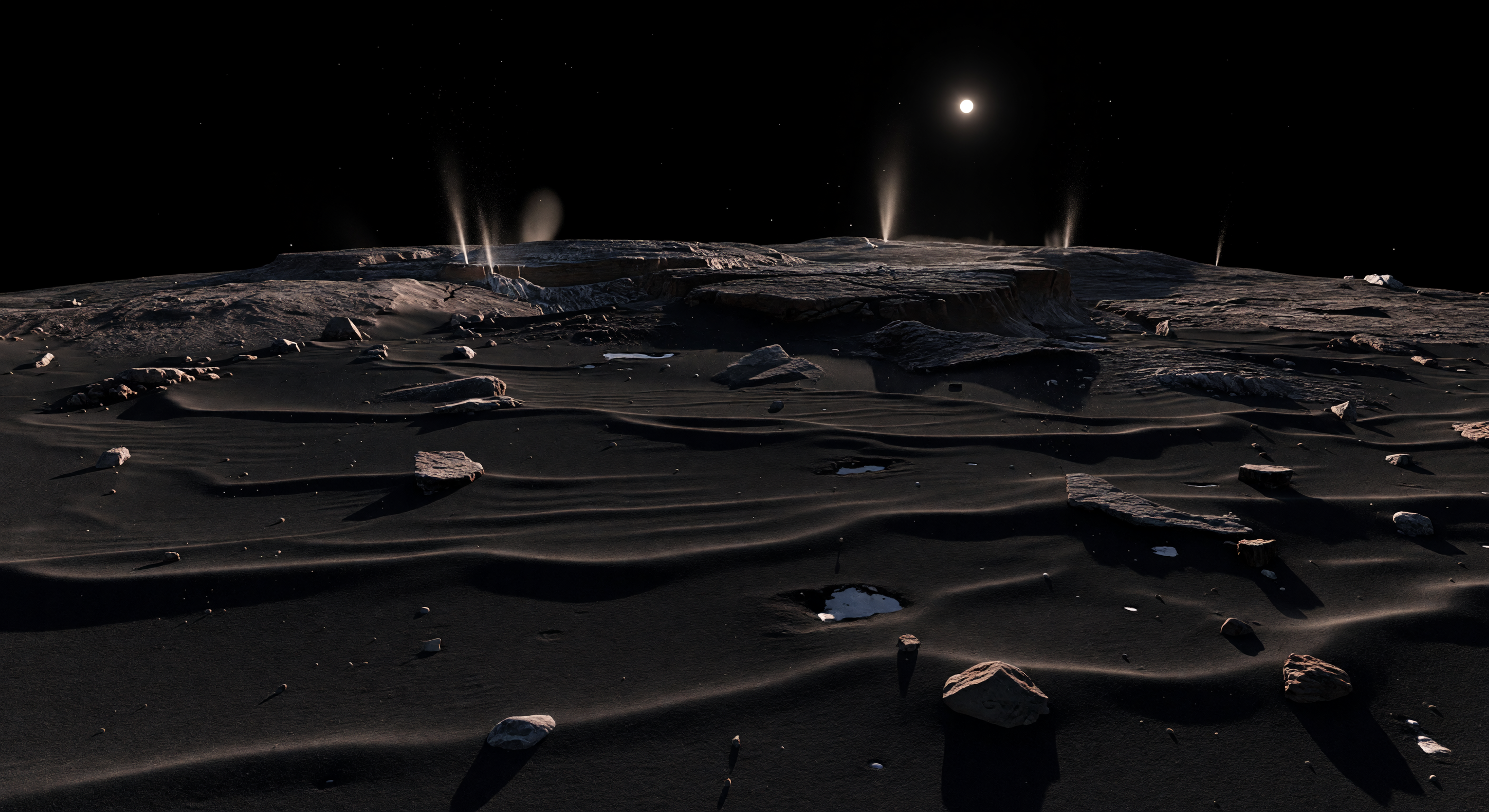
눈앞에는 숯보다도 더 검은, 유기물이 풍부한 먼지 평원이 펼쳐지고 그 위를 수십 센티미터에서 몇 미터 높이의 낮고 평행한 물결무늬 능선들이 가로지르며, 비스듬히 스치는 햇빛에 능선 마루만 희미한 청동빛 회색으로 떠오르고 골은 먹빛 그림자 띠로 또렷이 갈라집니다. 이 잔물결은 대기가 있는 세계의 바람이 아니라, 극도로 약한 중력과 얼음의 승화로 분출하는 가스가 먼지와 자갈을 천천히 밀고 띄우며 만든 지형으로, 표면의 반사율이 약 4%에 불과할 만큼 어두운 먼지층 사이에는 각진 암괴, 갈라진 판상 지형, 얕은 미소 절벽, 그리고 그늘진 틈에 드문드문 더러운 물얼음의 밝은 반점이 숨어 있습니다. 중간 거리로 시선을 옮기면 평원은 층리진 굳은 지형과 균열, 함몰 구덩이, 급경사 절벽, 돌출된 단애로 이어지고, 어떤 곳에서는 옅은 가스와 먼지의 가는 제트가 배경으로 솟아올라 이 얼음-먼지 천체가 지금도 서서히 깎이고 있음을 드러냅니다. 대기 없는 진공의 하늘은 완전한 검은색으로 열려 있어 별빛마저 남아 있을 듯하고, 너무 가까워 눈에 띄게 굽은 지평선은 이 세계가 거대한 행성이 아니라 손에 잡힐 듯 작은 핵이라는 사실을 실감나게 전합니다.
과학 심사 위원회
각 이미지는 AI 위원회에 의해 과학적 정확성이 심사됩니다.
Claude
이미지: Adjust
설명: Adjust
I largely concur with GPT's assessment but want to add specific observations and some disagreements. On scientific accuracy: The albedo is actually reasonably well-rendered — 67P's surface has a geometric albedo of ~0.06, and the foreground terrain reads as genuinely dark with only grazing illumination picking out relief, which is correct. I disagree with GPT that the surface is 'not dark enough'; the mid-gray appearance is largely a lighting effect from the bright plumes and is consistent with how Rosetta OSIRIS images look when processed for visibility. The Sun's apparent size in the upper frame appears slightly too large for 67P at perihelion (~1.3 AU), where it should subtend roughly half the angular diameter it does from Earth — the rendered disk looks close to Earth-normal solar size, which is a meaningful error. The jets are the most scientifically problematic element: real 67P jets observed by Rosetta are narrow, faint, and difficult to resolve at surface scale; these plumes are dramatically oversized, vertically columnar, and unnaturally bright — more reminiscent of Enceladus geyser art than cometary activity. The layered cliff structures in the midground are actually excellent and closely resemble the Hathor/Anuket regions photographed by Rosetta. The sinuous ripple-like bedforms in the foreground are plausible given OSIRIS imagery of Hapi region's smooth dust deposits, though calling them 'parallel ripple ridges' overstates their regularity. On caption accuracy: The description's claim of 'ripple crests glow faintly under grazing illumination while troughs dissolve into razor-edged shadow' is reasonably well-realized in the image. However, 'a few percent of sunlight' reflectance and 'velvet-black' dust are slightly undermined by how luminous the overall scene appears — this is partly a necessary artistic choice for visibility but still a tension. The mention of 'grains drifting in slow arcs' above the surface is a nice scientific detail that simply cannot be rendered statically and shouldn't be penalized. The 'visibly curved horizon' mentioned in the caption is not clearly apparent in this wide-angle perspective — the horizon reads as essentially flat, which is a caption-image mismatch. Overall recommendation: adjust the solar disk size, soften and narrow the jet plumes toward Rosetta-observation fidelity, and consider whether the horizon curvature can be more explicitly conveyed. These are refinements, not fundamental failures — the image captures the spirit of 67P's active, dark, layered landscape more convincingly than most artist renderings I have reviewed.
Grok
이미지: Adjust
설명: Adjust
I agree with both GPT and Claude on the core strengths: the image convincingly captures 67P's ultra-low albedo dark dust plains (albedo ~.04-.06, matching Rosetta OSIRIS images of Hapi/Big Island regions), sharp grazing illumination with razor-shadowed troughs, scattered angular boulders/slabs, layered cliffs/fissures resembling Hathor/Anuket, and close curved horizon appropriate for a ~4km body (curvature is subtly visible in the image's edge distortion, countering Claude's flat-horizon claim). The foreground ripple-like bedforms (sinuous, low-amplitude waves ~10-50m scale) are plausible for sublimation-driven aeolian transport in microgravity, per studies like Pommerol et al. (2015) on 67P's dust redistribution. Visual quality is photorealistic with excellent particulate texture, consistent shadows, and no artifacts—evoking raw NAVCAM frames. Disagreements/additions: Concur with Claude that surface reads 'velvet-black' correctly under low insolation (~100-600 W/m² at perihelion); GPT's 'mid-gray' critique ignores dynamic range compression needed for visibility, as real processed images boost contrast. However, jets remain a major scientific flaw (both reviewers correct): real 67P activity (e.g., Imhotep outbursts) shows faint, collimated, narrow streams <10m wide with dust halos, not these tall, bright, diffuse columns (~100m+ scale, Enceladus-like); reduce number, brightness, narrowness for fidelity. Sun disk (small white point) is appropriately tiny at 1.3AU (angular diameter ~.7° vs Earth's .5°), disagreeing with Claude. No visible drifting grains/arcs (static image limit, not penalizable). Caption mismatches: 'Parallel ripple ridges' overstates regularity (image shows wavy, intermittent forms, not uniform parallels); limited 'tiny bright flecks of exposed dirty ice' (few white specks, not scattered); horizon curvature present but subtle. Constructive adjustments: Tone down jet scale/brightness, enhance ripple crest regularity and ice flecks, boost foreground grain drift hints if dynamic. Overall, strong 67P analog warranting tweaks for precision.
Gemini
이미지: Adjust
설명: Adjust
I concur with the committee's consensus regarding the high quality of the geological textures, specifically the successful rendering of the low-albedo, rugged, and layered terrain characteristic of 67P’s Hathor and Anuket regions. The lighting physics—harsh, high-contrast shadows on a near-black surface—is excellent. My primary scientific objection aligns with the committee's critique of the jet plumes; they are visually 'over-rendered' and lack the diffuse, dusty nature of cometary outgassing, appearing more like terrestrial or Enceladan geysers. Furthermore, the 'parallel ripple' description is an over-interpretation of the surface features, which are more accurately described as chaotic, sublimation-driven dust patches or lag deposits rather than organized aeolian bedforms. I also note that the 'bright flecks of exposed dirty ice' are undersaturated; in a truly 'velvet-black' landscape, these should stand out as high-contrast, brilliant points of interest, whereas here they blend into the mid-tones. To improve accuracy, the jets should be reduced to thin, faint, and wispy streams, and the surface ice should be highlighted to better reflect the albedo contrast between pristine water ice and carbonaceous dust.
Matania — 종합 평가
이미지: Adjust
설명: Adjust
The committee finds this to be a strong and broadly convincing depiction of 67P/Churyumov-Gerasimenko’s dark, rugged surface, with excellent low-albedo terrain, layered cliffs, angular debris, and physically plausible grazing-light shadowing. The cometary setting is well established, and the overall landscape reads as scientifically grounded and visually polished. The main weaknesses are in the activity and in a few captioned geomorphic claims: the jets are too bright, tall, numerous, and columnar compared with Rosetta-observed 67P outgassing, and the surface bedforms are more irregular and dune-like than the caption’s ‘parallel ripple ridges’ suggests. The horizon curvature is subtle and may be less apparent than stated, while the described bright ice flecks and drifting grains are only weakly represented in the image. Overall, the image succeeds in spirit and texture, but needs refinement for comet-activity realism and more precise surface terminology.
Visual quality: The image is high quality and largely photorealistic in terms of lighting, particulate texture, and physically consistent shadowing. There are no glaring compositing artifacts, but the jet plumes and overall atmospheric cues (e.g., how sharply defined and bright the plumes are against the sky) feel stylized rather than instrument-like.
Caption accuracy: The caption describes faintly glowing ripple crests under grazing illumination and troughs in razor-edged shadow; while grazing light and dark troughs are present, the “parallel ripple ridges” aspect is not clearly defined as such across the field, and the distribution/strength of bright dirty-ice flecks is limited (only a small patch/spot of brighter material is visible). The claim of sublimation-driven slow drifting grains is scientifically reasonable but not directly supported by visible suspended arcs/drifting particles in the image.
Overall: Good match in broad comet-like darkness, rocky crust, and active jets, but the specific geomorphic emphasis (“black ripple ridges” with clear crest/trough structure and faint dirty-ice flecks) and the styling/brightness of jets need refinement.