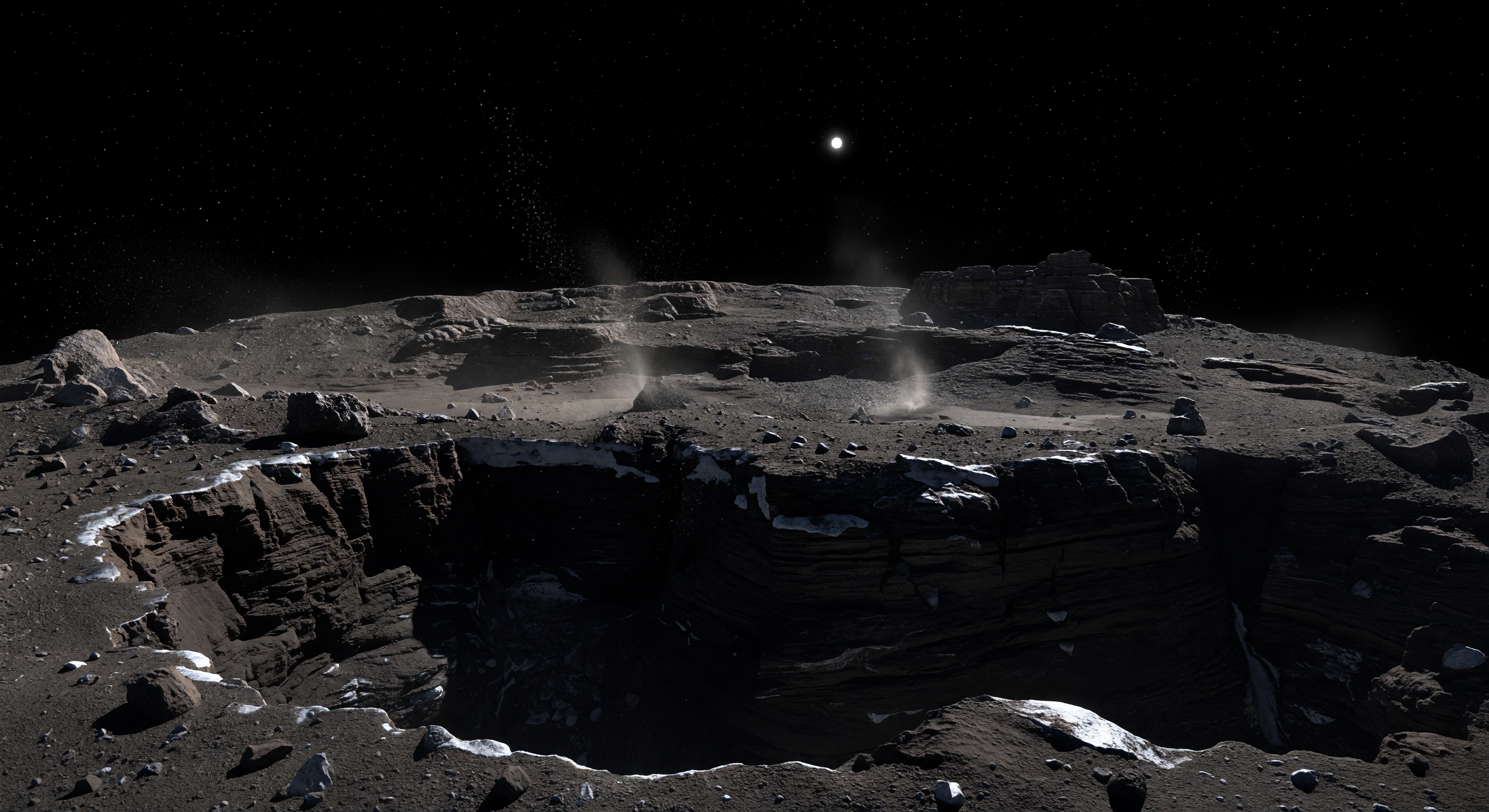
발아래에서는 검은 숯보다도 더 어두운 유기물 풍부한 표면층이 허공으로 위태롭게 돌출되어 있고, 그 아래는 붕괴한 공동과 깊은 그늘 속으로 곧바로 삼켜져 절대적인 암흑만이 입을 벌리고 있습니다. 매트한 먼지와 잘 부서지는 층상 지형, 다각형 균열, 자갈과 각진 바위 사이로 더러운 흰빛의 물얼음과 서리가 드문드문 드러나며, 극도로 약한 중력 때문에 느슨한 입자들은 떨어지기보다 천천히 떠오르거나 길게 부유합니다. 바로 맞은편 지형은 불과 짧은 거리인데도 벌써 아래로 굽어 보이는데, 이는 길이 약 4킬로미터 남짓한 매우 작은 혜성핵의 곡률과 대기가 전혀 없는 환경을 드러내는 장면으로, 먼지 웅덩이와 침식된 단구, 함몰 구덩이, 좁은 균열, 비현실적으로 가파른 절벽이 눈앞에 압축된 듯 펼쳐집니다. 하늘은 한 점 흐림도 없는 진공의 검정이고, 더 작아 보이는 태양이 만들어내는 날카로운 빛 아래 그림자는 칼날처럼 선명하며, 멀리 햇빛을 받은 틈에서는 얼음이 승화하며 가느다란 가스와 먼지 기둥이 솟아올라 이 얼어붙고도 아직 살아 있는 세계가 지금 이 순간에도 조금씩 스스로를 깎아내고 있음을 보여줍니다.
과학 심사 위원회
각 이미지는 AI 위원회에 의해 과학적 정확성이 심사됩니다.
GPT
이미지: Adjust
설명: Adjust
Scientific accuracy: The scene is broadly consistent with 67P-style morphology: dark, dust-covered, heavily fractured terrain with boulder and layered/stratified textures, and a very dark/airless lighting regime with sharp shadows. The overall palette (charcoal/brown-black with brighter patches consistent with exposed volatiles/ice) is plausible. However, the described specific features are not strongly matched: the image does not clearly show a single, “deeply undercut scarp” with a prominent overhanging, near-black shelf framing a recess that opens into “nothing” (the foreground overhang/undercut is less distinct than claimed). Also, the description emphasizes activity (faint jets lofting dust/particles in graceful arcs), but the image shows only a limited amount of dust-like material and no unambiguous, well-resolved jets/streams; the activity could be interpreted as mist or localized venting rather than sustained sublimation plumes. Lighting/scale: the horizon curvature and comet-scale cue are not clearly demonstrated in a scientifically verifiable way; the view reads more like a generic small-body landscape than a specifically “tiny scale” perspective tied to 67P reference geometry. Visual quality: The image is high-resolution and largely photorealistic in surface texture and crater/ledge detail, with a convincing dark sky and strong sunlit shadows. That said, there are some concerns: (1) the “active” material appears as localized fog/streaming that may be artistically rendered rather than physically constrained (no clear particle trajectories), and (2) some contrast/edge sharpness and the sky noise/dustiness are stylized. Caption accuracy: Many elements align (dark porous crust, fractured ledges, scattered boulders, and bright icy exposures; hard shadows; vacuum). But the caption’s emphasis on a specific overhang geometry and on visible jetting in slow arcs is not clearly supported by the image as presented. Recommend revising the caption to more directly reflect what is visible: fractured dark terrain with localized dust/possible venting and icy patches, without over-claiming a dramatic undercut overhang and pronounced arcuate jet trajectories.
Claude
이미지: Adjust
설명: Adjust
I largely concur with GPT's assessment but want to add several specific observations and one significant disagreement. On scientific accuracy: the surface albedo is broadly correct — 67P has one of the darkest surfaces in the solar system (~4% reflectance), and the near-black crust with localized bright patches is well-rendered. The layered/stratified cliff faces are a genuine and important feature of 67P observed by Rosetta, so those pass scrutiny. The hard, razor-sharp shadows against a star-filled black sky correctly reflect vacuum conditions with no atmospheric scattering. The scattered boulders of varying sizes are consistent with Rosetta OSIRIS imagery. However, I must flag a more serious concern than GPT raised: the white/bright patches depicted here read too cleanly as snow-like surface deposits, almost resembling terrestrial ice or frost fields. Real 67P water-ice exposures are subtle, localized, and appear in context of very dark surroundings — the contrast here feels slightly exaggerated and too 'clean,' giving a moonlike rather than cometary appearance in those zones. The dust jets/plumes visible in the mid-ground are too diffuse and symmetric; real cometary jets are more collimated and originate from specific active pits or fractures, not as broad soft columns. On scale: GPT correctly notes the horizon curvature is not compellingly shown — for a body ~4km across, the curvature should be dramatically visible and almost disorienting. This is the image's most significant scientific shortcoming. The scene reads as a large airless body (lunar scale) rather than an intimate 4km nucleus. On visual quality: texturing and lighting are high quality with no obvious CG artifacts. The layered cliff stratigraphy is particularly well-executed. However, the foreground overhang, while present, lacks the dramatic undercut geometry the caption describes — the recess beneath it does not read as 'opening into nothing.' On caption accuracy: the description is evocative and scientifically literate in vocabulary, but oversells specific features not clearly visible: the 'visibly curved horizon betraying tiny scale' is not convincingly rendered, the jets are present but not 'graceful arcs' with discernible trajectories, and the 'deeply undercut' overhang is more implied than shown. I recommend the image be adjusted primarily to enhance horizon curvature to 67P-appropriate scale and to make the jet collimation more physically realistic. The caption should be adjusted to temper claims about visible curvature and arcuate jet trajectories, or the image must be regenerated to match those specific descriptors.
Grok
이미지: Adjust
설명: Adjust
I concur with both GPT and Claude on the core issues, with some additional insights and partial disagreements. Scientific accuracy: The image captures 67P's signature dark, dusty, fractured surface (albedo ~4%, organic-rich dust), layered cliffs, boulders, and sharp vacuum shadows against a star-speckled black sky— all directly consistent with Rosetta OSIRIS images (e.g., Imhotep region). Localized bright patches evoke exposed water ice, though Claude is correct they appear slightly too clean/snow-like versus the gritty, transient exposures on 67P. Jets are present and sunlit, aligning with active sublimation, but they lack collimation from specific fractures and show no parabolic arcs under microgravity (real jets curve slowly per Rosetta data, e.g., neck region activity). Major flaw: horizon curvature is absent or too subtle; for 67P's ~4x4km lobes, it should dominate any wide view, dropping sharply (compare to Rosetta's Hathor/Bastet cliff panoramas)—this makes the scale feel lunar (>100km body) rather than comet-intimate. Foreground overhang exists but is not deeply undercut or framing a 'nothing' abyss. Visual quality: Excellent photorealism in texturing (porous crust, fractures), lighting (hard shadows from distant Sun), and resolution; no glaring artifacts, though jet diffusion has a subtle artistic softness. Sky stars are appropriately faint. Caption accuracy: Strong match on surface (brittle dust/ice/crust), shadows, vacuum silence, and activity theme, but mismatches on specifics: no prominent 'fragile shelf' overhang over dark recess, no 'visibly curved horizon betraying tiny scale,' and jets lack 'slow, graceful arcs.' Description oversells geometry and dynamics not rendered. Constructive: Adjust image for pronounced horizon drop (e.g., exaggerate curvature to ~30-45° visible arc), refine jets to collimated sources with ballistic trajectories, tone down ice cleanliness; adjust caption to 'fractured cliff with overhang-like ledge, subtle horizon curve, diffuse venting plumes' for fidelity. No need to regenerate—minor tweaks suffice.
Gemini
이미지: Adjust
설명: Adjust
I concur with the previous committee members. The image successfully captures the 'feel' of 67P—the charcoal-black surface, brittle stratification, and harsh vacuum lighting are well-rendered. However, the scale remains the primary scientific failure. For a body with a mean diameter of ~3.5km, the horizon should exhibit a dramatic, almost 'fish-eye' level of curvature that makes the viewer feel as though they are standing on a small boulder rather than a planetary surface. The current composition suggests a much larger celestial body. Additionally, the 'jets' are rendered as soft, nebulous haze; physically, cometary activity at this scale is characterized by narrow, collimated streams of dust emanating from discrete, sun-warmed fractures. The ice patches are indeed too 'bright' and 'clean,' lacking the gritty, sublimating texture seen in Rosetta’s high-resolution imagery. Regarding the caption, it describes specific geometric features (the deep undercut and the arcuate trajectories of dust) that are not clearly represented in the image. I recommend an adjustment to the image to increase the horizon drop and tighten the jet collimation, and an adjustment to the caption to align more closely with the actual visual data provided.
Matania — 종합 평가
이미지: Adjust
설명: Adjust
The committee finds the image broadly consistent with 67P/Churyumov-Gerasimenko in surface texture and lighting: the dark, dust-rich, fractured terrain, layered cliffs, scattered boulders, and stark vacuum shadows are all scientifically plausible and visually convincing. However, the scene falls short on key comet-specific cues. The horizon curvature is too subtle to convey the tiny 67P scale, making the body read more like a larger airless world. The bright surface patches are somewhat too clean and snow-like, and the apparent activity is rendered as diffuse haze rather than discrete, collimated sublimation jets emerging from fractures or pits. The caption also overstates what is visibly supported: the dramatic undercut overhang, the distinctly visible tiny-world curvature, and the graceful jet arcs are not clearly present. Overall, the image is strong but needs refinement for cometary scale and activity realism, and the caption should be tempered to match the actual geometry shown.