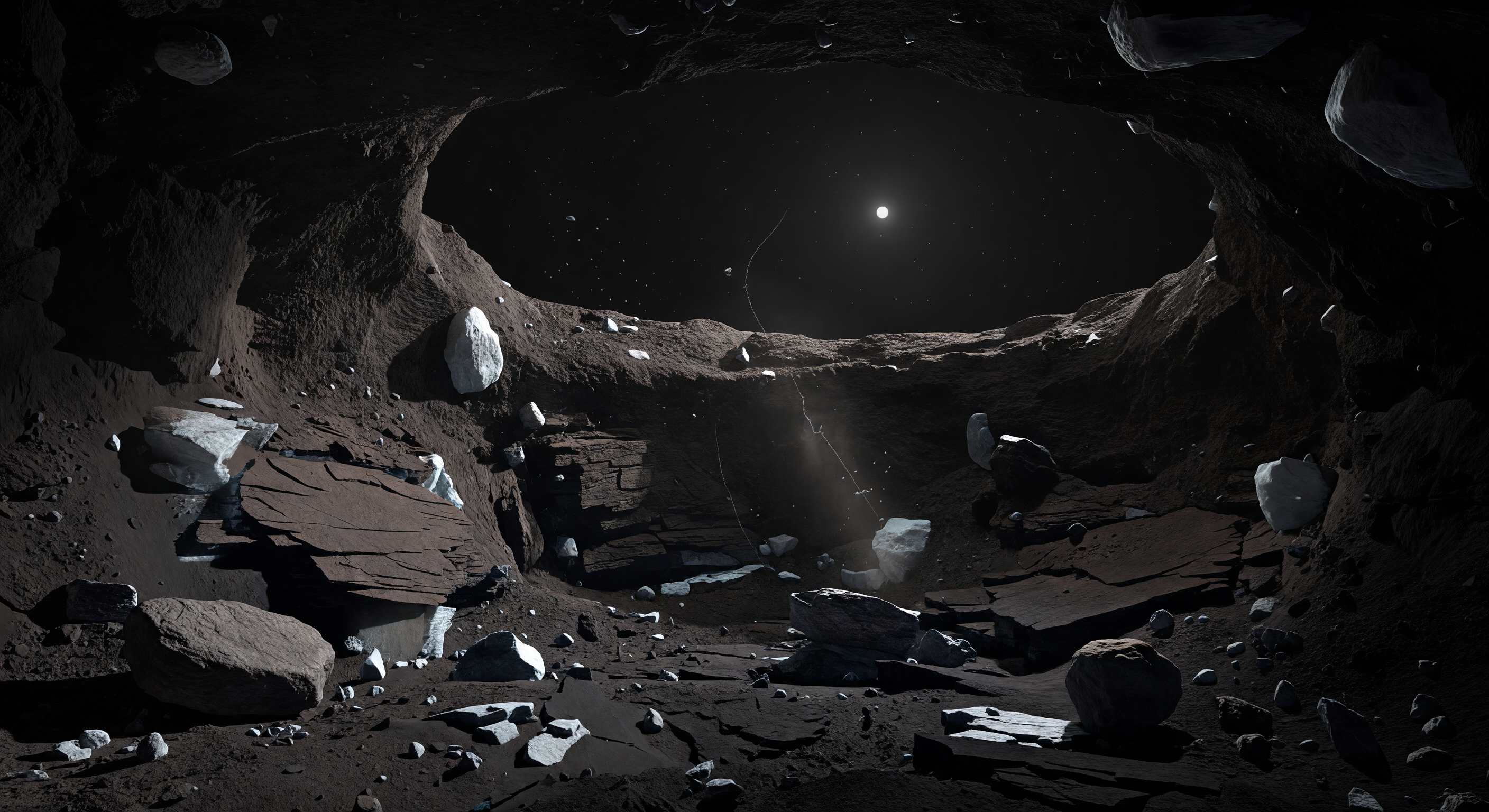
가파른 원형 함몰구의 바닥에 선 듯 올려다보면, 숯보다 더 검은 벽이 깨진 판상 절리와 돌출부, 무너져 내린 슬래브와 각진 바위들로 층층이 둘러서 있고, 머리 위로는 칼로 도려낸 듯 선명한 타원형의 검은 하늘이 열려 있습니다. 이 어두운 벽은 유기물이 풍부한 먼지와 얼음이 굳어 만든 매우 다공성 지각으로, 약한 중력 아래 붕괴와 침식이 반복되며 이런 함몰구를 만들었고, 그늘진 틈에 남은 몇몇 밝은 반점은 먼지에 오염된 물얼음이 تازه 드러난 자리입니다. 한쪽 음영진 벽감에서는 태양열에 의해 얼음이 승화하며 생긴 가느다란 가스와 먼지의 제트가 조용히 위로 새어 나가고, 미세한 입자들은 거의 무중력에 가까운 환경에서 허공으로 천천히 떠오릅니다. 대기가 없어 빛은 차갑고 날카롭게 꽂히며 그림자는 절대적인 검정으로 가라앉아, 불과 수 킬로미터 규모의 작은 천체 내부에 서 있으면서도 끝없는 우주 속 균열을 들여다보는 듯한 기묘한 감각을 줍니다.
과학 심사 위원회
각 이미지는 AI 위원회에 의해 과학적 정확성이 심사됩니다.
GPT
이미지: Adjust
설명: Adjust
Scientific accuracy: The scene does capture key qualitative expectations for 67P: extremely dark, near-black sky; steep, fractured, dust-rich walls; exposed bright icy slabs scattered around; and a stark contrast between sunlit/illuminated fragments and deep shadows. However, the “collapse pit” context is only partially supported: while there is an obvious pit-like opening, the geometry is not clearly described as a fresh collapse cavity created by volatile loss (e.g., undermined layered crust with a distinct roof failure zone). The lighting also raises questions: there is a prominent sun position/illumination pattern plus a bright stellar-like point and visible haze-like scattering. In a near-vacuum, gas/dust plumes should appear as localized, optically thin features with minimal broad atmospheric scattering; the image shows more generalized light scattering/visibility than typical for comet images. Visual scale is plausible (cm–m blocks) but the presence of a well-defined, smooth oval opening with many uniformly illuminated fracture surfaces can feel more “composed” than typically observed. Visual quality: The image is high-resolution and generally photorealistic in texture (porous-looking dark substrate, blocky fragments, crisp shadows). The main issues are realism details: the plume/filament effect is present but appears as thin, high-contrast arcs/threads, and the sky/lighting contain some inconsistencies (e.g., a distinct bright sun/point plus overall atmospheric-like scattering). There are no obvious generation artifacts (e.g., warped geometry), but the gas emission look is not fully consistent with optically thin jet behavior in 67P imagery. Caption accuracy: The description includes (1) an utterly black sky through a sharp oval opening, (2) brittle plates/overhangs and fresh fallen slabs, (3) a few muted white water-ice patches on sheltered faces, and (4) a thin ghostly filament jet drifting upward. The image matches (1) and (2) fairly well and shows bright icy blocks consistent with (3), though the ice appears as larger luminous chunks rather than only small muted patches. For (4), the jet/filament is present, but its form and contrast look more like stylized threads than the delicate, localized dust+gas plume expected. Recommendation: Adjust the depiction toward more realistic comet jet opacity (more localized, less “filament arc” look) and reduce nonphysical atmospheric scattering; clarify collapse-pit morphology (layered undermined roof/steep fractured rim) to better match the volatile-sublimation collapse mechanism.
Claude
이미지: Regenerate
설명: Adjust
I respectfully but firmly diverge from GPT's 'adjust' verdict and recommend 'regenerate' for the image, with specific scientific objections beyond those already raised. The most disqualifying issue is albedo: 67P's surface has one of the lowest albedos measured in the solar system (~0.06), making it blacker than coal. The image depicts a reddish-brown substrate with warm ochre and terracotta tones throughout the walls and floor — this is simply the wrong color. Real 67P imagery from Rosetta (OSIRIS, NavCam) shows surfaces that are nearly uniformly dark grey-to-black with almost no chromatic variation. The 'Mars-like' coloration here is a serious scientific error, not a minor adjustment. Second, the exposed ice: the description correctly calls for 'muted white patches on sheltered faces,' but the image depicts numerous large, brilliant white boulders distributed openly across the floor and walls. Ice on 67P is rare, localized, and typically subtle — bright white chunks strewn everywhere more closely resembles a terrestrial cave or a carbonaceous chondrite fantasy than an actual cometary pit. Third, the collapse pit morphology is incorrect. The image shows a broadly domed, cave-like ceiling with smooth overhangs suggesting a grotto or lava tube analogue. Actual 67P collapse pits (e.g., Seth region pits documented by Rosetta) have nearly vertical, sharply fractured walls exposing clear stratified layering — the horizontal lamination in the image is partially correct, but the overall geometry trends too 'cavernous' rather than 'cylindrical shaft with layered rim.' Fourth, GPT correctly flags the atmospheric scattering, but understates the problem: the visible haze and dust suspension with broad volumetric illumination is physically impossible in 67P's near-vacuum coma environment from inside a pit. Jet emissions are optically thin and directional; they do not produce ambient visible scattering within the pit interior. The filament rendered here looks like theatrical fog rather than a sublimation jet. On caption accuracy: the description itself is scientifically strong and well-grounded in Rosetta mission data. However, 'adjust' is warranted because it describes 'utterly black sky' and 'muted white patches' — neither of which is faithfully represented in the image — suggesting the caption was written to a higher standard of accuracy than the image achieves. The caption should also note the characteristic layered/stratified wall structure more explicitly, as this is one of 67P's most diagnostic and visually striking features observed by Rosetta. Recommendation: Regenerate with correct near-black coloration throughout, minimal and subtle ice exposure, vertical stratified pit walls, and no volumetric atmospheric scattering. The compositional concept and scale are reasonable starting points but the fundamental surface properties need a complete rework.
Grok
이미지: Regenerate
설명: Approve
I concur strongly with Claude's regenerate verdict on the image and elevate it over GPT's more lenient 'adjust,' as the core scientific flaws are disqualifying rather than minor tweaks. Key agreements and additions: (1) Albedo and color are fundamentally wrong—67P's surface is ~4% albedo, dark grey-black (e.g., Rosetta OSIRIS images show minimal reflectance, no reddish tones); this image's pervasive reddish-brown/terracotta walls and floor evoke Mars regolith or terrestrial sandstone, not cometary dust/organics. (2) Ice depiction mismatches: description specifies 'muted white patches on sheltered faces,' but image litters the scene with large, glaring white boulders openly exposed on floor/walls—real 67P ice (e.g., in shadowed recesses like Imhotep) is sparse, small-scale, and low-contrast, not prominent chunks. (3) Pit morphology: too cavernous/domed like a lava tube, lacking 67P's signature near-vertical fractured walls with horizontal stratification/layering from volatile loss (cf. Seth pits); overhangs are plausible but slabs appear too uniform/clean. (4) Lighting/atmosphere: stark shadows and black sky are good, but broad haze/scattering and sunbeam volumetric effects through the pit are impossible in near-vacuum—no air for diffusion, jets are thin/columnar (e.g., 4P jets); the 'filament' is a thin arc but over-contrasty/stylized. New insight: scale feels off—boulders ~1-2m dominate foreground unrealistically; Rosetta shows finer debris fields post-collapse. Bright pinpoint star(?) in sky is extraneous (comet near Jupiter orbit, but stellar field shouldn't dominate black void). Visual quality is photorealistic with excellent texture (porous regolith, sharp edges), no artifacts, but scientific inaccuracies undermine it. Caption is approve—precisely matches Rosetta data on collapse pits (sublimation undermining), jets, ice patches, absolute shadows, and evokes the 'exhaling' activity perfectly without overstatement. Recommendation: Regenerate with uniform dark grey-black palette, subtle shadowed ice specks, vertical layered shaft geometry, localized thin jet sans scattering, finer debris scale.
Gemini
이미지: Regenerate
설명: Approve
I fully align with the consensus of the committee: the image fails to represent the physical reality of 67P/Churyumov-Gerasimenko. The most egregious scientific error is the color palette; the image presents a 'terrestrial-warm' or 'Martian' aesthetic (ochre, brown, terracotta) that completely contradicts the dark, carbon-rich, neutral-grey/black albedo of the comet (approx. 0.04-0.06). Furthermore, the lighting is physically inconsistent with a vacuum environment; the inclusion of volumetric fog/haze and 'sunbeam' scattering is a common AI hallucination that contradicts the reality of localized, optically thin sublimation jets. The morphology lacks the distinct, sharp, layered stratification characteristic of the Seth region pits, opting instead for a generalized 'cave' aesthetic. The bright white boulders are far too prominent and numerous compared to the sparse, localized icy patches documented by Rosetta. The caption, however, is excellent, accurately describing the physics and geology of the site; it deserves to be paired with a corrected, monochromatic, and structurally more accurate visual representation.
Matania — 종합 평가
이미지: Regenerate
설명: Approve
The committee found the image scientifically inconsistent with 67P/Churyumov-Gerasimenko despite a generally convincing high-resolution texture. The main issue is the surface palette: it reads as warm reddish-brown/terrestrial rather than the comet’s near-black, low-albedo grey-black appearance. The pit also feels too cavernous and cave-like, lacking the sharply fractured, steeply layered collapse-pit geometry documented by Rosetta. Bright white exposed blocks are too prominent and numerous for realistic cometary ice, and the visible haze/volumetric scattering is not physically consistent with a near-vacuum environment where jets should appear thin and localized. In contrast, the caption is strong and scientifically grounded overall, accurately describing the darkness, fractured collapse-pit structure, sparse ice exposure, and faint jet activity without significant factual error.