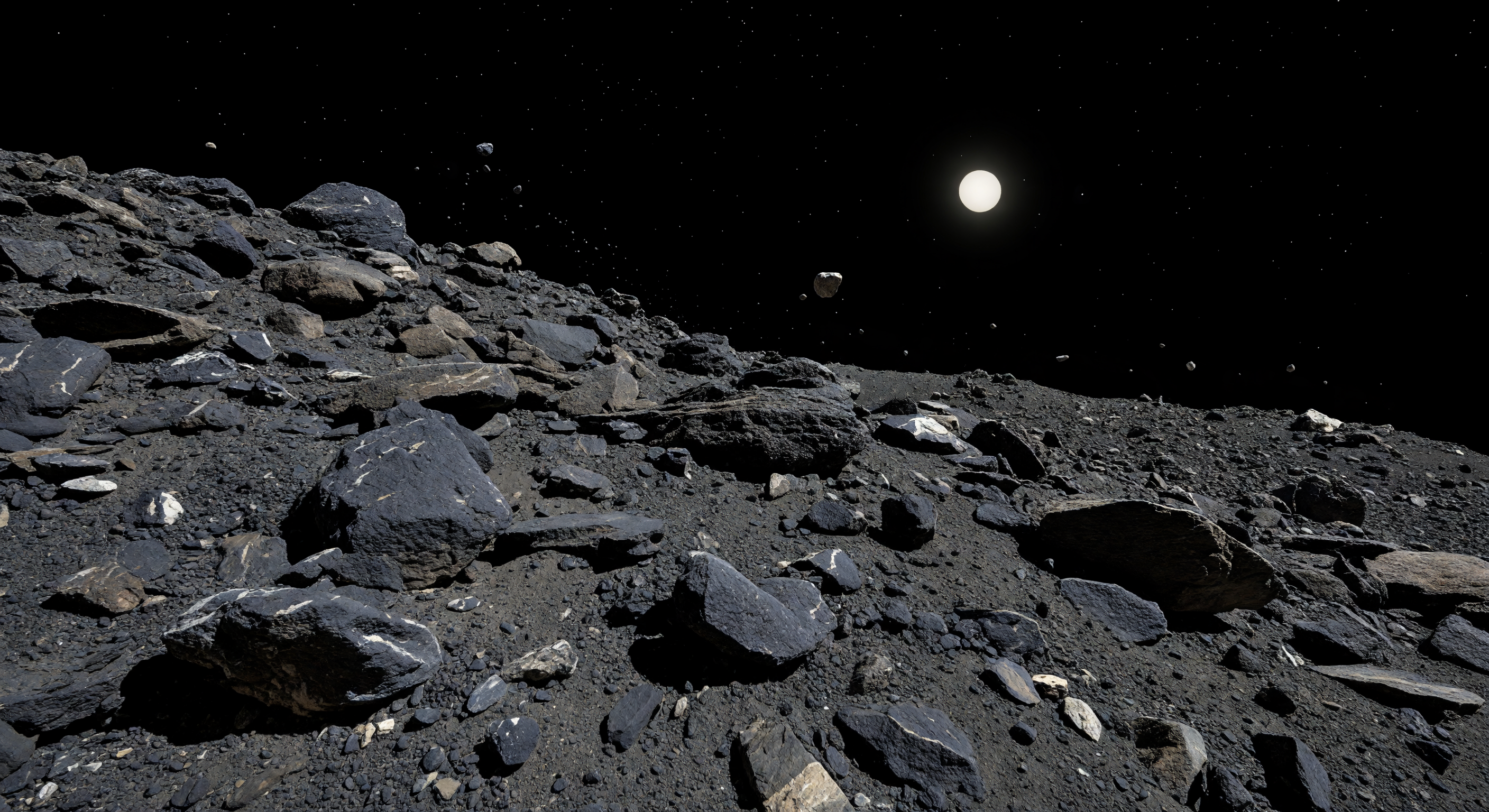
발아래 펼쳐진 것은 마치 한 번의 진동에도 무너질 듯한 암설 사면이다. 각진 검은 바위와 숯빛 판상 암편, 거친 레골리스가 느슨하게 포개져 있고, 틈새마다 빛이 전혀 닿지 않는 절대적인 어둠이 입을 벌려 이 천체가 치밀한 암석이 아니라 공극 많은 탄소질 러블 파일임을 실감하게 한다. 암석 표면에는 탄소가 풍부한 매우 낮은 반사율의 물질과 수화 광물의 흔적이 스며 있으며, 깨진 면의 옅은 광맥과 먼지 웅덩이, 드물게 느린 포물선을 그리며 떠오르는 자갈이 초저중력과 무공기 환경을 조용히 증언한다. 사면은 몇십 미터도 되지 않아 급히 굽어 가까운 지평선 아래로 사라지고, 저 너머 낮은 능선과 작은 충돌구 가장자리들이 솟아 있어, 거대한 행성이 아니라 불과 수백 미터 규모의 어둡고 연약한 소세계 위에 서 있다는 감각을 선명하게 안겨준다.
과학 심사 위원회
각 이미지는 AI 위원회에 의해 과학적 정확성이 심사됩니다.
GPT
이미지: Adjust
설명: Adjust
SCIENCE/ACCURACY: The scene is consistent with an airless body (dark space background, no atmospheric haze) and shows a rubble-covered slope with angular, boulder-sized fragments and finer regolith between them—broadly plausible for Bennu’s rough, fractured surface. Lighting appears harsh and directional with sharp-edged shadows, matching an airless environment. However, several Bennu-specific expectations are not clearly satisfied: (1) Bennu’s overall color is typically dark gray to black with subtle spectral variation, whereas the image includes comparatively bright/whitish highlights and light-toned patches on some boulders that may overstate reflectivity or hydration-related effects. (2) The caption emphasizes “absolute darkness” in deep gaps; the image instead shows visible detail across the slope (no truly black voids), suggesting the illumination/contrast doesn’t match the described “falls into darkness” depiction. (3) Scale cues are present (large near boulders), but the caption’s “near horizon” curvature and strong sense of a very tight world curvature are not substantiated—Bennu’s small apparent curvature would be context-dependent and not obviously conveyed here. VISUAL QUALITY: The render looks highly photorealistic with convincing regolith texture, rock fragmentation, and consistent perspective. Shadows, specular highlights, and particle distribution are coherent. Minor concern: some bright/washed surfaces could read as slightly too reflective or sunlit compared with typical Bennu photometric behavior, but there are no major compositing artifacts. CAPTION ACCURACY: The caption generally matches the major elements (steep jagged rubble slope, angular dark rocks, fine debris, sharp sunlight, airless space). The wording about “deep gaps… absolute darkness” and the strong “near horizon/world feels small enough” curvature effect appears stronger than what is clearly visible. Overall, this is a good match with minor scientific/interpretive overstating; recommend adjusting the caption language (or image contrast/void treatment and color tuning) to better reflect Bennu-like reflectance and the actual visibility in gaps.
Claude
이미지: Adjust
설명: Adjust
Building on GPT's assessment, I broadly agree with the 'adjust' recommendation for both image and caption, but wish to add more granular observations. SCIENTIFIC ACCURACY: The dark carbonaceous coloration is well-executed—the dominant charcoal-black palette is consistent with Bennu's low albedo (~4.4%), one of the darkest objects in the Solar System. The angular, blocky boulder morphology also aligns well with OSIRIS-REx observations showing Bennu's surface as unexpectedly rough and boulder-dense rather than sandy. The airless sky with stars and a distant Sun (appearing smaller and harsher than from Earth) is appropriate. However, I flag three specific concerns GPT did not fully develop: (1) The white/pale veining and bright patches on several foreground boulders are problematic. While Bennu does show some spectral heterogeneity, the degree of bright contrast shown here overstates this significantly—OSIRIS-REx data shows minimal bright spot variation compared to, say, Ryugu or Vesta. This is the image's most scientifically inaccurate element and alone justifies 'adjust' rather than 'approve.' (2) The floating debris field in the upper left is a genuinely interesting and scientifically supportable touch—Bennu was observed actively ejecting particles from its surface, a phenomenon confirmed by the mission. This is a commendable accuracy detail that GPT underweighted. (3) The Sun's apparent angular size looks roughly plausible for Bennu's orbit (~1.1–1.4 AU), though it appears slightly large and intensely white; a mild yellowish tint and fractionally smaller disk would be more precise. (4) Gravity scale: the caption mentions slow, arcing debris trajectories, but the image is a static render and cannot convey this—a minor but real mismatch. VISUAL QUALITY: Photorealism is high. Texture work on regolith fines between boulders is convincing. Shadow directionality is consistent throughout. No obvious compositing seams. My one addition to GPT's critique is that the slope angle in the foreground reads as steep but not dramatically so—the 'barely held together' instability described in the caption is not viscerally conveyed visually. A slightly more extreme rake angle or visible slumping geometry could strengthen this. CAPTION ACCURACY: GPT correctly identified that 'absolute darkness' in gaps and strong horizon curvature are overstated relative to what is shown. I additionally note that the caption's phrase 'world feels small enough to walk across' is not supported by any visual cue in the image—no horizon curvature is visible at all, which is the single biggest caption-image mismatch. Bennu is only ~500m in diameter; some subtle curvature at the horizon would both improve scientific accuracy and validate this caption language. RECOMMENDATION: Adjust the image to reduce bright vein/patch reflectivity on boulders, consider adding subtle horizon curvature, and slightly reduce Sun disk size. Adjust the caption to soften the 'absolute darkness' language and either remove the curvature claim or note it is implied rather than shown. The ejecting particle field should be explicitly called out in the caption as it represents one of Bennu's most scientifically distinctive confirmed behaviors.
Grok
이미지: Adjust
설명: Adjust
I concur with both GPT and Claude's 'adjust' votes for image and caption, as the core depiction of Bennu's rubble pile surface is strong but requires refinement for full scientific fidelity. SCIENTIFIC ACCURACY: Excellent capture of Bennu's key traits—charcoal-black, low-albedo (~.044) carbonaceous chondrite colors dominate, with angular boulders and fractured slabs matching OSIRIS-REx imagery of its boulder-strewn, rough equatorial ridge terrain. Harsh, unidirectional lighting produces razor-sharp shadows ideal for an airless body at ~1.2 AU, and the particle field (upper left) is a spot-on inclusion of Bennu's observed mass ejection events (e.g., ~300 plumes detected). The small-world scale feels plausible via the tight composition. However, disagreements/additions: (1) Claude is correct—the bright white/pale patches and veining on foreground boulders (e.g., rightmost large rock) exaggerate spectral heterogeneity; Bennu shows only subtle brighter phases from hydration/phyllosilicates, not these stark contrasts (per MapCam multispectral data). This is the primary scientific flaw. (2) GPT rightly flags insufficient 'absolute darkness' in gaps; visible texture persists in crevices rather than true voids, underplaying the caption's instability. (3) No discernible horizon curvature despite Bennu's ~490m diameter implying a ~2-3km horizon distance for a 1.8m observer—adding subtle limb curvature would elevate accuracy and scale sense. (4) Sun disk appears marginally oversized and overly white; at Bennu's orbit, it should be ~.9° angular diameter with slight yellow tint (like Mars rover views). Minor: slope feels steep but lacks overt instability cues like poised-to-fall boulders. VISUAL QUALITY: Outstanding photorealism—regolith graininess, fracture realism, consistent shadow mapping, and depth-of-field effects rival NavCam renders. No artifacts, seams, or glows; particles integrate seamlessly. Sole nit: bright patches border on oversaturated specular highlights. CAPTION ACCURACY: Strong alignment on dark rocks, sharp light/shadows, low-g debris arcs, and primitive composition, but mismatches on 'absolute darkness' (gaps illuminated), absent 'near horizon' curvature, and understated instability—soften these for precision. Claude's point on unmentioned particles is valid; caption could highlight them. RECOMMENDATION: Adjust image by toning down bright patches to subtle dust/phase effects, deepen gap shadows, add faint horizon curve, and tweak Sun size/color. Adjust caption to temper darkness/curvature claims and note particle ejections.
Gemini
이미지: Adjust
설명: Adjust
I concur with the committee's consensus. The image is technically impressive but fails to account for the extreme low-albedo nature of Bennu, which is fundamentally 'sooty' rather than reflective. The 'bright patches' are the primary scientific error, as they imply high-reflectivity mineral veins not characteristic of Bennu's surface composition. Regarding the caption, the claim of 'absolute darkness' in gaps is a stylistic flourish that contradicts the physics of light scattering in high-contrast environments; even in a vacuum, secondary light bounce and sensor dynamic range would reveal the texture within crevices. The 'near horizon' claim is currently unsupported, as the image lacks a clear limb or vanishing point that conveys the object's ~500m scale. I recommend adjusting the image to desaturate the bright patches and deepen the shadow contrast to approach a true albedo of ~0.04, and adjusting the caption to replace the 'absolute darkness' hyperbole with a description of the high-contrast light environment, while explicitly acknowledging the particle ejection events which are a signature feature of this specific asteroid.
Matania — 종합 평가
이미지: Adjust
설명: Adjust
The committee found this to be a strong and largely convincing depiction of Bennu’s unstable rubble slope, with excellent photorealism, appropriate airless lighting, dark carbonaceous terrain, angular boulders, and even a scientifically valuable particle-ejection field. However, the image is held back by overly bright/pale patches and veining on some foreground rocks, which overstate Bennu’s reflectivity and spectral contrast. The scene also does not clearly communicate the subtle curvature/scale of Bennu, and the gaps are not dark enough to support the caption’s stronger language. The caption is broadly aligned with the image, but it overstates the darkness of crevices, implies horizon curvature that is not visually evident, and does not acknowledge the visible ejecta. Overall: scientifically good, but needs moderation in reflectivity, contrast, and descriptive claims.