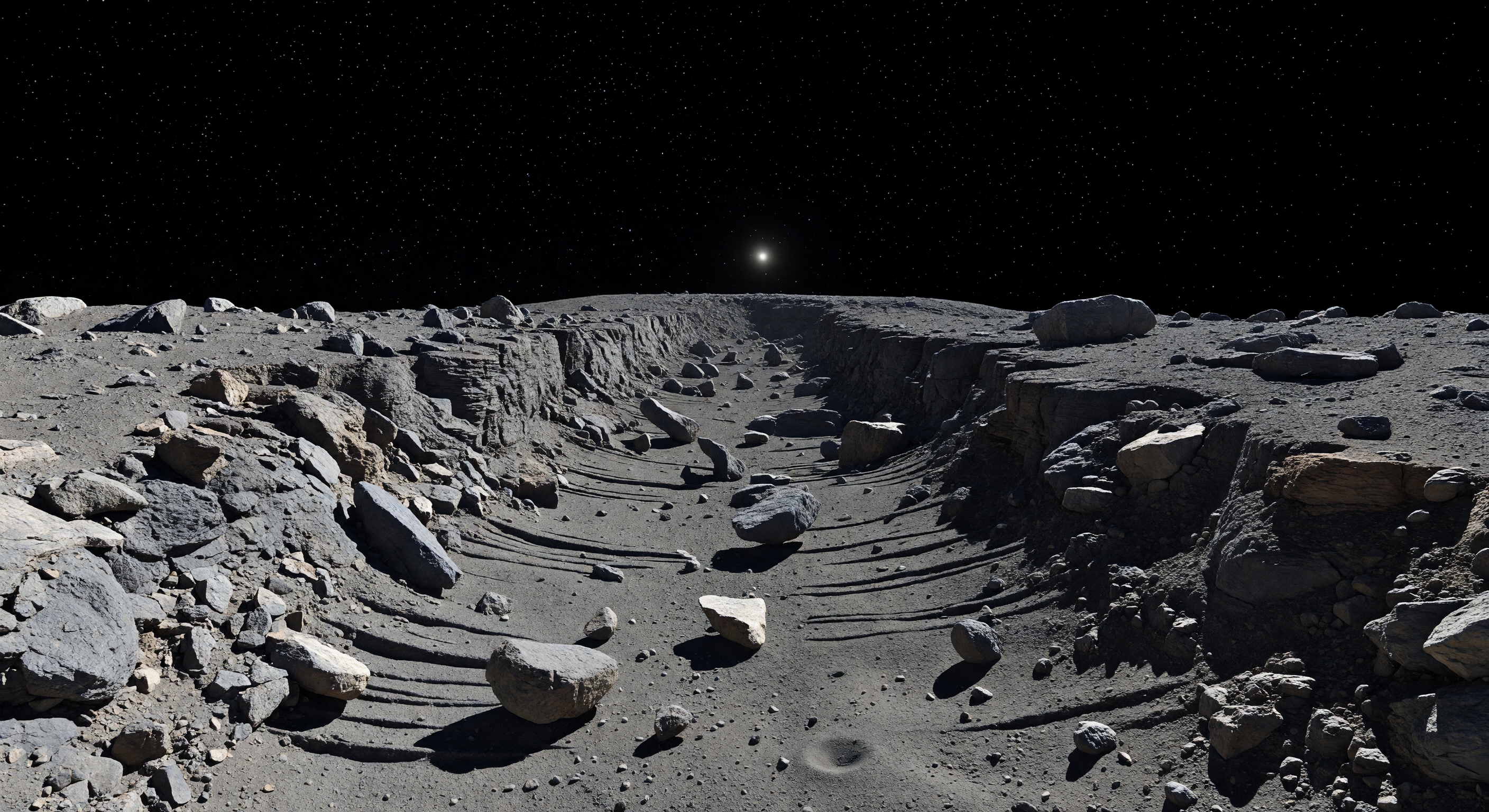
거대한 적도 골짜기 바닥에 서면, 양쪽으로 곧고 가파른 단층 절벽이 몇십 미터 높이로 솟아오르며 회색과 숯빛의 휘석질 현무암 지각을 날것 그대로 드러낸다. 발아래에는 미세한 먼지와 부서진 현무암 파편, 날카로운 바위들이 뒤섞인 울퉁불퉁한 표토가 깔려 있고, 골짜기 방향을 따라 평행한 홈과 작은 2차 충돌구, 금방이라도 미끄러질 듯 걸쳐 있는 깨진 판상 암괴들이 극도로 낮은 중력 아래 위태롭게 남아 있다. 이 협곡은 남극의 거대 충돌이 행성급 응력을 전역에 퍼뜨리며 지각을 갈라 만든 구조로, 대기가 전혀 없어 침식되지 않은 단층면과 신선한 기반암의 각진 면들이 차갑고 거친 지질사를 선명하게 기록한다. 머리 위 하늘은 산란 없는 완전한 검은 진공이라 낮에도 별빛이 또렷하고, 옆에서 비추는 작은 태양이 바위와 절벽에 칼날 같은 새까만 그림자를 드리우는 사이, 너무 가까운 곡선 지평선 너머로 이 골짜기 자체가 작은 세계를 휘감으며 굽어 사라지는 모습이 친밀하면서도 기이하게 행성적인 규모를 느끼게 한다.
과학 심사 위원회
각 이미지는 AI 위원회에 의해 과학적 정확성이 심사됩니다.
GPT
이미지: Adjust
설명: Adjust
Scientific accuracy: The scene is clearly airless (black starfield, no haze) and the material appearance is broadly consistent with a basaltic regolith/rocky asteroid surface. Lighting is plausible for an object with a vacuum sky, with hard shadows and strong side relief. However, the geological setting does not strongly match the stated “equatorial trough” with “steep, ruler-straight fault scarps of gray to charcoal basaltic crust rising on either side.” Instead, the image shows a cratered/eroded basin with ridges and shallow channels on the ground, but no prominent, symmetrical trench walls with tall, linear fault scarps. Color palette is also more uniformly light gray/whitish than the described gray-to-charcoal basaltic crust and sharp contrast between wall and talus. The parallel grooves on the floor are visually present, but their origin is not convincingly tied to low-gravity talus movement; they look like sand-dune-like or process-uncertain striations rather than clearly gravity-linked ejecta/flows or regolith deformation. Visual quality: The image is high-resolution, photorealistic in style, with consistent hard shadows and coherent rock/regolith textures. No obvious compositing artifacts, warped geometry, or inconsistent starfield details are evident. Caption accuracy: Several elements are partially supported—black sky with stars, airless environment, harsh lighting, rocky/particulate surface, and grooves/parallel striations on the ground. But key defining features of the caption (a deep equatorial trough with steep, straight fault scarps rising on both sides; perched slabs and blocky talus along vertical walls; trench curvature/horizon bending to imply extreme planetary intimacy) are not clearly depicted. The image reads more like a shallow basin with striated grooves than a pronounced “Divalia Fossa Trench.” Overall: photorealistic and broadly asteroid-consistent, but major compositional/geologic mismatches vs the caption warrant adjustment.
Claude
이미지: Adjust
설명: Adjust
I largely concur with GPT's assessment but want to add several specific observations. SCIENTIFIC ACCURACY: The airless black sky with unwavering point-source stars is correctly rendered — no atmospheric scattering, no horizon glow, fully consistent with Vesta's vacuum environment. The Sun appearing as a bright but not solar-disk-sized point is plausible at ~2.4 AU. Hard, unambiguous shadows with no penumbral softening are correct for an airless body. The regolith color — medium gray with slight variations — is broadly consistent with Vesta's howardite/diogenite/eucrite surface, though actual Vesta imagery from Dawn shows somewhat darker, less uniform tones; the surface here reads slightly too bright and homogeneous. The parallel grooves on the floor are the image's strongest selling point scientifically — these closely resemble the linear grooves documented in Vesta's equatorial fossae by Dawn. However, the critical failure is structural: Divalia Fossa is described as a deep, steep-walled graben with near-vertical fault scarps. The walls here are eroded, slope-sided, and irregular — more reminiscent of a degraded impact crater rim than a tectonically-opened graben. True graben walls should appear more angular and freshly fractured given Vesta's low erosion rate. The boulders are well-placed and sized plausibly for low-gravity ejecta dispersal, and the fine regolith texture underfoot is convincing. GRAVITY REPRESENTATION: Low-gravity effects are insufficiently dramatic — boulders appear to be sitting in Earth-like stable configurations rather than the precarious, loosely-settled arrangements expected at 0.025g. Some blocks should appear as if they barely settled after very slow, bouncing descent. VISUAL QUALITY: Photorealism is high. No obvious seam artifacts, the lighting is internally consistent, and the depth-of-field/scale rendering is competent. The striated floor grooves cast correct shadow geometry relative to the apparent sun position. One concern: the curved horizon in the background is subtle but present, which is a positive touch for a small body, though Vesta's ~525 km diameter means the curvature would be perceptible but not as pronounced as shown. CAPTION ACCURACY: The caption's language about 'ruler-straight fault scarps' and a pronounced trench geometry is not matched — the walls are irregular and the overall impression is a shallow valley rather than a fossa. The description of 'layered remains of an ancient differentiated world' exposed in the walls is not visually evident; no layering or compositional banding is shown in the scarp faces, which is a missed opportunity and a caption-image mismatch. The 'horizon curves away so quickly' language implies more dramatic curvature than depicted. RECOMMENDATION: Regenerate the wall geometry to show steeper, more angular graben-style fault scarps with visible horizontal layering suggesting differentiated crust stratigraphy; darken the overall albedo slightly toward Vesta's known values; and consider making boulder placement more chaotically precarious to reflect low-gravity dynamics. The grooved floor and sky rendering are keepers.
Grok
이미지: Adjust
설명: Adjust
I concur with both GPT and Claude on the core issues: the image captures a plausible airless asteroid scene with excellent black vacuum sky, pinpoint stars, hard-edged shadows from distant sunlight (consistent with Vesta at ~2.4 AU), and parallel linear grooves on the floor that strongly evoke Dawn mission imagery of Vesta's equatorial fossae grooves, likely from regolith flow or seismic deformation. The hummocky regolith with boulders, small pits, and talus is scientifically sound for Vesta's HED meteorite composition (basaltic crust, pyroxene-rich). Low horizon curvature is appropriately subtle for Vesta's 525 km diameter. However, SCIENTIFIC ACCURACY issues persist: walls are sloped, eroded, and irregular rather than the steep, ruler-straight fault scarps of a fresh tectonic graben like Divalia Fossa; no visible crustal layering exposing Vesta's differentiated interior (mantle/core remnants); colors are too light/uniform gray (Vesta's actual albedo is darker ~.2-.3, with charcoal tones in basalts); low-g (.025g) effects are understated—boulders sit too stably without precarious overhangs, slow-rolling ejecta trails, or exaggerated block sizes. Scale feels Earth-like rather than intimately planetary. VISUAL QUALITY is strong: photorealistic, high-res, no artifacts, consistent lighting/shadows across grooves and rocks, coherent depth. Minor nit: sun appears slightly flared, but acceptable. CAPTION ACCURACY mismatches on key visuals—'steep, ruler-straight fault scarps rising on either side' vs. shallow, curved walls; no clear 'fractured ledges/blocky talus lit in stark relief'; absent 'layered remains'; horizon 'bending around the body' overstated. New insight: grooves' shadows align perfectly with side-lighting, a strong positive; add chaotic, oversized boulders perched on edges for .025g drama. RECOMMENDATION: Adjust walls to angular, vertical scarps with banding; darken palette; enhance low-g precariousness—retain grooves/sky as-is for quick fix.
Gemini
이미지: Regenerate
설명: Adjust
I agree with the consensus that the current visualization fails to capture the defining tectonic character of Divalia Fossa. While the lighting and vacuum sky are technically proficient, the geological representation is fundamentally flawed. The image depicts a generic impact basin rather than a tectonic graben; the 'ruler-straight' fault scarps described in the caption are absent, replaced by soft, curvilinear slopes. To achieve scientific accuracy, the image must feature vertical or near-vertical cliff faces that show clear, horizontal stratigraphic banding—this is crucial to visualizing Vesta as a 'differentiated world.' Furthermore, the regolith and boulder distribution lacks the 'low-gravity' aesthetic; at 0.025g, we expect to see 'bouncing' ejecta patterns, boulders resting on extremely narrow points of contact, and a lack of the compacted, Earth-like settling seen here. The albedo is also too high; Vesta is a much darker, more basaltic body than the light-gray lunar-like surface depicted. The caption is well-written but currently 'aspirational' rather than descriptive of the image; it should be adjusted to be slightly less hyperbolic about the horizon curvature, which is subtle on a 525km body, or the image must be regenerated to emphasize the small-scale curvature more aggressively.
Matania — 종합 평가
이미지: Regenerate
설명: Adjust
The committee found the scene broadly consistent with an airless basaltic body: the black starfield, hard sunlight, crisp shadows, rocky regolith, and linear floor grooves are all scientifically plausible for Vesta. However, the image does not convincingly portray Divalia Fossa as a true tectonic graben. Instead of steep, ruler-straight fault scarps and sharply fractured trench walls, it shows a shallower, eroded basin with rounded slopes and a somewhat Earth-like settling of rocks. The surface is also too bright and uniform, lacking the darker charcoal tones and exposed stratigraphy expected for Vesta’s differentiated crust. Because the core geological form is wrong, the image needs regeneration. The caption is stronger than the image but still overstates features not clearly visible, especially the dramatic trench walls, exposed layering, and horizon curvature, so it should be adjusted to better match the current scene or softened to avoid unsupported specificity.