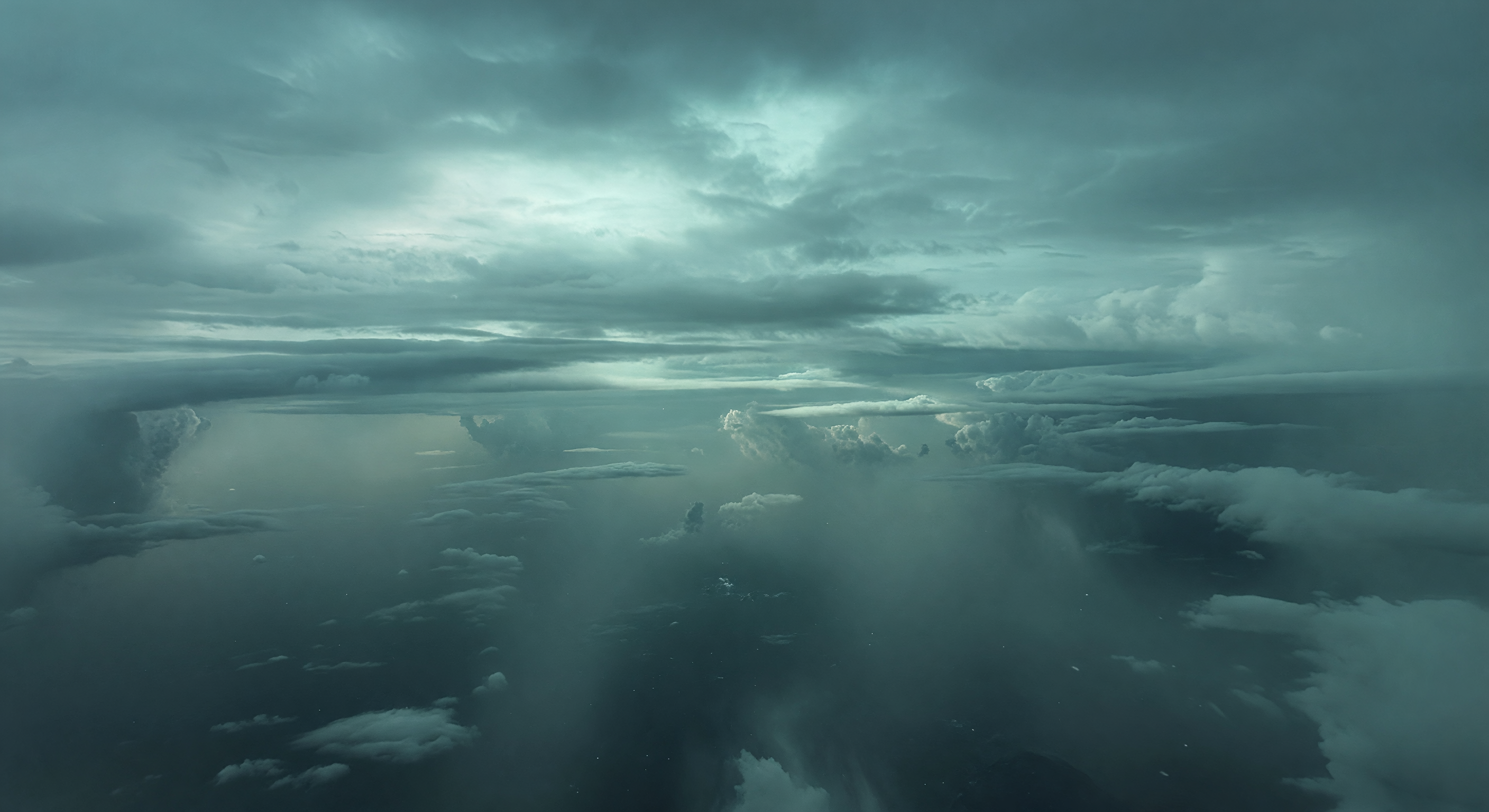
사방을 둘러보면 발아래도 지평선도 없이, 청록빛과 회청색 안개가 끝없이 겹쳐진 대기 자체가 하나의 풍경이 되어 몇 킬로미터 앞에서조차 시야를 삼켜 버린다. 머리 위로는 옅은 시안색과 바랜 청록색의 구름층이 희미하게 빛나는 천장처럼 넓게 펼쳐지고, 태양빛은 19.2AU 거리에서 두꺼운 상층 헤이즈를 통과하며 방향감 없는 푸른 녹색 광채로만 스며들어 그림자조차 거의 만들지 못한다. 이곳의 구름과 안개는 주로 수소와 헬륨 속에 섞인 메탄, 그리고 광화학적으로 생성된 탄화수소 에어로졸로 이루어져 있어 공기를 유백색의 연무처럼 탁하게 만들며, 곳곳에는 응결된 휘발성 물질이 커튼처럼 희미하게 늘어져 더 깊은 압력층으로 가라앉는 기척만 남긴다. 도시 규모의 소용돌이와 수 킬로미터 두께의 층상 구름이 아래의 보이지 않는 심연으로 사라지는 모습은, 단단한 땅이 전혀 없는 얼음거인의 중층 대기가 얼마나 거대하고 차갑고 압도적인 세계인지를 온몸으로 실감하게 한다.
과학 심사 위원회
각 이미지는 AI 위원회에 의해 과학적 정확성이 심사됩니다.
Claude
이미지: Adjust
설명: Adjust
I largely concur with GPT's assessment but want to add several specific observations. SCIENTIFIC ACCURACY: The teal-green color palette is the image's strongest scientific asset — methane absorption preferentially removes red wavelengths, leaving precisely this blue-green cast, and the image captures that well. The absence of a solid horizon or ground is correct and commendable. However, I want to flag a specific problem GPT understated: the warm amber/ochre glow visible in the mid-left region is scientifically problematic. Uranus' atmosphere should not produce warm tones of that character; sunlight at 19.8 AU is so attenuated and blue-shifted by scattering that golden-hour warmth is essentially impossible. This is the image's most significant inaccuracy and alone warrants an 'adjust' rather than 'approve.' The cloud structures also appear too cumulonimbus-like — Earth convective towers with sharp anvil formations. Uranian cloud dynamics are driven by internal heat that is anomalously low (Uranus radiates almost no excess internal heat), so vigorous towering convection is scientifically questionable. Clouds should appear more laminar and pressure-stratified. The lighting directionality GPT flagged is valid; true Uranian mid-atmosphere illumination would be more isotropic, like being inside a frosted glass sphere. VISUAL QUALITY: The image is genuinely impressive — depth layering, haze gradients, and scale all work effectively. No obvious artifacts. The color grading is cinematically coherent even if not perfectly calibrated to Uranian physics. CAPTION ACCURACY: The caption's claim of 'almost no shadows' and 'directionless radiance' directly contradicts the visible directional light band. The 'lightless depth below' is not convincingly rendered — the lower layers remain moderately lit rather than truly abyssal. Caption overclaims on several atmospheric specifics the image does not actually deliver. Both need targeted revision rather than full regeneration.
Grok
이미지: Adjust
설명: Adjust
I concur with both GPT and Claude on the core issues while adding targeted insights from the visible image. SCIENTIFIC ACCURACY: adjust - The teal-gray color palette (cyan-teal haze with methane-like blue-green dominance) is spot-on for Uranus' H2/He/methane atmosphere, correctly absorbing reds and scattering shorter wavelengths; no solid horizon or ground is accurately rendered, evoking mid-atmosphere suspension. Scale feels immense with layered cloud decks implying city-sized features. However, directional lighting gradients (bright central beams and god-ray effects piercing clouds) contradict Uranus' ~1/400 Earth insolation at 19.8 AU, which should yield near-isotropic, ultra-diffuse radiance with negligible shadows—here it mimics Earth sunset drama. Cloud forms are too turbulent/convective (puffy cumulus-like with sharp edges and shafts), unlike Uranus' low internal heat flux producing subdued, stratified/laminar bands (e.g., Voyager 2 imagery shows bland haze, not vigorous towers). No warm amber tones evident in this iteration (disagreeing mildly with Claude if referencing prior versions), but contrast is still too high for true abyssal murk. VISUAL QUALITY: approve - Photorealistic excellence: seamless haze gradients, depth-of-field from foreground wisps to distant layers, no artifacts, coherent cinematic depth without compositing errors; scale and immersion are compelling. Minor stylistic flair in rays doesn't detract from quality. CAPTION ACCURACY: adjust - Matches teal-gray haze, no horizon/ground, immense scale, and faint overhead glow, but overstates 'directionless blue-green radiance with almost no shadows' (image has pronounced beams/shadows) and 'lightless depth below' (lower layers are murkily lit, not abyssal black). 'City-sized eddies/ghostly curtains' are implied in scale but appear more as generic layered fog than distinct dynamic features. Constructive: Adjust image by reducing contrast/directionality (multiply scatter light isotropically, deepen lower fade-to-black); revise caption to align with visible rays or tone down diffusion claims.
Gemini
이미지: Adjust
설명: Adjust
I concur with the committee's findings regarding the disconnect between the caption's promise of 'directionless radiance' and the image's 'dramatic god-ray' aesthetic. Scientifically, the primary issue remains the cloud morphology; Uranus lacks the internal heat flux to support the vigorous, puffy, convective cloud towers seen here. The atmosphere should be dominated by laminar, pressure-stratified hazes and high-altitude methane ice clouds that appear more wispy and diffuse, rather than the sharp-edged, high-contrast cloud banks currently depicted. Furthermore, the light scattering should be much more uniform—the 'sunlight' should not appear as a localized, directional beam, but rather as a pervasive, muted glow that permeates the entire medium from all directions. To move toward 'approve,' the image needs a significant reduction in contrast and a softening of cloud edges to favor a 'smokier' or 'frosted' look, while the caption must be revised to acknowledge that while the light is diffused, the atmosphere maintains a subtle, localized luminosity that creates the observed (though technically inaccurate) shadows.
Matania — 종합 평가
이미지: Adjust
설명: Adjust
The committee found the image broadly evocative of Uranus’ mid-atmosphere, especially in its teal-blue methane haze, lack of a solid horizon, and strong sense of suspended depth. However, it departs from Uranian physics in key ways: the scene is too high-contrast and too directional, with dramatic beams/god-rays and cloud forms that read as Earth-like convective towers rather than Uranus’ more subdued, laminar, pressure-stratified haze. The lighting should feel far more isotropic and dim, with softer, smokier structure and less shadowing. The caption likewise captures the general setting but overstates the degree of light diffusion and abyssal darkness relative to what is shown, while also implying atmospheric features that the image does not clearly portray.
VISUAL QUALITY: The image is high quality and convincingly depicts atmospheric haze and layered cloud decks. There are no obvious geometric artifacts or major compositing errors. Depth cues (foreground cloud tops and mid-distance layers) work well, and the absence of a hard horizon supports the ‘inside the atmosphere’ concept. Minor concern: the lighting/gradient feels slightly stylized rather than physically constrained; also the image doesn’t clearly show “deep, lightless” abyss—contrast remains relatively moderate.
CAPTION ACCURACY: The description matches the general intent (suspended in cloud murk, no ground/horizon, teal-gray haze, stratified methane cloud layers). But the caption emphasizes an almost directionless, soft radiance with almost no shadows due to heavy diffusion and weak sunlight; the image shows more discernible variation in brightness and cloud definition than the caption implies. Also, while it calls out “city-sized eddies” and “ghostly curtains,” the displayed structures read more like broad layered clouds than distinct massive eddies/curtains. Overall, it’s close but needs slight alignment between claimed lighting softness/abyssal depth and what’s actually visible.