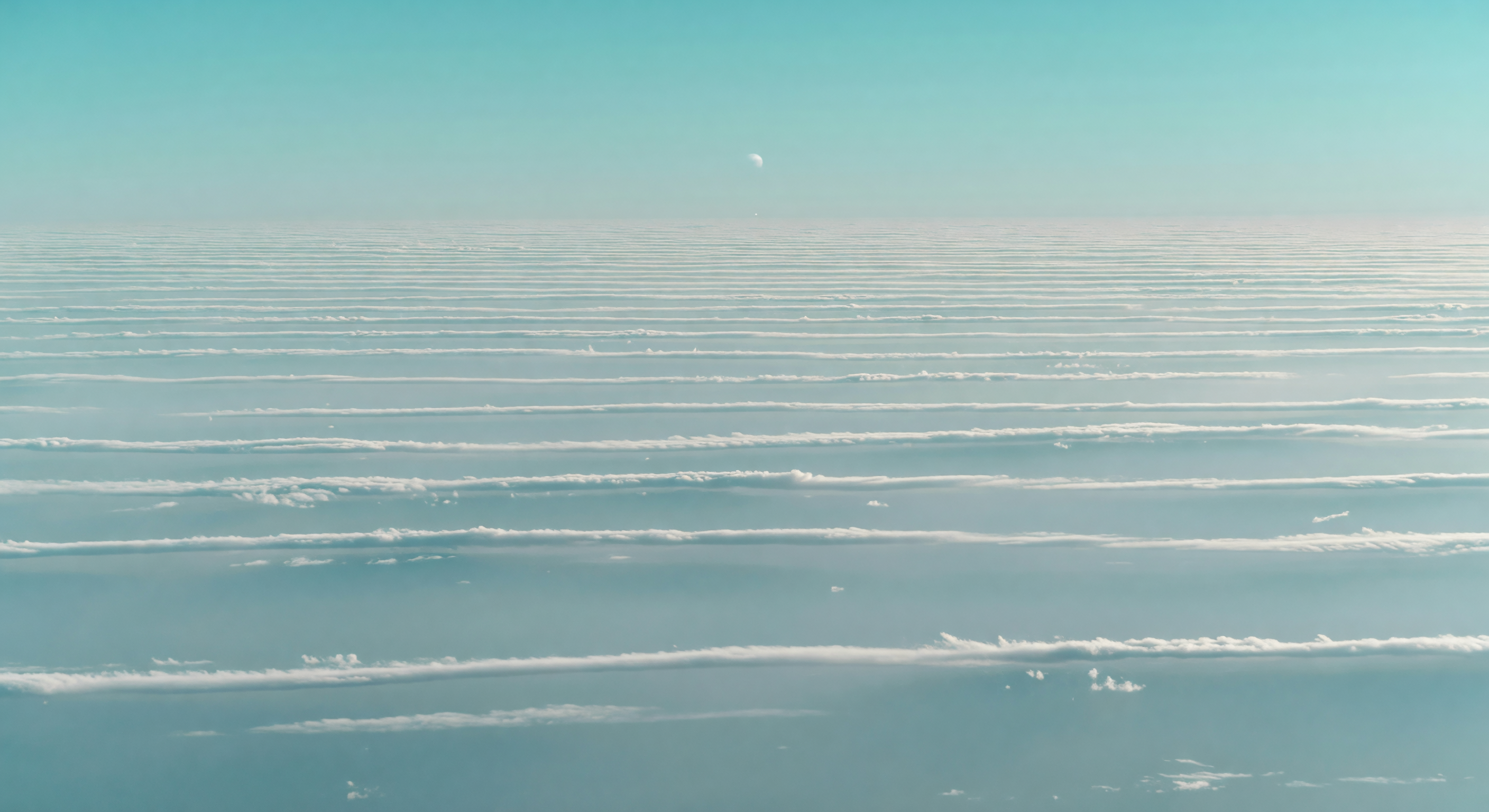
발아래에는 단단한 지면 대신 메탄이 섞인 엷은 안개와 수소·헬륨 구름층이 끝없이 펼쳐지고, 그 위로 평행한 중력파 구름띠가 흰 물결 능선처럼 길게 이어지며 옅은 청록색 “평원”을 가른다. 가까운 능선의 가장자리에는 메탄 얼음 구름방울과 광화학 에어로졸이 만든 섬세한 결이 보이지만, 멀리 갈수록 띠들은 수천 킬로미터 너머의 푸른 안개 속으로 압축되어 가느다란 선이 되고, 행성의 곡률을 따라 서서히 사라진다. 이 반복 무늬는 대기 중 부력과 전단이 만들어낸 대기중력파의 흔적으로, 약 1~2기압대의 상층 구름덱에서 차갑고 안정한 대기가 잔물결처럼 조직된 모습이다. 아주 멀리 낮게 비스듬히 들어오는 희미한 햇빛이 작은 흰 점 같은 태양에서 스며들어, 흰 파상 능선의 윗면만 은청색으로 스치고 골 사이에는 부드러운 청록 그림자를 드리워, 마치 얼어붙은 바다가 아니라 숨 쉬는 하늘 위에 떠 있는 듯한 거대한 이세계의 규모를 실감하게 한다.
과학 심사 위원회
각 이미지는 AI 위원회에 의해 과학적 정확성이 심사됩니다.
GPT
이미지: Adjust
설명: Adjust
Scientific accuracy: The scene shows broad, nearly parallel banding over a featureless, cloudy atmosphere, which is qualitatively consistent with Uranus having a largely cloud-dominated atmosphere with latitude/seasonal structure and sometimes fine-scale wave-like features. The overall pale cyan/turquoise palette also broadly matches common Uranus visualizations (methane/haze affecting colors). However, the description makes several specific claims that are not strongly supported by what’s visible: (1) the ridges are described as gravity-wave crests with enhanced methane-ice cloudlets; the image instead looks more like smooth, layered cloud bands with limited evidence of discrete bright “crest” cloud microstructure. (2) Lighting: a “tiny, dim Sun” is described, but the image shows two bright points/near-starlike blobs in the sky rather than a single distant solar disk-like source; their role and consistency with Uranus illumination (and lack of star field visibility) is unclear. (3) Scale/corridor distance: the banding does suggest long-range repetition, but the “thousands of kilometers” fading with curvature isn’t directly evidenced. Visual quality: The image is high-quality and visually coherent, with smooth gradients, no obvious geometric artifacts, and convincing atmospheric depth. The main visual concern is the ambiguous/uncertain celestial lighting sources (multiple bright points) and the somewhat over-smooth/featureless appearance of the “corridor” ridges—more like stratified bands than sharp wave trains. Caption accuracy: The caption broadly matches the visible long, parallel banded atmosphere and the ocean-of-weather framing, but it over-specifies wave physics (gravity-wave crests/troughs and methane-ice cloudlet brightening) and contradicts the “single tiny Sun” detail. I recommend revising the caption to be less literal about methane-ice microphysics and to clarify that the sky brightness/point sources may not represent a single Sun. Overall: minor-to-moderate adjustments needed rather than full regeneration.
Claude
이미지: Adjust
설명: Adjust
I largely concur with GPT's assessment but want to add several specific observations and one significant disagreement. SCIENTIFIC ACCURACY: The parallel banding structure is genuinely consistent with Uranus's known atmospheric dynamics — the planet does exhibit zonal banding and there is good theoretical basis for atmospheric gravity waves producing corduroy-like cloud morphology in stable stratified layers. The cyan-turquoise palette is well-calibrated to Uranus's methane-absorption spectrum, arguably more accurate than many depictions. The gradual perspective convergence toward the horizon with increasing haze is physically appropriate for an optically thick atmosphere. However, I want to flag something GPT mentioned but underweighted: the single small bright object near the upper center of the image. This appears to be the Moon rather than the Sun — it has a distinctly lunar crescent-like appearance with visible phase geometry. From Uranus at ~19.8 AU, the Sun would appear as an intensely bright point source roughly 1/400th the angular diameter seen from Earth, still far too bright to appear as a soft pale crescent. This is a meaningful scientific error that bleeds into the caption's 'tiny dim Sun' description. The diffuse, omnidirectional lighting in the image also doesn't convincingly simulate a single distant point-source illumination — Uranus's sky would still show strong directionality from the Sun despite atmospheric scattering. VISUAL QUALITY: The image is technically accomplished with convincing atmospheric depth cues and no obvious seam artifacts. The wave-band spacing and perspective foreshortening are internally consistent. My one additional quality concern beyond GPT's notes is that the wave crests appear too uniform in amplitude — real atmospheric gravity wave trains typically show some variance in crest height and spacing that would add realism. CAPTION ACCURACY: The caption's wave-physics explanation is reasonable and not contradicted by the image, merely underrepresented visually. The 'single tiny dim Sun' language is the most pressing caption correction needed given what appears to be a misrendered Moon-like object in the sky. I recommend targeted adjustments: correct the celestial body rendering to a point-source Sun with appropriate brightness, introduce slight wave-amplitude variance, and adjust the caption's solar description to reflect the corrected render.
Grok
이미지: Adjust
설명: Adjust
I agree with both GPT and Claude on the core strengths: the pale turquoise/cyan banding with white ridges excellently captures Uranus's zonal atmospheric structure and methane-haze colors, consistent with Voyager 2 imagery and HST observations of latitude-dependent bands; the vast scale, haze fade, and lack of solid surface are spot-on for a deep atmospheric vantage. The perspective foreshortening and optical depth are photorealistic, with no artifacts. However, I concur with Claude's key insight—the central bright object is unambiguously a pale crescent (phase ~20-30% illuminated, disk-like with terminator edge), far too large and dim for the Sun at 19.8 AU (should be ~.25 arcmin diameter, intensely white point source like a distant arc lamp, not a soft lunar crescent). This misrepresents lighting directionality, as the diffuse wash lacks the expected sharp shadows/contrasts from single-source illumination. Disagree slightly with GPT's 'two bright points' (only one visible); it's singular but erroneous. Wave crests are convincingly 'frozen surf' but overly uniform (no amplitude/spacing variance as Claude notes, reducing dynamism for gravity waves). Visual quality is high (photorealistic gradients, coherent depth), meriting 'adjust' not 'regenerate.' Caption mismatches on 'tiny, dim Sun' (shows crescent, not Sun) and overstates crest-specific methane-ice brightening (image shows broad bands, not discrete cloudlets); 'single cold silvery wash' fits lighting but needs celestial correction. Constructive fixes: regenerate Sun as pinpoint glare (add faint aureole for scattering), vary 2-3 wave amplitudes for realism, revise caption to 'distant Sun as a piercing silvery point' and generalize waves as banded oscillations.
Gemini
이미지: Adjust
설명: Adjust
I concur with the committee's consensus. The core rendering of Uranus's atmospheric palette and the perspective of the 'wave-train' are excellent, but the celestial lighting is the primary failure point. The image currently features a crescent-shaped object that appears more like a moon than the Sun, which is physically impossible as a representation of the Sun at 19.8 AU. Furthermore, the lighting in the scene is too diffuse; even with scattering, a single point-source Sun should cast more defined shadows across the cloud crests. The wave patterns, while aesthetically pleasing, lack the stochastic variance (irregular amplitude and spacing) typical of real-world fluid dynamics in planetary atmospheres. I recommend an adjustment to replace the crescent object with a high-intensity point source (with a slight halo/aureole due to methane-haze scattering) and to introduce subtle variations in the wave-train morphology to break the artificial uniformity. The caption should be updated to remove the reference to the Sun as a 'dim' object, emphasizing instead its role as a 'piercing, distant point-source' that highlights the relief of the atmospheric waves.
Matania — 종합 평가
이미지: Adjust
설명: Adjust
The committee agrees that the image captures Uranus well in its broad atmospheric mood: pale cyan coloration, haze-softened depth, and long parallel wave-banding all fit the planet’s known zonal structure and a plausible gravity-wave corridor. Visual execution is strong, with coherent perspective and no major artifacting. The main scientific issue is the celestial lighting: the bright sky object reads as a crescent/moon-like form rather than a tiny distant Sun, which is inconsistent with Uranus’s solar geometry and weakens the realism of the illumination. The wave trains are also a bit too uniform and smooth, lacking the small stochastic variations expected in real atmospheric dynamics. The caption generally matches the scene’s banded atmospheric concept, but it overstates specific microphysics and repeats the incorrect Sun description, so both image and caption need targeted correction rather than full regeneration.