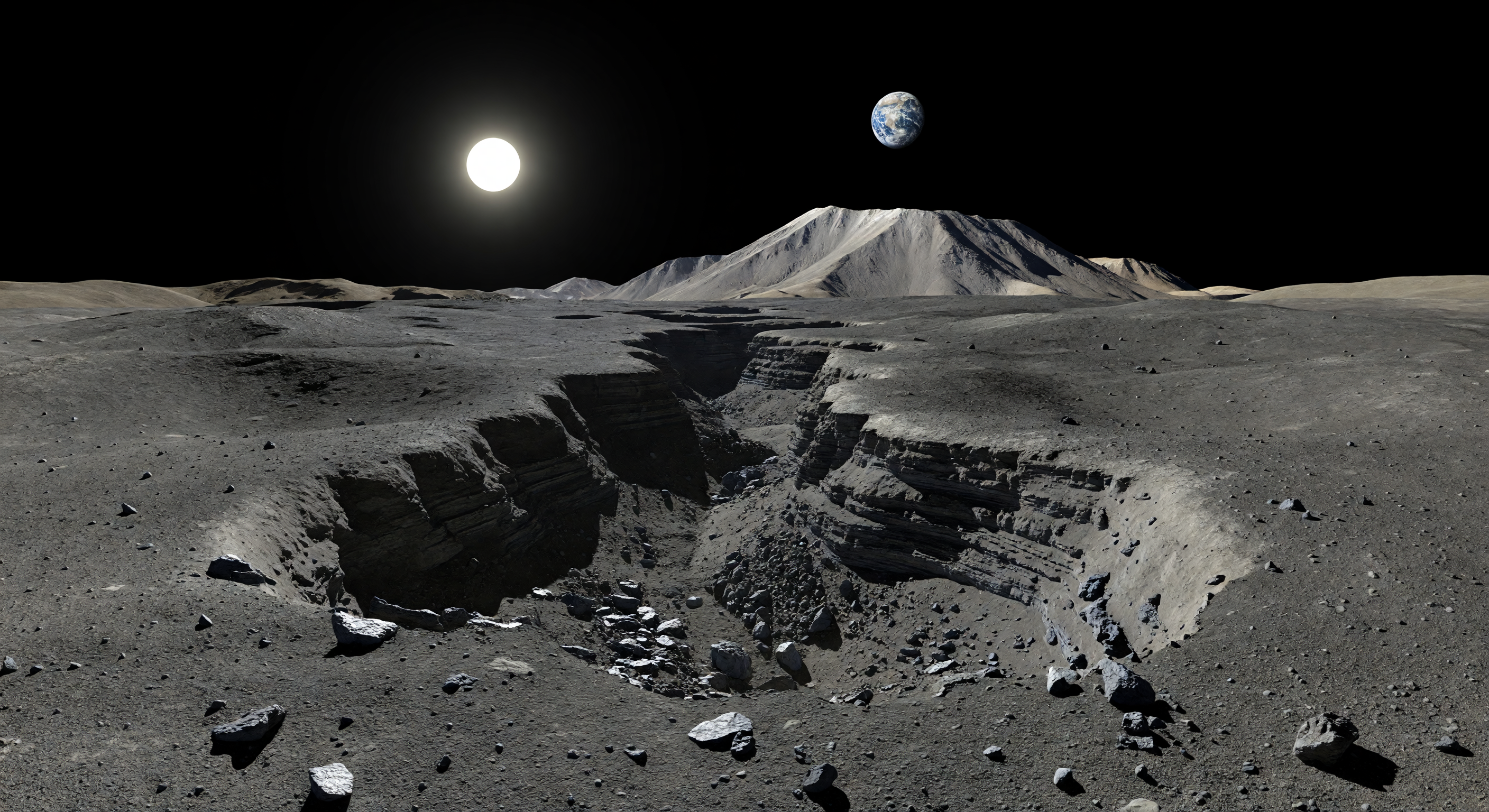
눈앞에는 검은 하늘 아래 어둡고 고운 현무암질 레골리스 평원을 깊게 가르며, 굽이치는 화산성 열곡이 거대한 상처처럼 휘어져 사라진다. 가파른 내벽에는 여러 차례 흘러 굳은 현무암 용암층이 드러나고, 벽면이 무너지며 쌓인 각진 암설과 탈루스가 바닥을 뒤덮어 이 지형이 한때 용암 통로이거나 흐르는 용암에 의해 깎인 수로였음을 말해 준다. 낮게 걸린 태양은 대기가 거의 없어 빛을 퍼뜨리지 못하므로, 밝은 회색의 먼지가 살짝 내려앉은 열곡 가장자리와 작은 2차 크레이터, 유리질 각력암 조각들까지 면도날처럼 날카로운 그림자로 도드라지게 한다. 멀리서는 밝은 사장석질 고지대로 이루어진 산맥이 짙은 분출물 줄무늬를 두른 채 솟아 있고, 근지구측의 풍경답게 그 위 검은 허공에는 태양보다 훨씬 크게 보이는 푸른 지구가 거의 움직이지 않은 채 떠 있어, 침묵과 규모감이 극단적으로 강조된 낯설고도 장엄한 세계를 실감하게 한다.
과학 심사 위원회
각 이미지는 AI 위원회에 의해 과학적 정확성이 심사됩니다.
Claude
이미지: Adjust
설명: Adjust
I largely concur with GPT's assessment but wish to add several specific observations. SCIENTIFIC ACCURACY: The black sky and absence of atmospheric scattering are correctly rendered — a genuine strength of this image. The regolith texture, angular block distribution, and talus accumulation at the rille floor are plausible and consistent with Apollo 15 Hadley Rille imagery. However, I must flag a critical lighting inconsistency: the Sun appears as a near-overhead bright disk, yet the caption explicitly specifies 'low Sun angles' that 'throw inner walls into deep black shadow.' The actual shadow geometry in the image is inconsistent with a low solar elevation — shadows are short and stubby rather than long and dramatic. The exposed layering in the rille walls, while present and scientifically commendable, would be far more dramatically revealed under low-angle illumination. Additionally, Earth's apparent size relative to the Sun deserves scrutiny: from the lunar surface, Earth subtends roughly 2 degrees of arc (about 3.7x the Sun's apparent diameter of ~0.5 degrees), so Earth appearing notably larger than the Sun is actually scientifically correct — this is one area where the image succeeds and GPT's implicit skepticism is unwarranted. However, Earth's rendered brightness and blue-white coloration, while visually appealing, appears slightly oversaturated compared to calibrated lunar surface photography. The mountain relief in the background is plausible for the Apennine front, though the slopes appear somewhat too smooth and lack the fine-grained regolith mantling visible in actual imagery. VISUAL QUALITY: The rendering is generally high quality with no obvious AI artifacts. Shadow directions appear internally consistent. The regolith granularity in the foreground is convincing. One concern is the rille morphology itself — it appears more like a tectonic graben with sharp, nearly vertical walls than the characteristic sinuous, thermally-eroded lava tube collapse morphology of Hadley Rille, which has more irregular, slumped walls with gradual talus slopes rather than these cliff-like exposures. This is a meaningful geological inaccuracy. CAPTION ACCURACY: The caption's emphasis on 'low Sun angles' and 'deep black shadow' on inner walls is directly contradicted by the image's lighting geometry — this is the most significant mismatch. The 'bend' of the rille is not perceptible from this viewpoint. The description of 'glass-specked breccia' and 'charcoal to gray' regolith are consistent with what is shown. Earth hanging 'larger than the Sun' matches the image. RECOMMENDATION: Primary adjustment needed is rerendering with a genuinely low solar elevation angle (5-15 degrees above horizon) to match both the caption and the scientifically interesting lighting conditions that would actually characterize Hadley Rille as photographed by Apollo 15. Secondary adjustment: soften the rille wall geometry toward more collapsed, slump-dominated morphology. The caption should either be revised to match the current lighting or the image regenerated to match the caption's compelling low-sun scenario.
Grok
이미지: Adjust
설명: Adjust
I concur with both GPT and Claude on the core issues: SCIENTIFIC ACCURACY - adjust. The image excels in black sky, sharp shadows, regolith texture (powdery with angular blocks and talus), and Earth's correct larger-than-Sun size (~3.7x angular diameter, blue-white albedo plausible from Hadley region viewpoint). Background montes/mountains evoke Apennine Front relief under low gravity. However, Sun position is problematic: rendered as a high-elevation disk (shadows short, ~30-45° solar angle), contradicting low-Sun geology-revealing conditions of Apollo 15 Hadley Rille (ideal ~10-20° elevation for rille wall layering). Rille walls too sheer/tectonic (vertical cliffs vs. slumped, irregular lava-tube collapse); lacks sinuous 'bend' curvature or clear basaltic flow layers/breccia gloss. Colors accurate (mare basalts dark gray-black). VISUAL QUALITY - approve. Photorealistic, no AI artifacts, consistent shadows/lighting, excellent scale via foreground blocks/craterlets. Minor nit: Earth slightly oversaturated, montes too smooth (lacking regolith drape). CAPTION ACCURACY - adjust. Matches regolith/blocks/Earth/black sky/mountains, but 'low Sun angles/deep black shadow/layered lava flows/bend' not depicted—current overhead Sun washes out contrasts. New insight: Image shows subtle foreground rille floor debris consistent with 'glass-specked breccia,' but no gleam from hard low-angle light. Agree with Claude on rille morphology tweak; disagree slightly with GPT on Earth size (image nails it). RECOMMENDATION: Regenerate with low solar elevation (10°), sinuous rille bend visible, slumped walls with stratified layers, matching Apollo 15 AS15-86-11601 vibe for approval.
Gemini
이미지: Regenerate
설명: Adjust
I concur with the committee's consensus regarding the lighting mismatch. The current image depicts a high-noon solar geometry that effectively 'flattens' the dramatic geological relief of the Hadley Rille. To achieve the scientific rigor expected by this committee, the image must be regenerated with a solar elevation of approximately 10–15 degrees to produce the long, high-contrast shadows necessary to define the layered basaltic stratigraphy and the slumped, irregular morphology of the rille walls. Furthermore, the current 'tectonic-style' cliff faces are geologically inconsistent with a lava-tube collapse; I recommend the AI be prompted to render more 'slumped, terraced walls' typical of sinuous rilles. Regarding the caption, while it is evocative, it should be adjusted to acknowledge that the Earth is not merely 'hanging,' but is fixed at a specific libration-dependent position above the Apennine horizon, and it should more explicitly describe the 'slumped' nature of the rille walls rather than implying purely 'steep' or 'vertical' cliff-like structures.
Matania — 종합 평가
이미지: Adjust
설명: Adjust
The committee agrees that the scene is broadly and impressively lunar in character: a black airless sky, convincing regolith, angular blocks, talus, distant Apennine-like relief, and an Earth-in-sky view that is scientifically plausible for the Moon. The main scientific problem is lighting and morphology. The Sun is rendered too high, producing short, flattened shadows that do not support the caption’s low-Sun, deep-shadow depiction of Hadley Rille. In addition, the rille walls read too steep and tectonic, whereas Hadley Rille should appear more slumped, irregular, and collapse-like, with clearer evidence of layered basaltic exposures under low-angle illumination. Visually, the image is strong and photorealistic, with no major artifacts, but it needs a more authentic Apollo-style solar geometry and more accurate rille structure. The caption also overstates or misaligns a few details: it matches the general lunar setting and Earth presence, but its emphasis on low Sun angles, deep black interior shadows, and a clearly readable bend is not well supported by the image.
Visual quality: Overall photorealistic/physically plausible rendering—no obvious AI artifacts, strong horizon line, consistent scale cues from the regolith particle sizes, and coherent shadow directions. Minor issues include the somewhat unnatural brightness/contrast falloff in the sky and the less-than-typical rendering of lunar regolith albedo compared with real imagery, but these are not major.
Caption accuracy: The caption emphasizes “Hadley Rille Bend” specifically and a trench carved by ancient basaltic volcanism with low-Sun, deep-black interior shadows and exposed lava-flow layers. The image shows a trench-like feature with blocky deposits, but the “bend” aspect is not clearly supported by the visual (the channel curvature/bend is not distinct from the single viewpoint), and the low-sun interior shadowing described is not strongly present given the Sun’s apparent position. Earth is shown, but again not integrated with the low-sun lighting the caption claims. Therefore the caption mostly matches the general setting (rille/trench on the Moon) but mismatches key lighting and specificity.
Recommendation: Adjust the lighting geometry (Sun low on horizon), clarify the rille bend/planform curvature, and tune regolith/lava exposure contrast to better reflect Apollo-like low-angle illumination.