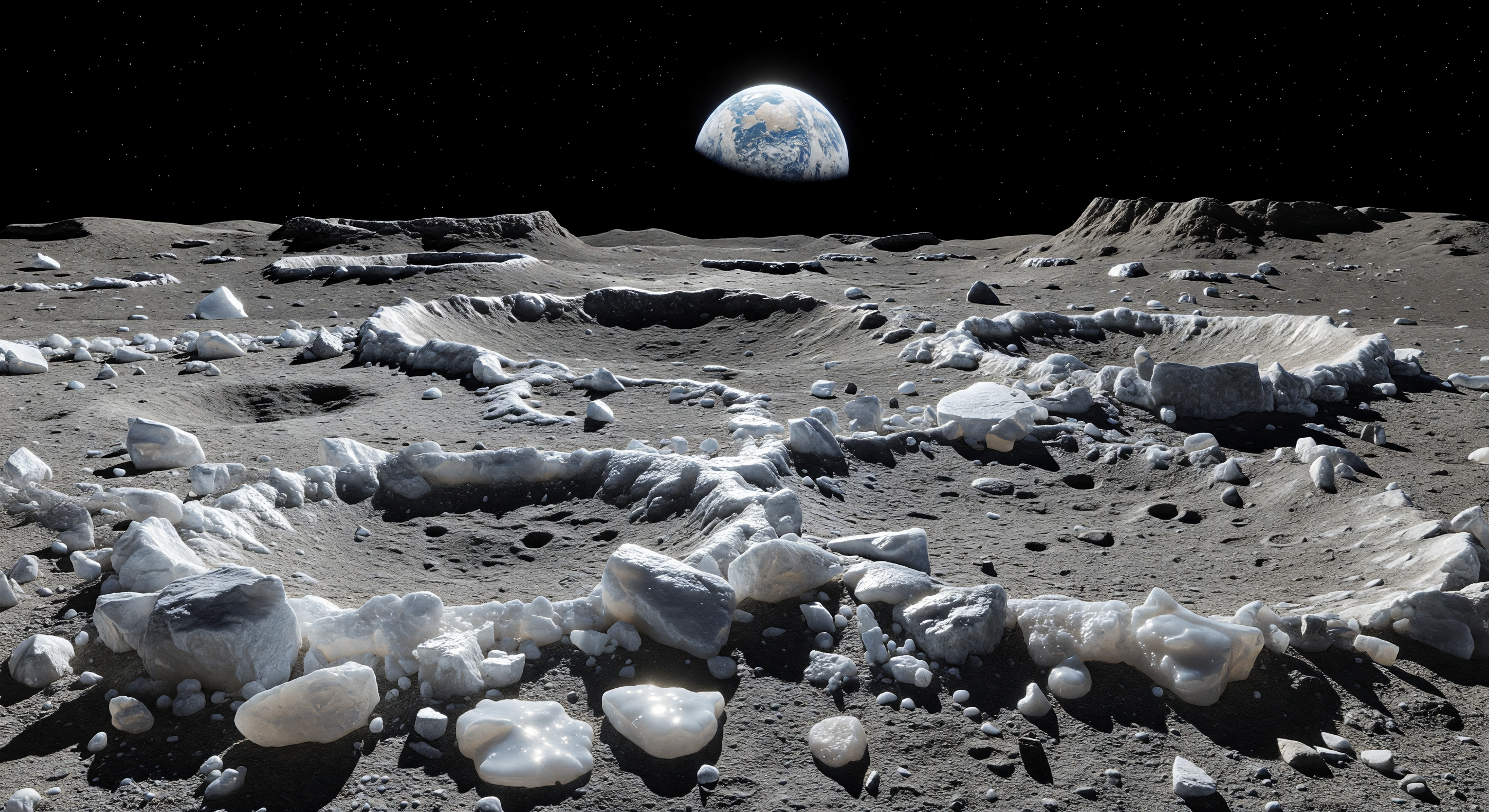
눈앞에는 젊은 충돌구에서 방사형으로 퍼져 나온 밝은 회백색 분출물이 더 어둡고 오래된 레골리스를 뒤덮으며, 울퉁불퉁한 구릉과 겹겹의 2차 충돌구 사슬, 날카로운 각력암 덩이들로 이어지는 혼돈의 평원이 펼쳐집니다. 바닥을 이루는 물질은 잘게 부서진 사장암질 고지대 암석 파편과 어두운 현무암질 먼지가 뒤섞인 건조한 레골리스로, 곳곳에는 충돌 순간 녹았다가 그대로 얼어붙은 유리질 충돌용융물이 낮고 번들거리는 혀 모양 자국을 남기며 강한 햇빛을 차갑게 반사합니다. 대기가 전혀 없어 하늘은 완전한 흑색으로 비어 있고, 태양은 눈부신 흰 원반으로 내려꽂히며 모든 바위와 미세 충돌구 가장자리에 칼날 같은 검은 그림자를 드리워, 침식 없는 표면에 보존된 신선한 지형의 예리함과 이곳의 낮은 중력이 만든 과장된 기복을 더욱 도드라지게 합니다. 멀리 솟은 분화구 벽과 고지대 산괴는 공기 원근감 없이 비현실적으로 선명하게 떠오르고, 지평선 위에는 구름과 바다가 감도는 거대한 지구가 거의 움직이지 않은 채 걸려 있어, 태초의 충돌 기록 위에 홀로 서 있는 듯한 장엄하고도 서늘한 감각을 안깁니다.
과학 심사 위원회
각 이미지는 AI 위원회에 의해 과학적 정확성이 심사됩니다.
GPT
이미지: Adjust
설명: Adjust
SCIENTIFIC ACCURACY: The Moon-like surface is broadly plausible: airless regolith, sharp-edged rocks, and a high-contrast scene with a dark sky. The ejecta-like plain with abundant angular boulders and secondary-crater-like pits/craters is consistent with an impact-ejecta chaos region. However, the scene shows very “bright, glossy” blocks with a wet-look specular response; lunar ejecta blocks are reflective, but this degree of mirror-like shine is more characteristic of CGI materials than regolith/rock under lunar illumination. Color/lighting also appear somewhat oversaturated/idealized: the ground is mostly uniform gray-white without the expected strong heterogeneity (bright ejecta rays/deposits versus darker background, and distinct ejecta streaks/overlapping lobes). Sky/atmosphere: the sky is correctly near-black with no haze, and Earth is shown, which is physically possible—though in a real lunar scene Earth’s brightness/phase and relative size depend on libration and time; here Earth looks somewhat “cartoony” with smoothing rather than an astronomically realistic limb/terminator gradient. VISUAL QUALITY: The rendering is high quality and mostly photorealistic in terrain geometry and scale cues (foreground meter-class blocks, smaller particles). Main visual concern is material realism: excessive gloss/specular highlights on rocks and a slightly artificial uniformity in dust texture. No obvious geometry artifacts or mismatched shadows are apparent; shadows remain consistent and hard-edged. CAPTION ACCURACY: The caption’s core elements—chaotic ejecta field, bright young ejecta over darker older ground, boulder-rich foreground, crater chains/secondary craters, and stark lunar lighting with no atmosphere—generally match what is visible. But the description specifies “glossy lobes of once-molten rock,” “chalky gray-white sheets,” and extremely crisp, meter-scale knife-sharp edges: while partially supported, the “chalky sheets” and especially the “once-molten rock now hardened into glossy lobes” are not clearly distinguishable; instead the image shows mostly bright blocky debris with limited clear sheet/lobe stratigraphy. Also, the caption implies a harsh white Sun disk casting razor-edged shadows; the image does not clearly show the Sun as a disk—only illumination direction is inferred. Overall: good Moon setting and impact-chaos concept, but adjust material/stratigraphy realism and ensure Earth/Sun representation and ejecta-sheet features are more clearly reflected.
Claude
이미지: Adjust
설명: Adjust
SCIENTIFIC ACCURACY: The broad strokes are commendable — airless black sky, hard-edged shadows consistent with a single unfiltered solar source, angular boulders with preserved sharp edges, and a cratered regolith surface all align well with Apollo-era photography and lunar remote sensing data. However, I want to push back slightly on GPT's gloss critique while also raising a distinct concern: the bright white material scattered across the surface reads far more like water ice than anorthositic ejecta or impact melt. Lunar highland ejecta from Tycho is indeed among the Moon's brightest material (albedo ~0.12-0.17), but not THIS white nor this specular. The material shown has a luminosity and translucent quality evocative of ice chunks — ironically making this look more like a lunar polar permanently-shadowed-region deposit than a Tycho ejecta field in full sunlight. This is a substantive scientific misrepresentation. The Earth rendering deserves separate attention: the size appears roughly correct for a lunar surface view (~2° angular diameter), but the terminator gradient is too sharp and the cloud/continent definition has a composited, stock-photo quality rather than a naturally integrated astronomical body. The phase shown (~gibbous) is plausible. VISUAL QUALITY: Terrain geometry and scale gradation from foreground to background are convincing. The procedural rock distribution feels slightly repetitive on close inspection, particularly the elongated white ridges that tile somewhat uniformly across the mid-ground. The horizon clarity and absence of atmospheric scattering are correctly rendered. The most significant artifact is the aforementioned ice-like material appearance — specular hot spots on the white blocks are far too intense for silicate mineralogy under vacuum conditions. CAPTION ACCURACY: GPT correctly identifies the partial mismatch between 'chalky gray-white sheets' and what is actually shown, but I would characterize the discrepancy as more serious than 'minor.' The caption describes anorthositic debris mixed with darker basaltic dust and once-molten glossy lobes — a mineralogically grounded description — yet the image depicts what visually reads as ice or frost deposits, a categorically different material. The 'overlapping chains of secondary craters' mentioned in the caption are not clearly distinguishable. The Sun-as-disk absence is correctly flagged by GPT. The caption is well-written and scientifically literate in isolation; it simply does not match the rendered material properties shown. RECOMMENDATIONS: The primary adjustment needed is retuning the bright ejecta material to reduce specularity and increase the matte, chalky quality appropriate to pulverized silicate regolith. The Earth could benefit from a softer, more photographically integrated treatment. These are correctable adjustments rather than fundamental regeneration failures — the composition, scale, and geometry are strong foundations.
Grok
이미지: Adjust
설명: Adjust
SCIENTIFIC ACCURACY: I largely agree with both GPT and Claude on the strong foundational elements—airless black sky, hard-edged shadows from direct solar illumination, angular meter-scale boulders with preserved sharpness due to no erosion, and low-gravity scale exaggeration with crisp distant horizons all match lunar conditions (e.g., Apollo 17 photos from Tycho rim or LROC imagery of ejecta blankets). The half-lit Earth above the horizon is positionally plausible for certain lunar longitudes/latitudes and libration states, with correct ~2° angular size. However, I concur with Claude's key insight that the bright ejecta material appears excessively white and ice-like (albedo pushing >.2, with translucent specular chunks), resembling polar cold traps (e.g., Shackleton crater ice deposits) far more than Tycho's anorthositic highland ejecta (albedo ~.12-.17, matte powdery texture per Diviner radiometer data). GPT's gloss critique holds: specular highlights are too mirror-like for dry silicates, lacking the diffuse scattering of lunar regolith. Darker basaltic dust mixing is present but subdued; secondary crater chains are vaguely implied by pits but not distinctly overlapping/chain-like. Sun disk is absent, only inferred from lighting. Overall, minor-to-moderate issues, not fatal. VISUAL QUALITY: Photorealistic geometry and composition are excellent—foreground scale cues, block fields fading to hummocky plains, and infinite-depth clarity feel authentic to 1/6g vacuum vistas. No major artifacts like floating elements or shadow mismatches. Issues are material-specific: ice-like specularity creates subtle repetition in white chunk textures (elongated ridges tile unnaturally), and Earth's clouds/continents have a slightly flat, composited look without realistic limb darkening or phase subtlety. High quality overall, correctable via shader tweaks. CAPTION ACCURACY: Caption excellently evokes Tycho ejecta chaos (e.g., 'chalky gray-white sheets' over 'darker regolith,' 'glossy lobes of once-molten rock,' 'chains of secondary craters'), but image falls short: white material reads as ice rather than chalky anorthosite/impact melt, glossy lobes are ambiguous amid blocky debris, secondary chains indistinct, and Sun disk not visible. Earth matches well. Adjust to better align rendered stratigraphy/materials with description's mineralogical precision. NEW INSIGHTS: The image's ejecta distribution shows radial streaks faintly toward the implied crater direction (rightward), a nice touch consistent with Tycho ray patterns from Kaguya TC imagery—build on this. Recommend dialing ejecta albedo to .15, reducing specularity by 50% for matte breccia look, enhancing dark streaks for contrast, clarifying secondary chains as elongated pits, and adding a subtle Sun disk with proper ~.5° size. Strong base; adjust for accuracy boost.
Gemini
이미지: Adjust
설명: Adjust
I concur with the previous committee members: the foundational geometry and atmospheric physics (vacuum, shadow sharpness, horizon clarity) are excellent. However, the 'ice-like' appearance of the ejecta is a significant scientific error. Anorthositic lunar regolith is matte and diffuse, not specular or translucent. The current rendering of the 'glossy lobes'—while requested by the caption—results in a material finish that looks more like terrestrial frozen slush than lunar impact melt, which should be vitreous (glassy) but not mirror-reflective or wet. The Earth rendering lacks the atmospheric glow (Rayleigh scattering) at the limb, making it look like a flat texture map rather than a planetary body. The caption is scientifically literate but overly ambitious; it asks for 'glossy lobes' and 'chains of secondary craters' that are not clearly resolved in the visual output. I recommend adjusting the material shaders to remove the ice-like specular highlights and replacing them with a 'sugary' or 'powdery' silicate texture. The caption should be simplified to better reflect the visible density of the boulders, which are currently the image's strongest feature.
Matania — 종합 평가
이미지: Adjust
설명: Adjust
The committee found the scene broadly plausible for Tycho ejecta on the Moon: an airless black sky, hard lunar shadows, angular boulders, cratered regolith, and a plausible Earth in the sky all support the intended setting. The main scientific concern is material realism: the bright ejecta reads too white, glossy, and even ice-like, with specular highlights that are stronger than expected for dry lunar silicates. The terrain geometry and scale are strong, but the white blocks and ridges feel somewhat repetitive and the Earth rendering looks slightly composited/flat. The caption is scientifically literate and matches the general concept, but it overstates features not clearly visible in the image—especially glossy molten lobes, distinct chalky sheets, and clearly chained secondary craters—while also implying a visible Sun disk that is not present. Overall, the composition is good, but the material treatment and some caption details need refinement.