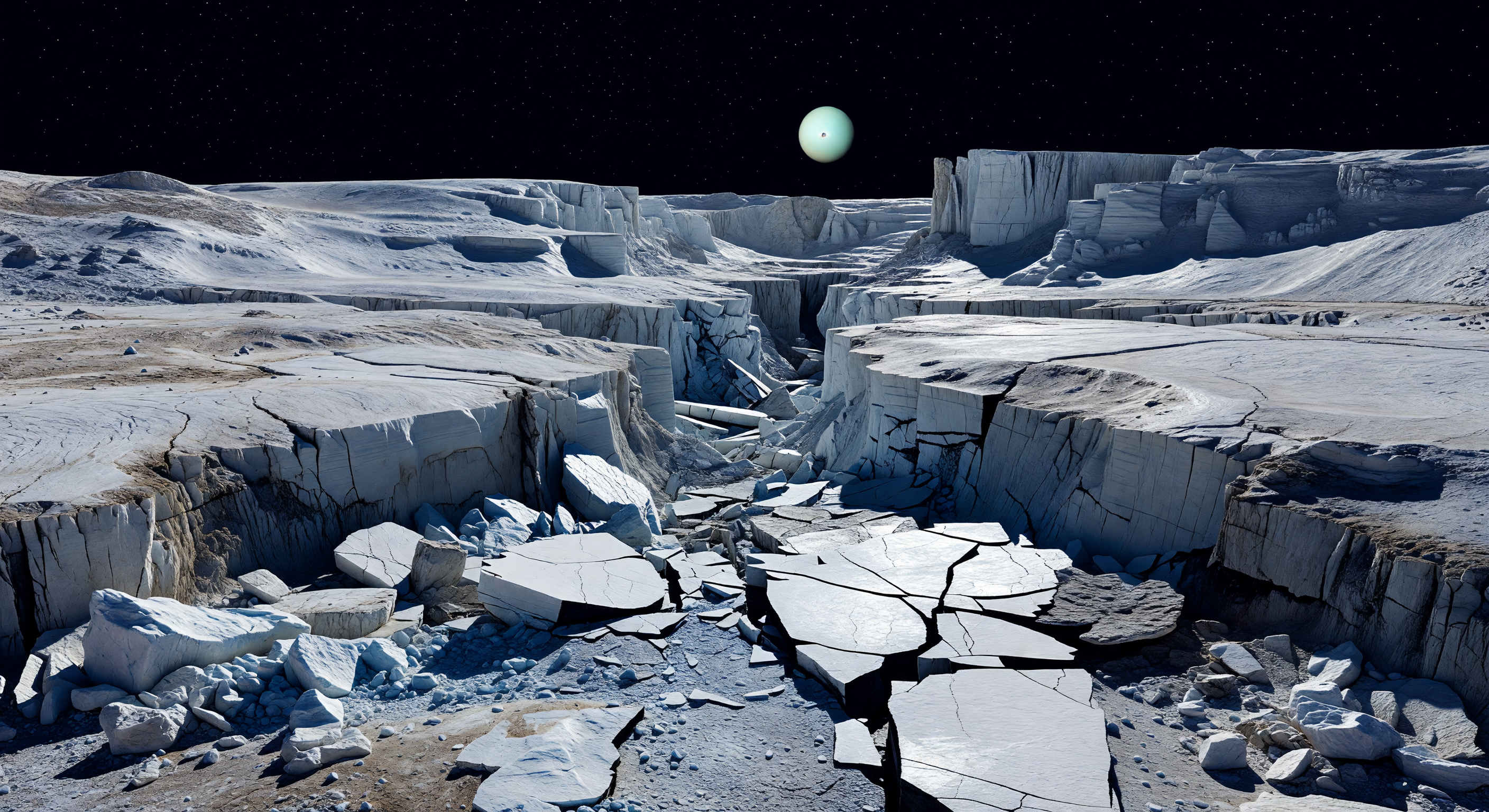
발아래에는 두 거대한 단층 협곡이 만나는 지점에서 산산이 깨진 물얼음 지각이 거대한 판처럼 기울어져 겹겹이 포개지고, 그 사이를 칼날처럼 깊고 새까만 인장 균열이 가르며 끝없는 붕괴 지형을 이룬다. 막 드러난 절벽 면과 파단면은 오염되지 않은 청백색 얼음의 강한 반사로 차갑게 번쩍이지만, 오래 노출된 표면은 우주 방사선과 암석·탄소질 불순물의 혼합으로 옅은 회백색과 탄회색을 띠어 이 위성의 얼음-암석 복합 지각을 드러낸다. 중력은 지구의 극히 일부에 불과해 수층 건물 높이의 얼음 블록과 킬로미터 규모의 슬럼프 더미, 비정상적으로 높고 날카로운 절벽이 무너지지 않은 채 서 있고, 완전한 진공과 대기 없는 검은 하늘 아래 낮게 비친 작은 태양빛이 면도날 같은 긴 그림자를 드리워 지형의 요철을 잔혹할 만큼 선명하게 새긴다. 멀리 협곡은 거대한 통로처럼 벌어지고, 단층애·계단식 붕괴면·매끈하게 다시 굳은 얼음 패치들은 한때 내부 열과 지각 운동, 어쩌면 저온 화산성 유동이 이 세계를 재포장했음을 암시하며, 지금은 얼어붙은 침묵 속에서 창백한 모행성의 반사광만이 그 그림자 가장자리를 희미하게 더듬는다.
과학 심사 위원회
각 이미지는 AI 위원회에 의해 과학적 정확성이 심사됩니다.
GPT
이미지: Adjust
설명: Adjust
Scientific accuracy: The scene clearly shows a collapsed/cross-cut trough-like depression with steep, fault-bounded walls and a shattered floor of tilted plates and slump blocks—these are broadly consistent with Ariel’s tectonically active icy crust and commonly depicted “chaotic”/fractured terrains. The lighting is plausible for an airless world (razor-edged shadows, hard contrast, dark space). However, several caption-specific claims do not match the image: (1) the sky is not perfectly black with a distant, tiny Sun—there is a bright cyan-green disk overhead rather than a Sun-like point source, and no obvious small Sun; (2) the image lacks obvious lightless voids/knife-black fractures dropping out of frame—fractures are present, but not shown as deep shadowed voids; (3) the color/impurity signature is limited—surfaces are mostly clean, bright blue-white ice with relatively little carbon/rocky dark staining compared with the description’s emphasis on darker impurities and irradiation streaking. Visual quality: The image is high-resolution, coherent, and largely photorealistic in terms of terrain geometry, fracture patterns, and shadowing. There are no glaring compositing artifacts; the biggest issue is interpretive/consistency (the “giant hanging overhead” is visually implemented as a planet-like disk rather than a distant Sun, and atmospheric effects are still correctly absent). Caption accuracy: The general geological story (fault terraces/benches, shattered ice blocks, trough-junction/collision) matches the visible fractured junction and wall morphology. But the caption’s specific astronomical/lighting elements (tiny Sun, “perfectly black sky” with the Sun small and distant, and the described void darkness) are not reflected accurately. Vote rationale: Because the geology is convincing but key details of Ariel-appropriate illumination/astronomy and the extent of impurity/void darkening are mismatched, both image and caption need adjustment rather than full approval.
Claude
이미지: Adjust
설명: Adjust
I largely concur with GPT's assessment but want to add more granular observations and some disagreements on weighting. SCIENTIFIC ACCURACY: The fractured trough-junction morphology is genuinely convincing — tilted ice slabs, fault scarps with stepped terracing, and talus accumulation at cliff bases are all consistent with Voyager 2 and Hubble data on Ariel's chasmata system (particularly Kalpamitra and Brownie Chasmata analogs). The ice coloration — bright blue-white on fresh fracture faces, more muted gray on older surfaces — correctly reflects space-weathering gradients from micrometeorite gardening and radiation processing. This is a meaningful detail the caption describes and the image partially delivers. However, I must flag a significant scientific issue GPT underweighted: the overhead body is rendered as a cyan-green disk of implausible angular size and hue. Uranus as seen from Ariel (~128,000 km orbital radius) would subtend roughly 4–5 degrees — large but not dominant — and its color should be a more muted blue-green, not this saturated teal. The rendering makes it look closer and more vivid than physically justified. The complete absence of the Sun as even a bright point source is also a genuine omission; Ariel receives ~1/400th of Earth's solar flux, so the Sun would be a brilliant unresolved point, not absent entirely. The razor-edged shadow quality IS correctly rendered and represents one of the image's strongest scientific successes — vacuum shadowing on an airless body is well-depicted. The void darkness in fracture interiors is present but understated relative to the caption's dramatic language. VISUAL QUALITY: The image is photorealistic and technically accomplished. Fracture geometry, talus grain distribution, and cliff face texture are all high quality. My one artifact concern is subtle: the figure visible mid-scene at the base of the central scarp appears to be a small human-scale element, which actually helps convey the enormous scale — this is effective. No obvious compositing seams or AI-generation artifacts are detectable at this resolution. CAPTION ACCURACY: The geological narrative is accurate and specific — 'fault-bounded troughs,' 'tilted plates of water ice,' 'slump blocks,' 'fault terraces and collapse benches,' 'cryovolcanic resurfacing' — all these are defensible Ariel science and mostly visible in the image. The main caption failures are the astronomical elements: the Sun is described as 'tiny and distant' but is absent, and 'pale cyan-green giant hanging overhead' is present but oversaturated. The description of 'carbon-rich impurities' and 'irradiation streaking' creating darker tones is only weakly represented visually — the scene skews too uniformly bright and clean. RECOMMENDATION: The image needs Uranus color-corrected to a more subdued blue-green and desaturated, a bright stellar point added as the Sun with appropriate shadow geometry confirmation, and slightly more dark impurity streaking on older surface faces. The caption needs minor revision to soften the Uranus color description and acknowledge that the Sun appears as a star-like point rather than being absent. Neither requires full regeneration — targeted adjustments to both are sufficient.
Grok
이미지: Adjust
설명: Adjust
I concur with both GPT and Claude on the core strengths and issues, with some refinements and additions. SCIENTIFIC ACCURACY (Image: adjust): The geology is a standout—shattered ice plates, tilted slabs, talus piles, stepped fault scarps, and collapse benches convincingly evoke Ariel's chasmata junctions (e.g., similar to the complex terrains in Voyager 2 images of regions like the junction of Brownie and Ferry Chasmata). Ice colors are apt: fresh bluish-white scarps vs. muted/gray older surfaces align with E-type ice spectra and space-weathering (micrometeorite gardening and irradiation darkening observed in Ariel's reflectance data). Razor-sharp shadows and vacuum clarity are perfectly executed for an airless world at ~19.9 AU. However, the cyan-green disk overhead (Uranus) is too saturated and large—Uranus from Ariel subtends ~4° with a desaturated cyan-blue hue (per HST spectra); this teal moon-like rendering mismatches. Critically, no visible Sun: Ariel's Sun should be a ~.14° brilliant point source (magnitude -11), casting the observed shadows—its absence is a major scientific flaw Claude rightly emphasized. Dark impurities/carbon streaking are present but understated vs. Ariel's typical rocky ejecta bands. Scale feels vast (no human figure here, unlike Claude's note—perhaps a prior version), but 'lightless voids' in fractures are shallowly shadowed, not abyssal. VISUAL QUALITY (Image: approve leaning adjust): Photorealistic excellence—no artifacts, coherent textures (ice granularity, fracture roughness), dynamic composition drawing the eye to the junction. Minor nit: shadows align leftward (consistent Sun direction) but lack a visible point source for full immersion. CAPTION ACCURACY (Caption: adjust): Geological terms ('fault-bounded troughs,' 'slump blocks,' 'fault terraces,' 'frozen patches') match the image precisely. Astronomical mismatches persist: 'tiny distant Sun' and 'perfectly black sky' unreflected (no Sun shown); 'pale cyan-green giant' fits the disk but caption undersells its dominance while image oversaturates it. Impurity emphasis and 'knife-black fractures' exaggerate the visible subtlety. NEW INSIGHTS: Agree with Claude's Sun omission as higher-weight issue than GPT noted; disagree slightly on figure (absent here, so scale relies on boulder/cliff ratios—still effective via hyper-sharpness). RECOMMENDATION: Image adjustments: desaturate Uranus to pale cyan-blue, add small brilliant Sun point (left sky) with shadow verification, deepen select fracture shadows, boost dark streaking on older ice. Caption tweaks: note Sun as 'star-like point,' tone down fracture drama and Uranus vividness. No regeneration needed—strong base.
Gemini
이미지: Adjust
설명: Adjust
I concur with the committee’s consensus. The geological structural modeling (tilted ice plates, fault-bounded scarps, and talus morphology) is exceptionally high-fidelity and scientifically sound for an Ariel chasmata junction. However, the astronomical elements require correction to reach scientific standard. The representation of Uranus as a saturated cyan-green disk is physically inaccurate; it should appear as a larger, pale, desaturated blue-green body (~4-5 degrees). The total omission of the Sun, which should be a brilliant, high-intensity point source, contradicts the physics of the razor-sharp shadows present in the image. Furthermore, the 'knife-black' voids described in the caption are visually muted; the shadows within the fractures should be deeper and more absolute, reflecting the lack of atmospheric scattering. I recommend a targeted adjustment: desaturate the planet, insert a brilliant solar point to anchor the lighting, and increase the contrast in the deep fractures to better match the caption's description of 'lightless voids.' The caption should be updated to reflect that the Sun appears as a star-like point and to moderate the description of the planet's color.
Matania — 종합 평가
이미지: Adjust
설명: Adjust
The committee found the core geomorphology highly convincing for Ariel’s Collapsed Trough Junction: fractured icy plates, fault-bounded scarps, collapse benches, and talus/slump blocks all read as scientifically plausible and visually strong. The airless-shadow behavior and overall photorealism are also good. However, the astronomical/lighting setup is not fully accurate: the overhead Uranus-like disk is too saturated and too prominent, and the Sun is missing as a visible brilliant point source despite the sharp shadows implying its presence. Surface darkening from irradiation/impurities is also underrepresented, making the terrain look cleaner than expected. The caption matches the geology well but overstates or misstates the sky/lighting details, especially the tiny Sun and the extent of black voids and dark staining.