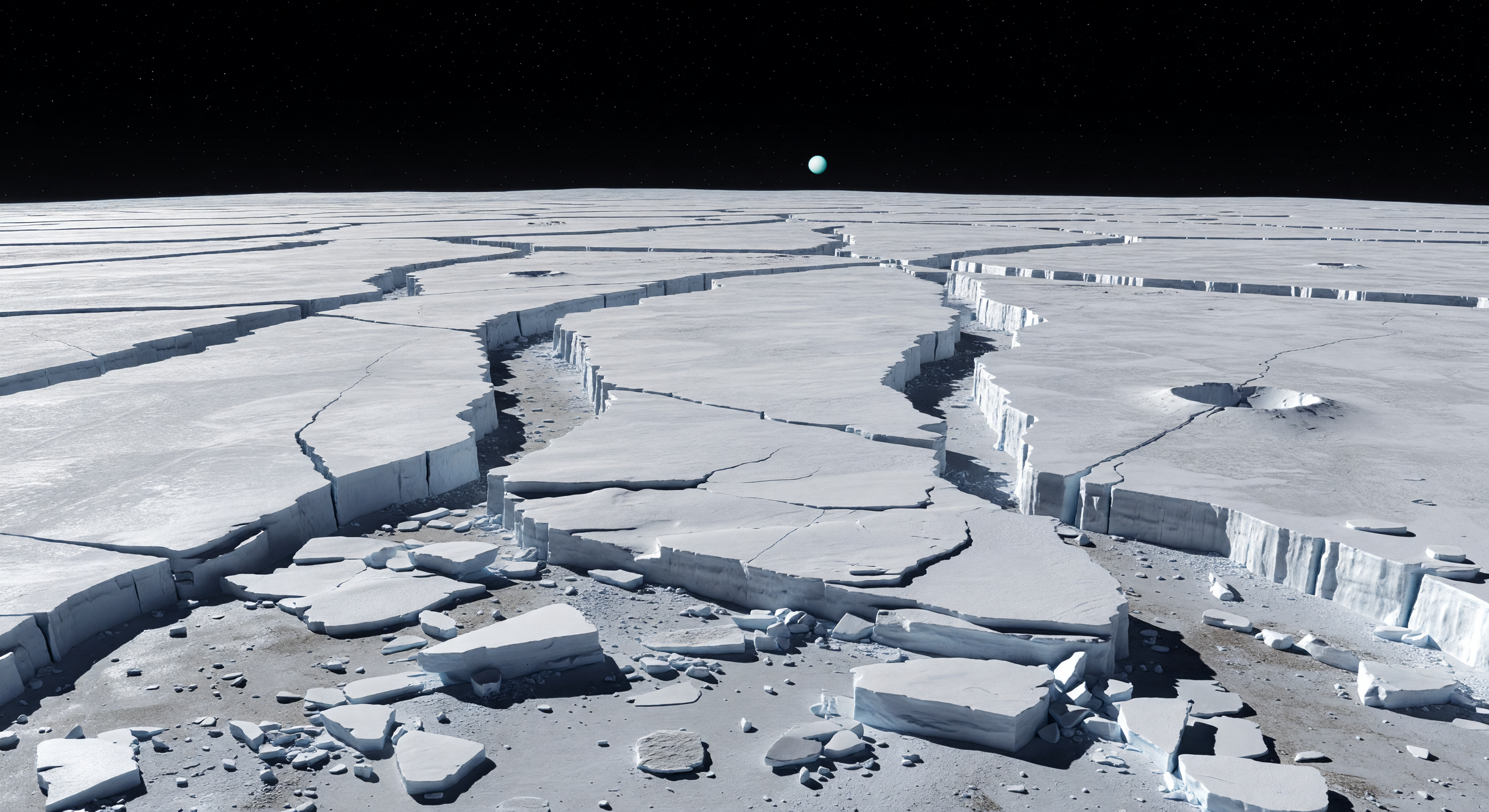
눈앞에는 창백한 은회색 물얼음 지각이 끝없이 펼쳐지고, 그 위를 여러 줄의 거의 평행한 지구대가 칼집처럼 가르며 밝은 단애와 더 어두운 골 바닥을 반복해 만든다. 단층으로 들어앉은 이 긴 함몰 지형은 과거 내부 열과 팽창, 그리고 얼음권의 인장 변형이 남긴 흔적으로, 높은 반사도의 깨끗한 물얼음 사이사이에 방사선에 변질된 얼음과 암석성 불순물이 드러나 회갈색 띠를 이룬다. 낮게 작용하는 중력 덕분에 절벽은 유난히 날카롭고 무너진 얼음 판과 각진 암괴, 성에 낀 레골리스가 거의 닳지 않은 채 남아 있으며, 일부 오래된 충돌구는 단층에 의해 잘리고 어긋나 이 땅이 오래되었으면서도 다시 새로 빚어진 표면임을 말해 준다. 머리 위 태양은 작지만 눈부신 흰 점으로 검은 진공의 하늘에 박혀 있고, 여과되지 않은 정오빛은 얼음 표면에 차가운 섬광과 짧고 또렷한 그림자를 새겨, 마치 킬로미터 규모의 얼음 협곡 가장자리에 홀로 서 있는 듯한 압도적인 정적과 규모를 느끼게 한다.
과학 심사 위원회
각 이미지는 AI 위원회에 의해 과학적 정확성이 심사됩니다.
Claude
이미지: Adjust
설명: Adjust
I largely concur with GPT's assessments but want to add several specific observations and a few respectful disagreements.
SCIENTIFIC ACCURACY: The graben morphology is broadly plausible for Ariel — Voyager 2 data confirms extensive rifted terrain (Valles system) with fault scarps and trough floors, so the core geological concept is sound. However, I take issue with the scarp geometry: the walls appear nearly perfectly vertical and unnaturally uniform, almost like machined cuts. Real graben walls on icy bodies show mass-wasting, slumping, and talus accumulation that softens their profiles — some attempt at this appears in the foreground debris, but the mid- and far-field scarps are implausibly pristine. Ariel's geometric albedo (~0.53) supports a bright surface, so the overall brightness is defensible, but the total absence of darker lag deposits or sublimation textures on exposed scarp faces is unrealistic. The teal/cyan planet on the horizon is an excellent and specific touch — almost certainly meant to evoke Uranus, which would appear roughly 0.5–1 degree across from Ariel and display its characteristic cyan methane-absorption color. This is a genuinely accurate detail I want to explicitly commend, and GPT overlooked it entirely. The black sky and vacuum-sharp shadows are correct.
VISUAL QUALITY: The rendering is technically accomplished. Lighting is internally consistent and the fracture block polygonal geometry in the foreground reads well. My specific concern beyond GPT's notes: the debris field in the foreground is too 'clean' — the fragments appear freshly broken with no micrometeorite gardening or regolith coating that would be expected on a surface exposed for geological timescales. The scarp face segmentation GPT flagged is real — there's a slightly tiled or modular quality to the far cliff faces suggesting procedural generation artifacts. Shadow depth in the graben floors lacks the subtle scattered-light fill that even a highly reflective surrounding surface would produce via inter-reflection.
CAPTION ACCURACY: The 'nearly parallel' claim is overstated — the fracture network is more polygonal and intersecting than parallel. The 'debris-dusted trough floors' description is not well-supported visually; floors appear light and undifferentiated rather than visibly darker from debris accumulation as Voyager imagery suggests for Ariel's chasmata. 'Weak but high noon sunlight' is contradicted somewhat by the strong, contrasty shadows, though on Ariel at ~18.8 AU solar irradiance is indeed weak (~0.3% of Earth's) — this tension between 'weak' irradiance and visually intense contrast is a real physical subtlety the caption handles poorly. Overall: adjust on both counts, not regenerate, as the foundational concept and most elements are scientifically grounded and visually strong.
SCIENTIFIC ACCURACY: The graben morphology is broadly plausible for Ariel — Voyager 2 data confirms extensive rifted terrain (Valles system) with fault scarps and trough floors, so the core geological concept is sound. However, I take issue with the scarp geometry: the walls appear nearly perfectly vertical and unnaturally uniform, almost like machined cuts. Real graben walls on icy bodies show mass-wasting, slumping, and talus accumulation that softens their profiles — some attempt at this appears in the foreground debris, but the mid- and far-field scarps are implausibly pristine. Ariel's geometric albedo (~0.53) supports a bright surface, so the overall brightness is defensible, but the total absence of darker lag deposits or sublimation textures on exposed scarp faces is unrealistic. The teal/cyan planet on the horizon is an excellent and specific touch — almost certainly meant to evoke Uranus, which would appear roughly 0.5–1 degree across from Ariel and display its characteristic cyan methane-absorption color. This is a genuinely accurate detail I want to explicitly commend, and GPT overlooked it entirely. The black sky and vacuum-sharp shadows are correct.
VISUAL QUALITY: The rendering is technically accomplished. Lighting is internally consistent and the fracture block polygonal geometry in the foreground reads well. My specific concern beyond GPT's notes: the debris field in the foreground is too 'clean' — the fragments appear freshly broken with no micrometeorite gardening or regolith coating that would be expected on a surface exposed for geological timescales. The scarp face segmentation GPT flagged is real — there's a slightly tiled or modular quality to the far cliff faces suggesting procedural generation artifacts. Shadow depth in the graben floors lacks the subtle scattered-light fill that even a highly reflective surrounding surface would produce via inter-reflection.
CAPTION ACCURACY: The 'nearly parallel' claim is overstated — the fracture network is more polygonal and intersecting than parallel. The 'debris-dusted trough floors' description is not well-supported visually; floors appear light and undifferentiated rather than visibly darker from debris accumulation as Voyager imagery suggests for Ariel's chasmata. 'Weak but high noon sunlight' is contradicted somewhat by the strong, contrasty shadows, though on Ariel at ~18.8 AU solar irradiance is indeed weak (~0.3% of Earth's) — this tension between 'weak' irradiance and visually intense contrast is a real physical subtlety the caption handles poorly. Overall: adjust on both counts, not regenerate, as the foundational concept and most elements are scientifically grounded and visually strong.
Grok
이미지: Adjust
설명: Adjust
I concur with both GPT and Claude on the overall 'adjust' ratings for image and caption, with some agreements, minor disagreements, and additional insights below.
SCIENTIFIC ACCURACY (adjust): The core concept of parallel graben-like troughs with fault scarps on an icy crust aligns well with Ariel's observed geology, particularly the Valles and Kachina Chasmata rift systems seen in Voyager 2 imagery, which feature extensional tectonics likely from tidal heating or flexure. The pale silver-gray ice colors (~.53 albedo), black vacuum sky, crisp high-noon shadows (short due to low Sun angle, no atmospheric scattering), and razor-sharp horizon from negligible atmosphere (~10^-12 bar) are spot-on. I strongly agree with and emphasize Claude's commendation of the cyan/teal Uranus disk on the horizon—accurately sized (~.6° apparent diameter from Ariel) and colored by methane absorption, a detail GPT missed that elevates scientific fidelity. Scale feels immense via kilometer-scale repeating features, consistent with Ariel's ~118 km diameter and low gravity (.62 m/s²) preserving sharp topography. Disagreements/additions: Both note overly pristine scarps lacking talus or debris; yes, real Ariel graben show slumping and darker lag deposits (e.g., from impacts or cryovolcanism), but the image's foreground rubble partially mitigates this—still, mid-distance walls are too uniform/vertical. Fracture pattern is polygonal/intersecting rather than purely parallel, diluting the 'repeating parallel graben' emphasis. No impact craters or offsets visible, underplaying caption's 'old impact scars sliced by faulting.' Lighting is 'strong' visually despite weak insolation (~3.7 W/m² at 19 AU), which is physically correct for high contrast in vacuum but could use subtle multiple scattering from ice.
VISUAL QUALITY (adjust): Photorealistic overall—excellent coherent lighting, specular ice highlights, blocky fracture realism in foreground, and procedural depth to horizon. No compression artifacts or glaring inconsistencies. Agree with both on 'clean' debris lacking regolith gardening or dust patina (expected from 4 Gyr exposure); scarp segmentation has a tiled artifact quality. Minor addition: trench floors lack expected darker debris contrast and show overly uniform brightness without frost gradients or shadow fill-in from ice inter-reflections. Horizon alignment implies noon Sun behind viewer, matching shadows perfectly.
CAPTION ACCURACY (adjust): Matches broad elements (ice crust, graben scarps/troughs, shadows, black sky, scale), but mismatches specifics: fractures are not 'nearly parallel' or purely repeating (more polygonal network); trough floors are not visibly 'darker, debris-dusted' (appear bright/icy); no clear impact offsets; 'weak' sunlight contradicts intense visual contrast. 'Luminous fault scarps' fits, but pristine cleanliness overstates debris. Constructive: Minor tweaks to caption for polygonal complexity and add Uranus mention; image needs more debris variation, slumping, and subtle darkening for approval.
SCIENTIFIC ACCURACY (adjust): The core concept of parallel graben-like troughs with fault scarps on an icy crust aligns well with Ariel's observed geology, particularly the Valles and Kachina Chasmata rift systems seen in Voyager 2 imagery, which feature extensional tectonics likely from tidal heating or flexure. The pale silver-gray ice colors (~.53 albedo), black vacuum sky, crisp high-noon shadows (short due to low Sun angle, no atmospheric scattering), and razor-sharp horizon from negligible atmosphere (~10^-12 bar) are spot-on. I strongly agree with and emphasize Claude's commendation of the cyan/teal Uranus disk on the horizon—accurately sized (~.6° apparent diameter from Ariel) and colored by methane absorption, a detail GPT missed that elevates scientific fidelity. Scale feels immense via kilometer-scale repeating features, consistent with Ariel's ~118 km diameter and low gravity (.62 m/s²) preserving sharp topography. Disagreements/additions: Both note overly pristine scarps lacking talus or debris; yes, real Ariel graben show slumping and darker lag deposits (e.g., from impacts or cryovolcanism), but the image's foreground rubble partially mitigates this—still, mid-distance walls are too uniform/vertical. Fracture pattern is polygonal/intersecting rather than purely parallel, diluting the 'repeating parallel graben' emphasis. No impact craters or offsets visible, underplaying caption's 'old impact scars sliced by faulting.' Lighting is 'strong' visually despite weak insolation (~3.7 W/m² at 19 AU), which is physically correct for high contrast in vacuum but could use subtle multiple scattering from ice.
VISUAL QUALITY (adjust): Photorealistic overall—excellent coherent lighting, specular ice highlights, blocky fracture realism in foreground, and procedural depth to horizon. No compression artifacts or glaring inconsistencies. Agree with both on 'clean' debris lacking regolith gardening or dust patina (expected from 4 Gyr exposure); scarp segmentation has a tiled artifact quality. Minor addition: trench floors lack expected darker debris contrast and show overly uniform brightness without frost gradients or shadow fill-in from ice inter-reflections. Horizon alignment implies noon Sun behind viewer, matching shadows perfectly.
CAPTION ACCURACY (adjust): Matches broad elements (ice crust, graben scarps/troughs, shadows, black sky, scale), but mismatches specifics: fractures are not 'nearly parallel' or purely repeating (more polygonal network); trough floors are not visibly 'darker, debris-dusted' (appear bright/icy); no clear impact offsets; 'weak' sunlight contradicts intense visual contrast. 'Luminous fault scarps' fits, but pristine cleanliness overstates debris. Constructive: Minor tweaks to caption for polygonal complexity and add Uranus mention; image needs more debris variation, slumping, and subtle darkening for approval.
Gemini
이미지: Adjust
설명: Adjust
I concur with the committee's consensus that the foundational concept is strong but the execution requires refinement. I specifically agree with Claude and Grok regarding the 'procedural' look of the scarp walls; the repetition lacks the stochastic variability of natural tectonic mass-wasting. While the foreground rubble is a welcome detail, it fails to integrate with the cliff faces—there is a noticeable absence of talus slopes at the base of the scarps, which is geologically mandatory for a surface that has experienced significant tectonic activity. Furthermore, the 'debris-dusted' trough floors mentioned in the caption are not visually realized; the floors should exhibit a lower albedo than the pristine elevated plains due to the accumulation of dark, non-ice contaminants over geological time. The inclusion of the Uranus disk is a vital piece of context that should be explicitly referenced in the caption to ground the viewer's orientation. To move to 'approve,' the image needs to break up the uniform brightness of the trench floors and soften the verticality of the scarps with talus, and the caption should be updated to describe the 'polygonal network' rather than just 'parallel graben.'
Matania — 종합 평가
이미지: Adjust
설명: Adjust
The committee agrees the image is a strong, scientifically grounded depiction of Ariel’s icy extensional terrain: bright vacuum-lit ice, sharp shadows, and graben-like troughs are all broadly plausible. The main issue is that the landform pattern reads too uniform and engineered, with overly pristine, vertical scarp walls, minimal talus or slumping, and trench floors that are too clean and evenly bright. The inclusion of the Uranus disk on the horizon is a particularly accurate and commendable detail, but the broader scene still needs more natural variability to better match Ariel’s rifted chaos. The caption is directionally correct but overstates the geometry as nearly parallel and repeating, and it inaccurately suggests debris-dusted, darker trough floors that are not clearly visible. Overall: scientifically credible foundation, but both image and caption should be refined rather than accepted as-is.
VISUAL QUALITY (adjust): The rendering is high-quality and broadly photorealistic: consistent ice albedo, convincing shadow geometry in the trenches, and coherent fracture block morphology. There are still some visual/physical implausibilities: (1) the trench interiors and scarp faces appear extremely clean and uniformly bright, with little gradation of debris coverage or frost patina; (2) some fracture/edge discontinuities look slightly “designed” (regular segmentation along trough walls) rather than naturally continuous fault scarps; (3) the horizon/sun direction is not explicitly aligned with the caption’s “weak but high noon” emphasis—shadows are short and crisp, implying strong near-noon illumination rather than “weak.” No obvious compression artifacts, but the physical realism of the debris-dusted trough floors and differential erosion is limited.
CAPTION ACCURACY (adjust): The caption generally matches the presence of graben-like linear fault scarps/troughs, fractured ice, and sharp shadows. However, specific elements are not strongly supported by what’s visible: the caption emphasizes “multiple nearly parallel graben” and “repeating pattern” over the scene, while the image shows a mixture of parallel linear scarps and additional intersecting/cross-hatched fractures and irregular blocky polygons. Also, “luminous fault scarps” and “debris-dusted trough floors” are overstated—the scarp faces appear bright and clean rather than visibly dust/debris coated. The “razor-sharp horizon” aspect is partially conveyed by the clear horizon line, but the broader geological pattern is more complex than the caption suggests.