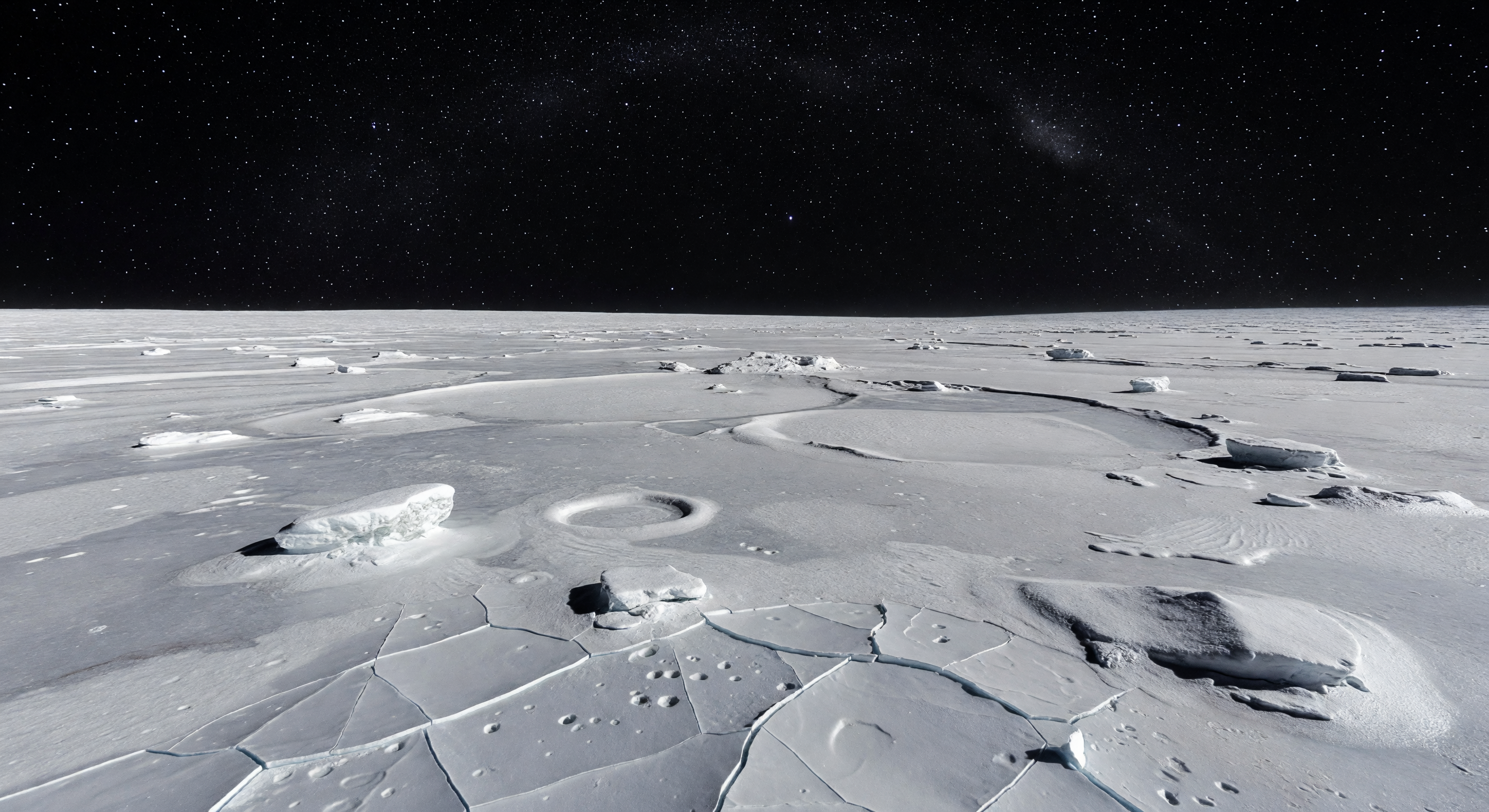
발아래 펼쳐진 저지대 평원은 눈부시게 밝은 질소 얼음으로 덮여 있으며, 그 위를 아주 얇은 메탄 서리가 유리막처럼 감싸 은빛과 옅은 회색의 냉랭한 광택을 더한다. 전경에는 다각형으로 갈라진 취성 지각, 좁은 홈, 승화로 파인 얕은 구덩이와 물결처럼 굽은 오목지, 그리고 신선한 휘발성 서리를 뒤집어쓴 각진 물얼음 기반암 덩이들이 극도로 선명하게 드러나는데, 이는 약 40 K의 극저온에서 액체 없이 얼음이 암석처럼 거동하며 오랜 시간 표면을 재구성해 왔음을 보여준다. 평원은 거의 완벽하게 평탄하지만 멀리 갈수록 완만히 처진 분지와 반쯤 묻힌 바위들이 이어지고, 작은 천체 특유의 가까운 곡면 지평선이 시야를 감싸며 이 세계의 왜소한 규모를 실감하게 한다. 머리 위 하늘은 대기가 사실상 없는 진공의 검은색으로, 별들과 은하수가 날카롭게 빛나고 태양은 원반이 아닌 눈부신 흰 점 하나로만 보여, 희미하지만 칼날처럼 또렷한 빛과 잉크처럼 새까만 그림자를 이 끝없는 서리 평원 위에 드리운다.
과학 심사 위원회
각 이미지는 AI 위원회에 의해 과학적 정확성이 심사됩니다.
GPT
이미지: Adjust
설명: Adjust
Scientific accuracy: The surface imagery is generally consistent with a cold, volatile-ice plain: bright, pale nitrogen-rich frost with polygonal cracking patterns and darker linear troughs/grooves suggesting sublimation/deposition and/or differential contraction. The “no atmosphere / vacuum-black sky” aspect is not well supported in the image, however: there is no obvious Eris-sun location (no obvious low, tiny solar disk), and the lighting reads like Earth-like or a nearby sun with comparatively soft global illumination; the sky also looks like a generic starfield rather than a scene with a defined illumination geometry. Colors are plausible (mostly silver-white with darker patches), but the specific claim of methane glaze and exposed angular water-ice blocks protruding through a thin volatile veneer is not clearly identifiable from the image—there are bouldery/raised features, yet they don’t clearly read as distinct water-ice “blocks” versus simply thicker frost. Scale/horizon: the description mentions an unusually close curvature; the image horizon is present but not strongly emphasized as “curving upward surprisingly close,” so scale is only partially conveyed. Visual quality: The image is high resolution and looks photorealistic in terms of surface texture (cracks, ridges, clasts, specular highlights). There are no glaring artifacts, but the sky and lighting setup appear synthetic/implausible for Eris conditions: the sun is not depicted and shadow behavior appears inconsistent with a weak solar illumination environment at ~97 AU (Eris’s incident sunlight is extremely low; contrasts may still exist in vacuum, but the overall impression here doesn’t clearly match that regime). Caption accuracy: The caption is rich in specific geologic interpretations (nitrogen frost, methane redeposition, 40 K regime, polygonal plates, troughs, scalloped pits, angular water-ice blocks). The image supports polygonal cracking and a broadly frosty, plateau-like plain, but key elements are missing or not clearly evidenced: “scalloped pits,” “thin glaze of methane frost,” and “horizon curves upward surprisingly close” are not convincingly shown. Overall, it matches the general idea of a frost-dominated outer-solar-system plain, but several specific claims and the lighting/illumination geometry need adjustment.
Claude
이미지: Regenerate
설명: Adjust
I largely agree with GPT's assessment but want to push the image vote to 'regenerate' based on several compounding issues that together constitute major scientific inaccuracies rather than minor adjustments. Let me be specific about each dimension.
SCIENTIFIC ACCURACY — MAJOR ISSUES: The most glaring problem is the lighting regime. Eris orbits at ~96 AU, meaning solar irradiance is roughly 1/9200th of Earth's. Even in vacuum with no atmospheric scattering, the surface should appear dramatically dimmer overall, with an extremely small solar disk (Sun subtends ~0.02° from Eris vs ~0.5° from Earth). The image depicts what reads as bright, near-full illumination more consistent with the inner solar system or at most the asteroid belt. Shadow geometry is inconsistent with a tiny, nearly point-source sun at extreme distance — we would expect extremely sharp, high-contrast shadows but with the overall scene being very dark except in direct sunlight. The image instead shows soft, broadly illuminated terrain. The Milky Way band is visible and that is scientifically plausible given no atmosphere, but the overall sky brightness and star rendering feel composited rather than physically accurate. The polygonal cracking patterns are the strongest scientific success in this image — they are consistent with volatile ice sublimation/redeposition cycles producing thermal contraction polygons analogous to what New Horizons showed on Pluto's Tombaugh Regio. However, attributing these confidently to nitrogen frost on Eris is speculative; Eris's surface composition is methane-dominated with some nitrogen, distinct from Pluto's nitrogen-dominated plains. The surface color is broadly acceptable (pale grey-white) though Eris's albedo of ~0.96 — the highest of any known large solar system body — would suggest an almost blinding white surface in any available light, and the image's grey tones are somewhat undersaturated for this.
SCALE AND HORIZON: GPT correctly notes that the unusually close horizon implied by Eris's smaller radius (~1163 km) is not conveyed. Eris is roughly 2/3 the radius of the Moon; the horizon should feel noticeably closer than Earth but the image does not distinguish this meaningfully from a generic planetary surface.
VISUAL QUALITY: The surface texture work is the strongest element — polygonal plates, troughs, raised blocks, and specular frost highlights are rendered with high photorealistic quality and no obvious AI artifacts. However, the compositing of the starfield sky onto the terrain surface reads as synthetic; the transition at the horizon lacks physical coherence, and the Milky Way orientation/brightness feels like a stock astronomy photograph pasted rather than integrated into a coherent illumination model.
CAPTION ACCURACY: The caption is scientifically ambitious and largely defensible as a description of what Eris's surface plausibly looks like, but it overclaims relative to the image. 'Scalloped pits' are not clearly visible. 'Thin glaze of methane frost' is not distinguishable from bulk nitrogen frost visually. The 'tiny brilliant Sun casting razor-sharp black shadows' is described but not depicted — this is the single largest discrepancy between caption and image. The 40 K temperature claim is accurate for Eris. The 'horizon curves upward surprisingly close' is poetic but not evidenced in the image. Caption vote 'adjust' is appropriate — the text is good science writing but needs to be reconciled with what is actually shown, particularly regarding the sun's appearance.
RECOMMENDATION: Regenerate the image with correct solar illumination geometry (tiny sun disk visible, very dim ambient scene, extreme shadow contrast), much brighter white albedo surface, and a more physically integrated sky-to-surface transition. The polygonal terrain geometry should be retained as it is the strongest scientific element. The caption should be adjusted to either describe the sun's position or remove the claim if the sun is not depicted, and should temper the methane-frost and scalloped-pit claims if those features cannot be visually distinguished.
SCIENTIFIC ACCURACY — MAJOR ISSUES: The most glaring problem is the lighting regime. Eris orbits at ~96 AU, meaning solar irradiance is roughly 1/9200th of Earth's. Even in vacuum with no atmospheric scattering, the surface should appear dramatically dimmer overall, with an extremely small solar disk (Sun subtends ~0.02° from Eris vs ~0.5° from Earth). The image depicts what reads as bright, near-full illumination more consistent with the inner solar system or at most the asteroid belt. Shadow geometry is inconsistent with a tiny, nearly point-source sun at extreme distance — we would expect extremely sharp, high-contrast shadows but with the overall scene being very dark except in direct sunlight. The image instead shows soft, broadly illuminated terrain. The Milky Way band is visible and that is scientifically plausible given no atmosphere, but the overall sky brightness and star rendering feel composited rather than physically accurate. The polygonal cracking patterns are the strongest scientific success in this image — they are consistent with volatile ice sublimation/redeposition cycles producing thermal contraction polygons analogous to what New Horizons showed on Pluto's Tombaugh Regio. However, attributing these confidently to nitrogen frost on Eris is speculative; Eris's surface composition is methane-dominated with some nitrogen, distinct from Pluto's nitrogen-dominated plains. The surface color is broadly acceptable (pale grey-white) though Eris's albedo of ~0.96 — the highest of any known large solar system body — would suggest an almost blinding white surface in any available light, and the image's grey tones are somewhat undersaturated for this.
SCALE AND HORIZON: GPT correctly notes that the unusually close horizon implied by Eris's smaller radius (~1163 km) is not conveyed. Eris is roughly 2/3 the radius of the Moon; the horizon should feel noticeably closer than Earth but the image does not distinguish this meaningfully from a generic planetary surface.
VISUAL QUALITY: The surface texture work is the strongest element — polygonal plates, troughs, raised blocks, and specular frost highlights are rendered with high photorealistic quality and no obvious AI artifacts. However, the compositing of the starfield sky onto the terrain surface reads as synthetic; the transition at the horizon lacks physical coherence, and the Milky Way orientation/brightness feels like a stock astronomy photograph pasted rather than integrated into a coherent illumination model.
CAPTION ACCURACY: The caption is scientifically ambitious and largely defensible as a description of what Eris's surface plausibly looks like, but it overclaims relative to the image. 'Scalloped pits' are not clearly visible. 'Thin glaze of methane frost' is not distinguishable from bulk nitrogen frost visually. The 'tiny brilliant Sun casting razor-sharp black shadows' is described but not depicted — this is the single largest discrepancy between caption and image. The 40 K temperature claim is accurate for Eris. The 'horizon curves upward surprisingly close' is poetic but not evidenced in the image. Caption vote 'adjust' is appropriate — the text is good science writing but needs to be reconciled with what is actually shown, particularly regarding the sun's appearance.
RECOMMENDATION: Regenerate the image with correct solar illumination geometry (tiny sun disk visible, very dim ambient scene, extreme shadow contrast), much brighter white albedo surface, and a more physically integrated sky-to-surface transition. The polygonal terrain geometry should be retained as it is the strongest scientific element. The caption should be adjusted to either describe the sun's position or remove the claim if the sun is not depicted, and should temper the methane-frost and scalloped-pit claims if those features cannot be visually distinguished.
Grok
이미지: Regenerate
설명: Adjust
I concur with both GPT and Claude's assessments, particularly Claude's escalation to 'regenerate' for the image due to compounding scientific inaccuracies that undermine the core plausibility of an Eris landscape. SCIENTIFIC ACCURACY (regenerate): Strongest element is the polygonal cracking and frosty white surface textures, which aptly evoke volatile ice sublimation on a TNO like Eris (albedo ~.96, surface likely methane/nitrogen ices at ~40-50 K); these align with Pluto analogs from New Horizons. However, major flaws persist: (1) Lighting is fundamentally wrong—Eris at ~96 AU receives ~1/900th Earth's insolation, demanding a tiny (~.02° angular diameter) Sun disk (not visible here), ultra-dim ambient lighting, and razor-sharp, high-contrast shadows with no fill light in vacuum; the image shows overly bright, softly shadowed terrain akin to lunar or inner solar system conditions. (2) No discernible tiny Sun position, contradicting description's 'tiny brilliant Sun'; shadows lack the exaggerated sharpness/parallelism expected from a distant point source. (3) Horizon/scale fails to convey Eris's small size (R~1163 km, ~1/3 Earth gravity)—horizon distance ~2-3 km vs Earth's 5 km; it appears flat/distant like a larger body. (4) Colors are pale but undersaturated grey-white; Eris should gleam near-blindingly white. Sky starfield is plausible (no atmosphere = crisp stars/Milky Way), but composited artificially without illumination coherence. Eris composition is methane-heavy with nitrogen traces (unlike Pluto's N2 plains), so 'nitrogen frost plain' is plausible speculation but 'methane glaze' and 'water-ice blocks' are not distinctly rendered. VISUAL QUALITY (regenerate): Photorealistic surface details (cracks, ridges, specular highlights on frost) are excellent, no AI artifacts, but sky-terrain compositing is jarring (horizon transition unnatural), and lighting implausibility breaks immersion—feels like mismatched elements rather than a unified vacuum scene. CAPTION ACCURACY (adjust): Description is scientifically literate and evocative (accurate temps, processes like sublimation/redeposition, vacuum sky), but mismatches image: no visible tiny Sun/shadows, scalloped pits vague (pits present but not scalloped), methane glaze/water blocks not distinguishable, horizon curvature not 'surprisingly close.' Temper overclaims or align with depicted elements. NEW INSIGHTS: Retain polygons/scallops as strengths; regenerate prioritizing correct photometry (e.g., reference Eris models or Pluto's dim sunlight sims), visible pinpoint Sun low on horizon, brighter albedo, closer curved horizon via wide-angle distortion. Agree with Claude's recs; caption could specify Sun location if added.
Gemini
이미지: Regenerate
설명: Adjust
I concur with the committee's consensus. The image fails the 'physics-first' test required for a TNO environment. The most critical failure is the photometrics: the scene mimics Earth-like scattered light rather than the extreme point-source, high-contrast lighting of a 96 AU environment. To correct this, the generator must prioritize a 'black-sky-with-pinpoint-sun' illumination model where the ambient light is near zero, and shadows are cast only by direct, harsh, collimated sunlight. The albedo of the surface must be pushed toward a brilliant, near-reflective white to represent Eris's extreme reflectivity. The horizon issue is a matter of perspective; a lower, wide-angle camera placement is needed to force the curvature and emphasize the small scale of the body. The caption is scientifically sound but currently describes features (the tiny sun, scalloped pits, and horizon curvature) that the image lacks, creating a disconnect. Once the image is regenerated to include these specific, physically modeled features, the caption will be accurate.
Matania — 종합 평가
이미지: Regenerate
설명: Adjust
The committee found the terrain conceptually strong but physically under-modeled for Eris. The polygonal frost cracking, pale volatile-ice surface, and broad outer-solar-system feel are the image’s main successes, suggesting a plausible nitrogen/methane frost plain. However, the lighting is the decisive failure: the scene reads too bright and softly lit for Eris’s extreme distance, with no convincing tiny Sun, insufficient shadow harshness, and a sky-to-surface integration that feels composited rather than physically coherent. The horizon and body scale are also not clearly communicated. The caption is scientifically ambitious and generally informed, but it overstates features not clearly visible in the image, especially the tiny Sun, scalloped pits, methane glaze, and close curvature of the horizon.