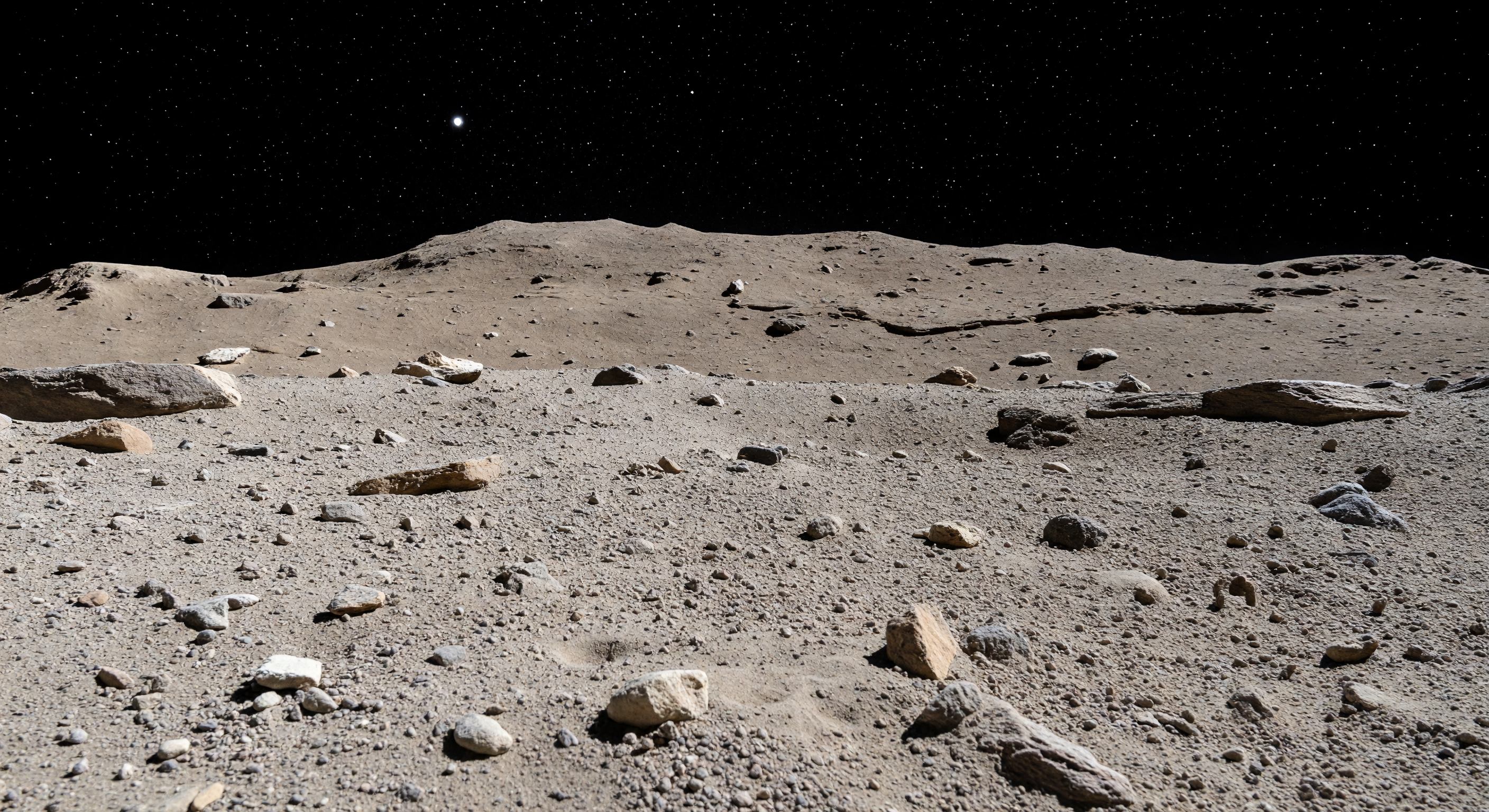
발아래에는 베이지회색의 미세한 규산염 먼지와 자갈, 부서진 쇄설물이 빽빽하게 깔려 있고, 그 사이사이로 더 어두운 갈흑색의 각진 돌조각과 깨진 암편이 가루 같은 표토에 반쯤 잠긴 채 드러나 있다. 대기가 전혀 없는 환경이라 햇빛은 조금 더 작아 보이는 태양에서 거칠게 쏟아지고, 모든 입자와 암석 모서리는 번짐 없는 칠흑 같은 그림자를 드리워 표면의 미세한 구덩이, 느슨한 먼지의 분급, 사면을 따라 이동한 잔물결 모양 퇴적과 짧은 홈상 균열까지 놀랄 만큼 또렷하게 드러낸다. 가까운 전경의 자갈 하나하나가 손에 잡힐 듯 선명한 반면, 몇십 미터 앞의 둔덕과 작은 충돌 함몰지는 이미 급히 굽어지는 지평선 너머로 떨어져 나가 이곳이 거대한 행성이 아니라 충돌로 가공된 작은 암석 천체의 표면임을 실감하게 한다. 머리 위로는 산란도 안개도 없는 완전한 진공의 검은 하늘이 펼쳐지고, 한낮에도 별빛이 날카롭게 박혀 있어, 마치 우주를 떠다니는 돌산의 등에 바짝 엎드려 서 있는 듯한 기묘한 고요와 규모감을 전한다.
과학 심사 위원회
각 이미지는 AI 위원회에 의해 과학적 정확성이 심사됩니다.
Claude
이미지: Adjust
설명: Adjust
I broadly agree with GPT's assessments but want to add and nuance several points. SCIENTIFIC ACCURACY: The airless black sky, hard unfiltered sunlight, and regolith texture are directionally correct for Eros. However, I have specific concerns beyond GPT's observations. First, the rock sizes and distribution are problematic for Eros at descent scale: NEAR-Shoemaker imagery shows Eros' regolith is dominated by fine-grained material with a notably smoother texture in ponded regions, and while boulders exist, this image feels slightly too Mars-like in its rock abundance and size diversity — the clast population looks more like a terrestrial desert pavement or Mars than a low-gravity S-type asteroid. Second, and critically, the color palette leans slightly too warm/beige. Eros has an S-type spectrum and NEAR data shows it is predominantly gray with only subtle reddening; some rocks here look distinctly tan-to-ochre, suggesting a compositional bias toward terrestrial or Martian analogues. Third, the horizon curvature is insufficiently pronounced. At Eros' mean radius of ~8.4 km, the horizon would drop away dramatically within hundreds of meters — the gentle undulating ridge shown here looks more like a wide terrestrial or Martian plain than the aggressively near horizon of a ~17x7 km potato-shaped body. The prominent bright point-source in the sky is presumably the Sun, which is acceptable, but it appears slightly too large and diffuse rather than a pure point source as seen from ~1.46 AU. VISUAL QUALITY: The image is technically well-executed with consistent directional lighting, no obvious seam artifacts, and convincing depth-of-field simulation in the foreground gravel. The star field is plausible though its visibility against the bright ground surface is slightly unrealistic — the exposure contrast between a sunlit regolith and visible stars would be extreme in reality. The shadows cast by boulders are directionally consistent, which is a quality strength. CAPTION ACCURACY: GPT correctly identifies that micro-shadowing per individual grain and specific shallow pits and grooves are not convincingly visible. I add that 'delicately perched rocks revealing feeble gravity' is entirely absent from the image — no precariously balanced or elevated rocks are discernible, which is actually one of Eros' most scientifically interesting and visually distinctive features documented by NEAR-Shoemaker. The caption over-promises this feature. The 'tightly packed mosaic' description also poorly matches what is shown, which is a more loosely scattered boulder field. RECOMMENDATIONS: Adjust color slightly cooler and grayer, increase apparent horizon curvature to better represent a small body, introduce one or two visibly perched or gravity-defying rocks as a scientifically meaningful and caption-matching detail, and refine the caption to remove claims about micro-shadows and grooves that are not rendered. The fundamental concept is sound and worth preserving rather than regenerating.
Grok
이미지: Adjust
설명: Adjust
I concur with both GPT and Claude on the core issues, with some additional insights and partial disagreements for precision. SCIENTIFIC ACCURACY (vote: adjust): The image correctly captures the airless vacuum (black star-filled sky, no haze), hard unfiltered sunlight with sharp shadows, and regolith texture broadly consistent with Eros' S-type ordinary chondrite composition per NEAR-Shoemaker data (e.g., particulate fines with scattered boulders/clasts). Colors are mostly gray-beige, aligning with Eros' ~.05-.10 albedo and subtle spectral reddening, though Claude's point on slight excess warmth (tan/ochre tones in some clasts) is valid but minor—actual NEAR images show similar variability. Strong agreement on insufficient horizon curvature: Eros' ~17x8x8 km irregular shape at descent scale (~100-500m altitude) demands a dramatically close, sharply curved horizon (geometric horizon distance ~1-2 km max), not the subtle ridge here, which mimics larger bodies like Phobos or Ida. Low-gravity indicators like perched/balanced rocks are absent, a missed opportunity for Eros' hallmark 'boulder tracks' and unstable clasts. Rock distribution is decent but leans boulder-heavy vs. NEAR's finer-dominated regolith with ponds; no clear pits/grooves. The bright sky point-source (Sun) is appropriately sharp but slightly oversized (~1° apparent diameter at 1 AU, smaller at Eros' orbit). Overall minor-to-moderate inaccuracies warrant adjustment, not full regenerate. VISUAL QUALITY (supports image adjust): Photorealistic excellence—crisp textures, consistent lighting/shadows, no artifacts, believable depth and exposure. Minor nit: star visibility is plausible in long-exposure composites but exaggerated vs. sunlit dynamic range (NEAR images rarely show stars prominently). CAPTION ACCURACY (vote: adjust): Description overstates visible details—'razor-black micro-shadows...every grain' implies sub-mm resolution not achieved (textures smoother than per-grain); 'shallow pits and short grooves' invisible; 'delicately perched rocks' entirely absent; 'tightly packed mosaic of...centimeter-sized pebbles' better fits as 'scattered clasts in fines.' Horizon is 'near/curved' but insufficiently so. Caption is directionally accurate but needs toning down unrendered specifics. NEW INSIGHTS: Add faint linear 'boulder tracks' (erosional grooves from migrating clasts, documented on Eros) for low-g realism; cool palette by 10-15% (target RGB ~120-140 gray); exaggerate curvature via tighter FOV or lower vantage; insert 1-2 perched boulders. Agree with Claude's recs; disagree mildly with GPT on pebble sizing (visible clasts are cm-scale, but fines under-resolved). Strong concept—refine for approval.
Gemini
이미지: Adjust
설명: Adjust
I concur with the committee's consensus. The image possesses high visual fidelity but fails to capture the unique 'small-body' geometry of 433 Eros. The primary scientific deficiency is the horizon: at descent scale, the curvature on a body of this size should be aggressive, creating a 'wraparound' effect that the current image lacks, which instead presents a standard, flat-terrain perspective. Furthermore, the committee is correct that the regolith lacks the characteristic 'ponding' (areas of smooth, fine-grained material) often seen in NEAR-Shoemaker imagery, and the color balance is slightly too warm for an S-type asteroid. The caption is overly descriptive of features (micro-shadows on individual grains, perched rocks, and specific impact grooves) that are not present in the render. To reach 'approve' status, the image needs a more pronounced horizon drop-off, a cooler, more neutral gray color palette, and the inclusion of at least one clearly unstable, perched boulder to demonstrate the low-gravity environment. The caption should be revised to describe the general regolith texture and the harsh, high-contrast lighting without claiming sub-millimeter detail or specific geological features that are not visible.
Matania — 종합 평가
이미지: Adjust
설명: Adjust
The committee finds the concept scientifically sound but not yet fully aligned with Eros at descent scale. The image convincingly shows an airless, sunlit regolith surface with a black sky and sharp shadows, which broadly fits an asteroid environment. However, it reads a bit too much like a generic rocky desert: the horizon curvature is too subtle for Eros, the palette is slightly too warm, the regolith appears more boulder-heavy than fine-grained, and hallmark low-gravity cues such as perched boulders or clear boulder tracks are missing. The caption overcommits to details not clearly visible, especially micro-shadows on every grain, shallow pits and grooves, and delicately perched rocks. Overall, the committee recommends adjustment rather than regeneration.
Visual quality: The image is high-quality and realistic in general—crisp regolith texture, plausible hard-surface lighting, and consistent perspective. There are no obvious compositing artifacts, surreal objects, or inconsistent sky elements. The star field appears plausible for a space-view composite, though the overall star density/visibility relative to the bright illuminated ground is difficult to validate; additionally, there is a bright “sun-like” light in the sky area that is not mentioned and is not clearly identifiable as Eros-relevant geometry. These are minor for quality, but they affect strict scientific correspondence.
Caption accuracy: The caption describes a very specific descent-scale lithology (beige-gray dust + crushed gravel + centimeter pebbles, darker angular stones half-sunk, shallow pits/grooves from impacts, and a near curved horizon). The image does show dusty/gravely regolith with many angular clasts and a gentle rise toward the horizon, but clear evidence of shallow pits, short grooves, and perched stones is limited at this resolution/view. The absence of unambiguous grooves/pits and the less-than-fully-resolved micro-shadowing means the caption overcommits to features that aren’t clearly depicted. Recommend adjusting the caption to match what is actually visible (dense mixed regolith with scattered angular boulders/clasts, strong sunlight, airless black sky) rather than emphasizing micro-shadow per-grain and specific small impact microfeatures.