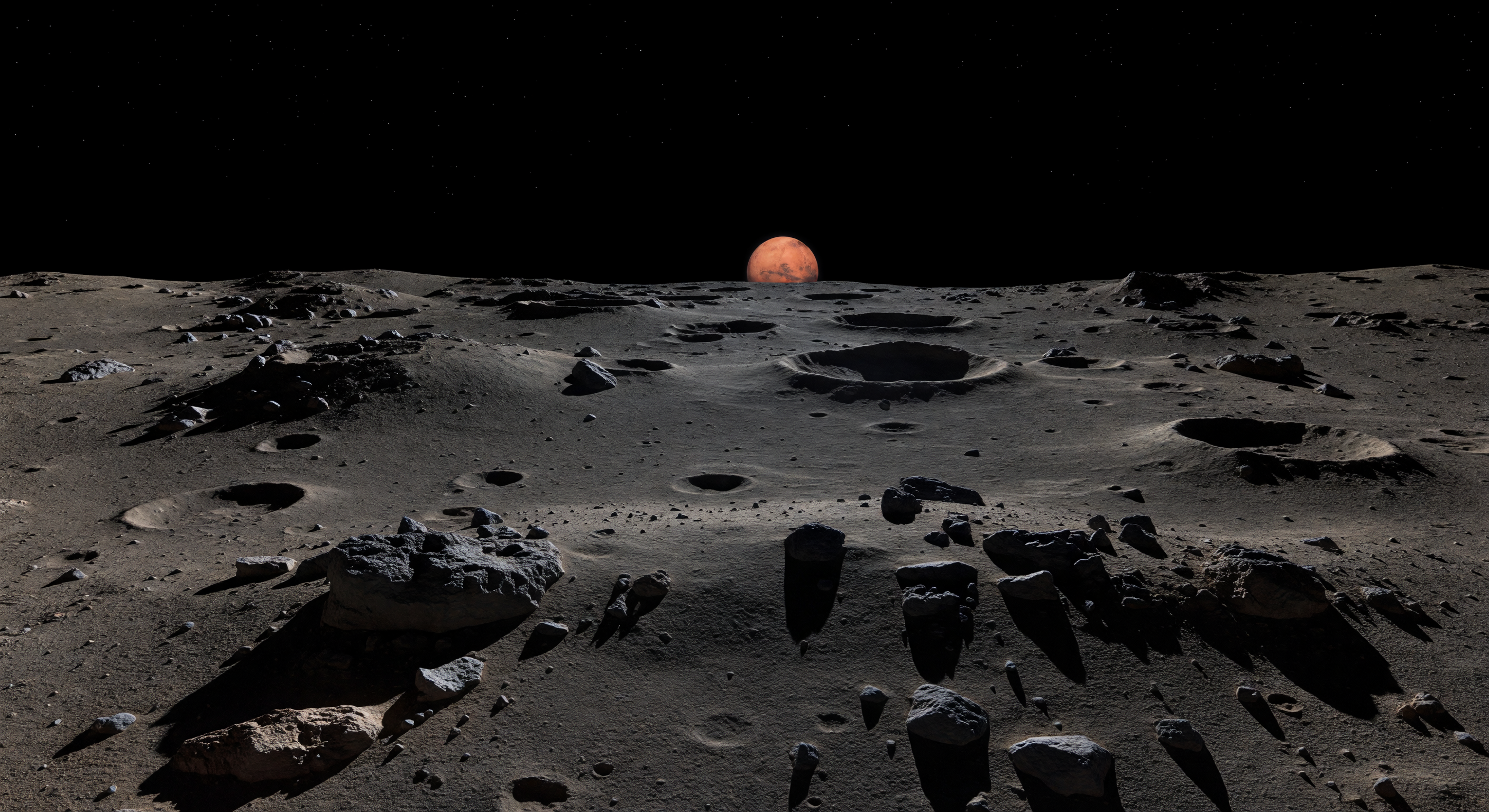
여기서는 부드럽게 물결치는 검은 탄소질 레골리스 평원이 작은 지평선까지 이어지고, 얕은 미세 충돌구와 먼지에 반쯤 묻힌 각력암 덩이들 사이로 태양이 비스듬히 쏘아 보낸 빛이 따뜻한 회갈색 띠와 수백 미터 길이의 칠흑 같은 그림자를 번갈아 새겨 넣는다. 대기가 전혀 없는 진공에서는 빛의 산란이 없어 그림자 경계가 칼날처럼 날카롭고, 낮게 비친 작은 태양은 낮은 반사율의 암흑 표면을 차갑게 비추면서도 그 미세한 먼지층과 다공성 쇄설물을 또렷하게 드러낸다. 이 작은 위성의 극도로 약한 중력은 위태롭게 얹힌 바위, 무너지지 않은 섬세한 크레이터 테두리, 그리고 믿기 어려울 만큼 길게 트인 시선 속에서 느껴지며, 정지한 듯한 검은 하늘에는 별빛과 함께 거대한 붉은 행성이 낮게 걸려 가장 깊은 그늘에 희미한 붉은 반사광만 살짝 스며들게 한다. 모든 것이 고요하고, 공기도 소리도 없는 이 경계의 시간대에서 풍경은 마치 우주 속에 드러난 원시 소행성의 피부 위에 직접 서 있는 듯한 낯설고도 친밀한 규모로 다가온다.
과학 심사 위원회
각 이미지는 AI 위원회에 의해 과학적 정확성이 심사됩니다.
Claude
이미지: Regenerate
설명: Adjust
I largely agree with GPT's assessment but believe the image warrants a stronger 'regenerate' verdict on scientific grounds specific to Deimos. Let me address each dimension:
**SCIENTIFIC ACCURACY (regenerate):** The most fundamental problem is that this image does not depict Deimos — it depicts what appears to be Earth's Moon or a generic lunar analog. Deimos is one of the smallest known moons in the solar system (~15 × 12 × 11 km), and its surface gravity is approximately 0.003 m/s², roughly 1/3000th of Earth's. This has profound implications: (1) The horizon should close at an extremely intimate distance — perhaps only a few kilometers — yet this image shows a convincingly 'large-body' horizon curvature consistent with a much larger object. (2) The crater morphology shown — with well-defined bowl shapes, crisp raised rims, and clear ejecta blankets — is more consistent with the Moon than Deimos. Deimos's actual surface, as imaged by Viking, shows craters heavily subdued and infilled by an unusually thick regolith layer, giving it a notably smoother, more muted appearance than what is depicted. (3) Mars is rendered as a small, low-horizon object approximately lunar-disc-sized or smaller. From Deimos at ~23,460 km orbital radius, Mars would subtend roughly 16–17 degrees of arc — appearing approximately 30× larger in area than our Moon appears from Earth. Mars should be an enormous, visually dominating presence filling a significant portion of the sky, not a small reddish ball near the horizon. This is a major scientific error that fundamentally misrepresents the Deimos-Mars visual relationship. (4) The boulder scale and distribution, while plausible for an airless body, appears scaled to a much larger world. (5) The lighting does show long shadows consistent with a low sun angle, which is appropriate, but GPT is correct that the terminator-zone razor-sharp alternating light/dark banding described in the caption is not convincingly rendered — shadows are present but not dramatically elongated across hundreds of meters as described.
**VISUAL QUALITY (adjust):** The image is technically well-executed and photorealistic in isolation. Texturing, rock rendering, and shadow consistency are strong. However, for the intended subject, this quality is somewhat irrelevant given the fundamental misidentification of the body depicted. There is a very subtle sky glow that should not exist in an airless environment, consistent with GPT's observation.
**CAPTION ACCURACY (adjust):** The caption is scientifically well-researched and accurately describes Deimos in text — carbon-rich regolith, porous primitive material, faint Mars glow, intimate horizon curvature, feeble gravity. However, it fails to specify Mars's true angular size as seen from Deimos, which would have forced the image generator toward accuracy. The caption's description of 'Mars hanging low overhead' contradicts showing it near the horizon as a small object. The phrase 'razor-sharp light carving the landscape into alternating bands' oversells what the image delivers. The caption is better science than the image it supposedly describes, which creates a fundamental mismatch. I recommend regenerating the image with explicit prompting constraints: Mars at correct angular diameter (~16°), heavily subdued infilled craters, intimate horizon, and dramatically elongated terminator shadows.
**SCIENTIFIC ACCURACY (regenerate):** The most fundamental problem is that this image does not depict Deimos — it depicts what appears to be Earth's Moon or a generic lunar analog. Deimos is one of the smallest known moons in the solar system (~15 × 12 × 11 km), and its surface gravity is approximately 0.003 m/s², roughly 1/3000th of Earth's. This has profound implications: (1) The horizon should close at an extremely intimate distance — perhaps only a few kilometers — yet this image shows a convincingly 'large-body' horizon curvature consistent with a much larger object. (2) The crater morphology shown — with well-defined bowl shapes, crisp raised rims, and clear ejecta blankets — is more consistent with the Moon than Deimos. Deimos's actual surface, as imaged by Viking, shows craters heavily subdued and infilled by an unusually thick regolith layer, giving it a notably smoother, more muted appearance than what is depicted. (3) Mars is rendered as a small, low-horizon object approximately lunar-disc-sized or smaller. From Deimos at ~23,460 km orbital radius, Mars would subtend roughly 16–17 degrees of arc — appearing approximately 30× larger in area than our Moon appears from Earth. Mars should be an enormous, visually dominating presence filling a significant portion of the sky, not a small reddish ball near the horizon. This is a major scientific error that fundamentally misrepresents the Deimos-Mars visual relationship. (4) The boulder scale and distribution, while plausible for an airless body, appears scaled to a much larger world. (5) The lighting does show long shadows consistent with a low sun angle, which is appropriate, but GPT is correct that the terminator-zone razor-sharp alternating light/dark banding described in the caption is not convincingly rendered — shadows are present but not dramatically elongated across hundreds of meters as described.
**VISUAL QUALITY (adjust):** The image is technically well-executed and photorealistic in isolation. Texturing, rock rendering, and shadow consistency are strong. However, for the intended subject, this quality is somewhat irrelevant given the fundamental misidentification of the body depicted. There is a very subtle sky glow that should not exist in an airless environment, consistent with GPT's observation.
**CAPTION ACCURACY (adjust):** The caption is scientifically well-researched and accurately describes Deimos in text — carbon-rich regolith, porous primitive material, faint Mars glow, intimate horizon curvature, feeble gravity. However, it fails to specify Mars's true angular size as seen from Deimos, which would have forced the image generator toward accuracy. The caption's description of 'Mars hanging low overhead' contradicts showing it near the horizon as a small object. The phrase 'razor-sharp light carving the landscape into alternating bands' oversells what the image delivers. The caption is better science than the image it supposedly describes, which creates a fundamental mismatch. I recommend regenerating the image with explicit prompting constraints: Mars at correct angular diameter (~16°), heavily subdued infilled craters, intimate horizon, and dramatically elongated terminator shadows.
Grok
이미지: Regenerate
설명: Adjust
I concur with both GPT and Claude on the core issues, with Claude's Deimos-specific critique being especially incisive and warranting 'regenerate' for the image. **SCIENTIFIC ACCURACY (regenerate):** This image unmistakably portrays a lunar-like scene (Earth's Moon), not Deimos. Key failures: (1) Horizon distance/curvature is far too distant and shallow for Deimos's ~12 km scale and .003 m/s² gravity—actual visible horizon from a 2m observer height is ~1.5-2 km, creating a tight, sharply closing curve, not the expansive view shown. (2) Mars appears as a tiny ~1° disc near the horizon, but from Deimos's ~23,500 km orbit, Mars subtends ~16° (over 250x the Moon's .5° from Earth), dominating the sky like a vast reddish wall—potentially filling 1/3 of the visible hemisphere if low. This is a glaring omission. (3) Craters are crisp, bowl-shaped with raised rims, unlike Deimos's Viking-observed heavily subdued, dust-mantled, shallow pits from thick regolith blanketing. Boulders and hummocks look lunar-scale, not Deimos's primitive, porous rubble. (4) Lighting has long shadows suitable for terminator but lacks the caption's 'razor-sharp alternating bands' over hundreds of meters—contrast is present but not extreme striping. Sun size is appropriately tiny, sky mostly black (minor glow artifact noted by others). **VISUAL QUALITY (regenerate):** Photorealistic rendering with excellent texture, consistent shadows, and no major artifacts, but scientific mismatches (wrong body scale, Mars size) undermine plausibility, making it unconvincing as Deimos. Subtle sky gradient persists. **CAPTION ACCURACY (adjust):** Caption is scientifically strong—accurately evokes Deimos's dark C-type regolith, fine dust, subdued features, feeble gravity effects, intimate horizon, and faint Mars glow—but mismatches image: no clear long-shadow striping, Mars not 'low overhead' at proper scale (caption undersells its dominance), dust softening limited. Minor tweak: specify Mars's ~16° angular size explicitly. New insight: Deimos's irregular potato-shape should subtly warp horizon geometry, absent here. Regenerate with prompts enforcing tiny horizon (~2km), giant Mars (16° disc), subdued craters, extreme terminator striping.
Gemini
이미지: Regenerate
설명: Adjust
I agree with the consensus that the image must be regenerated. The primary failure is the misrepresentation of the Mars-Deimos scale relationship; an observer on Deimos would see Mars as a massive, sky-dominating entity (subtending ~16 degrees), not a small, distant orb. Furthermore, the image fails to capture the unique 'potato' geometry of Deimos, resulting in a horizon that looks like a planetary surface rather than a tiny, irregular moon. The crater morphology is too lunar/sharp; Deimos is characterized by significant regolith infill that softens topography. The caption is well-written but requires adjustment to explicitly guide the AI on these specific scale constraints—specifically mandating a 16-degree Mars, a very close horizon curvature, and a 'subdued/infilled' rather than 'sharp/bowl-shaped' crater aesthetic.
Matania — 종합 평가
이미지: Regenerate
설명: Adjust
The committee found the image technically strong but scientifically misaligned with Deimos. The scene reads more like a generic lunar landscape than a tiny, irregular Martian moon: Mars is far too small and understated, the horizon is too broad, and the cratered terrain is too crisp and bowl-like for Deimos’s heavily regolith-mantled surface. The terminator lighting is directionally plausible, but it does not produce the extreme razor-sharp long-shadow banding the theme calls for. The caption is stronger scientifically than the image, but it still needs refinement to better constrain scale and lighting details and to avoid overclaiming effects not clearly visible.
VISUAL QUALITY: The image is high quality and looks photorealistic (or at least convincingly rendered) with coherent ground shading, plausible crater bowls/rims, and consistent perspective. No obvious major rendering artifacts, broken geometry, or inconsistent object lighting stand out. The main issue is physical plausibility of the lighting/shadow pattern rather than visual errors.
CAPTION ACCURACY: Partially matches. The caption’s carbon-rich dark regolith, shallow craters, and boulders are broadly consistent with what is shown. But the caption’s emphasis on razor-sharp, alternating long-shadow bands over hundreds of meters is not clearly evident in the image. Additionally, the caption mentions an unusually fine dust blanket softening features and an extremely “perfectly black sky”; neither is clearly demonstrated (dust softening is limited, and sky is not perfectly black). The reddish Mars glow is present as a colored planet, yet the described illumination behavior (revealing texture only in the deepest shadows) is not strongly supported.
Overall: Good landscape depiction, but the key scientific/lighting narrative (“terminator long shadows” as sharp striping) is not convincingly present—so both votes should be adjusted rather than fully approved.