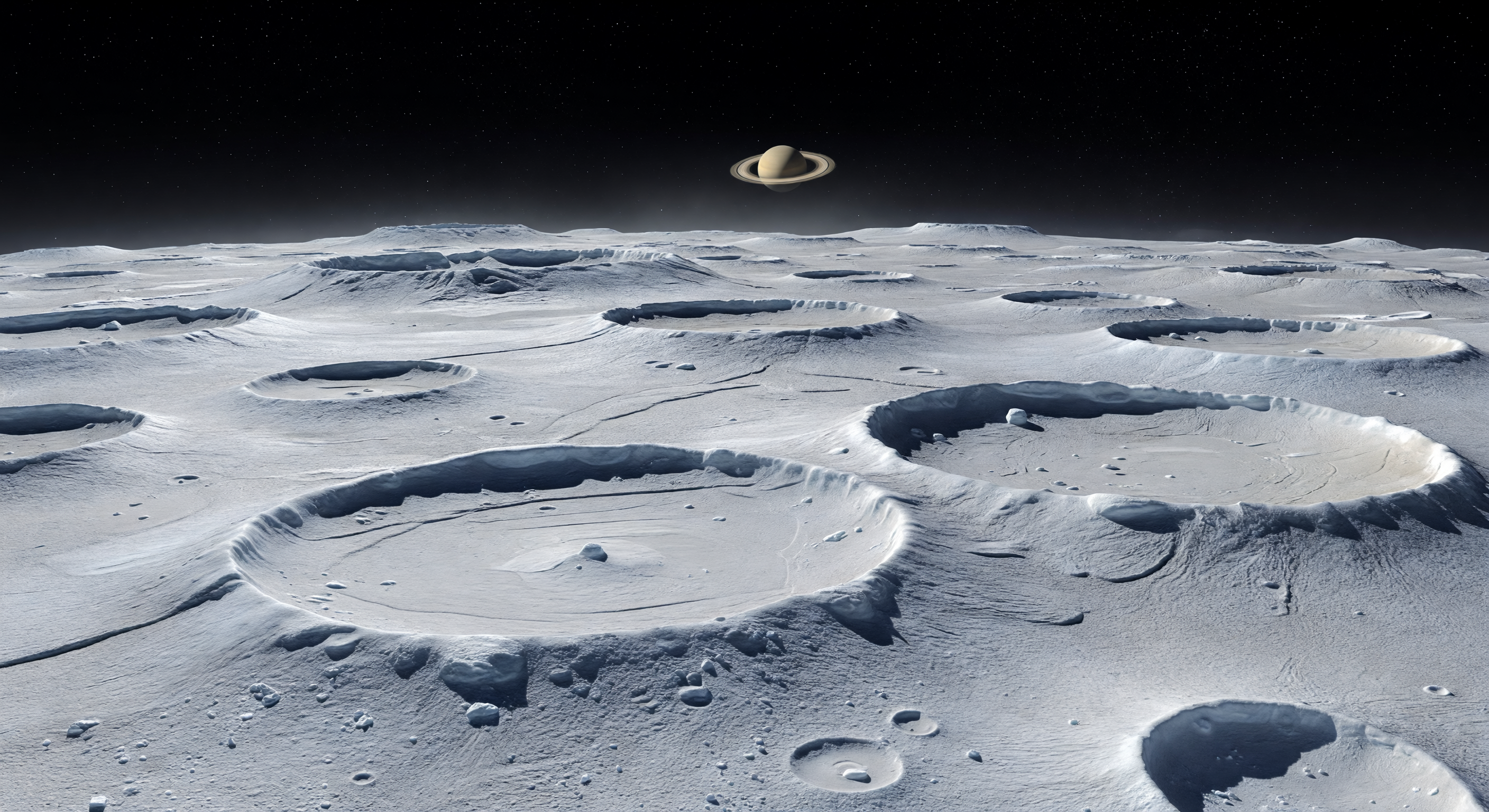
낮은 얼음 능선 위에 서면, 앞에는 수없이 포개진 오래된 충돌구들이 흰색으로 번쩍이는 둥근 테두리와 옅은 회청색 바닥을 드러낸 채 빽빽하게 이어지고, 작은 천체 특유의 바짝 굽은 지평선이 이 세계의 왜소한 크기를 실감하게 합니다. 이 지형은 거의 전부 단단한 물얼음 기반암과 미세한 서리, 밝은 얼음 먼지로 이루어져 있으며, 충돌구 가장자리가 날카롭지 않고 부드럽게 처진 모습은 얼음이 오랜 시간 아주 느리게 흘러 형태를 완화시키는 점성 이완의 흔적입니다. 분화구 사이의 완만한 평원에는 좁은 구조 홈, 작은 2차 충돌구, 허물어진 사면 무늬와 낮은 얼음 덩이들이 남아 있어, 극저중력과 반복된 충돌, 그리고 얼음 지각의 변형이 함께 빚은 북부 고지의 역사를 읽게 합니다. 대기가 거의 없어 하늘은 한낮에도 완전한 검정으로 가라앉고, 멀고 작은 태양은 칼날처럼 선명한 남청색 그림자를 드리우며, 눈부시게 밝은 얼음 표면과 깊게 식어든 음영 사이의 극적인 대비가 이 얼어붙은 진공 세계를 더없이 낯설고 장엄하게 만듭니다.
과학 심사 위원회
각 이미지는 AI 위원회에 의해 과학적 정확성이 심사됩니다.
GPT
이미지: Adjust
설명: Adjust
Scientific accuracy: The scene shows an icy, cratered landscape consistent with Enceladus’ general surface (bright water-ice terrain, high crater density in some regions, subdued relief, and pervasive fractures/grooves). However, the image appears more like a generic icy satellite: the crater rims are not clearly “rounded by viscous flow” in a systematic way, and the prominent linear grooves/ditches look more like fresh tectonic features than the described “narrow tectonic grooves” within an older, softened crater quilt. Color/lighting are broadly plausible for airless bodies (no haze, hard shadowing), but the sky is somewhat stylized/dark-blue near the horizon rather than a truly pure black Enceladus sky; additionally, there is a clearly visible Saturn-like ring plane/planetary presence with bright illumination that is not described and could imply a different viewing geometry than the caption. Visual quality: The render is high-resolution and largely photorealistic for a planetary visualization (consistent ice texture, coherent shadows, credible scale cues, and no obvious geometric artifacts). Minor concerns include the overall “computer-render” look of the sky gradient and the lack of truly Enceladus-specific detail (e.g., the distinctive regional character of northern highlands vs. smoother plains, and any clear stratigraphic/terrace indicators). Caption accuracy: The caption claims a “low icy ridge” foreground and “overlapping impact craters” with bright rounded rims and pale gray-blue floors; the image does show foreground ridged terrain and many overlapping craters, but the floors/rims read more uniformly bright and less clearly as softened viscous-flow features. It also emphasizes a “pure black sky” and “small and fierce” distant Sun with razor-edged navy shadows; the shadows are sharp, but the sky and distant lighting cues do not match the “pure black” description, and the presence of a prominent planetary body/rings is not accounted for. Net: largely good for an Enceladus-like cratered icy landscape, but the caption overpromises specific geologic softening and sky/Sun characteristics not clearly supported by the image.
Claude
이미지: Adjust
설명: Adjust
Building on GPT's review with some agreements and several additional observations. SCIENTIFIC ACCURACY: The most glaring scientific issue GPT correctly flagged but understated is Saturn's presence in the sky. Saturn is visible but implausibly small and dim for an observer on Enceladus — from the moon's surface, Saturn would subtend roughly 12–13 degrees of arc (about 24x the apparent diameter of our full Moon), dominating the sky as an enormous, overwhelming presence. The tiny ringed dot shown is closer to how Saturn appears from much farther out in the solar system, perhaps from Titan's distance or beyond. This is a significant scientific error. The Sun is also conspicuously absent rather than showing as a small but intensely bright point source as the caption describes. The cratering density and morphology are broadly plausible for Enceladus' northern highlands, which are indeed among the most ancient and heavily cratered regions. However, the viscous relaxation that defines Enceladus craters — their characteristically shallow, flat-floored, dome-like profiles caused by warm ice flow — is not convincingly rendered; craters appear too fresh and bowl-shaped, more reminiscent of the Moon or Mimas. The tectonic lineaments are present and appropriate. The blue-gray ice coloration is scientifically reasonable. VISUAL QUALITY: The render is technically competent with good texture detail and coherent directional lighting. The horizon curvature is subtly present but could be more pronounced given Enceladus' tiny 252 km radius — the close horizon should feel almost unsettling. The sky gradient near the horizon is not vacuum-accurate; space should transition to pure black essentially immediately above the surface on an airless body. No significant rendering artifacts detected. CAPTION ACCURACY: The caption's claim of 'razor-edged navy shadows' is partially supported — shadows are sharp — but 'navy' overstates the color contrast given the scene's relatively flat lighting. The 'pure black sky' and 'small and fierce Sun' are both contradicted by the image. The viscous-flow softening described in detail is not visually evident. The Saturn omission in the caption while Saturn appears prominently in the image remains a disconnect. RECOMMENDATION: The Saturn scale must be corrected to be the dominant sky feature it would actually be — this alone warrants an adjust verdict rather than approve. Crater morphology should be reworked toward the relaxed, shallow profiles characteristic of Enceladus. The caption should either be updated to acknowledge Saturn's presence and correct the Sun description, or the image should be regenerated to match the caption's stated sky conditions.
Grok
이미지: Adjust
설명: Adjust
Agreeing strongly with both GPT and Claude on key issues, with additional insights. SCIENTIFIC ACCURACY (Image: adjust): The cratered terrain aligns well with Enceladus' northern highlands (e.g., high density of overlapping craters as seen in Cassini images of regions like ~60°N, °E), subdued relief due to viscous relaxation, and tectonic grooves/scarps are present and plausible. Colors (brilliant white rims, pale blue-gray floors) match the E-ring fallout and irradiated ice spectra. Lighting is vacuum-sharp with hard shadows, correct for no atmosphere. However, Claude is spot-on: Saturn appears as a tiny distant dot, unrealistically small (should subtend ~12-13° or ~24x Moon-sized from Enceladus' surface, per orbital mechanics: distance ~238,000 km, Saturn diameter ~116,000 km). Sun is absent despite caption's 'small and fierce' description—should be a ~.4° bright point source at ~10° elevation typical for mid-latitudes. Horizon curvature is present but insufficiently dramatic for 252 km radius (horizon ~3 km away, should curve sharply). No major artifacts, but craters look somewhat bowl-shaped rather than distinctly shallow/flat-floored from ice flow (cf. actual Enceladus craters like Sabkha or Al-Battani, which are U-/dome-shaped per Cassini altimetry). VISUAL QUALITY (Image: approve leaning adjust): Photorealistic overall—excellent ice textures (granular rubble, frost glitter), coherent shadows, no blurring or aliasing. Minor 'CG render' feel in sky gradient (faint blue haze near horizon unrealistic for airless body; should be stark black). Foreground ridge and scale cues (steep scarps in low-g) effective. CAPTION ACCURACY (Caption: adjust): Description vividly captures geology ('softened rims,' 'tectonic grooves,' 'hummocks of ejecta') which image mostly shows, and 'pure black sky' partially fits despite gradient. But mismatches glaring: no visible Sun ('razor-edged navy shadows' half-true, shadows sharp but not deeply navy); undescribed prominent Saturn/rings; viscous flow softening not as pronounced as claimed (craters appear fresher). 'Low icy ridge' foreground matches. Net: Solid Enceladus visualization but needs Saturn scale-up/Sun addition for accuracy, sky pure-black, and caption tweak to note Saturn or regenerate sans planet. Constructive: Prompt next iteration with 'Saturn dominating sky at 12° angular size, tiny Sun point source, exaggerated horizon curve, shallow relaxed craters per Cassini data'.
Gemini
이미지: Regenerate
설명: Adjust
I concur with the previous committee members regarding the significant discrepancies between the image and the physical reality of Enceladus. The depiction of Saturn as a distant 'star' rather than a massive, sky-dominating presence (subtending ~12-13 degrees) is a fundamental failure of astronomical scale. Furthermore, the 'CG-look' gradient near the horizon is physically impossible for an airless body like Enceladus; the transition from surface to space must be an immediate, stark drop-off into pitch black. The crater morphology lacks the characteristic 'viscous relaxation' observed in Cassini imagery, appearing too much like standard, high-relief lunar craters. To achieve 'approve' status, the image must feature: 1) A massive, looming Saturn filling a significant portion of the sky, 2) An immediate, high-contrast horizon with a pure black sky, 3) Shallow, dome-like, or flat-floored crater profiles, and 4) A distinct, bright point-source Sun. The caption should be adjusted to incorporate the presence of Saturn, which is too visually significant to ignore in the descriptive text.
Matania — 종합 평가
이미지: Adjust
설명: Adjust
The committee finds the scene broadly consistent with Enceladus' cratered northern highlands in overall material and lighting, but not yet scientifically faithful in several important ways. The icy surface, overlapping craters, subdued relief, and tectonic lineaments are plausible, and the rendering quality is strong. However, the craters read too fresh and bowl-shaped rather than clearly relaxed by viscous ice flow, and the sky geometry is the major flaw: Saturn appears far too small and distant for an observer on Enceladus, where it should dominate the sky. The horizon-to-space transition also feels too gradual and atmospheric for an airless moon, with an unrealistic blue gradient near the horizon. The caption similarly overstates or misstates the scene by describing a pure black sky and a small, fierce Sun while omitting Saturn's conspicuous presence. Overall: a solid Enceladus-inspired image, but both image and caption need correction to match the moon's true visual and orbital context.