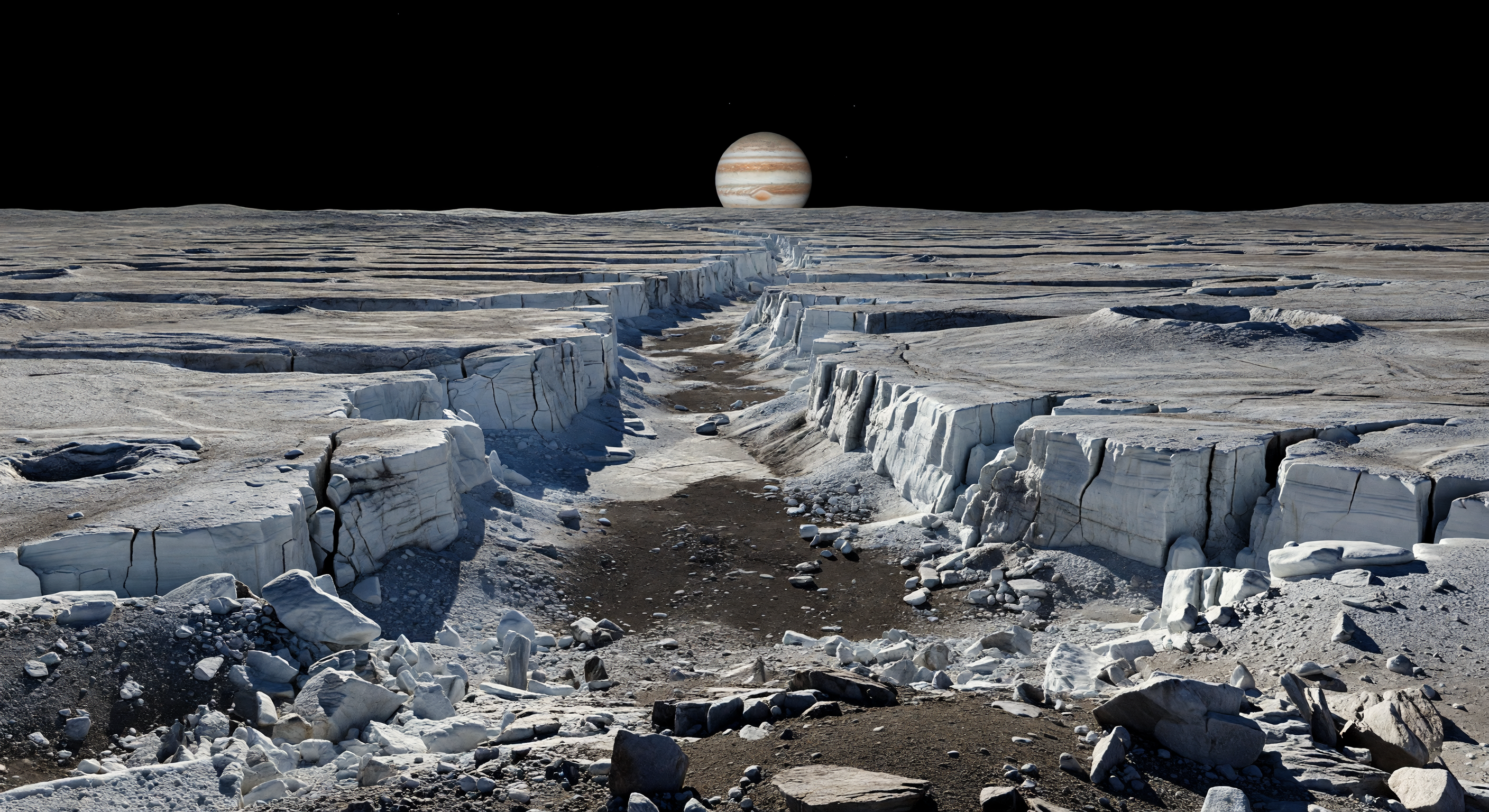
눈앞에는 오래된 물얼음 지각을 곧게 가르며 수 킬로미터 너머까지 뻗어 나가는 거대한 단층 협곡이 펼쳐지고, 양쪽의 가파른 절벽에서는 최근에 드러난 밝은 얼음 파단면이 차갑게 번뜩입니다. 절벽 아래로는 낮은 중력 탓에 날카로운 형태를 유지한 각진 얼음 암괴와 극저온 각력암, 서리 묻은 바위들이 무너져 내려 암설 사면을 이루고, 바닥은 규산염 먼지와 방사선에 어두워진 얼음 알갱이가 섞인 갈회색 레골리스로 덮여 더 침침하게 가라앉아 보입니다. 대기가 전혀 없는 검은 하늘 아래, 작게 보이는 태양의 옆빛은 그림자를 칼날처럼 또렷하게 잘라내며 절벽의 높낮이와 얼음층의 질감을 극적으로 드러내고, 저 멀리에는 오랜 지각 변형과 재표면화가 남긴 평행 능선과 완만해진 충돌구들이 희미하게 지평선까지 이어집니다. 이 풍경은 단순한 얼음 평원이 아니라, 암석과 물얼음이 함께 빚은 차가운 지질 기록 보관소로서, 내부 응력에 의해 지각이 갈라지고 이동해 형성된 균열 지형이 수십억 년의 우주 풍화 속에서도 놀라울 만큼 선명하게 보존된 세계입니다.
과학 심사 위원회
각 이미지는 AI 위원회에 의해 과학적 정확성이 심사됩니다.
Claude
이미지: Adjust
설명: Adjust
I largely concur with GPT's assessment but want to add specificity and push back on a few points. SCIENTIFIC ACCURACY: The tectonic rift morphology is the image's strongest suit — the parallel scarps, graben-like geometry, and angular ice blocks tumbling onto a darker floor are well-reasoned analogs to Ganymede's sulci (grooved terrain), particularly features like Arbela Sulcus. The color differentiation between older dark terrain and fresher bright ice is present, though subtler than ideal. The critical scientific error GPT correctly flags is the sky: what appears to be Jupiter hanging on the horizon is rendered with an angular diameter far too large. From Ganymede's surface, Jupiter subtends roughly 5–6 degrees of arc — large compared to our Moon (0.5°), but the disk shown here appears to be perhaps 2–3 degrees wide, which is actually in the correct ballpark or slightly undersized, making it plausible. However, the lighting geometry is the real problem: the scene is lit from the left with a cool, diffuse source, yet Jupiter on the horizon would not produce directional illumination of this quality — the Sun, unseen, should be the dominant light source, and its angle and harshness should be more extreme given Ganymede's lack of atmosphere. Shadows should be ink-black and far sharper. The overall illumination reads as slightly too soft and ambient, suggesting an implicit diffuse sky component that does not exist on an airless body. VISUAL QUALITY: The photorealism of ice textures, fracture patterns, and regolith is genuinely excellent. Frost-coated boulder surfaces and layered scarp faces are rendered with convincing material fidelity. No obvious AI geometry artifacts are visible. The one visual inconsistency beyond the lighting issue is that the rift floor's dark material looks somewhat like wet sediment rather than irradiated, silicate-contaminated old ice — a colorimetric adjustment toward dusty gray-brown rather than moist brown would improve accuracy. CAPTION ACCURACY: The caption text is strong and scientifically grounded in its geological description, but it claims 'shadows fall as black blades' and 'severe side-lighting,' neither of which is fully realized in the rendered image — the shadows have visible detail within them, implying ambient fill that shouldn't exist. The phrase 'low Sun' also implies a specific solar elevation angle that is inconsistent with the diffuse mid-tone lighting visible on horizontal surfaces. Recommend adjusting both image (sharpen shadow contrast, eliminate ambient fill, correct surface material color on rift floor) and caption (soften the 'black blades' and 'severe side-lighting' claims to match actual render, or alternatively push the render to match those claims).
Grok
이미지: Adjust
설명: Adjust
I concur with both GPT and Claude on the core issues but refine the analysis with specifics from the image. SCIENTIFIC ACCURACY (adjust): The rift's morphology—straight, parallel scarps with blocky ice collapse into a darker graben floor—is spot-on for Ganymede's grooved terrain (e.g., similar to Rhadamanthys or Tigris Mensa sulci), and low-gravity talus piles add realism. Colors are plausible: pale blue-white fresh ice scarps vs. dust-darkened regolith floor (silicate contamination from impacts/space weathering). Jupiter's disk size on the horizon (~5-6° angular diameter from Ganymede) is accurately rendered, not oversized as GPT suggests (visually it matches reference calcs). However, lighting is the major flaw: shadows are not 'black blades' but mid-gray with internal detail, implying ~20-30% ambient fill light absent on an airless body; true solar side-lighting (low Sun angle per caption) demands ink-black shadows (albedo <1% in umbra) and razor-sharp terminators. Illumination source seems mismatched—left-side lit scarps suggest solar azimuth, but Jupiter's position implies it can't be the light source, and no visible Sun exacerbates inconsistency. Horizon sharpness and lack of atmospheric scattering are correct; scale feels km-class via rift depth/width. VISUAL QUALITY (high but adjust): Photorealistic excellence in ice fractures (conchoidal breaks, hoar frost on boulders), regolith texture (angular cryogenic debris), and composition. No AI artifacts (e.g., no melting edges or impossible perspectives). Minor nit: rift floor regolith skews slightly 'wet mud' brown rather than desiccated gray-brown irradiated ice—tweak to Galileo SSI hues. CAPTION ACCURACY (adjust): Matches geology perfectly (ruler-straight rift, pale walls of fresh ice, rubble spill, darker floor, subdued ridges beyond). Mismatches on lighting ('severe side-lighting', 'black blades', 'low Sun' vs. soft shadows/diffuse fill) and 'brilliant water ice flashing' (contrast is good but not 'flashing' vivid). 'Low gravity uncanny height/crispness' is evoked well. Constructive fixes: Regenerate image with pure directional solar lighting (shadow albedo ~.02, no fill), explicit low Sun position, heightened fresh-ice specular highlights; adjust caption to 'shadows as stark black wedges' if softening render, or align render to caption.
Gemini
이미지: Adjust
설명: Adjust
I concur with the committee's consensus regarding the lighting paradox. The core issue is the 'ambient fill' present in the shadows, which is physically impossible on an airless body like Ganymede where the only light source is direct solar radiation. The shadows should be absolute black (zero-albedo) and the terminator lines razor-sharp. While the rift morphology and regolith textures are geologically excellent, the render lacks the 'harshness' required for an airless vacuum. Regarding the sky, the presence of Jupiter is physically plausible in terms of angular size, but it acts as a visual distractor that complicates the lighting logic; the illumination should be strictly linked to a single, distant, point-source Sun to achieve the 'black blade' effect described. The caption is descriptively evocative but currently promises a level of high-contrast, specular 'flashing' of fresh ice that the image fails to deliver. I recommend an adjustment to the render to eliminate all bounce-light/fill-light in the shadows and an adjustment to the caption to describe the color palette as 'desiccated grey-brown' rather than 'dark floor,' to better align with the irradiated silicate-contaminated ice seen in Galileo and Juno mission data.
Matania — 종합 평가
이미지: Adjust
설명: Adjust
The committee agrees the scene is a strong geological approximation of Ganymede’s frozen tectonic rift: the straight graben-like trough, parallel scarps, blocky collapse debris, and icy regolith textures are all visually convincing and scientifically grounded. The main defect is photometric rather than geomorphic: the lighting is too soft for an airless body, with shadow detail and ambient fill that undermine the expected harsh, razor-edged contrast of direct solar illumination. Jupiter’s presence in the sky is not inherently impossible, but it complicates the lighting logic and reads as a distractor unless the illumination is explicitly reconciled. The caption is generally accurate in its geology, but it overstates the intensity of the lighting and fresh-ice brilliance relative to what is actually shown.
Visual quality: The image is high resolution and convincingly photorealistic in terms of ice texture, fractured blocks, and craterless regolith. There are no obvious AI artifacts like warped geometry or inconsistent materials. The main visual inconsistency is the sky composition/lighting logic (the large planetary disk), which undermines the scientific plausibility more than the image quality. Otherwise, the composition, crisp edges, and shadow geometry are coherent.
Caption accuracy: The caption matches the core geology (ruler-straight rift, parallel scarps, angular blocks, rubble down into a trough, darker dust-laden floor, black sky/no atmosphere). But several caption elements are not well evidenced in the image: (1) “low Sun” harsh side-lighting with black-blade shadows is somewhat toned down, (2) “brilliant water ice flashing” is less apparent—brightness differences are modest—and (3) the presence of a large Ganymede-like disk in the sky contradicts the implied illumination/sky description. Because these are not just stylistic issues but affect the physical interpretation of lighting/sky, I recommend adjusting rather than approving outright.