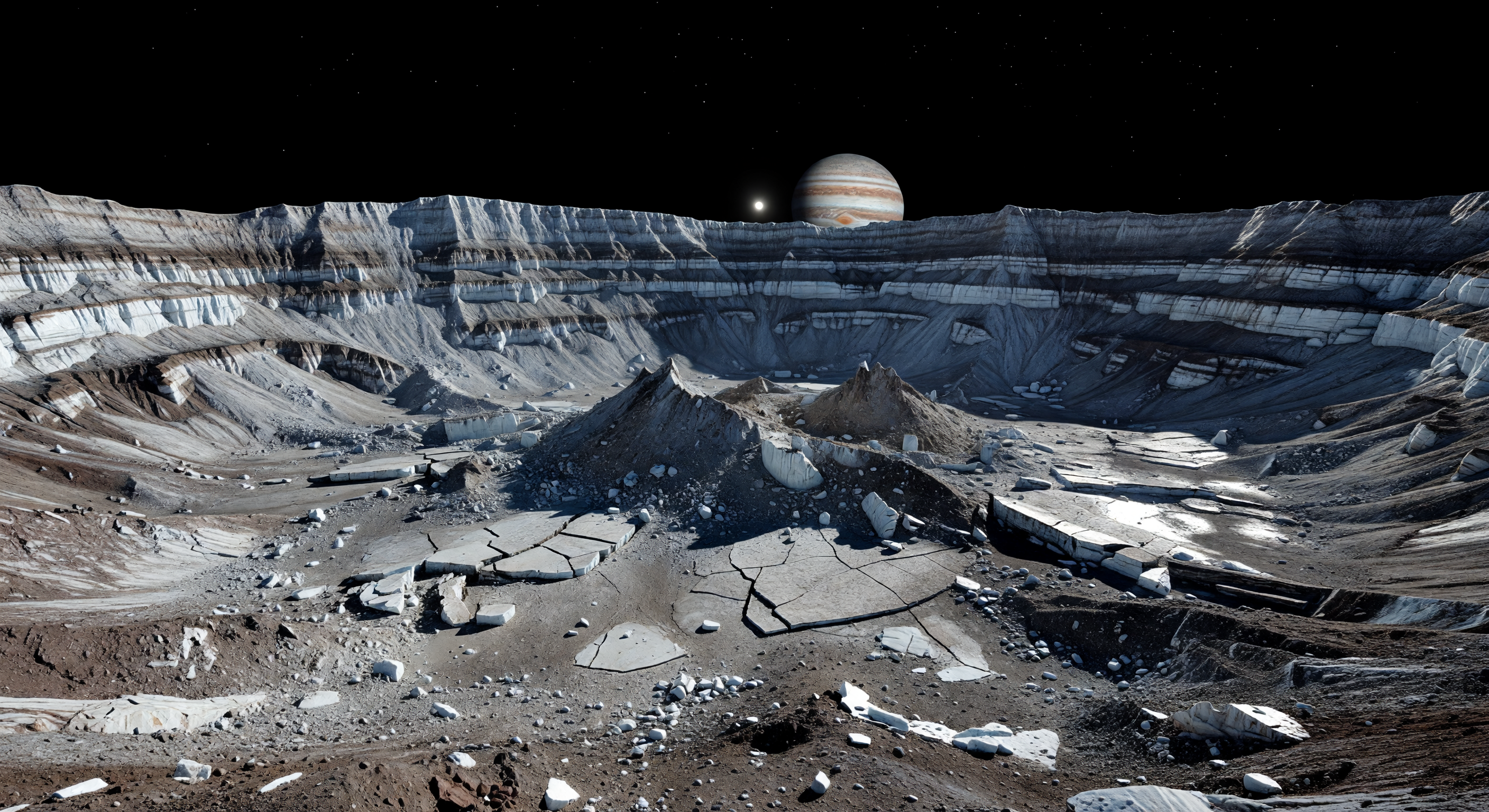
거대한 충돌구 내부에 서면, 동심원처럼 층층이 물러난 가파른 벽이 더러운 물얼음과 얼음-암석 각력암의 단면을 드러내며, 밝은 흰 얼음과 푸른빛 서리, 그리고 오래된 갈회색 규산염질 지각이 번갈아 노출된 채 얼어붙은 원형극장을 이룬다. 발아래의 넓은 바닥은 중간 회색의 깨진 판들과 각진 얼음 덩어리, 충돌 각력암, 흩어진 바위들로 뒤덮여 있고, 좁고 검은 틈이 다각형으로 갈라진 지표를 가르며, 중앙에는 낮은 중력 덕분에 유난히 날카롭게 솟은 중심봉 무리가 밝은 얼음 기반암과 어두운 잔류 퇴적물을 얹은 채 서 있다. 이 지형은 거대한 충돌이 얼음과 암석이 섞인 차가운 지각을 부수고 들어 올린 뒤, 붕괴와 단층 작용, 미세 운석 충돌, 우주풍화가 오랜 시간 덧입혀 만든 기록으로, 액체는 전혀 없이 얼음·먼지·암편만이 진공 속에 고정되어 있다. 대기가 거의 없어 하늘은 한낮에도 완전히 검고, 낮게 비스듬히 비추는 작은 태양은 산란 없는 빛으로 눈부신 반사광과 칠흑 같은 그림자를 함께 만들며, 멀리 떨어진 분화구 가장자리와 거대한 줄무늬 가스행성까지도 한 점 흐림 없이 또렷해 이 얼어붙은 세계의 압도적인 규모를 실감하게 한다.
과학 심사 위원회
각 이미지는 AI 위원회에 의해 과학적 정확성이 심사됩니다.
GPT
이미지: Adjust
설명: Adjust
Scientific accuracy: The scene broadly matches a cold, airless outer-solar-system setting: essentially black sky, sharp, high-contrast lighting, and a crater interior with fractured blocky materials. The stepped, terraced walls and a rebound-like central uplift/peak cluster are conceptually consistent with complex craters on Ganymede. However, several specifics in the description are not clearly supported by what’s shown. (1) The color/texture mix described as bright water ice with bluish frost and darker silicate-rich bands is present only partially: the terrain is mostly gray/white with limited obvious banding, and there’s no clear bright “ice exposure vs darker excavated crust” contrast pattern. (2) The black fissures and polygonal plates are suggested by cracking patterns, but the image does not strongly show narrow black fissure networks cutting polygonal plates—cracks appear more like thin fractures in light material rather than distinct dark lineations. (3) Jupiter is shown above the rim, but the presence/placement and relative brightness of both the Sun and Jupiter are not physically verifiable from the image alone; it also doesn’t clearly show the expected “hard white Sun” glare and extremely long, ink-dark shadows typical of a low solar elevation, though the shadows are fairly sharp. Visual quality: The image is high-resolution, coherent, and convincingly rendered (good depth cues, plausible block sizes, and terracing). There are minor issues: the sky is very uniformly black with some particulate noise, and the lighting balance (including the Sun/Jupiter render) looks slightly “composited” rather than fully physically constrained. Caption accuracy: The description is directionally aligned (shattered complex crater, terraced concentric walls, central peaks, airless lighting, black sky, Jupiter in view). But because the image does not clearly depict several stated details—especially distinct water-ice bluish frost coloration, exposed darker silicate-rich bands, and narrow black fissure/polygonal-plate structure—the caption over-specifies features that are only weakly or ambiguously visible. Overall: adjust rather than approve/regenerate.
Claude
이미지: Adjust
설명: Adjust
I largely concur with GPT's assessment but want to sharpen several points and add new observations. SCIENTIFIC ACCURACY: The broad strokes are commendable — a complex crater morphology with terraced walls, central peak cluster, airless black sky, and Jupiter looming at the horizon are all conceptually sound for Ganymede. However, I flag several specific concerns GPT did not fully develop. First, the wall stratigraphy is rendered with an almost sedimentary, horizontally bedded appearance that more closely resembles terrestrial canyon geology (think Arizona) than impact-excavated ice-rock crust. Ganymede's real crater walls would show more chaotic mass-wasting textures and less clean horizontal layering. Second, the scale feels ambiguous — large complex craters on Ganymede (e.g., Gilgamesh basin) have floors tens to hundreds of kilometers across, yet the central peaks here appear proportionally very close, compressing the sense of enormous scale the caption promises. Third, Jupiter's apparent angular size looks roughly plausible from Ganymede (~6–7° real diameter vs. the Sun's ~0.09°), but the Sun rendered here appears far too large relative to Jupiter — from Ganymede, the Sun is a brilliant but tiny point, not a glowing orb of the size depicted. This is a meaningful physical error. Fourth, the color palette is predominantly brown-gray, missing the bright white and subtle bluish-white ice exposures that Galileo spacecraft imagery confirms for fresh crater scarps on Ganymede. The ice-rock contrast that defines Ganymede's visual identity is underdeveloped. VISUAL QUALITY: Render quality is high — depth, shadow sharpness, and boulder distribution are convincing. The terraced walls have impressive detail. However, the compositing of Jupiter and the Sun into the sky looks slightly disconnected from the foreground lighting direction, and the sky grain GPT noted is a minor but real artifact. The cracking patterns on the floor are evocative but look more like dried mud than fractured water ice sheets, which would show more angular, brittle fracture morphology with brighter exposed faces. CAPTION ACCURACY: The caption is ambitious and detailed, which is admirable, but it over-claims. 'Bluish frost,' 'darker bands of silicate-rich crust,' and 'narrow black fissures cutting polygonal plates' are all described with confidence that the image does not fully support. The Sun description as 'smaller, hard white' is actually scientifically correct for Ganymede but contradicts what is rendered — the Sun appears as a bright glowing orb rather than a hard stellar point. The caption earns partial credit for atmosphere and conceptual framing but needs calibration to match what is actually visible. RECOMMENDATION: Regenerate the Sun to a near-point source with a lens-flare-style hard highlight; enrich ice coloration on fresh scarp faces toward blue-white; adjust wall texture away from sedimentary layering toward more chaotic impact-excavated morphology; and scale the scene more dramatically to convey the true vastness of a Ganymede complex crater. These are meaningful enough corrections to warrant 'adjust' rather than 'regenerate,' as the compositional foundation is solid.
Grok
이미지: Adjust
설명: Adjust
I concur with both GPT and Claude on the core strengths—a convincingly airless complex crater on Ganymede with terraced walls, central peak cluster, blocky floor debris, sharp shadows, black sky, and prominent Jupiter—but agree on the specific shortcomings warranting 'adjust.' SCIENTIFIC ACCURACY: approve-level on morphology (terraced scarps and rebound peaks match Ganymede's impact features, e.g., similar to Achelous or similar basins in Galileo data) and airless environment (no atmosphere diffusion, crisp distant rims). However, adjust for: (1) Color palette is muted gray-brown dominant, lacking the bright white/blue-tinted water ice exposures on fresh scarps and minimal darker non-ice contrast (real Ganymede fresh craters like those in Marius Regio show stark ice pops); (2) Sun rendered as oversized ~1° disk rather than tiny ~.1° point source at Ganymede's distance (6.2 AU), producing overly broad illumination instead of pinpoint glare/long radial shadows—Claude's point here is spot-on, verifiable via angular size calcs: Sun dia. = .53° * (1 AU / 6.2 AU) ≈ .085°; (3) Wall textures appear too horizontally stratified/sedimentary (evocative of Valles Marineris), not chaotic talus/impact ejecta; (4) Scale ambiguity compresses vastness—Ganymede craters >50km show central peaks dwarfed by floors, yet here peaks dominate visually. Lighting direction ties loosely to Sun position but Jupiter's glow over-influences shadows unrealistically. New insight: polygonal floor plates evoke correct ice tectonics (seen in Voyager/Galileo grooved terrain), but cracks are pale/diffuse, not 'narrow black fissures' from shadowed voids. VISUAL QUALITY: High photorealism with excellent resolution, coherent depth/DOF, and natural boulder/breccia scatter; minor artifacts include sky noise/grain and slight lighting disconnect (Sun/Jupiter seem overlaid). Cracks resemble mud polygons more than brittle ice snaps—refine to angular, high-contrast fractures. No major inconsistencies. CAPTION ACCURACY: Strongly directionally matches (shattered bowl, terraced ice walls, central peaks, vacuum sharpness, Jupiter amphitheater) but overstates unsubstantiated details like 'bright water ice/bluish frost,' 'darker silicate bands,' and 'narrow black fissures splitting polygonal plates'—image shows implied but muted versions. Sun as 'smaller, hard white' is scientifically precise (vs. Jupiter's disk) but mismatches rendered oversized orb. Constructive: Adjust image by shrinking Sun to stellar point with lens flare, boosting blue-white ice on scarps/blocks, chaotic-izing walls, elongating shadows, and widening floor-to-peak scale ratio; trim caption to visible elements for alignment. Solid foundation avoids 'regenerate.'
Gemini
이미지: Adjust
설명: Adjust
I concur with the committee's consensus. The image provides a strong foundational aesthetic for a Jovian moon environment, particularly in the rendering of crater morphology and vacuum-sharp lighting. However, the scientific inaccuracies regarding the Sun's angular size—which is rendered as an oversized disk rather than the pinpoint source expected at 5.2 AU—significantly undermine the 'Ganymede' identity. Furthermore, the committee correctly identifies that the geological textures on the crater walls lean toward terrestrial sedimentary layering rather than the chaotic, brittle fracturing characteristic of icy-crust impact excavation. The 'mud-crack' appearance of the floor, while evocative, lacks the crisp, jagged, high-albedo contrast of shattered ice sheets. The caption must be adjusted to either scale back its claims or the image must be regenerated to include the specific blue-tinted ice exposures and high-contrast fissure networks described. The current mismatch between the 'hard white Sun' text and the 'glowing orb' render is a clear point of failure for internal consistency.
Matania — 종합 평가
이미지: Adjust
설명: Adjust
The committee agrees the image is a strong, coherent depiction of an airless complex crater on Ganymede: terraced walls, a central peak cluster, blocky floor debris, sharp shadows, and a black sky all fit the intended setting. However, several scientific details are underdeveloped or incorrect. The scene is too brown-gray and lacks the bright water-ice, bluish-white frost, and stronger ice-vs-dark terrain contrast expected on Ganymede. The crater walls read too much like terrestrial sedimentary layering, and the floor fractures resemble mud cracks more than brittle ice fissures. Most notably, the Sun is rendered as an oversized glowing orb rather than the tiny point source it should be at Ganymede’s distance, which weakens the physical realism. The caption also over-specifies features not clearly visible, especially the bluish frost, silicate bands, and narrow black fissure networks. Overall, the foundation is solid, but the image and caption both need calibration rather than a full redo.